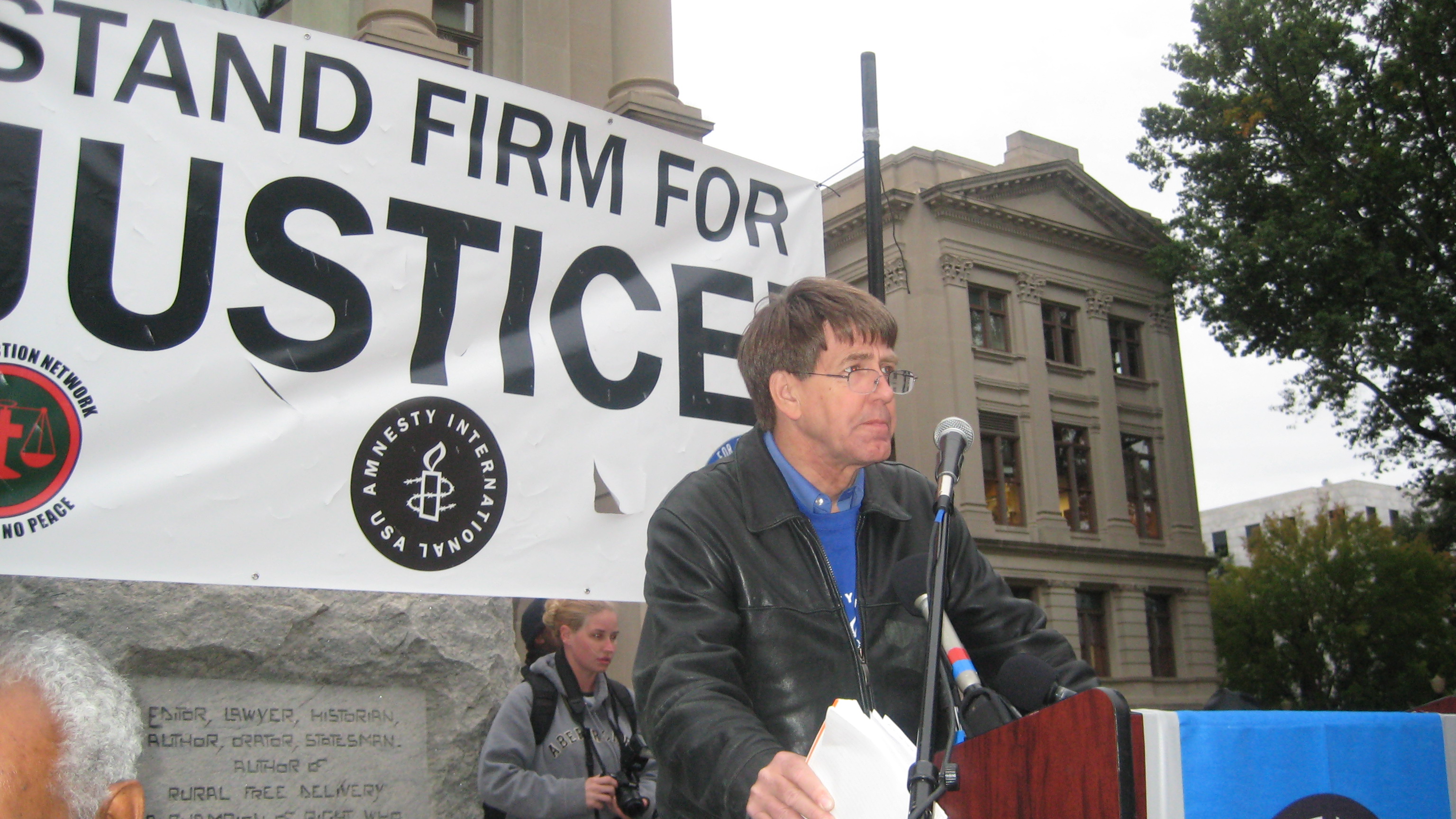
Author: Alan Bean

New York Times editorial: Davis decision a “tragic miscarriage of justice”

A Grievous Wrong

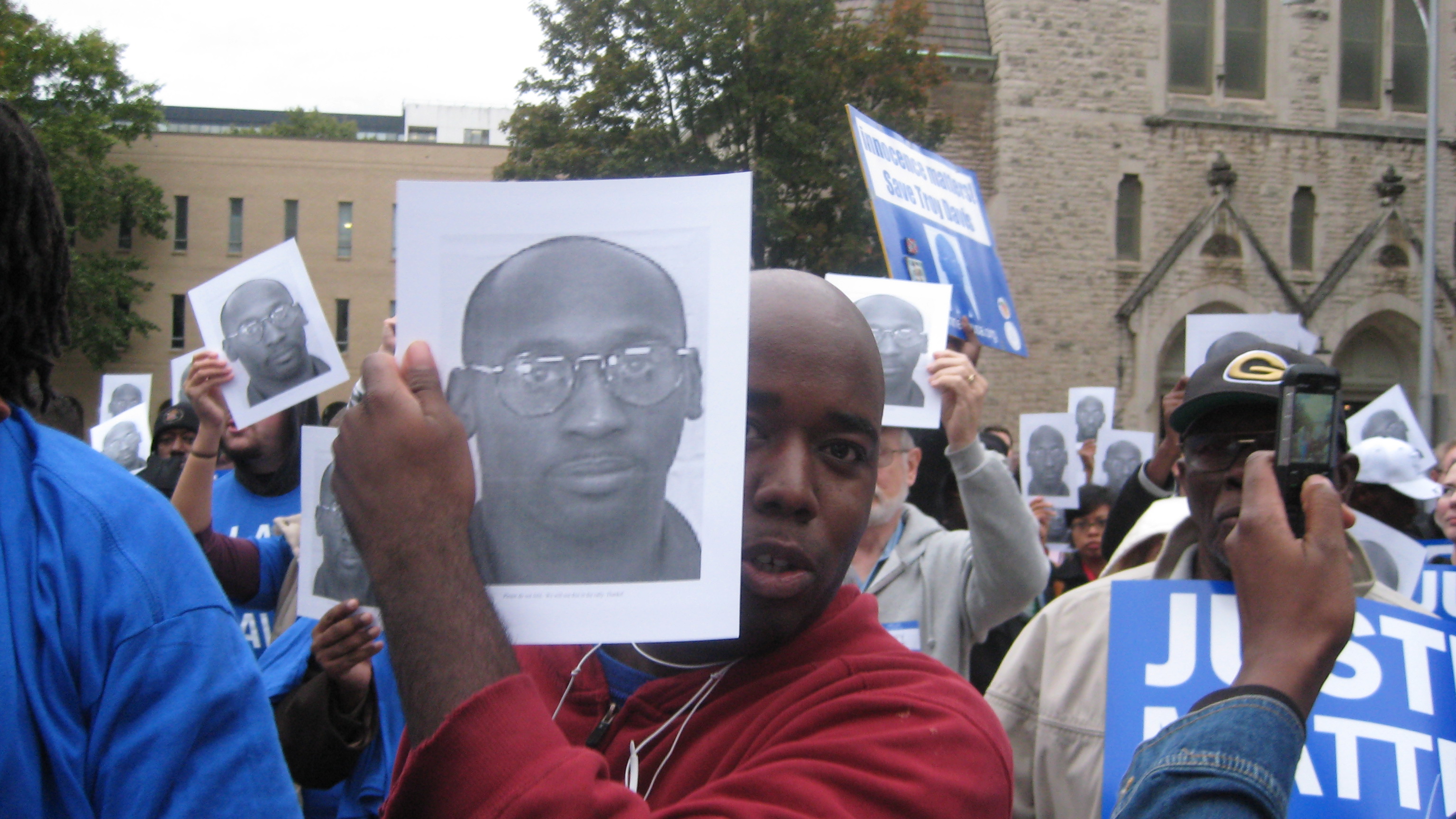
Troy Davis is scheduled to be executed on Wednesday for the 1989 killing of a police officer in Savannah, Ga. The Georgia pardon and parole board’s refusal to grant him clemency is appalling in light of developments after his conviction: reports about police misconduct, the recantation of testimony by a string of eyewitnesses and reports from other witnesses that another person had confessed to the crime.

This case has attracted worldwide attention, but it is, in essence, no different from other capital cases. Across the country, the legal process for the death penalty has shown itself to be discriminatory, unjust and incapable of being fixed. Just last week, the Supreme Court granted a stay of execution for Duane Buck, an African-American, hours before he was to die in Texas because a psychologist testified during his sentencing that Mr. Buck’s race increased the chances of future dangerousness. Case after case adds to the many reasons why the death penalty must be abolished.

The grievous errors in the Davis case were numerous, and many arose out of eyewitness identification. The Savannah police contaminated the memories of four witnesses by re-enacting the crime with them present so that their individual perceptions were turned into a group one. The police showed some of the witnesses Mr. Davis’s photograph even before the lineup. His lineup picture was set apart by a different background. The lineup was also administered by a police officer involved in the investigation, increasing the potential for influencing the witnesses.

In the decades since the Davis trial, science-based research has shown how unreliable and easily manipulated witness identification can be. Studies of the hundreds of felony cases overturned because of DNA evidence have found that misidentifications accounted for between 75 percent and 85 percent of the wrongful convictions. The Davis case offers egregious examples of this kind of error.

Under proper practices, no one should know who the suspect is, including the officer administering a lineup. Each witness should view the lineup separately, and the witnesses should not confer about the crime. A new study has found that even presenting photos sequentially (one by one) to witnesses reduced misidentifications — from 18 percent to 12 percent of the time — compared with lineups where photos were presented all at once, as in this case.

Seven of nine witnesses against Mr. Davis recanted after trial. Six said the police threatened them if they did not identify Mr. Davis. The man who first told the police that Mr. Davis was the shooter later confessed to the crime. There are other reasons to doubt Mr. Davis’s guilt: There was no physical evidence linking him to the crime introduced at trial, and new ballistics evidence broke the link between him and a previous shooting that provided the motive for his conviction.

More than 630,000 letters pleading for a stay of execution were delivered to the Georgia board last week. Those asking for clemency included President Jimmy Carter, 51 members of Congress and death penalty supporters, such as William Sessions, a former F.B.I. director. The board’s failure to commute Mr. Davis’s death sentence to life without parole was a tragic miscarriage of justice.


Georgia Board Refuses to Grant Clemency in Troy Davis Case

By Alan Bean

Melanie Wilmoth and I were eating breakfast in a Shoney’s restaurant just west of Jackson, Mississippi when I got the email.  The George Board of Pardons and Parole has refused to grant clemency to Troy Davis.  

I was shocked.  On the other hand, I would have been shocked if the call had gone in Troy’s favor.  This really is a case of the irresistible force meeting the immovable object.  How could the Board fail to grant clemency in a case riddled with so much ambiguity and uncertainty?  How could they refuse to do the right thing after so many public figures had publicly expressed their grave doubt about Troy’s guilt? 

Then again, how could the Board have ruled differently?   The tear-stained faces of Officer McPhail’s family were hard to ignore.   These people are convinced that their loved one was gunned down in cold blood by a man who has spent the past few decades eluding his just fate.  It would be a travesty, they told the board, if a convicted murderer was spared from his rendezvous with the needle.  Justice demands a killing, they seemed to say.

The conservative perspective in this case has always emphasized the repeated refusal of appeals courts to toss the jury’s original verdict.  Surely this means that the most objective and responsible people in the justice system are convinced that Davis is guilty as charged.

Actually, it means nothing of the sort.  There is no way of knowing who killed Mark McPhail.  Three jurors now say they could not have voted to convict if they knew then what they know now.  Seven of nine eye witneses have recanted their earlier testimony.  Many of these people claim that they were coerced and manipulated by investigators eager to nail the killing on somebody.  One of the two eye witnesses who has not backed away from their original testimony may be the actual perpetrator.  None of this proves that Troy Davis is innocent; but the foundation on which the conviction originally rested have long since crumbled to dust.

The Supreme Court ordered an innocence hearing to see if Troy Davis could produce compelling evidence of actual evidence.  US District Judge William Moore concluded that Davis hadn’t offered overwhelming evidence of innocence which meant he was still guilty in the eyes of the law.

Why didn’ the Supreme Court all for an ambiguity hearing to establish whether the State of Georgia still had enough evidence to convict Troy Davis?  There ain’t no such thing as an ambiguity hearing.  The state doesn’t need to prove they could convict Troy all over again; they simply had to show that he couldn’t prove he was innocent.  If he failed in this endeavor, the original verdict remained in place.

Another judge, say a Carter or Clinton appointee, could have ruled differently and probably would have, but Judge Moore was the man asked to make the call.

Should Troy Davis be forced to prove he didn’t pull the trigger?  Isn’t it reckless to kill a man who may be innocent? 

Or are these the operative questions?  Has the Troy Davis case devolved into a shoving match between people who look at the old duck-rabbit image and draw different conclusions? 

William Sessions and Bob Barr aren’t saying Davis is innocent; they are saying the evidence is too fuzzy for any objective conclusion to be drawn.

Which means that, should the State of Georgia take the life of Troy Davis they are either killing a man who, objectively considered, may be innocent; or they have been caught up on the partisan, ideological, subjective rhythms of a culture war tug-of-war and are determined to see their side win.  We are dealing with the equivalent of the subjective question, Did the receiver have control of the ball when he went out of bounds?  Fans of one team say he did; fans of the other say he didn’t.  But in this case, there appears to be no objective third-party to examine the film.  We simply see how many of our people we can put on the Board of Pardons and Parole and lobby for our chosen outcome.

Amnesty International, the human rights organization that has done the most to plead for Troy Davis, has never argued for actual innocence.  Some of the attorneys associated with the case may believe their man is actually innocent, but they know they can’t prove it.  What about the Georgia Board of Pardons and Parole?  Are they saying that, as things currently stand, the State of Georgia has enough evidence to convict  Troy Davis (or anyone else) of killing officer McPhail?   Or are they merely trying to shore up the integrity of a discredited judicial system?  What’s the rationale here; that’s what many of us are asking.

So, where do we go from here?  This thing is far from over.  The Governor of Georgia CAN NOT intervene in this case.  But the presiding District Attorney in the jurisdiction that convicted Davis could step in “in the interest of justice.”  Check out Melanie Wilmoth’s companion post to learn how you can help make this happen.

Texas Execution Put On Hold By Supreme Court

Death row inmate Duane Buck.
Duane Buck

By Alan Bean

It doesn’t get any closer than this.  Two hours after the State of Texas legally could have executed Duane Buck, the US Supreme Court issued a stay.  It has long been asserted that racial bias factored inappropriately in Buck’s death sentence.  A psychologist answered in the affirmative when asked if the fact that Buck is black made it more likely that he would someday commit another act of violence.

Unlike the case of Troy Davis, Buck’s guilt has never been in dispute.  But would the jury have been more likely to sentence the defendant to life in prison if they hadn’t been led to believe that, being black, he would likely kill again.

As a statistical matter, the psychologist was right: black males are considerably more likely, as a group, to commit acts of violence than white males.  But race, per se, has nothing to do with it.  In the post Civil War South, white males were far more likely to commit murder than black males.  Buck’s blackness did not predispose him to violent behavior– and that is the only relevant issue for a jury to consider.

The racially biased testimony of the expert witness, in this and five other cases, deeply concerned John Cornyn when he was Texas Attorney General, and it clearly bothered the Supreme Court as well.  There are no guarantees that they will call for a new sentencing hearing, of course, but at least the matter will receive careful review. (more…)

Why did violent crime drop by 13% last year?

By Alan Bean

The Bureau of Justice Statistics reports that the rate of violent victimization declined a jaw-dropping 13 percent in 2010.  Nobody seems to know why.  During the prison boom, drops in the crime rate were often associated with mass incarceration–they can’t commit crimes if they’re all locked up.  But we have been sending fewer American citizens to prison in recent years and the drop in crime has only accelerated.  And all of this during the worst recession in 80 years.  What’s going on?

There is little association between violent crime and unemployment statistics.  More often than not, violence is a rage response.  Cost-benefit calculation is only involved when criminals kill to eliminate potential witnesses, but few murders or assaults fit this scenario.  Drug and alcohol abuse can be contributing factors, but people rarely get violent because they are high and the use of some drugs (marijuana, for example) actually inhibit violent behavior. 

The best explanation for shifting rates of violent crime comes from Randolph Roth’s excellent American Homicide.  After analyzing statistics on violent crime from the earliest days of European settlement, Roth shows that America is a far more violent nation than other Western democracies.  For instance, “Th next most homicidal democracy, Canada, has had only a quarter of the homicides per capita that the United States has had since Worth War II.”

Here are a few of Roth’s big-picture observations: (more…)

Jena, Louisiana five years on

 By Alan Bean

Reed Walters doesn’t think he did a very good job explaining his prosecution of the Jena 6.  It wasn’t for lack of opportunity.  The New York Times invited the LaSalle Parish DA to write an op-ed and the Christian Science Monitor published a curious piece of historical reconstruction written by a Walters supporter at the Jena Times. 

In his NYT op-ed, Walters defended his refusal to charge the boys who hung nooses from a tree at the Jena High School with a hate crime.  It didn’t take much ingenuity to make the case.  Charging the noose boys with a hate crime was always a really bad idea.  The kids needed a history lesson on lynch law and the South’s history of racial violence.  A few months in prison would simply have left them traumatized and unchanged.

Things got out of hand in Jena because nobody in a position of power could acknowledge that the noose hanging was racially motivated.  The nooses appeared the morning after a freshman asked if it was okay for black students to sit under the tree in question.  But when the noose hangers insisted they were just acting out a scene from the popular miniseries Lonesome Dove, men like Reed Walters and Superintendent Roy Breithaupt were eager to believe them.

Why?

You don’t talk about the South’s racial history in towns like Jena.  That’s why. (more…)

Former FBI Chief says Troy Davis should not die

By Alan Bean

In an op-ed written for the Atlanta Journal-Constitution, William Sessions asks the State of Georgia not to execute Troy Davis.

Four Months ago I predicted that the State of Georgia would not execute Troy Davis

It wasn’t suggesting that mercy tinged with common sense would prevail. 

In the absence of outside scrutiny, there is no question that Georgia would send Mr. Davis to God without a single qualm.   (more…)

Dreaming a Christian aristocracy: The evolution and meaning of Dominionism

By Alan Bean

Our twenty-four hour news cycle doesn’t lend itself to careful analysis of complex social movements.  Rick Perry, the pugnacious presidential hopeful, raised eyebrows when he used a loose network of organizations associated with the New Apostolic Reformation to organize a big religious-political rally in Houston.  Interest quickened when the mainstream media learned that some of Perry’s friends were “Dominionists,” folks who want to bring secular politics (and everything else) under the dominion of God.

The questions couldn’t be avoided.  If elected, will Rick Perry pack his cabinet with Christian preachers?  Since that didn’t sound likely, the pundits too-easily assumed that politicians like Rick Perry and Michelle Bachmann are just standard-issue conservatives with close ties to the religious right.  (more…)

Anything that smells of race and civil rights . . .

Viola Davis (left) appears in a scene from the motion picture The Help.By Alan

Jerry Mitchell, a columnist with the Jackson Clarion-Ledger, writes that The Help has been a financial boon for the Delta town of Greenwood (where most of the movie was filmed) and for the entire state of Mississippi.  But a comment from Fred Zollo, the producer of Mississippi Burning and Ghosts of Mississippi, grabbed my attention. “[The Help] is hardly a civil rights film,” Zollo said. “If you do anything that smells of race and civil rights, very few people will want to see it.”

Zollo is right.  American audiences can deal with Jim Crow racism and the civil rights movement as subplots, but we aren’t ready to face these realities head on.  

This isn’t just about popular entertainment.  The mere mention of racial injustice hooks an immediate “Oh please!” (with exaggerated eye-rolling) from most white Americans. 

Thus it has ever been.  In his excellent Tri-Faith America: How Catholics and Jews Held Postwar America to Its Protestant Promise, Kevin M. Schultz show how three faith communities transformed America from a Protestant hegemon into a Judeo-Christian nation.  In the 1930s, in response to the renewed KKK bigotry of the post WW1 era and the rise of Hitler’s Nazis in Germany, thousands of “trialogues” featuring a Protestant pastor, a Roman Catholic priest and a Jewish Rabbi were held all across America.  During the Second World War, the three faiths teamed up with the USO to tell millions of soldiers that the Judeo-Christian tradition made American democracy possible.

One soldier was so moved by this demonstration of unity that he approached the speakers after the meeting. 

The soldier was of Greek origin ad was born Greek Orthodox but had not attended church “for a long time” and had grown cynical, thinking “there was too much that was farce” in religion.  He had been persecuted for his faith too and he had, in turn, “persecuted the colored race and looked down upon other groups.”  But at one of the Camp Meetigs, “a miracle happened to me there . . . As Rabbi Goldstein was speaking I was standing beside a colored soldier.  All at once a new feeling came over me.  I looked up to the heavens and thought that in spite of the inequalities of life and all the troubles of the world there was something great and good worth fighting for and dying for, if need be.  Chaplain, the young man said, “my religion is going to mean something to me from now on.”

If Protestants, Catholics and Jews could dramatize their unity, bridging the color line was the natural next step.  But the National Conference of Christians and Jews made a conscious decision to avoid the race issue.  Hollywood followed suit.  Although eager to address the issue of “intolerance” in a generic way, race was off the table. 

Frank Sinatra and the executives at RKO studios made a similar decision in 1944.  Throughout the war, Sinatra had added an epilogue to nearly every one of his weekly performances on CBS’s Old Gold show.  He gave a brief lecture on a “very, very important subject known as tolerance.”  Sinatra would describe a situation where some form of “intolerance” was on display in America, usually through a fictional scenario involving a child being persecuted because of his or her race or religion.  Sinatra concluded his lectures explaining why this kind of intolerance was wrong.

Wishing to capitalize on the success of Sinatra’s “tolerance” segments, RKO pictures decided to film a fictional radio program. 
There was, however, one adaptation made by RKO executives when it brought Sinatra’s tolerance story to the silver screen: race was excised . . . The film featured no black kids and, most remarkably, it even discussed the generosity of the tormented Jewish boy’s father, who gave blood to the Red Cross without regard to whether a Catholic or Protestant or Jew received it.  This was an odd statement considering there was never any consideration of dividing blood by religion, while the Red Cross famously segregated blood from black donors.

In The Help, white socialites endorse the construction of separate toilets for black maids.  Nothing in the film gets closer to the spirit of Jim Crow racism.  When we realize that African American males comprise less than 7% of the America population but over 40% of the prison population and 60% of those exonerated by DNA evidence, our lack of progress is evident.  The problem persists because, in majority white settings, it is difficult to even raise the racial justice issue let alone deal with it.

Three ways to help Troy Davis

If you’re wondering how to respond to Georgia’s scheduled September 21st execution of Troy Davis you’ve come to the right place.  Thanks to Courtney-Rose Harris of the NAACP for providing this information.  AGB

Three ways to help Troy Davis and his family

The Georgia Board of Pardons & Paroles will determine Troy Davis’ fate on September 19 during a final clemency hearing.  As NAACP President & CEO Benjamin Jealous said, “Time is running out, and this is truly Troy’s last chance for life.”

Now is the time for action!  The NAACP (in partnership with Amnesty International) began the TooMuchDoubt campaign Tuesday.  There are three easy ways that people can support Troy Davis.

1. Sign the petition to the Board of Pardons and pass this on to your friends and family. Each name means a more united front for justice:

2. Send a message of support to Troy as he fights for justice on what may be the final days of his life.

3. Make sure everyone knows about this injustice. Spread the word on Facebook and Twitter (hashtag #TooMuchDoubt) so that Troy Davis’ story can be heard. We still have a chance to save his life, but only if people are willing to speak out against injustice.

The NAACP will also be on the ground mobilizing our members and allies in the state of Georgia as Davis’ hearing date approaches.   On September 15 we will hold a rally at the historic Ebenezer Baptist Church in Atlanta, GA.

It’s clear that there is no justice in executing a man when there is just too much doubt. We are certain that with this information your readers and supporters will be more than compelled to support Troy Davis.  Feel free to reach out to me at 443/676-7503 or crharris@naacpnet.org with any questions.

Courtney-Rose Harris

NAACP Connect Project Specialist

New Media Department
1156 15th Street NW, Suite 915
Washington, DC 20005
(202) 463-2940 (O)

Execution date set for Troy Davis

Larry Cox addresses Troy Davis rally in Atlanta

By Alan Bean

Now that the state of Georgia has established a September 21-28 window for the execution of Troy Davis, organized support for the Georgia defendant will ramp into high gear.  Amnesty International, the organization most closely associated with the Davis case, will be coordinating the opposition.  Executive Director Larry Cox has issued a brief statement which includes this important piece of historical context:

The Board stayed Davis’ execution in 2007, stating that capital punishment was not an option when doubts about guilt remained.  Since then two more execution dates have come and gone, and there is still little clarity, much less proof, that Davis committed any crime. Amnesty International respectfully asks the Board to commute Davis’ sentence to life and prevent Georgia from making a catastrophic mistake.

Laura Moye, the AIUSA attorney closest to the Davis case, released this statement:

It is because of cases like Troy Davis’ that support for the death penalty has dropped significantly in this country. The possibility of human error is far too high, and the chances of executing the innocent are far too real.


Order signed for Sept. execution of Troy Davis

By GREG BLUESTEIN, Associated Press

ATLANTA (AP) — Georgia is scheduling the execution later this month of an inmate who has won widespread support for his claims of innocence in the 1989 slaying of a Savannah police officer, his attorney said Tuesday. (more…)