You will also want to check out the tone deaf comments that follow Mark’s excellent piece. They help explain my longing for a new kind of Christianity.
We are proud to have Professor Osler on the Friends of Justice board.
(This post is part of a series concerning Curtis Flowers, an innocent man convicted of a horrific crime that has divided a small Mississippi town. Information on the Flowers case can be found here.)
On June 7, 2010, Curtis Flowers becomes the first man in American history to go to trial six times on the same captial charges. But why should anybody care?
If you get your news from conservative blogs and Fox News, the plight of a black murder suspect probably isn’t high on your list of concerns. Curtis Flowers was found guilty by three separate juries, so he must be guilty, right?
If your taste runs to progressive politics you may have developed a mild interest in racial justice. But who can keep up with all the horror stories? After a while, compassion fatigue sets in. Besides, criminal cases are so damn complicated–who has time to absorb all the details?
Now, DNA cases are another story. They do the test, the guy is proven innocent, and you see him striding out of the courthouse sandwiched between jubilant attorneys. DNA don’t lie, so the details don’t matter. The state messed up–end of story.
This being the case, isn’t it best to give the DNA guys their half hour of fame and let the non-DNA folks fend for themselves? Makes sense, right?
Actually, it doesn’t.
Only 10% of violent crimes involve the kind of DNA evidence that points unambiguously to guilt of innocence.
Since most jurisdictions don’t save physical evidence, ten years down the road there’s usually nothing to test.
So if you want to know how the system goes off the rails, and why it happens so often, you’ve got to wrestle with the Flowers case. Here’s five good reasons to break down and pay attention.
1. Post DNA advocacy must expose the mechanics of wrongful conviction, and it’s all on display in the Flowers case. On May 23, 2010, the Dallas Morning News reported that “The flood of exonerations in Dallas County, where since 2001 more wrongfully convicted people have been freed through DNA testing than anywhere else in the nation, is slowing to a trickle. There are only so many cases where genetic evidence is available to test . . . The emphasis of the conviction integrity unit established by District Attorney Craig Watkins in 2007 is shifting toward challenging cases where there is no DNA to test, but where questions remain about an inmate’s guilt or innocence.”
The Curtis Flowers case represents all the legal flaws that led to wrongful convictions in the 254 DNA exonerations America has witnessed since 1989. If you want to see how these cases would have looked in the absence of DNA, the Flowers case is exhibit 1. DNA exoneration cases have made it possible to pinpoint the mechanics of wrongful prosecution: the manipulation of eye witness testimony, the abuse of inmate snitch testimony, the use of junk forensic science, a blatant attempt to maximize the number of white jurors, and prosecutorial tunnel vision. The Flowers case involves flagrant examples of each one of these elements.
3. The Flowers case demonstrates the corrosive effect of extremist politics on the judicial system. People like prosecutor Doug Evans and Lydia Chassaniol, (the State Senator sponsoring a bill designed to increase the chances of conviction in the Flowers case) freely associate with leaders of the paleo-conservative Council of Conservative Citizens without apology or regret. Chassaniol is a proud member of the organization. The CCofC is the successor organization to the Jim Crow era Citizen Councils and has never retreated from the old segregationist orthodoxy. Consider Article 2 of their “Statement of Principles”:
“We believe the United States is a European country and that Americans are part of the European people. We believe that the United States derives from and is an integral part of European civilization and the European people and that the American people and government should remain European in their composition and character. We therefore oppose the massive immigration of non-European and non-Western peoples into the United States that threatens to transform our nation into a non-European majority in our lifetime. We believe that illegal immigration must be stopped, if necessary by military force and placing troops on our national borders; that illegal aliens must be returned to their own countries; and that legal immigration must be severely restricted or halted through appropriate changes in our laws and policies. We also oppose all efforts to mix the races of mankind, to promote non-white races over the European-American people through so-called “affirmative action” and similar measures, to destroy or denigrate the European-American heritage, including the heritage of the Southern people, and to force the integration of the races.”
Thus far, the press corps in Mississippi is either unaware of these affiliations or considers them unworthy of mention.
4. The Flowers case proves that a prosecutor always gets another chance, and another, and another. The 1986 case Batson v. Kentucky established the principle that prosecutors are allowed to eliminate minorities from the jury using “peremptory strikes” so long as they can give a “race neutral” justification for each strike. In the third Flowers trial in 2004, District Attorney Doug Evans used all fifteen of his peremptory challenges to exclude African-Americans from the jury. Three years later, the Mississippi Supreme Court, after concluding that Evans violated the “Batson rule”, used unusually strong language in their concluding remarks:
“Because racially-motivated jury selection is still prevalent twenty years after Batson was handed down and because this case evinces an effort by the State to exclude African-Americans from jury service, we agree that it is “necessary to reconsider Batson’s test and the peremptory challenge system as a whole.” While the Batson test was developed to eradicate racially discriminatory practices in selecting a jury, prosecuting and defending attorneys alike have manipulated Batson to a point that in many instances the voir dire process has devolved into “an exercise in finding race neutral reasons to justify racially motivated strikes.” When Batson was handed down, Justice Marshall predicted that ‘[m]erely allowing defendants the opportunity to challenge the racially discriminatory use of peremptory challenges in individual cases will not end the illegitimate use of the peremptory challenge.’ As this case has shown, Justice Marshall was correct in predicting that this problem would not subside.”
If Doug Evans was guilty of gross racial bias during the voir dire phase of the third Flowers trial, why is he still prosecuting Mr. Flowers? Why didn’t the Attorney General’s office take over the prosecution of this case the minute prosecutorial bias was confirmed?
5. The Flowers case shows how race trumps objectivity. In 1994, two years before the Tardy murders, Stephen Bright, Director of the Southern Center for Human Rights in Atlanta, Georgia, criticized the unwillingness of jurists to admit the influence of racial bias in death penalty cases. “Some think racial discrimination is inevitable and impossible to prevent; others think the influence of race can be eliminated. The question must be answered, not avoided. If racial discrimination cannot be prevented, the death penalty should not be carried out. If discrimination can be eliminated, then it should be the highest priority of the courts. But to pretend that it does not exist, to deny a remedy, to deny even a hearing, is to give up on achieving the goal of equal justice under law. Tragically, that is what state and federal courts have done.”
In the 4th Flowers trial, all five African American jurors held out for acquittal while all seven jurors voted to convict. Racial bias has dictated the outcome of all five Flowers trials? But which side is getting it wrong, and why?
People often ask me what distinguishes Friends of Justice from other advocacy groups. In lieu of an answer, let me tell you a story.
Five women have been raped by a black man in a mid-sized college town. An alarmed community is crying out for justice. Investigators have been working on the case for months but still have no suspect. So they get creative.
An attractive young woman in revealing clothes enters a popular college pizza joint. Patrons have no way of knowing she is a police officer. A few moments later, the woman leaves the restaurant. A young black male follows her out the door. He walks to her car. He offers to drive her home. He asks for her phone number. He offers to take her to a bar and buy her a drink.
Back at the station, the police officer gets the name of the man who followed her out of the restaurant and does a background check. It happens to be the same guy she arrested a few months earlier for possessing marijuana and carrying an illegal weapon.
Officers take a Polaroid picture to the most recent victim. “That’s him,” she says.
Shortly thereafter, the victim picks the suspect out of a police line up.
Convinced they have their man, police make an arrest and move toward trial.
No physical evidence ties the suspect to the crime and several witnesses are ready to testify that they were with him at the time of the rape. A classic he-said-she-said stand-off. Who are you going to believe, the woman who was raped or friends eager to bolster their buddy’s alibi?
A trial date is set.
Now, suppose you are the man charged with rape. The prosecutor offers you a sweetheart deal in exchange for a confession. You won’t take the deal. You aren’t going to confess to a crime you didn’t do. The DA shrugs and tells you to have it your way.
Who ya gonna call?
The ACLU? The NAACP? The nearest Innocence Project? Amnesty International? The Southern Poverty Law Center? The Center for Constitutional Rights?
You have never heard of most of these outfits and it wouldn’t matter if you had; None of these organizations has a strategy for pre-conviction intervention in criminal cases. They do some wonderful things, but pre-trial intervention isn’t one of them. The need is there, certainly, but, apart from securing qualified legal counsel, no one has a strategy that addresses cases like this.
You’ve already got a defense attorney and he’s doing everything he can. But ethics rules make it hard for defense counsel to get their side of the story to the media. The attorney tries to get additional facts into the courtroom, but the judge slams the door.
The case goes to trial. Nobody learns that the state had identified another suspect. Nobody learns that four additional rape victims couldn’t pick the defendant out of a line-up. It never comes to light that the case involving the dope and the gun occurred after the defendant had been robbed. When he called the police, they weren’t interested in his story, but he looked suspicious so they decided to conduct a search.
The jury never hears that several police officers, aware of these facts, were beginning to question the state’s handling of the case. The defense attorney has spoken to some of these officers, but the judge won’t let them testify.
The jury and the media hear only one story. The rape victim says the suspect raped her. It feels so good to put a rapist behind bars. It feels so bad to contemplate letting a guy who can’t prove his innocence walk free over a technicality like reasonable doubt.
The all-white jury deliberates for six hours and comes back with a unanimous verdict. Guilty as charged.
In retrospect, an air of inevitability hung over the case. You take a heinous crime, a sympathetic white victim, a black guy who has already been charged with two felonies, unswerving eye-witness testimony, an all-white jury and a law-n-order town and you will get a conviction every time.
But is the guy guilty?
With evidence this ambiguous, how can you be sure?
It’s simple, really. Twelve jurors heard all the evidence and reached a unanimous verdict. That’s how you know he’s guilty.
The defendant in this case has a name: Timothy Brian Cole.
Ten years after conviction, the real rapist (the man the police were considering until they pulled their surveillance trick in the Pizza Joint) wrote a letter of confession. He had waited patiently for the statute of limitations to expire, then he made his move.
A judge refused to hold a hearing.
Four years later, Timothy Cole died; his asthma aggravated by stress and prison condictions.
In 2001, the actual rapist, a man named Jerry Wayne Johnson, was released from prison. He made a second attempt to confess.
Same result.
Finally, in 2007, Johnson’s third confession, combined with a request to re-test the rape kit, was presented to a Lubbock Judge.
Same result.
This appeal was made to an Austin judge who granted a hearing at the conclusion of which Timothy Cole was fully exonerated . . . eight years after his death.
Michelle Mallin, the woman whose confident testimony put Tim Cole behind bars got the news from investigator George White.
“You shouldn’t feel bad about this, Michele,” White told her. “[Cole] put himself in that lineup . . . It’s OK. He had asthma. He was going to die anyway.”
In the great city of Lubbock, a confession from the actual rapist and irrefutable DNA evidence wasn’t enough to prompt a re-evaluation of Tim Cole’s case. How would Tim have faired if, like 90% of defendants charged with violent crimes, there was no DNA evidence to examine? He would still be known, if he was known at all, as the woman who raped Michelle Mallin in 1985.
If possible, Friends of Justice intervenes prior to final conviction. We tell the story defense counsel is usually prohibited from telling. We get the background information courtroom reporters rarely find. We review the case from every angle imaginable: history, sociology, even theology come into the process. We aren’t bound by the rules impinging on officers of the court.
We are loose canons, but we are never reckless.
When legal professionals cannot or will not or will not tell the truth, Friends of Justice fills the gap.
Is Rand Paul a racist? And what about Rand’s father, former presidential candidate Ron Paul? Does civil rights resentment run in the family?
Rand Paul attracted media attention when he told Rachel Maddow that he rejected key provisions of the Civil Rights Act of 1964. Maddow: “Do you think that a private business has the right to say we don’t serve black people?”
Rand Paul: “Yes:
Rand Paul, the Tea Party victor of Tuesday’s Republican primary in Kentucky, is beginning to backtrack.
After listening to Rand Paul for thirty seconds you realize that the son got all of his father’s ideas, but only a modicum of the old man’s intelligence.
I doubt either man is a racist in the sense of hating individual black people for the color of their skin. But Ron Paul grew up in a world saturated with neo-Confederate clap-trap and deep racial resentment.
Two years ago, James Kirchick with the New Republic wrote an article called, “Angry White Man: The Bigoted Past of Ron Paul.” The article created a brief Tea Pot Tempest before passing into oblivion. Kirchick tracked down some of Mr. Paul’s old newsletters dating back to the mid-1970s and was shocked by the content. Paul (or his surrogates) regularly made crudely disparaging remarks about Martin Luther King, the civil rights movement, homosexuals, Jews, Israel and AIDS victims while describing low-income African Americans as lazy, welfare dependent criminals. Moreover, Paul appeared to embrace a full range of One World conspiracy theories.
Asked to explain the newsletters on Wolf Blitzer’s CNN program, candidate Paul expressed shock and bewilderment. He hadn’t written the offensive newsletters, he said, and didn’t know who did. He was doing a lot of traveling and public speaking at the time, Paul explained, and had a medical practice to look after. As a result, he farmed the newsletter out the underlings and didn’t give it a lot of attention.
That was enough to satisfy Mr. Blitzer.
More troubling, however, is the comments section. Ron Paul devotees defended their leader against Kirchick’s “smear campaign” but seemed untroubled by the content of the old newsletters. This is typical:
While many of the statements are politically incorrect. Are they exactly errant? To me it seems like messages of frustration for a government that literally has kept blacks down by welfare and other means to get their votes. As for Israel, I know RP says he would also not give money to their enemy. Does it make sense to fund Israel and then fund their enemies even more? As for Alex jones and the central bankers, bilderburg, etc. If people don’t see that has been happening since about 1913 then they are the loons! This is not conspiracy but fact. As for racism! I don’t think there is a race that doesn’t have bad people, lazy people, corrupt people, etc. which I believe was also in one of those newletters but wasn’t mentioned here! Can’t wait to see what you write when the One World System is in place…and it will be! We are so far along in globalization it would make your head spin and somehow you spent too much time writing this article instead of researching the latter.
The most common reaction boiled down to: “So, what’s the big deal? Every right-thinking American believes that stuff.”
I am profoundly unconvinced by Ron Paul’s exercise in spin control. Kirchick asked all the right questions at the conclusion of his article:
Paul’s campaign wants to depict its candidate as a naïve, absentee overseer, with minimal knowledge of what his underlings were doing on his behalf. This portrayal might be more believable if extremist views had cropped up in the newsletters only sporadically–or if the newsletters had just been published for a short time. But it is difficult to imagine how Paul could allow material consistently saturated in racism, homophobia, anti-Semitism, and conspiracy-mongering to be printed under his name for so long if he did not share these views. In that respect, whether or not Paul personally wrote the most offensive passages is almost beside the point. If he disagreed with what was being written under his name, you would think that at some point–over the course of decades–he would have done something about it.
Even if the real Ron Paul is a big fan of Martin Luther King and the civil rights movement, his association with groups like the John Birch Society and proponents of Christian Reconstructionism raise troubling questions. In a 2008 address at a John Birch Society convention, Paul praised the organization and thanked its supporters for working supporting him over the years.
Christian Reconstructionism is a philosophy rooted in the writings of Rousas John Rushdoony, a pseudo-scholar who denied the holocaust and saw slavery as fully legitimate. According to Rushdoony’s Wikipedia article: “Rushdoony believed that interracial marriage, which he referred to as ‘unequal yoking’, should be made illegal. He also opposed ‘enforced integration’, referred to Southern slavery as ‘benevolent’, and said that ‘some people are by nature slaves’.”
Gary North, Rushdoony’s son-in-law (and ardent Reconstuctionist), worked for Ron Paul when he first went to Washington in 1976. Ron Paul’s racial views may have evolved over the past few decades, but this stuff is in his DNA.
I like Ron Paul. On a few subjects (the drug war, the Iraq war) I find his arguments compelling. I met him when I was giving a talk at a libertarian convention in College Station, Texas a few years ago and he seemed like a genuine guy. But he isn’t the kind of secular libertarian you will find at Reason Magazine or the Cato Institute.
I predict that neither Rand Paul nor his illustrious father will be damaged by charges of closet bigotry. This supposedly negative press will help both men more than it will hurt them. It is virtually impossible for an outspoken supporter of civil rights to succeed in conservative politics. The bigots may be in the minority, but they comprise a powerful constituency that no savvy Republican can ignore.
How widespread is civil rights resentment in white America? Here’s one way to find out: ask a representative sample of Americans if they share Rand Paul’s concerns about the Civil Rights Act of 1964.
I predict that a majority of white respondents would answer in the affirmative. I pray I’m wrong about that.
A single fact reveals the strength of the conservative movement in America: uncompromising liberal zealots like Dennis Kucinich become fodder for late night comedians (Jon Stewart of the Daily Show included) while uncompromising conservative zealots like Rush Limbaugh have taken control of the Grand Old Party.
Put another way, undiluted conservatism sells; straight up liberalism smells fishy to a majority of Americans.
True blue progressives like to think that, if the Democrats painted a glowing portrait of a fair, inclusive, compassionate America the electorate would tilt our way.
We aren’t likely to see that proposition tested any time soon. Our progressive President got elected by contrasting a good war (Afghanistan) with a bad war (Iraq). He offers a soft critique of the war on drugs but keeps pouring federal money down the same black hole. He caved in on the off shore drilling issue in advance of an unprecedented disaster that will become a big part of his political legacy. He let the public option die on the Senate floor without a word of protest.
I have observed these developments with dismay. But Barack Obama got where he is because he learned the primary lesson of the 20th century: conservatives flourish when they stick to a simple America-first, pro-business, limited government mantra; liberals survive by cleaving to the pragmatic (and intrinsically boring) center.
This should be the best of times for progressive politics. The big issues of the day, the health care crisis, the banking imbroglio, the mortgage mess and the BP oil disaster, are advertisements for federal regulation. So, why are Rush Limbaugh, Glenn Beck and the Tea Party Movement marching from glory to glory while progressives find themselves on the ropes?
It’s simple. The apocalyptic disasters befalling this country are scary. People are afraid. Fear creates an every-man-for-himself stampede to the life boats. Folks in the grip of a fight-flight complex snarl at moderation, balance, compassion and sacrifice.
Frightened people cling to old, familiar ways. They embrace the simple tenets they imbibed with their mother’s milk: unquestioning patriotism, biblical literalism, American exceptionalism and white hegemony.
Progressives are mystified by Glenn Beck’s quest for a lost golden age. In 1950, the freedom and professional aspirations of women and minorities were radically limited. Who’d want to go back there? Just look at the progress we have made!
Conservatives remember the sense of unity and common purpose created by World War II and the long, twilight struggle against international communism. Although they are loath to admit it in public, the architects of the conservative revival despise the civil rights movement for destroying the myth of national virtue. Rand Paul, fresh from his primary victory in Kentucky, told Rachel Maddow last night that he would have opposed laws designed to eliminate Jim Crow segregation in businesses. This concern was ostensibly rooted in Paul’s libertarian convictions, but there is a deep disdain on the hardcore Right for mushy words like “equality, justice, diversity and inclusion.”
Conservatives want to keep things simple: simple religion, simple economics, simple national mythology, simple moral standards and a simple system of social stratification in which everybody knows his place (and no one uses awkward phrases like “his or her”).
If Mexicans would go home, women would return to their traditional roles as primary parents and help meets, if the Bible returned to the classroom, if women and minorities would just be grateful we gave them the vote, if we could rebuild a common front against socialism, if little children could hear the glorious story of manifest destiny and American exceptionalism, and if entrepreneurs were free to make money and create jobs, America would once again control the world.
Old folks traumatized by rapid change, parents bringing children into the world, and suburbanites fleeing the crime and despair of the inner city are reassured by by the supermarket spirituality of the megachurch and by folks like Rush Limbaugh and Glenn Beck. Ultimately, the line between Beck-Limbaugh Americanism and Christian piety is hard to discern.
Can the simple tenets of American conservatism triumph perpetually?
Probably not.
Traditional Christianity, evangelical and mainline, has hit a wall: even the Southern Baptists are experiencing negative growth. This trend will continue.
The need for increased government regulation is now too obvious to ignore.
The political clout of ethnic minorities will continue to expand.
Women will continue to demand equality in the home, in religious communities, and in the workplace.
The war in Iraq has exposed the limitations of military power.
The banking industry and international corporations are no longer seen as engines of national prosperity.
The health care debacle wasn’t fixed by the half-measures that survived the political process.
The BP oil spill will spark a new environmental movement.
The price tag of mass incarceration is too high, the war on drugs is too futile, and the racial disparities in our legal system are too glaring to be ignored.
These factors will keep progressive politicians in the game. Just barely. But high levels of threat will generate a desire for simple religion, simple politics, simple history, simple economics and a simple social hierarchy.
Most liberals recoil in horror from the Religious Right. America would be better off, they say, if the Old Time Religion went the way of the Dodo. In the ivory towers of the American academy, this opinion has hardened into orthodoxy.
Folks can go secular if they choose, but millions of Americans have developed a hankering for a new kind of Christianity.
I am one of them.
The old evangelical verities are too captive to fear-based politics to be of much help to people who care about justice, equality and simple fairness.
Unfortunately, liberal religion is too amorphous, arid and academic to instruct the faithful or inspire the young.
We need a new kind of Christianity. A stout, unapologetically biblical, non-dogmatic, ecumenical, justice-loving, Jesus-centered, truth-celebrating version of the old, old story of Jesus and his love.
This kind of religion won’t appeal to everyone, and shouldn’t try to. But as things presently stand, educated young people growing up in the faith are generally forced to chose between a morally compromised and intellectually indefensible brand of evangelicalism and a sterile secularism that provides little foundation for ethical reflection and practical compassion.
Let’s be clear, I’m not looking for a new-and-improved Christianity to take the place of last year’s model. The churches currently in existence have compelling reasons for maintaining a steady-as-she-goes approach. Megachurches are in the mass marketing business. As such, they have to keep things simple, hip and uncontroversial. The Bible must be viewed as a perfect book that is utterly free of error or internal contradictions. That’s what I mean by simple. But megachurch religion must be limited to the perceived needs of the faithful, and the faithful aren’t overly concerned about issues like economic justice, criminal justice or the plight of poor people. Ergo, these subjects are pretty much off the table. A vague form of small government conservatism is embraced by most megachurch pastors because it allows preachers to sidestep all kinds of application issues. How does Christian piety relate to the social issues of the day? It doesn’t . . . unless we are talking about abortion or homosexuality.
I am arguing for an alternate version of Christianity that asks the hard questions and struggles to live out the answers. Can such a church get big enough to support a pastor? I’m not sure. This may sound like an odd question, but it explains why this new kind of Christianity generates a lot of talk and very little practical action. In religion, as elsewhere, money drives the game.
The new kind of Christianity I envision would NOT be in head-to-head competition with the established church, and it wouldn’t be interested in questioning or supplanting non-Christian religious traditions. Adherents of this new Christianity would have little interest in arguing with athiests and unbelievers. The goal would be spiritual growth coupled with an honest attempt to apply the teachings of Jesus to the challenges of the real world.
Brian McLaren
Tragically, as folks like Brian McClaren, Jim Wallis and Bishop NT Wright have learned from painful experience, attempts to reframe historical Christianity attract critics from both ends of the ideological spectum.
Furthermore, you can’t build a megachurch or a popular movement on this kind of religious foundation.
The religious awakening I have in mind won’t crave cultural hegemony. Let’s be honest, a viable religious counterculture dedicated to biblical justice won’t gain wide popular appeal.
Here’s the real test. Religious people, white Christians in particular, must come to the grips with the spiritual wickedness in the criminal justice system. Can we stand up for the victims of wrongful prosecution?
If we can, we’re beginning to get it.
If we can’t, we haven’t grasped the radicality of the Gospel Jesus died for.
Charlie Smith interviewed me for this article several weeks ago and has done a good job of representing my views. My take is featured in the second half of the piece. (More on the Friends of Justice perspective can be found on our website). Greenwood is thirty miles west of Winona and the Commonwealth has been following the Flowers case since four people were brutally murdered at a Winona furniture store in 1996. Coverage from other Mississippi outlets has been sporadic. In a state still stuggling with a painful Jim Crow heritage, the racial implications of the Flowers case are troubling. I was in Mississippi again last week and discussed the story withy Jerry Mitchell, a reporter noted for his investigative work on civil rights era murders. I think it is safe to say that Flowers 6 will get improved coverage. In a case this flimsy, media scrutiny forces everyone, jurors included, to second-guess their easy assumptions about this case.
WINONA — Fifty-four jurors have been convinced beyond a reasonable doubt that Curtis Giovanni Flowers fired the shots that killed four people at a Winona furniture store in 1996.
The Mississippi Supreme Court has overturned 36 of those votes — three convictions — based on what it held to be prosecutorial errors and racial discrimination in jury selection.
Two other times at least one juror remained unconvinced of Flowers’ guilt, resulting in mistrials.
Starting June 7, 12 more registered voters of Montgomery County, selected from a pool of 600, will weigh Flowers’ fate. (more…)
Across America, violent crime rates are falling. Homicide rates for 2009 were down sharply, continuing a decade-long trend.
According to the Washington Post, “The national decrease in murder began about two decades ago. In 1991, the national homicide rate hit 9.8 per 100,000 inhabitants, prompting forecasts of permanently rising street violence — then fell to 5.7 in 1999. Many wondered whether this “Great Crime Decline” could be sustained for another 10 years. The answer would appear to be yes: By 2008, the murder rate had drifted down to 5.4 per 100,000, the lowest level since 1965. And given the preliminary figures, the rate for 2009 should be lower still. Indeed, if present trends continue, America will experience a degree of public safety not known since the 1950s.” (more…)
The acquittal of Jeffrey Cotton, a Houston police officer, has brought racial tension in Houston, Texas to the boiling point. As the New York Times points out, Houston has a reputation as a tolerant and racially diverse community. But when a jury composed of ten white and two black jurors ruled that Mr. Cotton acted according to proper police procedure local opinion quickly divided along racial lines.
An officers in an overwhelmingly white, upscale Houston neighborhood saw two black youths getting out of a parked car and jumped to the conclusion that the car had been stolen. The boys were told to get face down on the ground. At that point, the officer called for back-up and a second officer, Jeffrey Cotton, arrived.
That’s when Bobby and Marion Tolan came out of their house, saw their son, Bobby lying face down on the ground, and started accusing the officers of abusing their authority. When officer Cotton threw Marion Tolan against the garage door, her son started getting up and was shot in the abdomen. Fortunately, the shooting wasn’t fatal.
Most white observers would read a story like that and identify with the officers. In their eyes the two young men were suspected felons so, of course, they were handled roughly. Officer Cotton thought Bobby Tolan had a gun and fired his weapon in self-defense. From a white perspective, there was nothing racial about the incident. Who knew that an ex-baseball player owned the home?
Most black residents, including it seems, the entire civil rights community, see the incident differently. Would the first officer on the scene have reacted the same way if he had seen two white adolescents pull into the driveway and get out of the car? To ask the question is to answer it. How often do police officers in upscale neighborhoods like Bellaire see young white boys getting out of vehicles? Wouldn’t this be a regular occurrence?
But this officer thought the young men looked suspicious because this was a white neighborhood and the kids were black. There is no other explanation for the officer’s behavior. There is nothing intrinsically suspicious about getting out of a car. (more…)
What happens when the Texas Attorney General’s Office tries to drop the charges against a defendant for want of evidence and the presiding judge denies the motion?
The AG’s Office took over the case against Vergil Richardson and several family members when District Attorney Val Varley was recused from the case. Varley showed up at the scene of the drug bust (see details in the story below) brandishing a fire arm. This made him a potential fact witness and led to his recusal.
One gets the impression that Judge John Miller (pictured to the left) is behaving as if his good friend (and legal tag team partner) Val Varley is still prosecuting the case. But what is the special prosecutor supposed to do now? When you have established that you don’t have enough evidence to go to trial and the judge sets a trial date anyway how do you proceed?
Friends of Justice was asked to look into this case in November of 2008 and has stayed in touch with Vergil Richardson since that date. Richardson, a dedicated High School coach, has been unable to work in his chosen profession since the day the indictment came down.
CLARKSVILLE — A ruling by 102nd District Court Judge John F. Miller Jr. in a Red River County drug case has brought a stir of concern all the way to the Texas capital.
Miller denied a motion by the state Attorney General’s office special prosecutor in the case. The special prosecutor has asked the charges against former coach Vergil Richardson be dismissed for lack of evidence. (more…)
I stumbled across this Associated Press article while eating my Cheerios this morning. Like most drug war articles, Martha Mendoza pits policy wonks supporting prevention against zealots who want to keep the prisons overflowing with low-level drug offenders. But read carefully and you notice that Mendoza is taking sides.
Investigative pieces in Mother Jones or The Atlantic might wax polemical now and then, but mainstream journalism almost always falls back on a weary he-said-she-said format in which no clear winner emerges. This passes for balanced and objective journalism. In actuality, it is a craven exercise in butt protection.
I generally find myself at odds with Libertarians. Like most Americans I favor a squishy king of market based socialism in which the government protects vulnerable citizens from the Darwinian excesses of unfettered laissez-faire. Take the oil disaster in the gulf. The government has an obligation to assist with the clean-up effort and a few sane regulatory measures could have prevented the fiasco.
But when it comes to the drug war the libertarians have the best of the argument. The market in illegal drugs is unregulated by definition. When you make a commodity illegal you forfeit the right to regulation. What remains is pure supply-and-demand economics. Insatiable demand will be supplied. (more…)
 Please check out Mark Osler’s recent contribution to the Huffington Post, Jesus Christ, Capital Defendant.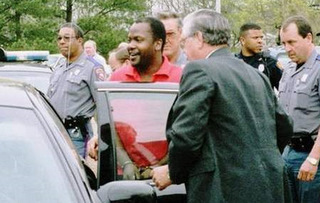
 People often ask me what distinguishes Friends of Justice from other advocacy groups. In lieu of an answer, let me tell you a story.
 Is Rand Paul a racist? And what about Rand’s father, former presidential candidate Ron Paul? Does civil rights resentment run in the family?


 Across America, violent crime rates are falling. Homicide rates for 2009 were down sharply, continuing a decade-long trend.
  The acquittal of Jeffrey Cotton, a Houston police officer, has brought racial tension in Houston, Texas to the boiling point. As
 I stumbled across
  Friends of Justice