Donald Washington’s Jena

Donald Washington, Louisiana’s first African-American US Attorney, is stepping down.  Among his greatest achievements, he says, is his handling of the controversial Jena 6 case in 2007. 

If you think Mr. Washington is proud of bringing a serious racial incident to the American public’s attention, think again.  Quite the reverse.  Louisiana owes Mr. Washington a vote of thanks for effectively debunking bogus claims made by people like me.

“There’s a huge story that one day may be told,” Washington said. “To sum up our involvement, the Department of Justice did a great job of ensuring that controversies that happen on school campuses don’t become federal cases unless the facts in evidence lead us in that direction.”

Mr. Washington was under heavy pressure to prosecute the young men who hung nooses from a tree at Jena High School as hate criminals.  I have always supported his restraint in that regard. 

But there’s more.

“As far as the kids are concerned, it is more than abundantly apparent that they never intended for what happened in two disparate and separate events to be linked together and become the focus of a national controversy. And to this day, all of those groups that intended to ferret out any kind of nefarious conduct on behalf of the citizens of the Jena community still have failed to do so.”

If you find that hard to follow, here’s a rough translation: “There was never the slightest relationship between the nooses hung at the High School in September and the schoolyard assault on Justin Barker three months later.”

Since I am the first person to link the nooses and the beat-down, I take Mr. Washington’s comments personally.  That doesn’t mean I disagree with his assessment in every particular.  I never argued that the black football players who assaulted Mr. Barker were consciously avenging the noose provocation.  On September 20th, 2007 I enjoyed a series of conversations with the men and women who rode the buses to Jena from all over the nation.  Most of the folks I talked to believed the assault on Barker followed hard on the heels of the noose hanging. 

Not so.  It’s true that black students were deeply provoked by the noose incident.  The nooses appeared the morning after a black freshman asked if it was okay for black students to sit under the tree at the white end of the school courtyard.  Although black kids were free to visit the tree whenever they chose, everybody in Jena understood that one side of the courtyard was reserved for white kids and the other end was for the black students.  It had been that way ever since Jena schools integrated in compliance with federal law in 1970.  The kid who asked the question was challenging the tradition of a segregated school courtyard.  That was the issue and folks on both sides knew it.

Black kids were angry in the wake of the noose incident; but they weren’t fighting mad. 

The Jena equation doesn’t balance until you factor in the behavior of adults. 

First, the school superintendent announced that the noose hanging was completely unrelated to racism.  Is Mr. Washington, the outgoing US Attorney from the Western Louisiana Division of the Department of Justice, signing off on this bizarre sentiment?

So it seems.

It was the refusal of school officials to acknowledge that Jena High School had a racial problem that sparked the anger of black students.  Now they were fighting mad.  Pushing matches flared up on campus.  Nothing serious, but tension was escalating.  It got so serious that police officers placed the campus on full lockdown.

That’s when the second bull-headed act by a white public official took place.  The principal called all the students to the school auditorium for a special assembly.  True to tradition, the white kids sat on one side of the aisle, the black kids on the other.  Every uniformed police officer in town was in the room.  District Attorney Reed Walters walked to the podium and told the kids to settle down and get a grip.  Then he turned to the kids on the black side of the aisle, pulled out his Parker Jotter and said, “I want you to know that I can end your lives with a stroke of my pen.”

Walters has admitted making this remark.  He says he thought the white and black students should have been able to work things out among themselves.

One thing was certain, the student body wasn’t going to get any guidance from adults.

DA Reed Walters and Superintendent Roy Breithaupt weren’t acting on their own initiative.  They were desperate men doing what they had to do.  They couldn’t address the racial history of Jena without throwing their community into an uproar.  Besides, Reed and Roy were raised in the segregated South.  Their behavior suggests they have never backed away from the racist assumptions at the heart of the Jim Crow regime.  These men weren’t going to tolerate overt racism.  If the white kids had donned sheets and burned a cross on the black end of the school yard, school officials would have taken action.  But anything more subtle than that would be ignored or interpreted as innocent juvenile horseplay.

Justin Barker was best friends with the boys who hung the nooses.  These were country kids who grew up in all-white schools.  When they hit high school, they were bused to the semi-integrated high school in Jena.  It was only natural that these kids were intimidated by black students–especially football players.  But it would be a tragic mistake to single out the kids who hung the nooses for special attention– as Walters and Breithaupt’s bizarre behavior suggests, the noose hangers were reflecting the values of the culture that shaped them.

Tension between the white “noose boys” and the black football players rose steadily during the fall semester–but the altercations were always off campus.  Then somebody set fire to the high school campus–a detail rarely mentioned in media accounts.  Robert Bailey was assaulted at a Friday night dance and this led to a related altercation at a convenience store the following morning.  When school opened on Monday morning, angry confrontations erupted during the lunch hour.  Kids were rehashing the Bailey beat-down and Justin Barker was at the heart of the action.

So, although there is no direct connection between the noose incident and the assault on Justin Barker, it doesn’t take a genius to connect the dots.

Unless, as folks like Donald Washington would have you believe, the Friends of Justice narrative is largely fictional.

Which brings us to June of 2009 when the five Jena defendants still awaiting trial pled guilty to simple battery and were sentenced to a week of unsupervised probation.  When the week was over, the charges were expunged from their records.

Why did Reed Walters allow a dedicated team of lawyers to bargain him down from attempted murder to simple assault?

Because the Friends of Justice narrative was accurate in every detail.  In fact, the carefully-researched truth was far worse.  If Reed Walters had taken a single defendant to trial, the whole sordid story would have come out and crowds of indignant protestors would have returned to Jena.

Walters yielded to the inevitable.  Simple as that.

Donald Washington has another story.  “All in all,” he says, “the federal agencies involved — from the U.S. Attorney’s Office to the FBI to the Department of Community Relations — performed their duties admirably, professionally and thoroughly.”

I won’t quibble.  I was contacted by Carmelita Pope Freeman of the Community Relations Service of the Department of Justice shortly after the Jena story first broke in the national media.  Carmelita wanted to sit down with folks on both sides of the issue and work toward an amicable resolution.  I told her she needed to wait until the legal process was over.  In a recent conversation, Ms. Freeman told me her work in Jena is finally winding up.  I hope she was able to make solid progress.  I hope lessons were learned.  But my fear is that Donald Washington’s take on the situation received the imprimatur of the federal government and everyone moved on.

The last time I spoke to Donald Washington was at a townhall meeting in Bunkie, Louisiana in the summer of 2008.  “I read everything you write,” he told me, “and I’ve got no problem with what you’re trying to do.  Just one word of caution: Be fair.”

I assured the US Attorney that I would be heed his advice.  As I turned away, Mr. Washington’s eyes lit on the diminutive Ann Colomb, a housewife from nearby Church Point, Louisiana.

“I’m sorry ma’am,” Washington said, “but you look awfully familiar.  Have we met?”

“No, Mr. Washington,” Ann replied, “we haven’t met.  I was the woman you put in jail for dealing drugs.”

The US Attorney’s face fell.  “Oh, Mrs. Colomb,” he said, “I am so sorry about what happened to you and your family.  And I want you to know that the men who lied about you and your sons are being punished to the full extent of the law.”

When Ann Colomb told me this story later she wasn’t impressed.  “All they did was give more time to the snitches that had the courage to admit what they done,” Ann told me.  “I don’t blame those poor souls for lying on us; the folks I blame is Don Washington, Brett Grayson and the rest of the those DOJ boys that paid the snitches to lie on innocent people.”

You will be discouraged to learn that federal cases built almost entirely on the uncorroborated testimony of convicted drug dealers are still being prosecuted in the Western District of Louisiana.  Next week, five defendants the feds know as “the Sunnyside Organization” will go to trial in the federal courtroom in Lafayette.  I have been monitoring this prosecution for three years and it looks like a replay of the Colomb fiasco.  More on that when the trial is over.

US Attorneys like Donald Washington serve at the whim of presidents.  Washington was appointed by George W. Bush and Barack Obama wants to move in a different direction.  How different, I wonder?  Does the president know how the Jena situation was resolved?  Does he know what happened to Ann Colomb and her sons?  Does he know what is happening to the Sunnyside defendants even as we speak?  Probably not–he’s a busy man.  But I will do everything in my power to keep him, and you, informed.
Curtis Flowers: a brief introduction

This brief summary of the Curtis Flowers case now introduces the extended version of the story on the Friends of Justice website. 

A brief introduction to the Curtis Flowers case

On the morning of July 16, 1996, four people were brutally murdered at a furniture store in the small Mississippi town of Winona.  By 11:00 am everybody had heard the news: Bertha Tardy, the proprietor of Tardy ‘s Furniture, had been killed execution style.  Carmen Rigby, Tardy’s longtime bookkeeper, had suffered the same fate, as had hired hands, Bobo Stewart and Robert Golden. Golden was black, the other three victims were white. Six months later, Curtis Flowers, a young black Winona resident who had worked three days for Bertha Tardy, was arrested and charged with the brutal murder of four innocent people.

Thirteen years, $300,000 and five trials later, Mr. Flowers remains behind bars and the state has been unable to obtain a final conviction.

The first trial was held in Tupelo, MS in 1997 and the second trial was in Gulfport two years later.  District Attorney Doug Evans was determined to convict Curtis Flowers four times: once for each cold-hearted murder.  It was a risky strategy.  To pull it off, Evans had to limit the evidence in each trial to a single victim and that was a virtual impossibility.  Evans won guilty verdicts and death sentences in Tupelo and Gulfport, but both trials were overturned by the Mississippi Supreme Court.

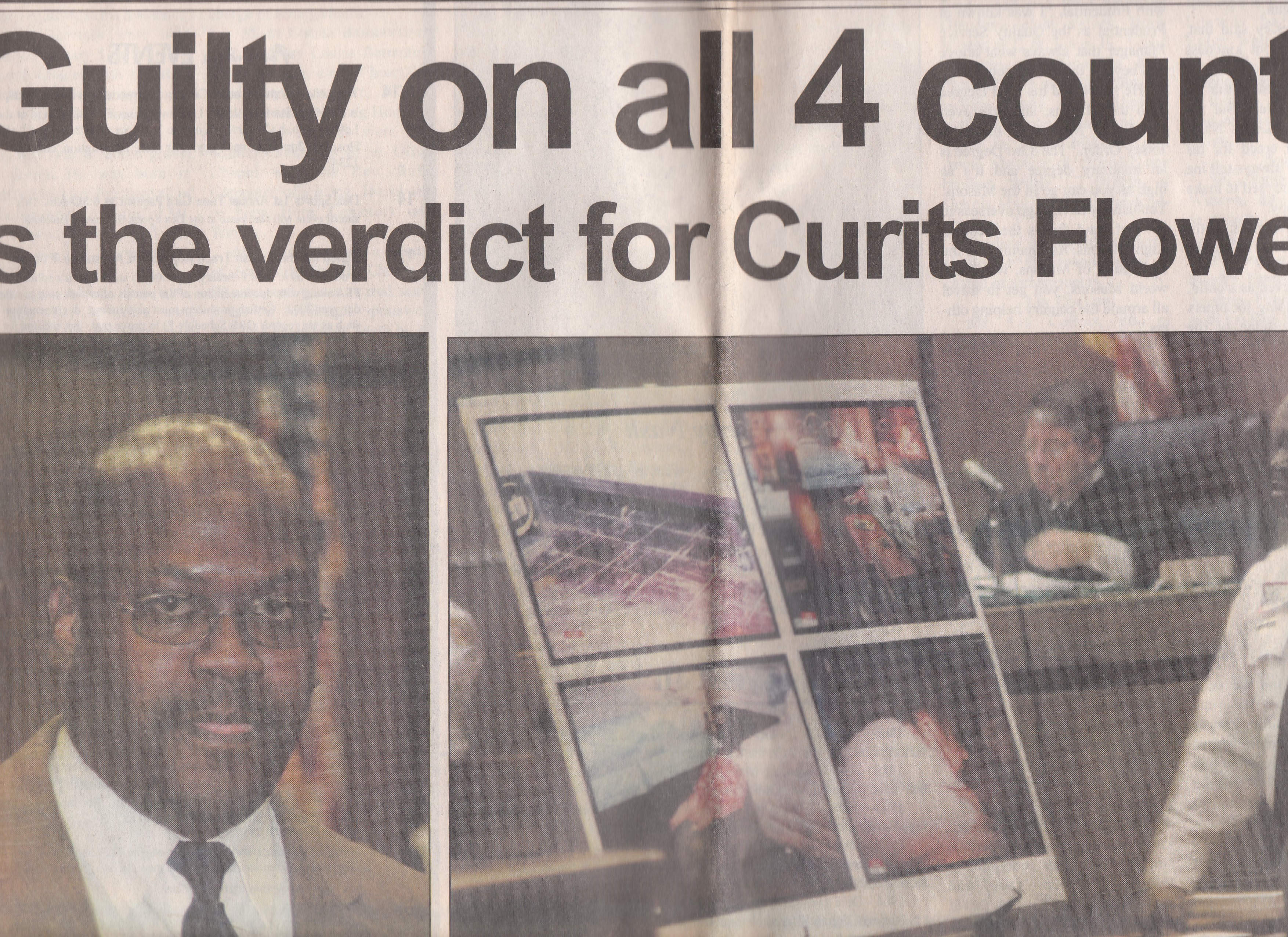
In February of 2004, Curtis Flowers was found guilty, yet again, on four murder counts.  The trial was held in Winona, the county seat of Montgomery County.  The Winona Times ran a special edition featuring a large head shot of Flowers beside graphic pictures from the murder scene. Victims were shown lying in their own blood. Several residents were outraged by the pictorial spread and wrote angry letters to publisher, Dale Gerstenlager. Gerstenlager responded that, apart from the photographs, readers couldn’t appreciate what a terrible deed Flowers had done.

The verdict would not stand.  According to former Supreme Court Justice Oliver Diaz, “We reversed because the jury selection process ended up not being fair. Every challenge the state had was used against African Americans and the only African American that was seated was when the state ran out of challenges and could not challenge anymore and one was seated.”

Doug Evans knew he would have a hard time getting a conviction in Winona if even a single African American was seated on the jury.  In a county that is half black, a jury with eleven white jurors couldn’t be produced legally, so Evans broke the law. 

It was an act of desperation.  In Winona’s white community, Flowers’ guilt is a no-brainer–as obvious as the sun in a clear blue sky. 

Black jurors have been much harder to convince.

The case against Flowers is circumstantial.  He can’t produce a convincing alibi for his activities the morning of the murders.  A gunshot residue test taken three hours after the murders found a single micron of residue on the web of his right thumb.  But the real clincher was the bloody footprint found at the scene of the crime.  Tests prove it was made by a size 10.5 Grant Hill Fila tennis shoe, and a box for precisely that shoe was found in the dresser drawer of the girlfriend Flower’s was living with.  Granted, there were no shoes in the box (it was filled with hair ribbons), but the shoe box in the dresser has been the heart of the state’s case.

Doug Evans had the shoe box evidence nailed down within a few weeks of the murders, but Flowers wasn’t arrested until January of 1997, half a year later.  In the interim, Evans and his invgestigator, John Johnson, cobbled together a list of witnesses who could trace Flowers’ movements on that fatal morning.

The state’s theory of the crime is relatively simple.  Curtis Flowers was angry because Bertha Flowers wanted to deduct $400 worth of damaged batteries from his paycheck.  Set on revenge, Flowers rose early on the morning of the crime and walked to the Angelica garment factory, five-to-ten minutes from his home.  There, shortly after 7:00 am, Flowers stole a handgun from the car of his uncle, Doyle Simpson.  Flowers returned home for a brief period.  Then, just after 9:00 am, he walked to the Tardy’s furniture store, killed four people in cold blood, stole $400 from the cash register, ditched the gun, ran home, disposed of his clothes and the Grant Hill Filas he was wearing and stuck the $400 in the headboard of his girlfriend’s bed.

It took six months to find witnesses who could place Flowers at the Angelica factory and along the various routes the state believed he traveled on the day of the crime.

On the surface, this looks like an airtight case, and it has generally been reported as such (to the extent it has been reported at all).  But at Flowers’ fourth trial in December of 2007, all five black jurors voted to acquit while all seven white jurors voted to convict.

A frustrated Doug Evans returned to the Montgomery County courthouse in Winona less than a year later for the fifth trial.  Three black jurors were selected, but they were all solidly middle class and well-connected to the white community.  Two of the black jurors were willing to trade a guilty verdict for a life sentence.  But James Bibbs, a retired Winona school teacher, hung the jury.  Judge Joey Loper embodied the outrage of Winona’s white community.  He had Bibbs dragged into the courtroom.  Loper told the recalitrant juror that he had lied to get on the jury and demanded that DA Evans file perjury charges.  Loper then insisted that Evans lobby other Mississippi prosecutors in support of a law that would allow the state to file motions for a change of venue (something only defense attorneys could do). 

A bill giving prosecutors the right to call a jury from a multi-county district in cases that went to trial three times without a final conviction was supported by state senator Lydia Chassaniol and state representative Bobby Howell.  The bill was introduced in the 2009 legislative session and sailed through the Senate without serious opposition.  In the House, however, it was killed in committee by the African American chairman of the house judiciary committee.

The same bill is currently being debated in the Mississippi Legislature.

Meanwhile, Judge Loper and DA Evans were forced to recuse themselves from the case against James Bibbs.  The Mississippi Attorney General’s took over the case and promptly dropped the charges due to a lack of evidence. 

A sixth trial is scheduled for June 7, 2010.  This time, the world will be watching.

Doyle Simpson and his 380 automatic

The gun that ended the lives of Bertha Tardy, Carmen Rigby, Bobo Stewart and Robert Golden belonged to Doyle Simpson.  All are agreed on that point.  Simpson made two visits to his car on the morning of the crime and reported that his gun had been stolen from a locked glove compartment shortly before the crime was committed.  Catherine Snow, one of Simpson’s co-workers, claims she saw Curtis Flowers leaning against Simpson’s car at 7:30 that morning.

But is Doyle Simpson credible under oath?  When first interviewed, he told investigators that he bought the weapon from his brother Robert.  When that story fell apart, Simpson testified that he bought the gun from a friend named “Ike”.  Simpson calls Ike a good friend but doesn’t know his last name.

The murder weapon belonged to Doyle Simpson–that much seems clear.  But was the gun in the glove compartment of Simpson’s car the morning of the murders? 

Doyle Simpson is no stranger to the streets.  He has used drugs and has probably been involved in the drug trade.  Back in the day, Simpson’s throat was slit and his body was unceremoniously deposited in a tree outside New Orleans.  Miraculously, the Winona hustler survived.  But whoever tried to kill him had no regard for human life and dignity.  Much like the person who pulled the trigger five times in the Tardy Furniture Store.

On the witness stand, Doyle Simpson has the demeanor of a scared rabbit.  Did he make his gun available to some very bad people who made him an offer he couldn’t refuse?  In the most recent trial, in September, 2008, Simpson made an interesting slip.  Asked to specify when he put the gun in his car, Simpson replied, “The day before they stole it.”

Who, we are left to wonder, are “they”.

More to say on this later.  Stay tuned.

Loving the World

This sermon was preached at St. John the Apostle United Methodist Church in Arlington, Texas on January 10, 2009. 

“There are no good people and bad people. No right people and wrong people.  Just one big lost humanity dying for the glory of God.”

LOVING THE WORLD

January 10, 2010

Luke 3: 1-22

Let’s face it, John the Baptist is a hard guy to relate to. He was severe, demanding and more than a little scary. Even as a young boy, John was drawn to the desert to the east of the Dead Sea. As he matured, he spent more and more of his time in the wilderness until, finally, it became his home. According to the Bible, locusts and wild honey was his steady diet.

John was the classic abstainer. He didn’t eat rich food, he didn’t drink wine and, it appears, he even refused to live indoors.

But there was a method in all this madness. John was trying to free himself from the corrupting influence of Imperial Rome. God’s Messiah, the Christ, was at hand—John could feel it. The Holy One of Israel would be like a harvester who beats the wheat on the threshing floor, storing the good grain in his barn, and burning the chaff in the fire.

John didn’t suffer from a messiah complex; his marching orders came from the fortieth chapter of the prophet Isaiah. John was “The voice of him that crieth in the wilderness, ‘Prepare ye the Way of the Lord.”

John’s job was to get God’s people ready for the coming of Messiah when, Isaiah promised, “every valley will be exalted and every mountain and hill made low.”

John knew what that meant. A true and purified Israel would be lifted up and the corrupt forces of Roman power and domination would be cast down . . . and cast out.

And when that happened, John believed, “All flesh shall see the salvation of God.”

Considered against this backdrop, John’s lifestyle makes a weird kind of sense. He didn’t drink wine because wine was costly. As Jesus reminded his disciples, John didn’t wear fancy clothes or live in palatial splendor: nice clothes and palaces cost money. And you couldn’t earn money in first century Israel without getting wrapped up in the Roman system.

John didn’t expect his audience to adopt his radical lifestyle in every particular, but he wanted them to live as far from Roman corruption as circumstances allowed. Tax collectors could collect what the law prescribed, but not a shekel more. Soldiers had to stop shaking down the populace and learn to live on their meager wages. If poverty was the price of moral freedom, so be it.

In John’s mind, money and corruption were joined at the hip; purity and poverty were sisters.

People came to John asking how they could prepare themselves for the coming Day of the Lord, and he was ready with an answer: “Whoever has two coats must share with anyone who has none; and whoever has food must do likewise.”

Was John a subversive, a radical, a weirdo on the fringe?

King Herod certainly thought so. This isn’t the Herod we meet in Matthew—the one who tried to kill the baby Jesus. That was Herod the Great. When that Herod died, his kingdom was divided up between four of his sons, one of whom bore the name of Herod Antipas. This is the Herod we meet in today’s text.

“Antipas” is a short version of the Greek word “Antipatros” which means “Like the father.” Antipas had an older brother, Antipater (a name that means essentially the same thing). But Antipater and another brother named Aristobulus were killed by their paranoid father, Herod the great. As his name Antipas suggests, the apple didn’t fall far from the tree. Herod Antipas really was “like the father.”

Herod Antipas came to power as an adolescent and had been on his throne for over thirty years by the time John the Baptist appeared in the wilderness. In the eyes of Antipas, John was just another weirdo revolutionary who needed to be eliminated.

Do we agree?

Let’s be honest here. When you hear John say, “Whoever has two coats must share with anyone who has none; and whoever has food must do likewise,” don’t you get a little uncomfortable? Haven’t we been taught to view people who talk like that as the enemy?

Of course we have.

But if John was a wild-eyed radical, why did Jesus come to Jordan seeking his blessing?

If you are serious about the life of the Spirit (and you wouldn’t be here if you weren’t) you can’t escape John’s dilemma: How can we hang out in Rome without living like the Romans do? How can we honor God while living in a godless world?

Those of you who didn’t grow up Baptist may wonder what I mean by “the world”. Drain the glory of God from creation and you are left with the world. Creation is the coffee; the world is the grounds. We easily assume that we can shuffle through life with one foot in the world and the other foot in the kingdom of God.

That’s what Herod was trying to do. Like his daddy, Herod Antipas wanted to be known as “King of the Jews” and he worked hard to protect Jewish religious sensibilities. When Pontius Pilate displayed the Roman eagle in the temple in Jerusalem, Herod Antipas backed him down.

On the other hand, Antipas was a close friend of the great Tiberius, the man who, by this time, had reigned as Roman emperor for as long as anyone could remember. Paranoid and half crazy, Tiberius lived on the Mediterranean fortress island of Capri. Herod Antipas checked in on his emperor friend every now and then—it was good for business. Herod built a Roman town on the shores of the Sea of Galilee and named it “Tiberius”. Then, fearing that this might not be enough to cement his position in the Roman world, Antipas transformed the Sea of Galilee into the Sea of Tiberius. The mad emperor liked that sort of thing.

When John came preaching repentance in the wilderness, Herod Antipas was pushing fifty, teetering on the verge of the most disastrous midlife crisis in recorded history. The moment Herod saw Herodias, he had to have her.

But there were problems. For one thing, Herodias was the wife of Herod’s brother Philip and the sister of Herod’s step-brother Agrippa. When Philip was forced to divorce Herodias he was a little miffed. Agrippa was seething.

And then there was the fact that Herod was married to the daughter of a king, Aretas, the Arabian ruler of Nabataea. When his daughter fled home in tears, Aretas readied his army for war.

Herod was undeterred. Having spent much of his life in Rome, Antipas knew how to live as the Romans do. If Herod could convince the emperor that marrying Herodias was a good idea, it didn’t matter what anybody else thought.

In the Roman world, might made right. The Emperor Caligula once had his horse sworn in as a Roman senator to make precisely this point. No one dared challenge this bizarre move because Caligula had cornered the market on power.

Herod’s marriage to Herodias didn’t just enrage Herod’s brother Philip, his step-brother Agrippa and Aretas, his father-in-law; it earned the enmity of John the Baptist. Herod had John arrested and carted off to the lonely castle of Machaerus east of the Dead Sea.

Unlike John, King Aretas had a powerful army and was willing to use it. Herod was vanquished in battle (God only knows how many innocent men died in the process) and Herod and Herodias fled in terror to their good friend Tiberius. Predictably, Tiberius took Herod’s side, but before the imperial armies reached King Aretas, Tiberius was dead.

Now the power equation shifted dramatically. If might makes right, and you lose your might, right becomes wrong in a heartbeat. Herod’s step-brother Agrippa was a good friend of the new Emperor, a madman named Caligula. Herod Antipas soon found himself living in lonely exile in Gaul, modern France. (Pontius Pilate soon suffered the same fate.) Meanwhile, with the backing of his good friend Caligula, Agrippa claimed the mantel, King of the Jews.

John the Baptist never claimed to be the last word. “I baptize with water,” he told the people, “but the Christ will baptize you with the Holy Spirit and with fire.”

By all accounts, Jesus embraced John’s view of the world. As soon as Jesus was baptized by John, he retreated to the wilderness for forty days and forty nights to hammer out the shape of his ministry. Then we see him moving from town to town, calling disciples and preaching a gospel remarkably like John’s. Like John, Jesus was inspired by Isaiah: “The Spirit of the Lord is upon me, because he has anointed me, to preach good news to the poor.”

Throughout his ministry, Jesus withdrew to the wilderness to be alone with God . . . but, unlike John the Baptist, Jesus returned to a world dominated by the likes of Herod Antipas. Jesus didn’t wait for the tax collectors, the prostitutes and the soldiers to come to him—Jesus invaded their world with a holy enthusiasm that shocked his contemporaries.

Jesus didn’t condemn the world, like John, and he wasn’t conformed to the world, like Antipas; he embraced the world in the love of God and the power of the Spirit.

How could it have been any different? “God so loved the world,” the Bible says, “that he gave his only Son.” Far more than Herod Antipas, Jesus was truly “like the father”. Jesus found God’s glory in the wilderness and released that glory back into the world. As followers of the Son, we share this mission.

I told you the sad story of Herod Antipas for a reason. Remember, drain the glory of God from creation and you are left with the world. And as Herod Antipas learned to his sorrow, when you embrace the world, you make yourself and everyone you touch miserable. How can we live in Rome without living like the Romans do?

In the wilderness, Jesus drank in the glory of God. Returning to the world, Jesus poured out God’s glory. Drink in; pour out. Retreat; advance. Breathe in; breathe out.

This sanctuary is our wilderness. We enter this place as strangers to the glory of God. That’s why we bristle when John tells us to share what we have with those who have nothing. That’s why we flinch when Jesus squanders his good news on the poor.

We long for the Spirit. We long for the glory of God. We long for Jesus. But you can’t get to Jesus without going through John. Baptism in water, the baptism of repentance, comes first—then we’re ready for the good stuff. This is where we get the glory back. Confessing that we have fallen into the rhythm of the world, we enter the rhythm of the Spirit.

We enter this wilderness sanctuary feeling beat-up and betrayed, angry with the world. We hear the gospel, but it has an alien ring—like words in a foreign tongue. Then we remember the baptism that washes the world away. We remember the baptism of the Holy Spirit and fire. Suddenly, the world is ablaze with the glory of God.

Now, there are no good people and bad people. No right people and wrong people. Just one big lost humanity dying for the glory of God. The Love of God ignites a love for the world, in the name of Jesus, in the power of the Spirit, Amen.

Alan Bean

White Power USA

Is there a link between Neo-Nazis, Birthers, Tea Party enthusiasts and mainstream conservatism?  The producers of this video think there is. 
White Power USA was produced for Al-Jazeera English by American journalists drawing on the same sources you would expect to see in the mainstream press.  Except, for some reason, the MSM hasn’t shown much interest in the racist roots of the Tea Party crowd. 

The White Power leaders depicted in this documentary are desperate for media attention.  Although groups displaying the swastika and the stars-n-bars are enjoying rapid membership growth, most extremists have learned to mainstream the message.

The producers of “White Power USA” aren’t suggesting that everyone involved in America’s most dynamic populist movement is racist.  But can mainstream Christian conservatives attend Tea Party events without noticing the overtly racist symbols and sentiments on display?

Those following my posts on the Curtis Flowers case will be particularly interested in the extended interview with Council of Conservative Citizens co-founder Gordon Baum.  Members of a CCC chapter in northern Mississippi also get a few minutes of camera time.  If we’re known by the company we keep, Senator Lydia Chassaniol needs to find better company

In this post-9-11 world, some won’t be interested in viewing a  documentary associated with Al Jazeera, and that’s okay.  On the other hand, this may be the perfect time to heed the gentle call of Wee Robbie Burns: “O would some power the giftie gie us to see ourselves as others see us.”

Clay prosecution shows the origins of the mortgage mess

Alvin Clay

 Congress, finally, has turned its attention to mortgage fraud.  According to the New York Times, The F.B.I. is presently investigating more than 2,800 mortgage fraud cases, almost five times the 534 inquiries in 2004. Attorney General, Eric Holder, feels the current efforts to fight financial crime will foster confidence in the system. 

But merely increasing the number of prosecutions isn’t enough–the feds must address the quality of their mortgage fraud cases.  According to the Times, “Of the 2,800 mortgage fraud investigations under way at the Federal Bureau of Investigation, most — 1,842 — were classified as major cases, which meant they involved more than $1 million in losses.” 

Guess how much money was lost in the five real estate deals at the center of the Alvin Clay prosecution?  When all five properties had been re-sold, the total loss to buyers, sellers and the financial system was $16,000.  

 That’s it. 

This doesn’t mean that the Donny McCuien and Ray Nealy, the two men at the heart of the Little Rock scam, weren’t worthy candidates for prosecution.  They were.  But small-time hustlers like McCuien and Nealy were always incidental to the FBI.  They G-men were after an attorney and real estate broker named Alvin Clay.  

Nealy and McCuien turned to real estate fraud because government oversight was virtually non-existent.  Banks were willing to make “stated” loans and the con artists came running.  In a stated loan, a financial institution agrees to believe that a prospective buyer possesses the assets indicated in a loan application.   Call it the honor system.  This extreme degree of credulity was driven by a desire to make as many loans as possible, a dynamic fueled by greedy managers and corporate executives hell-bent on maximizing bonuses.  Nobody was paying attention–it was bad for business. 

The financial institutions involved in the McCuien-Nealy scam were begging to be exploited.  Alvin Clay made the same mistake the banks and trust companies were making–he took McCuien and Nealy at their word.  

On the sixth day of Alvin Clay’s trial, I said that t federal government was avoiding embarrassing questions because it didn’t have any good answers. 

•Why has the government hitched its wagon to a man who lies when the truth would sound better?

•Why has the government spent five years and a million dollars pursuing an innocent man?

•Why did the government initiate an investigation of Alvin Clay before they had any evidence of wrongdoing?

•Why has the government used the threat of pain and the promise of relief to suborn perjury from its star witness?

•Why did FBI agent Rodney Hayes lie to a judge to get a search warrant and perjure himself before a grand jury to get an indictment?

•When the Eastern District of the US Attorney’s Office was forced to recuse itself from this case; why did the Western District pick it up?

The answer to most of these questions is the same: the federal government, represented by Assistant US Attorney Bob Govar, noticed that a combative defense attorney named Alvin Clay was involved in a series of real estate deals and decided to look into it.  There was no initial evidence of wrongdoing; FBI agent Rodney Hayes was sent on a fishing expedition.  The goal was to nail Clay, an attorney with a longstanding adversarial relationship with Govar.  The ambitious Hayes understood the nature of the game.

It never occurred to the feds that the McCuien-Nealy scam was driven by systemic regulatory gaps, or that financial industry was willing to tolerate a high degree of corruption if it increased the overall level of activity.  The real crime was staring the FBI in the face; but they were so intent on busting a single black attorney they couldn’t see the obvious.

Hopefully we have all learned something from the mortgage fiasco.  The Clay case demonstrates how much there is to learn.

Harry Reid isn’t racist, he’s just old

Harry Reid: Barack Obama receives race apology after book tells all about 2008 election campaign Everybody knows what Harry said.  Barack Obama had a good shot at the presidency because he was “light skinned” and spoke “with no Negro dialect, unless he wanted to have one”. 

Reid and Obama both concede the words were poorly chosen.  But are we dealing with racism?

Republican politicians think so.  Or rather, they feel that if the senior Democrat in the Senate gets a pass on this one, America should apologize to Trent Lott.

No one on either side of this dust-up is suggesting that Reid’s observations were factually inaccurate.  True or not, it is suggested, the remarks was indelicate and insensitive.

To whom?

African Americans, for the most part, don’t seem to mind.  Reid was merely stating the obvious–some white Americans are more comfortable with people of color so long as they don’t have too much color.

Morever, middle class African American parents stress to their children that a mastery of standard English (the way folks talk on the evening news) is a prerequisite to a good job. 

Whites from the rural South face a similar challenge, although to a smaller extent.

If Harry Reid thinks it’s okay for white voters to prefer light-skinned black candidates who could pass for white over the telephone, I’ve got a problem with that.  It isn’t okay.  Lyndon Johnson didn’t need to transcend his Texas dialect to get elected.  In fact, his “Muh fella Amuricans” was reassuring to a lot of people.  So why should a black candidate have to sound white to get elected?

On the other hand, if Reid was merely admitting the regrettable fact that many potential African American candidates look and sound too black to make it to the White House I defy anyone to argue.  Whether he should have said what he said is another matter.  If he had slipped in a few qualifiers like “unfortunately” or “I wish it were otherwise, but . . .” no one would have taken offense.

Of course, the word “Negro” suggests that Mr. Reid is every bit as old as his pictures suggest.  The use of the old n-word is more likely to offend young African Americans who didn’t grow up hearing it and have never used it themselves.

According to the Telegraph (a British paper), the book “Game Change”, by Mark Halperin and John Heilemann, “alleges that when efforts to persuade the late Edward Kennedy to endorse his wife’s presidential bid fell flat when the former president reportedly told his old friend that just a few years ago Mr Obama would have been serving them coffee.”

Yuck!  No wonder Kennedy threw his weight behind Obama!

Clinton’s “coffee” remark suggests that because African Americans were once relegated to servile jobs, Barack Obama is an uppity Negro who wants too much too fast.  If Reid shared that perception he would deserve the negative press he is getting.  But the Senate majority leader was clearly excited about Obama’s candidacy.

I suspect Mr. Clinton would have shared Mr. Reid’s enthusiasm for Barack Obama if Hillary Clinton hadn’t been in the primary race.  Politics makes strange bed fellows and strains long-established friendships.  If Bill had no horse in the presidential race (and no, I am not calling Hillary Clinton a horse) I suspect he would have been thrilled that his party had a strong candidate. 

On the other hand, opinions we don’t dare acknowledge, even to ourselves, can slip out when we’re hurt or angry. 

I am too concerned about the millions of white Americans (most of them over fifty) who are unprepared for an African American president to worry about folks who artlessly rejoice in the upward trajectory of a black politician.  Had Reid been forty years younger, the right words would have sprung naturally to his lips. 

Trent Lott addressed a meeting of the racist Council of Conservative Citizens and explicitly endorsed their views.  Lott wished that segregationist Dixiecrat Strom Thurmond had been elected in 1948.  Lott was raised to believe in the goodness of segregation and no one in the social and political circles he moves in has ever suggested he change his mind.  If that’s the way Mr. Lott thinks he might as well shout it to the world.  But don’t expect the rest of us to give him a pass.

Like Trent Lott, Harry Reid is the product of a racist era.  The difference is that Reid knows the old ways were wrong, even if his off-the-cuff remarks suggest he hasn’t outgrown his roots as much as we, or he, might like.

No place for truth

Law professor, Stanley Fish thinks the law is more concerned with right answers than with true answers.   

To illustrate, Dr. Fish tells the story of Leonel Torres Herrera. 

“Found guilty of murder, (Herrera) claimed that because new evidence proving his innocence had emerged his case should be reconsidered. Chief Justice William Rehnquist, writing for the majority, replied that innocence or guilt was not a question for his court to consider absent a demonstration that the original trial was infected by error. Justice Sandra Day O’Connor, in a concurring opinion, agreed. Petitioner, she said, does not appear before us an “innocent man,” but as a “legally guilty person” who is not “entitled to get another judicial hearing” given his failure to demonstrate that the trial he received was unfair. The trial was fair, and the question of his guilt has been determined in a constitutionally correct procedure. That procedure provides the right (if not the true) answer to the question, “was he guilty?” (Herrera was later executed.)

In the picture above, Ms. O’Conner mourns the passing of her old pal, Bill Rehnquist.  I doubt she shed a tear, or even noticed, when Mr. Herrera breathed his last.

Fish is right.  The legal system is so fixated on correct procedure that the truth pften runs a poor second.  The prosecution in the Curtis Flowers case has been reversed three times, but it wasn’t because DA Doug Evans’ case against Flowers is a jumble of circumstantial evidence and wild conjecture held together with perjured testimony.  If Mr. Evans hadn’t been guilty of blatant prosecutorial misconduct, Curtis Flowers would no longer be in the land of the living. 

Leonel Torres Herrera

 Leonel Torres Herrera died without getting a chance to present credible evidence of actual innocence in open court. 

Fortunately, Troy Davis will get to tell his story. 

The criminal justice system can value the true answer over the merely right answer if it so chooses.  But if judges decide the rules were followed during the original trial, the fact that the truth was given short shrift can be ignored as irrelevant.  From a legal standpoint, once a defendant has been found guilty at the conclusion of an error-free trial, he is guilty and should be treated as such.

Troy Davis has faired better than Mr. Herrera because the public has lost confidence in legal system’s ability to establish the truth.

Baptists and the Death Penalty

Hear the word “Baptist” and what words spring to mind: narrow, fundamentalist, bigoted, judgmental, moralistic? But Baptists, like every other religious group, represent a complex configuration of all things human.  Traditionally, Baptists have been America’s greatest defenders of religious liberty (yes, really) and, in theory at least, Baptist preachers are unrestrained by dogma or denominational hierarchy and are thus free to speak from conscience. 

Occasionally, we exercise that right.

As Bob Allen points out in an excellent article for the Associated Baptist Press, Americans–Baptists included–are gradually becoming disenchanted with the death penalty.  The Baptist Standard, the voice of Texas Baptists, picked up Allen’s article, which should tell you something.  True, they didn’t print the excellent chart showing that the southern states accounted for 87% of American executions in 2009 and 95% in 2008, and that Texas, as always, leads the parade.  But you’ve got to cut these guys a little slack–they’re writing for Baptists in Texas.

Baptists are associated with punitive policies because the hardline traditionalists in our ranks have done an excellent job of marketing their views.  Still, it is very difficult to make a consistent theological case for the death penalty or mass incarceration from the Bible.  Proof texts can be found for any position, but the overwhelming thrust of both the Hebrew and Christian Scriptures is in the direction of mercy, compassion and restoration.  Unfortunately, those of us who take the Bible straight have done a lousy job of getting the word out. 

Although Bob Allen doesn’t realize it, he is the first mainstream reporter in America (outside Mississippi) to publicize the case of Curtis Flowers.  Tom Mangold did an excellent report for BBC Radio, and I have spoken to several reporters who intend to do something with the Flowers story in the near future–but Allen is the first to mention Flowers by name, albeit in connection with the widely reported Troy Davis story.  Here’s the relevant portion of the article:

In August the federal Supreme Court ordered a hearing to receive testimony about whether new evidence establishes the innocence of Troy Davis, an African-American man on death row for the 1991 murder of a white police officer in Savannah, Ga.

Seven of nine witnesses who testified they saw Davis shoot and kill Officer Mark Allen McPhail later recanted, saying police pressured them into falsely fingering Davis. One of two witnesses who did not recant allegedly told family and friends that he is the actual murderer.

Supporters of the fallen officer say Davis was convicted on physical evidence and should be executed in the name of justice. But Alan Bean, an ordained American Baptist minister who runs a criminal-justice-reform organization called Friends of Justice, said manipulation of eyewitness testimony is a problem in the court system nationwide.

“Not only do police officers and investigators coerce ‘eyewitnesses’ into cooperating with the government’s theory of the case,” said Bean, a white man who helped bring national attention to a noose-hanging incident that revealed racial tensions in Jena, La. “There is growing evidence that even sincere and well-intentioned eyewitness testimony is far less reliable than is generally believed.”

Bean started Friends of Justice in response to an infamous drug sting in Tulia, Texas, in 1999, in which more than half of the town’s black male residents were arrested and convicted on the questionable testimony of a single undercover officer. Bean said he is monitoring the Troy Davis case because of its similarity to one involving Curtis Flowers, a black man behind bars for the 1996 execution-style slaying of four people in Winona, Miss., who has been tried five times without a final conviction by the state.

Mark Osler: Schools or Prisons?

[arnold-schwarzenegger-conan.jpg]I saw this story about CA governor Arnold Schwarzenegger calling for a “Schools not Prisons” politics on the NYT site and thought it warranted a post.  Unfortunately, I’m cramming for Saturday’s Friends of Justice Board meeting and a Sunday preaching opportunity and don’t have time for reflection.  Fortunately, Baylor law professor Mark Osler has addressed the issues over at Osler’s Razor and raises some provocative issues.

Political Mayhem Thursday: Schools or Prisons?

Lame-duck California Governor Arnold Schwartzenegger is supporting a Constitutional amendment in that state which would require that the state spend more money every year on universities than it does on prisons.

I think it is an intriguing idea.

First, though, we have to acknowledge that incarcerating a lot of people is probably going to reduce crime, even if we just incarcerate people at random– there simply will be fewer people on the street to commit crimes. Incarcerating a large part of the population does reduce crime.

However, incarcerating a lot of people is an expensive way to achieve what may be a minor result. The better we target the people who really create crime– the key men– the more efficient the system and the fewer people we need to incarcerate to obtain a given result. Of course, for this to happen, we must acknowledge one over-riding goal in criminal justice: To incapacitate the key men. It would be unusual to find that kind of political discipline.

Still, I would love it if we could try, and as a result give more money to universities than we do to prisons.

What do you think?

-Mark Osler

Larry James: Hopelessness vs. Laziness

Larry James is president and CEO of Central Dallas Ministries.  This brief post on the link between poverty and hopelessness is one of the best things I’ve read in a long while.

Hopelessness vs. Laziness

It occurred to me recently that middleclass and upperclass folks who accuse underclass folks of being lazy don’t really understand life in the ghetto.

When you have little or no hope of landing the kind of job that would allow you, literally, to work your way out of poverty and all of its deadends, a paralysis of hopelessness can set in. When it does, lots of people simply come to a halt. It is as if a wall emerges from the ground in the pathway and the parade of a person’s life simply stops.

Hopelessness may lead to a series of odd jobs; you know, hit and miss kind of work that pays a wage, but not one that’s liveable or progressive.

For lots of people the deadends of life signal an end to effort.

“What’s the use?” can become the fundamental question of life. And, until that question finds a reasonable answer, life is going nowhere.

So, the next time you think “lazy,” stop and reconsider.

Ask some questions.

-Larry James