The end of racism?

Prayer on Election Night

Howard Witt wonders if the election of Barack Obama will bring lean times to the civil rights movement.  The appeal for help we recently posted on our blog caught his attention. 

Isn’t it ironic, he asked me, that the organization responsible for breaking two of the biggest criminal justice horror stories of the 21st century might have to shut down for lack of financial support? 

Ironic it is!  Friends of Justice set up shop in Jena shortly after Barack Obama announced his presidential campaign.  How strange is was that we should be talking about nooses hanging from trees with America on the verge of electing its first black president.

We have come so far.  We have so far to go.

Witt is aware that advocacy organizations, large and small, raise money by identifying a bogeyman and presenting themselves as the only thing standing between the public and certain disaster.  Conservatives and liberals both play this game.  Reverend Dobson’s wacky letter from the future is an extreme example of the genre–his purple prose inspired by the desperation of the Christian Right.

So what happens when a progressive black man is elected president and you don’t have George W. Bush to kick around any more? 

“For many Americans,” Witt writes, the election of America’s first black president on the same day that Nebraska banned all affirmative action laws “add up to one conclusion when it comes to the long and bitter struggle over civil rights: Problem solved. Everyone’s equal now. Let’s move on.”

I told Witt that Friends of Justice doesn’t assault straw man antagonists, so I doubt much will change.  In Jena, for instance, it was tempting to suggest that the problem was a racist DA.  But Reed Walters is just one symptom of a broken system.

Al Sharpton’s comments are encouraging:  “The issue now is not racism in terms of a guy with a Klan hood,” he told Witt.  “The issue is inequality and bringing about the change we have voted for. With a strongly Democratic Congress and a black president, if we can’t pass legislation now to fix the education system and the criminal justice system, then we are simply incompetent.”

I doubt it will be that easy, but it’s good to see Rev. Sharpton focusing on systemic issues.

In wake of Obama’s victory, civil rights leaders make adjustments

By Howard Witt | Tribune correspondent
November 6, 2008

HOUSTON-On the very day that the rest of America elected the first black president in the nation’s history, voters in Nebraska approved a referendum banning all government affirmative action programs in the state.

For many Americans, those two developments add up to one conclusion when it comes to the long and bitter struggle over civil rights: Problem solved. Everyone’s equal now. Let’s move on.

Or, as Ward Connerly, the black conservative activist from California who has led a national crusade against race-based affirmative action programs, put it: “We have overcome the scourge of race.”

Civil rights leaders across the country scarcely had time to savor Sen. Barack Obama’s unprecedented election victory before grappling with an ironic new dilemma Wednesday: How to keep the nation’s focus on the continuing racial injustices they see when an African-American will be occupying the White House.

“Now that we’ve got a black person in the most powerful and most highly symbolic place, I do expect many white Americans will consider it one less reason for black Americans to whine,” said James Rucker, founder of Color of Change, an Internet-based civil rights group with more than 400,000 members. “The problem with that is, we still have housing discrimination, hate crimes, the overrepresentation of African-Americans in prison and inequities in education. One election doesn’t make all that go away.”

Obama’s election feels historically cleansing to Americans of all races who know that when the nation was founded more than 200 years ago, blacks were not even regarded as fully human. But even though the most overt forms of institutional discrimination, like segregation and bans on interracial marriage, were purged from the nation’s lawbooks a generation ago, profound social and economic disparities still divide blacks from whites in America.

For example, the income gap between blacks and whites has been slowly closing since the 1968 assassination of Rev. Martin Luther King Jr. But at its current rate, it still would take five centuries for blacks to reach income equality with whites, according to a study earlier this year by the Institute for Policy Studies in Washington.

To address such enduring inequalities in the new age of the Obama presidency, Rev. Al Sharpton, a leader of some of the nation’s largest and most visible civil rights protests over the last decade, already was contemplating how to recalibrate his approach.

“The movement has to go from confrontation to accountability,” Sharpton said. “The issue now is not racism in terms of a guy with a Klan hood. The issue is inequality and bringing about the change we have voted for. With a strongly Democratic Congress and a black president, if we can’t pass legislation now to fix the education system and the criminal justice system, then we are simply incompetent.”

At the NAACP, the nation’s oldest and best known civil rights organization, joy over Obama’s election was mixed with caution.

“We now will have a former civil rights lawyer and community organizer in the White House, so that should mean on certain issues we will have to do less convincing,” said Benjamin Jealous, the organization’s president. “But at the same time, we have to remind Americans that racism still exists. The man referred to as President Barack Hussein Obama would still have a hard time catching a cab in Chicago.”

Other civil rights leaders noted that, long before Obama rose to national prominence, many whites had already grown weary of hearing about racial justice issues.

Alan Bean, a Baptist preacher who directs a small Texas-based civil rights group called Friends of Justice, has worked to expose several cases of alleged racial bias in small-town criminal courts, including last year’s Jena 6 case that drew more than 20,000 civil rights protesters to the small Louisiana town.

This week, he issued a plaintive fundraising appeal to his supporters warning that his group is nearly out of money and may soon have to close its doors.

“When we send out these appeals, the response is usually minimal,” Bean said. “I don’t think there are a lot of people in America who understand just how broken the criminal justice system is and how important it is that there are organizations like us standing up for victims of wrongful prosecution and conviction.”

Bean is hopeful that Obama will elevate the importance of civil rights cases in the U.S. Justice Department. And the president-elect has already a signaled an interest in expanding the definition of civil rights to encompass economic as well as racial disparities.

But just in case the new administration were to falter, Sharpton said he’s prepared to stage one of his signature civil rights protests outside the Obama White House.

“I don’t think that would happen, because Obama’s commitment to civil rights is basically there,” Sharpton said. “But if we had to protest, we would. If the issue is accountability on change, that’s where we’ll go.”

hwitt@tribune.com

First, Mr. Obama, do no harm!

 Will Barack Obama make our self-destructive criminal justice system the primary focus of his first term in office?

 Not a chance.

 Will he quietly inject criminal justice reform into the political debate?

 Even that is asking too much.

 Barack Obama won the election by refusing to defend liberalism.  He had to support a good war in Afghanistan to pass the commander in chief test, and he had to talk tough on crime (capital punishment) to appear presidential.  By feigning a conservative stance on hot button issues Obama focused a two-year campaign on Iraq and a faltering economy. 

 In short, Obama won by avoiding issues that are losers for progressive politicians.  Unfortunately, the failure of the criminal justice system is one of these issues. 

The Blue team won by a less-than-jaw-dropping majority even though everything broke in its direction: a protracted and unpopular war in Iraq; widespread dissatisfaction with the Bush administration, and an economy in full meltdown.  What if things had worked out better in Iraq and the economy was still showing modest growth?  Could a democratic candidate still have pulled out a victory? 

 Maybe, but only by a razor-thin margin. 

 And this after Obama’s team executed a virtually flawless campaign strategy.

 We are witnessing the death spasms of a conservative revolution inaugurated by Barry Goldwater’s agenda-setting run for the White House in 1964; but that doesn’t justify talk of a new liberal Camelot.  Barack Obama can only succeed by showing the same cagy deference to mainstream American conservatism that secured a path to the White House. 

The criminal justice system impacts black Americans in grossly disproportionate numbers. Obama can’t issue a clarion call for reform without creating the impression that poor black people are his primary constituency.  That way lies political death.

Nonetheless, positive change is coming.  As California’s current budget crisis demonstrates, America can’t afford its bloated prison system any more than it can afford a cold war era standing army. 

 Unlike Bill Clinton, the president-elect won’t be tempted to protect his conservative flank by making the criminal justice system even more unfair and dysfunctional.  When Clinton was first elected, conservatism was resurgent.  Uncanny political acumen and the fortuitous candidacy of Ross Perot allowed the Arkansas governor to prevail.  Only the brilliant strategy of triangulation made the political virtuoso from Arkansas a viable candidate. 

Bill Clinton kept his right wing critics at bay by funneling huge amounts of money to police departments and multijurisdictional narcotics task forces across the nation.  So long as these agencies could demonstrate that they were locking up lots of bad guys, the money kept flowing.  Clinton’s largesse helped to federalize the war on drugs, setting the stage for the overt racial profiling and procedural sloppiness on display in the infamous Tulia drug sting.

Just because the conservative movement is in complete disarray doesn’t mean America is ready for a progressive revolution.  John McCain’s campaign ruthlessly exploited the fears and delusions of a fearful populace.  The good news: these tactics failed; the bad news: John McCain believed he couldn’t win without them.

 There is a legend that bluesman Robert Johnson sold his soul to the devil in exchange for a supernatural way with the guitar.  John McCain sold his soul to the devil by embracing the silly slash-and-burn tactics he once derided . . . and he still can’t play the political guitar worth a lick.

 The president-elect knows that a political over-reach will send him back to the Windy City.  Therefore, he will proceed like a seasoned quarterback; taking only what the defense gives him.

Fortunately, Barack Obama can improve the criminal justice system in small ways without making waves.

The Justice Department was deeply politicized by the Clinton and Bush administrations.  By selecting a fair-minded and independent attorney general, Obama can put an end to sixteen years of institutional turmoil. 

Secondly, by appointing one or two moderate Supreme Court Justices, Obama will arrest the rightward tilt of the judiciary.  James Dobson’s apocalyptic vision of a liberal Supreme Court run riot is delusional; all Obama can do is swing the ideological pendulum back to the center.

It took a staggering degree of across-the-aisle bipartisanship to thoroughly mangle our criminal justice system.  Republicans were outnumbered in both houses at the beginning of Clinton’s first term, but Reagan conservatism remained the ascendant political philosophy.  Bill Clinton couldn’t make any headway with health care reform, so he shifted his focus to welfare reform and mass incarceration.  Democrats eager to flash their conservative credentials jumped on the bandwagon with tough-on-crime Republicans. 

 Barack Obama won’t attempt a reversal of the disastrous legislation that produced mass incarceration.  Still, he understands that American racism is on display in our criminal justice system.  There is a broad consensus on these issues within the academic world Obama has inhabited throughout most of his adult life and the savvy Harvard constitutional scholar certainly got the memo.

 Obama can’t lead the reform charge, but he can quietly encourage an open and frank examination of urban poverty and mass incarceration. 

As a governor and a president George W. Bush used the courts to score political points.  Conservative appeals judges were appointed.  “Tort reform” made it increasingly difficult for trial lawyers to sue bad actors in the corporate world.  Bush un leashed an orgy of prison building in rural Texas.  During his single term as governor, Texas became famous for executing more people than the rest of the free world combined.

Then W. moved to 1600 Pennsylvania Avenue and picked up where Bill Clinton had left off.  Nothing reassures frightened voters more than three-strikes laws, conservative judicial appointments, mandatory minimum sentences and massive prison construction. 

Barack Obama won’t move aggressively to roll back these maladaptive policies, but I would be shocked to see him play the demagogue.

The criminal justice system can be reformed indirectly, through a renewed war on poverty.  Mass incarceration is a maladaptive response to social despair, high levels of unemployment, slave wages, and a flowering underground trade in illegal drugs.  By providing real alternatives to the streets, Obama can slow the steady stream of petty felons flooding our prisons.

A WPA-style works project aimed at long-neglected inner city and rural communities could provide an alternative to the fatalism of the streets.  It will take billions of dollars and a lot of drill sergeant discipline to make hardened bangers pick up a hammer; but it beats the hell out of sending non-violent street kids to the crime schools known as prisons.

 The much-heralded demise of conservatism hasn’t created a mandate for compassion and common sense.  The next president can’t let his rivals frame him as the friend of thugs and drug dealers.  In confronting
America’s criminal justice mess, the Hippocratic Oath should be the watchword for an Obama administration: “First, do no harm.”

Baptists hear about Troy Davis

Thanks to Bob Allen, thousands of Baptists have been introduced to Troy Davis.  Allen’s story for the Associated Baptist Press is based on my recent “I am Troy Davis” post, materials from the Friends of Justice website, and a good deal of fresh research.  It is great to see the tragic plight of Mr. Davis and the work of Friends of Justice presented to a Baptist audience.

Baptist criminal-justice activist applauds Ga. stay of execution

By Bob Allen
Wednesday, 29 October 2008
ARLINGTON, Texas (ABP) — An American Baptist minister who advocates criminal-justice reform hailed as a “miracle” the latest stay of execution for a black man convicted of murdering a white Georgia police officer nearly 20 years ago.

Alan Bean of the Arlington, Texas-based group Friends of Justice was one of about 600 death-penalty protestors who demonstrated on the steps of the Georgia State Capitol on the eve of the most recent scheduled date for execution of Troy Davis.

The provisional stay was issued Sept. 24 by the Atlanta-based 11th U.S. Circuit Court of Appeals. It was the third such stay for Davis, 40. His lawyers were given 15 days to file documents, after which the court will have 10 days to decide if the case should go back to a lower court, which could order a new trial.

Bean, best known for bringing attention to alleged racial injustice related to incidents at a Jena, La., high school in 2006, said the stay of execution was not expected. Davis has lost several appeals based on claims he is an innocent man.

Several public meetings and rallies were held in recent weeks around Atlanta demanding a new trial for Davis. One included about 1,000 people, who marched from a local park to Ebenezer Baptist Church, the historic congregation once co-pastored by Martin Luther King Jr. and Sr.

About 140,000 people signed a petition to halt Davis’ execution by lethal injection. Pleas for commutation of his sentence came from former President Jimmy Carter, former Anglican Archbishop Desmond Tutu of South Africa and Pope Benedict XVI. Other supporters include entertainer Harry Belafonte and Sister Helen Prejean, the nun whose anti-death penalty activism inspired the film Dead Man Walking.

Davis has spent 17 years on death row for the Aug. 19, 1989 murder of Mark Allen MacPhail, a 27-year-old police officer in Savannah.

People close to Davis say he was wrongly convicted. There was no physical evidence linking him to the crime, and a murder weapon was never found. The case against him was solely based on witness testimony implicating him, and seven of the nine witnesses against him have since recanted.

Bean said he doesn’t know if Davis is guilty or innocent — which, he contends, is precisely why there needs to be a new trial. What is clear from reading court documents, Bean said in a recent blog, is that “law enforcement shaped testimony through threats and promises.”

“Police officers, outraged by the savage and merciless slaying of one of their own, rushed to judgment [and] then shaped the ‘evidence’ to support a hastily-reached conclusion,” he wrote.

Bean said the issue for him is not about Troy Davis or even just the death penalty. “Ultimately, this new movement is about our broken criminal-justice system and the urgent need for sweeping reform.”

Friends of Justice started in 1999 in response to a drug sting in Tulia, Texas, in which half of the town’s black males were arrested and convicted on the uncorroborated testimony of an undercover narcotics officer. The group advocates greater due-process protections for poor people of color, who populate the criminal-justice system in numbers disproportionate to their percentage of the population.

Bean labels that disparity the “New Jim Crow” and compares modern-day justice reform to the Civil Rights Movement of the 1950s and 1960s. He said the Georgia rally on behalf of Davis “felt like the early stages of a religious revival.”

“If you are the praying kind, please continue to pray for Troy Davis and for the nation that isn’t sure what to do with him,” Bean wrote.

Angola 3 featured on NPR’s All Things Considered

Albert Woodfox

Albert Woodfox

Thanks to Tory Pegram, Campaign Director of the Angola 3 Project (and Friends of Justice board member), for providing these handy links to three compelling pieces that aired this week on National Public Radio’s All Things Considered.  Advocates of the Angola 3 get their say along with the folks who are trying to keep Herman Wallace and Albert Woodfox in prison.  You can’t listen to these well-produced stories without believing that there has been a tragic miscarriage of justice in this case.  Listen and let us know what you think.

For those preferring cold print, I have pasted the website narrative below.

Part 1: Doubts Arise About 1972 Angola Prison Murder

http://www.npr.org/templates/story/story.php?storyId=96030547

Part 2: Favors, Inconsistencies Taint Angola Murder Case

http://www.npr.org/templates/story/story.php?storyId=96199165

Part 3: Why Did Key Angola Witness Go To The ‘Dog Pen’?

http://www.npr.org/templates/story/story.php?storyId=96255685

Deep in Louisiana, a long winding road dead ends at Angola, a prison unlike any other. The size of Manhattan, 30 miles from the nearest town, it’s really a place unto itself.

It was in this faraway place that a 23-year-old corrections officer was stabbed to death with a lawnmower blade in 1972. In the almost 40 years since, those are about the only details of the crime anyone can agree on.

Two men – Herman Wallace and Albert Woodfox – were quickly convicted of killing Brent Miller. A judge sentenced them to life and the prison placed them in solitary confinement – for 36 years. It’s the longest any inmate has spent in isolation in modern U.S. history. Now, all these years later, the murder seems even more unsettled and elusive than it did then, and there are questions about their guilt. (more…)

Paris and the cruel grip of history

Richard Abshire of the Dallas Morning News offers a timely update to the racially-tinged death of Brandon McClelland in Paris, Texas.  A companion piece chronicles the Northeast Texas community’s historical association with lynching.

This is the second time Paris officials have been accused of racial bias in recent history.  Last year, Shaquanda Cotton was sentenced to a Texas Youth Commission holding facility for pushing a teacher’s aid.

Neither Shaquanda Cotton’s mother nor the mother of Brandon McClelland want to see the men responsible for this latest outrage put to death–both women are staunch opponents of the death penalty–but they want to see justice served.

It has been argued that the white men accused of killing McClelland couldn’t have committed a hate crime because they were good friends with their black victim. 

Friends don’t drag friends to death. 

That said, it is difficult to establish the motivation of any crime.  Brandon McClelland paid the ultimate price for associating with violent individuals who were strangers to natural human affection.  We need to know far more about the victim’s relationship to his murderers.  According to Abshire:

The men were thought to be friends. Mr. McClelland was convicted of perjury for lying on Mr. Finley’s behalf in a manslaughter case. Mr. Finley went to prison from 2004 to 2007 for shooting a friend in a Paris park; Mr. McClelland was sentenced to a two-year term.

 Did McLelland perjure himself to help out a buddy, because he was threatened with dire consequences if he told the truth, or are we dealing with a complicated mix of both factors?  Is McLelland of normal intelligence, or were his white associates taking advantage of a man with a serious learning disability?  More light needs to be shed on these questions.

Is it fair to bring up the close historical association between Paris and lynching? 

It isn’t just fair; it is critically important.

Heinous crimes perpetrated by an entire community leave a psychic stain (ala Lady McBeth) that will not wash away.  You don’t torture a man to death and then wander casually back to business as usual.  Churches complicit in this kind of demonic rage remain crippled and scarred until confession is made and forgiveness is extended. 

Across America, especially in the southern states, individuals, families, and congregations shoulder crushing emotional and spiritual burdens, often without realizing it.  You see the consequences most clearly in the criminal justice system and in strained and tenuous relations between black and white communities. 

I congratulate Mr. Abshire for noting that a monument to the Confederacy stands on the courthouse steps in Paris.  I have noted the same phenomenon on the grounds of the state capitols in Little Rock, Arkansas and, last week, in Atlanta, Georgia. 

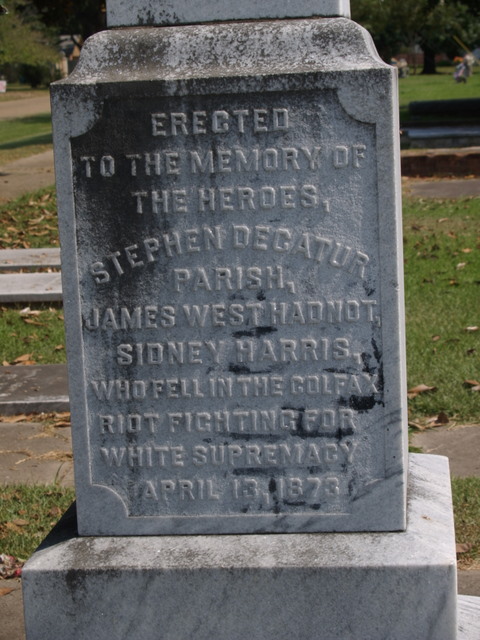
The most soul-destroying example of this form of spiritual oppression can be found in Colfax, Louisiana. 


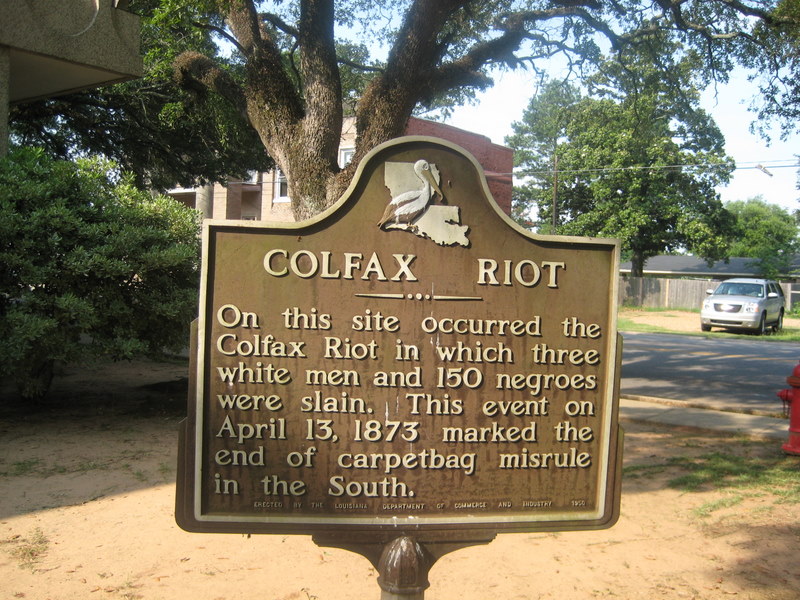
In the cemetery across the street from a Baptist church you will find this obelisk celebrating the sacrifice of three brave souls who gave their lives fighting for “white supremacy” in 1873.  The marker was unveiled at a well-attended ceremony in 1921.  

Down the street at the courthouse stands a sign celebrating the “Colfax race riot” that broke the back of “Carpetbag misrule.”

Since I first stumbled upon these historical artifacts I have read two recent and carefully researched books on the Colfax Massacre.  The real facts do not reflect well on the tiny community. 

During the Reconstruction period, Grant Parish was carved out of central Louisiana as a protected space for Republicans (most of them black).  After a disputed election, 300 Democrats marched on a Colfax courthouse defended by 150 poorly armed black residents.  The brave champions of white supremacy set fire to the courthouse, then mowed down the Republican defenders as they fled.  Several dozen people taken captive during the “battle” were summarily executed later that night.

When a heroic US Attorney named J.R. Beckwith tried to bring a representative handfful of the murderers to justice, his efforts were blocked by a Supreme Court weary of Reconstruction.  In that sense, the marker in front of the Colfax courthouse is on target: the Colfax massacre did sound the death knell of Reconstruction politics in the South.  Hence the name of Charles Lanes’ book, “The Day Freedom Died“.

How are the people who worship across the street from a marker valorizing racial hatred affected?  How can black residents of Grant Parish expect to obtain justice from a courthouse that celebrates the mass murder of African Americans?

How can communities like Jasper, Tulia, Jena, Little Rock and Paris come to terms with the horrors of history?  In the natural flow of events it rarely happens. 

The only fitting response to the death of Brandon McClelland would be a formal, organized, community-wide process of remembering, confession and restoration.  Only then will the tragic stories stop flowing from the press.  Demons must be exorcised.

Help Friends of Justice win $5,000

JusticeMakers
JusticeMakers

Dear Friends,

Would you take five minutes, and help Friends of Justice win $5,000 to fund our work?  Friends of Justice has been nominated for the JusticeMakers Competition, which recognizes people doing innovative work for due process and human rights in the criminal justice system.  This competition includes a “People’s Choice Award”, where members of the general public can rank the different nominees and determine who gets a $5,000 prize.

Would you sign in to the JusticeMakers website, and rank our proposal?  While you’re at it, take a look at the other amazing projects out there!  It’s sure exciting to see all the amazing work that folks are doing around the world to defend equal justice for all!  I hope you’ll be inspired.

Friends of Justice is counting on you–our supporters–to put us over the top and help us win $5,000!   For a small organization like us, that prize would make a big difference–it means that when some desperate parent calls us because their child is being wrongly prosecuted, we will have the resources to investigate their case and see what can be done.  Sign in today at http://www.justicemakers.net.

Thanks for your support,

Lydia Bean

More information below…

(more…)

James Dobson’s letter from the future

James Dobson, Religious Right personality and founder of Focus on the Family, is circulating a letter from the future.  Dobson’s vision of America under the limp-wristed leadership of President Barack Obama is as dark and twisted as the “Chick tracts” that label non-fundamentalists as the spawn of Satan (especially liberals and Catholics).  It’s like an Onion parody.

Dobson’s Letter meanders on for a dozen pages but the central premise is painfully simple: the ultra-liberal (ACLU-affiliated) judges President Obama will appoint to the Supreme Court are going to run amok.  Not only will they legalize gay marriage, they will sanction any church, school or Boy Scout troop that refuses to celebrate gayness.  Books critical of “the gay agenda” will be pulled from the shelves of Barnes and Nobles.  Home schoolers will be punished for teaching their children that homosexuality is wrong or that Jesus Christ is the way, the truth and the life.  Sex education classes will rejoice in the gay life style and teachers and parents who refuse to go along . . . well, you get the idea.

The letter is aimed at the naive evangelical Christians who, polls suggest, are flocking to the Democratic candidate in surprising numbers.  These deluded souls thought they were voting for change; instead they unleashed a liberal apocalypse.

Dobson et al make a pretense of dissociating Obama from this scourge of the liberal fundamentalists.  The poor man never dreamed that placing a few ACLU types on the court would transform America into Sodom and Gomorrah in a mere four years.  Obama wrings his hands in disbelief as the Frankenstein monster he has unleashed rampages through the heartland.

Dobson’s Obama, following the lead of Bill Clinton, fires all the US Attorneys in America, replacing them with card carrying members of the ACLU eager to punish former Bush officials.

If you want to tell Dr. Dobson what you think of his letter (please read it first) you can go to the Matthew 25 website.  But I have come not to scorn Focus on the Family but to lament the demise the implosion of an organization that once did good work.

When Nancy and I were starting out in pastoral ministry, Dobson’s organization produced a series of parenting manuals and practical videos aimed at the evangelical mainstream.  The basic themes were tough love, the need for clear parent-child boundaries, consistent consequences, and the idea that parenting is a high calling.  If children are allowed to rule the home, Dobson taught, they will become unhappy tyrants who grow into undisciplined and unloving adults.  Think of a biblically based “Super Nanny” and you’ll have the right idea.

Then Dobson ran off the rails.  Every year his comb-over became more extreme and his religion more political.  Before long, Dobson was Rush Limbaugh with a Bible.  His gay-hating, gun-toting, free enterprise-loving, militaristic Jesus became harder and harder to square with the Jesus of the Gospels.

And now we have this fear-mongering letter.  Dr. Dobson clearly has no idea how progressive Americans think and feel.  Tragically, an equal and opposite ignorance can often be found on the extreme left.  Dobson’s exercise in self-parody simply widens the gap.

I Am Troy Davis!

In my last post I told you that, barring a miracle, Troy Davis would die on Monday evening.  Folks, we got our miracle!

“Upon our thorough review of the record,” the 11th Circuit Court of appeals (federal) announced today, “we conclude that Davis has met the burden for a provisional stay of execution.”

This outcome was NOT expected.  The international outcry surrounding this case is having an effect.  We have to sympathize with the families of Troy Davis and Officer Mark MacPhail, the man Davis is accused of killing in 1989.  This emotional roller coaster ride has been excruciating for everyone associated with the Davis case.

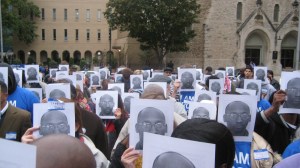
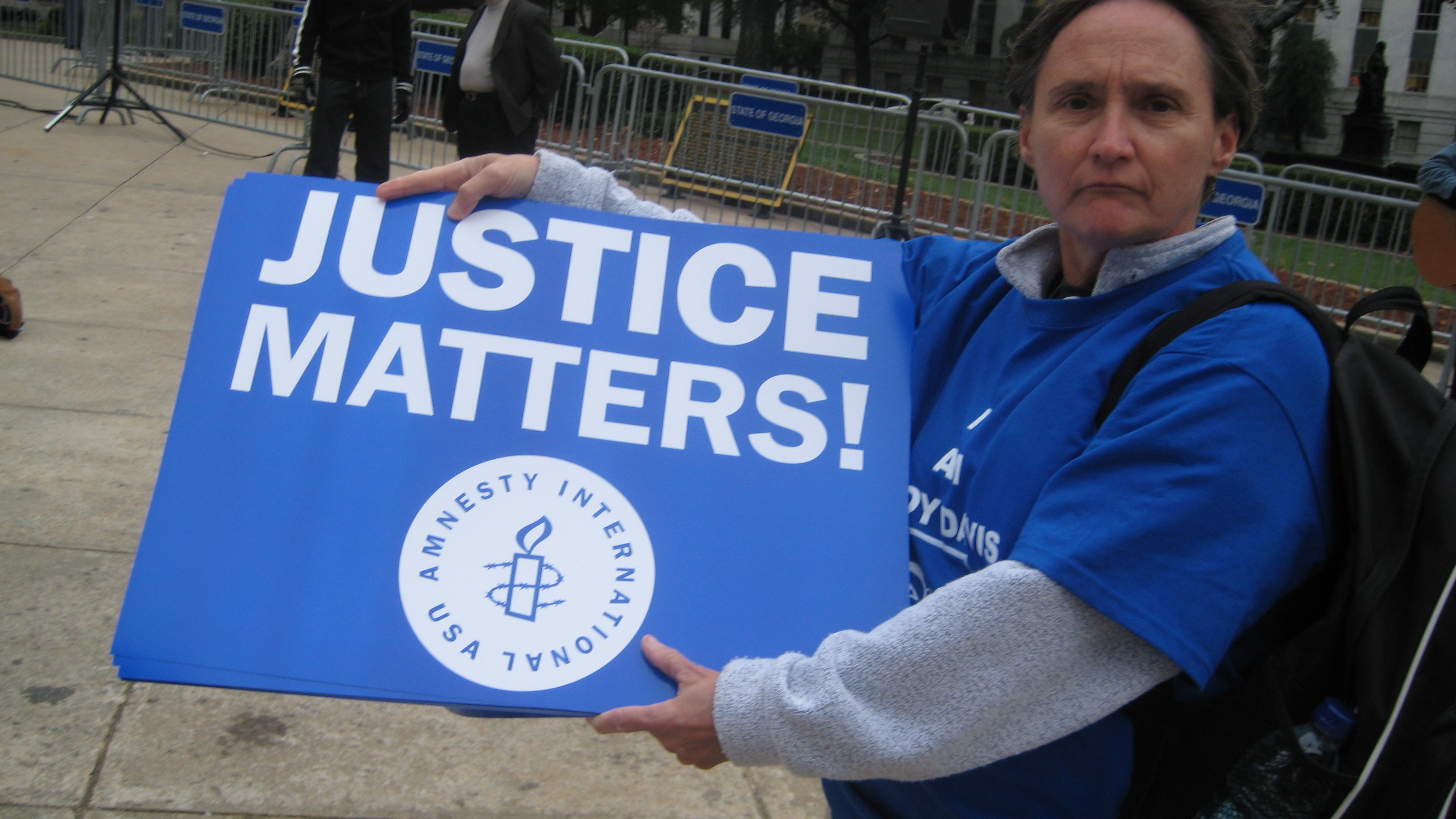
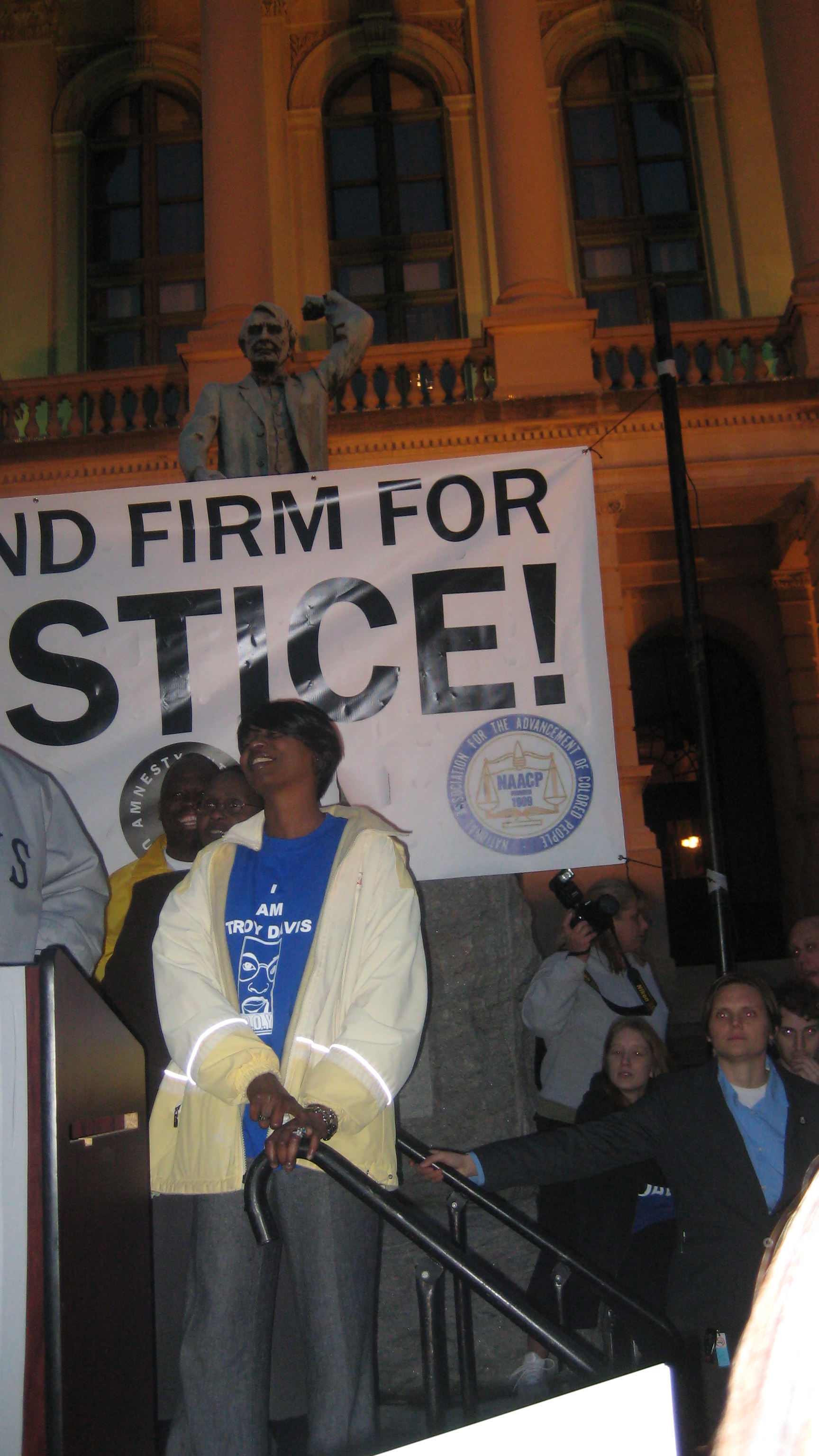
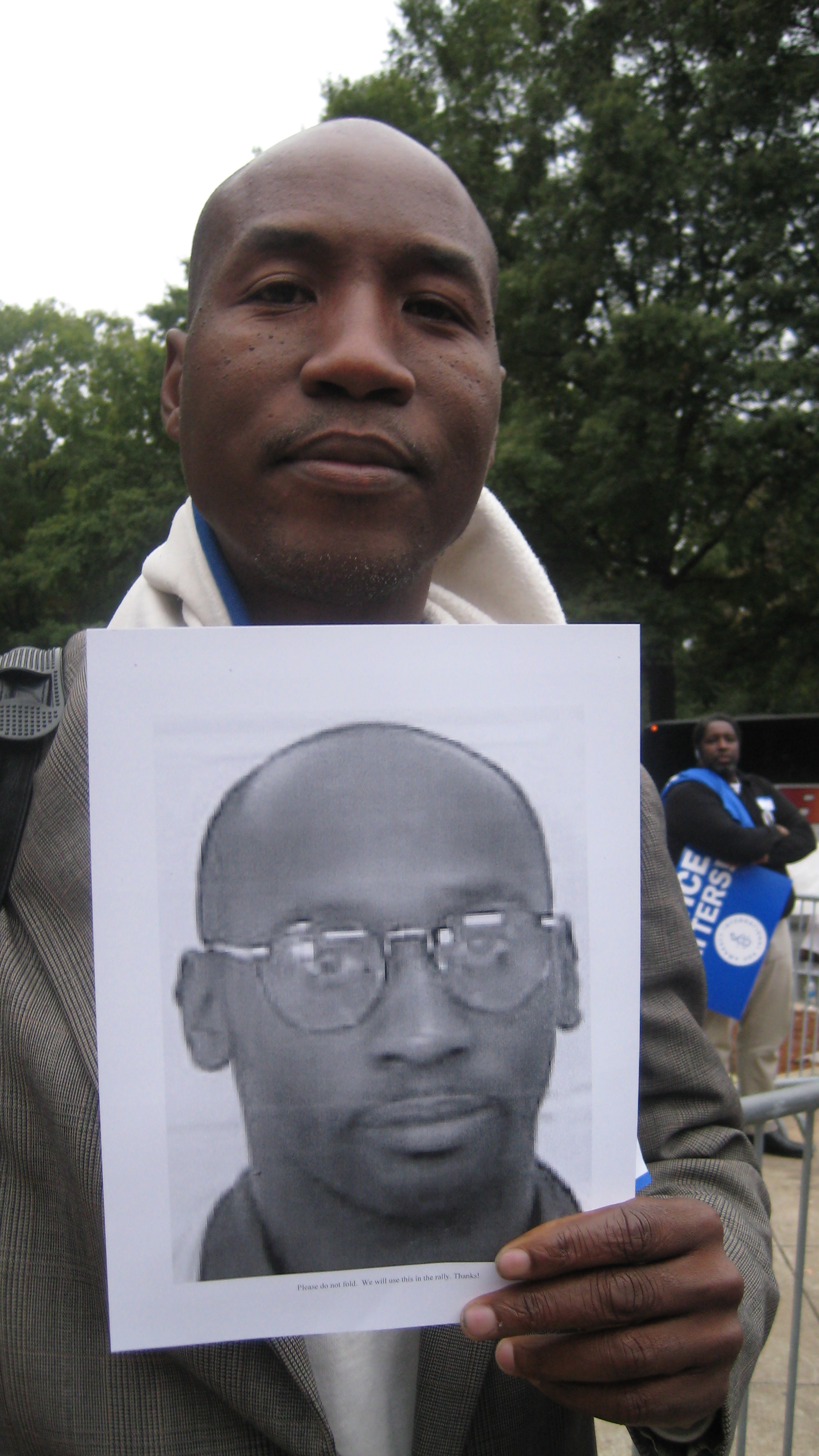
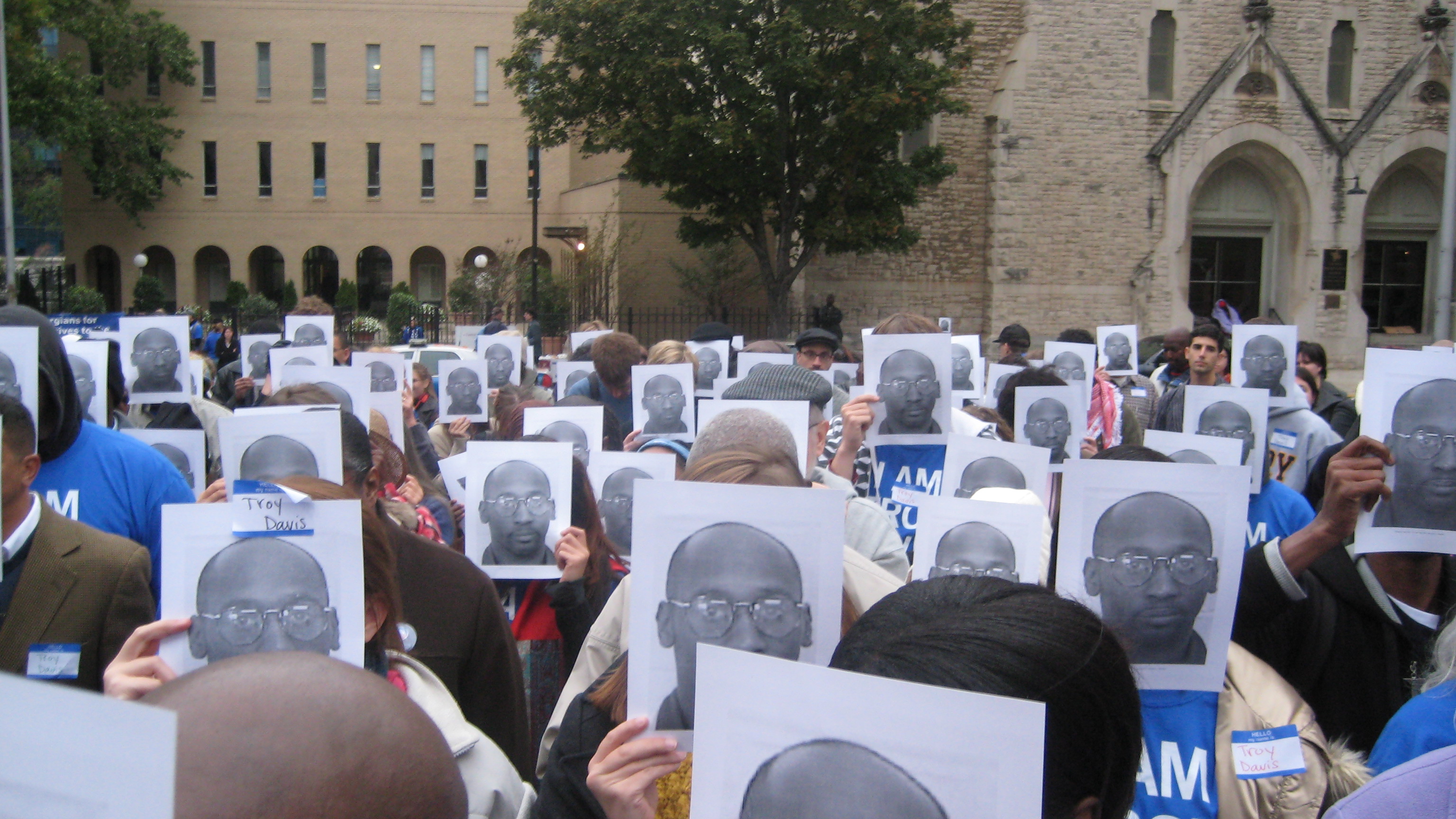
“I am Troy Davis!” 600 supporters chanted from the steps of the Georgia State Capitol Thursday evening.  “Justice matters!” we roared again and again; “Innocence matters!”

There were just a few men setting up the stage when I arrived at the Capitol an hour before the rally was scheduled to begin.  Gradually, the sidewalk began to fill with the most diverse crowd I have seen at a justice rally.  Black and white, old and young, sophisticates and just plain folks, college students and preachers–all were united by a strange mix of love and outrage.

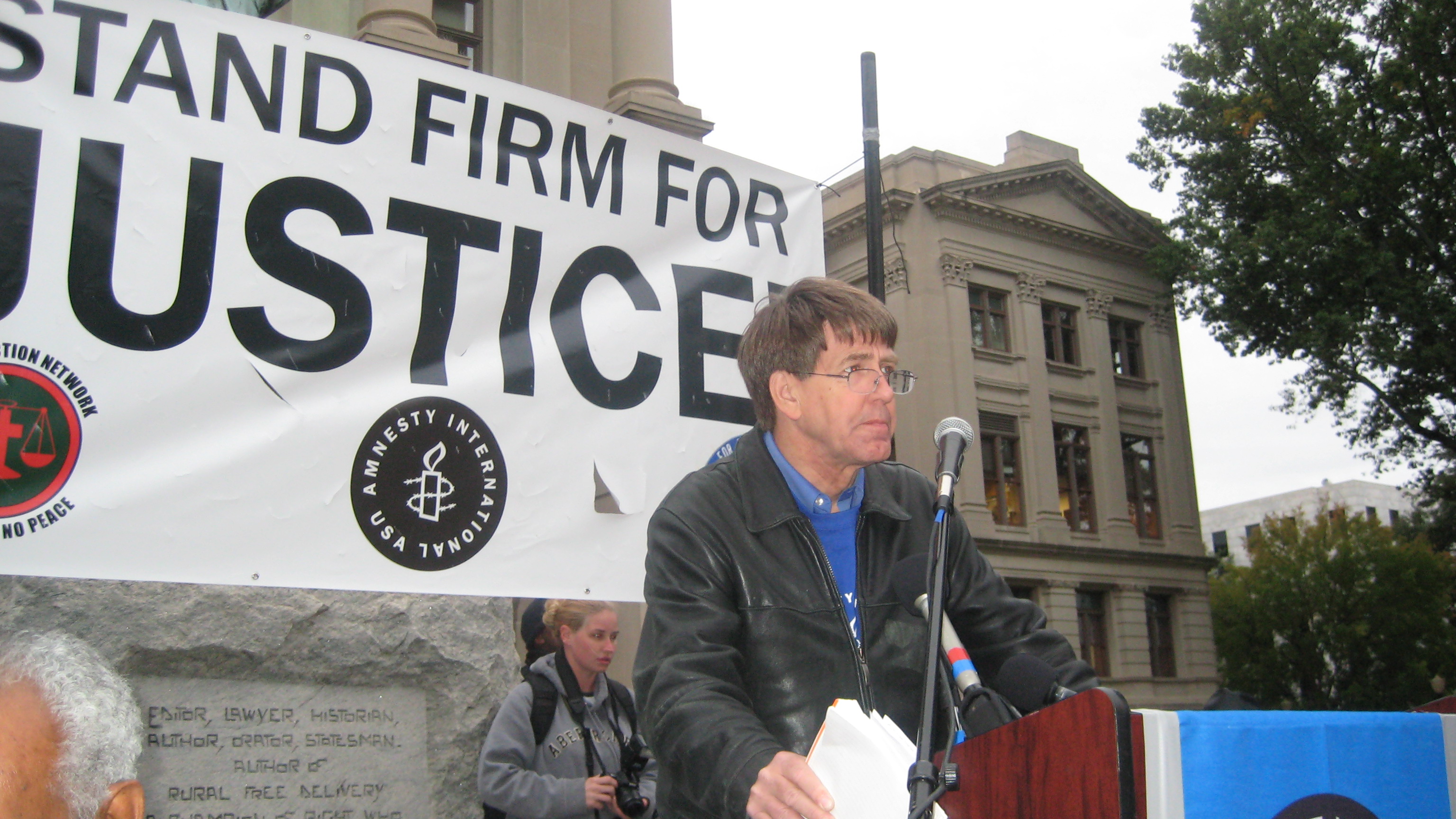
As the crowd assembled I moved from person to person, introducing myself.  Amnesty International president Larry Cox impressed me immediately.  When I asked if he had a law practice before assuming his current duties Larry shook his head.  “I’m not a lawer,” he said, “I’ve been an activist all my life.”


Unlike most of the speakers, Cox read from a prepared transcript, but with such intense urgency that his passion was palpable.  Cox is adamantly opposed to the death penalty, a commitment shared by virtually all of the two dozen people who graced the makeshift stage last night.  One African American pastor confided to us that, until joining the fight for Troy Davis, he was a death penalty proponent.  No more.

But Mr. Cox has grown to love Troy Davis and his family.  This isn’t just about the death penalty anymore.  It’s personal.

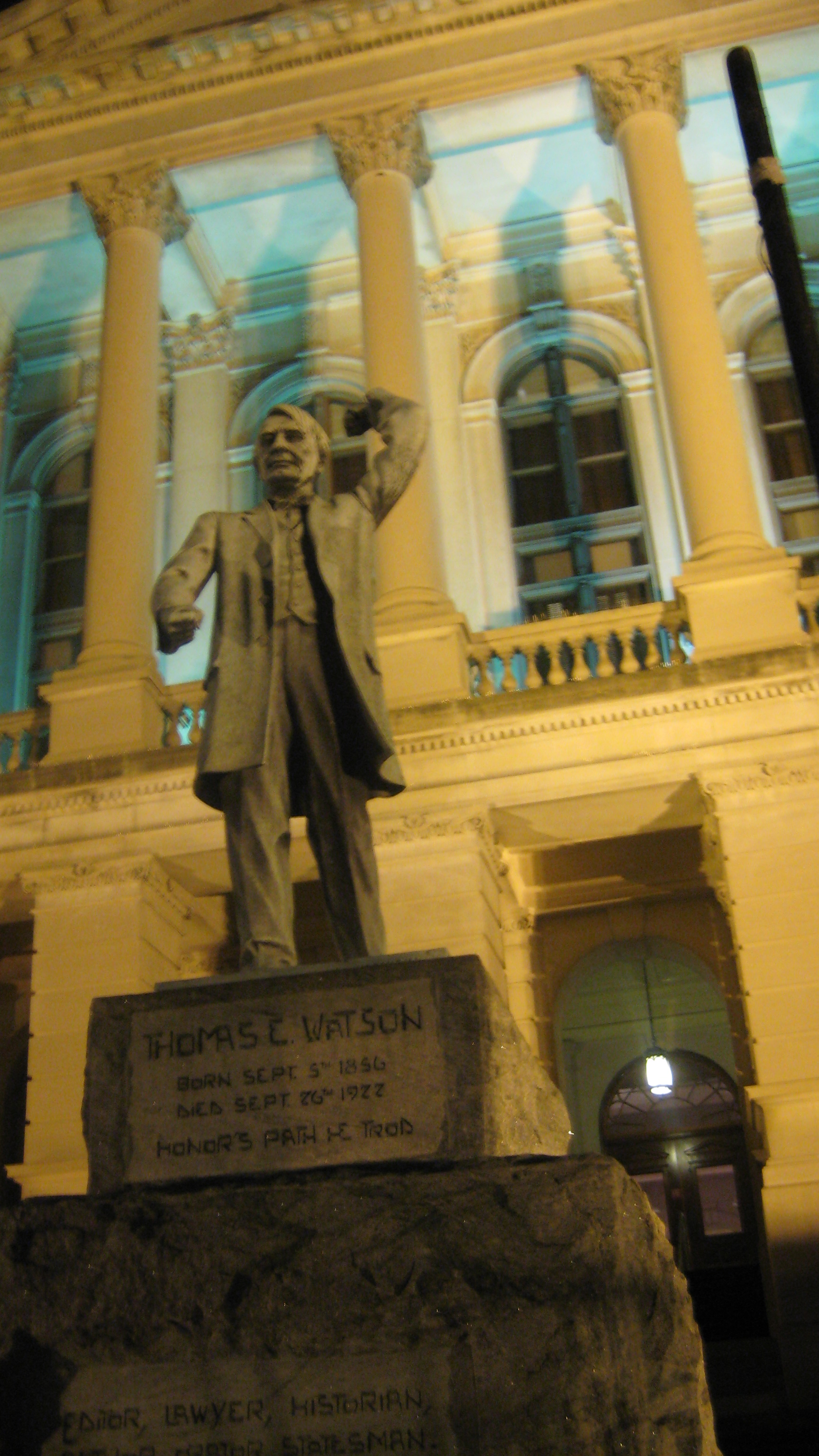
An imposing statue of Thomas E. Watson (d. 1922) dominates the main entrance to the Georgia Capitol Building.  As the speakers took their turns at the microphone last night, old Mr. Watson glared down on us, his fists raised in angry protest.  I suspect the statue was made from a photograph of the firey Watson on the stump, but last night, his face bathed in the spot lights that surround the Capitol, he looked like a man possessed.

“Who’s this Watson guy,” I asked the wife of an Episcopal clergyman. 

“I’m not sure,” she replied, “but I hear he laid the groundwork for segregation in the state of Georgia.

She’s right.  According to the New Georgia Encyclopedia, Thomas E. Watson was a complex character who began his political career during the Reconstruction years.  The Georgia politician was a populist who defended the small farmer against the industrialists of his day.  Initially, he worked hard for the black vote, opposing lynch law and the practice of re-establishing slavery by leasing black prisoners out to the highest bidder.

But Watson soon changed course.  As the Jim Crow regime took hold in Georgia, his stump speeches became studded with anti-black, anti-Catholic and anti-Jewish rhetoric of the most ghastly sort.  Another good man had fallen under the demonic shadow of white supremacy. 

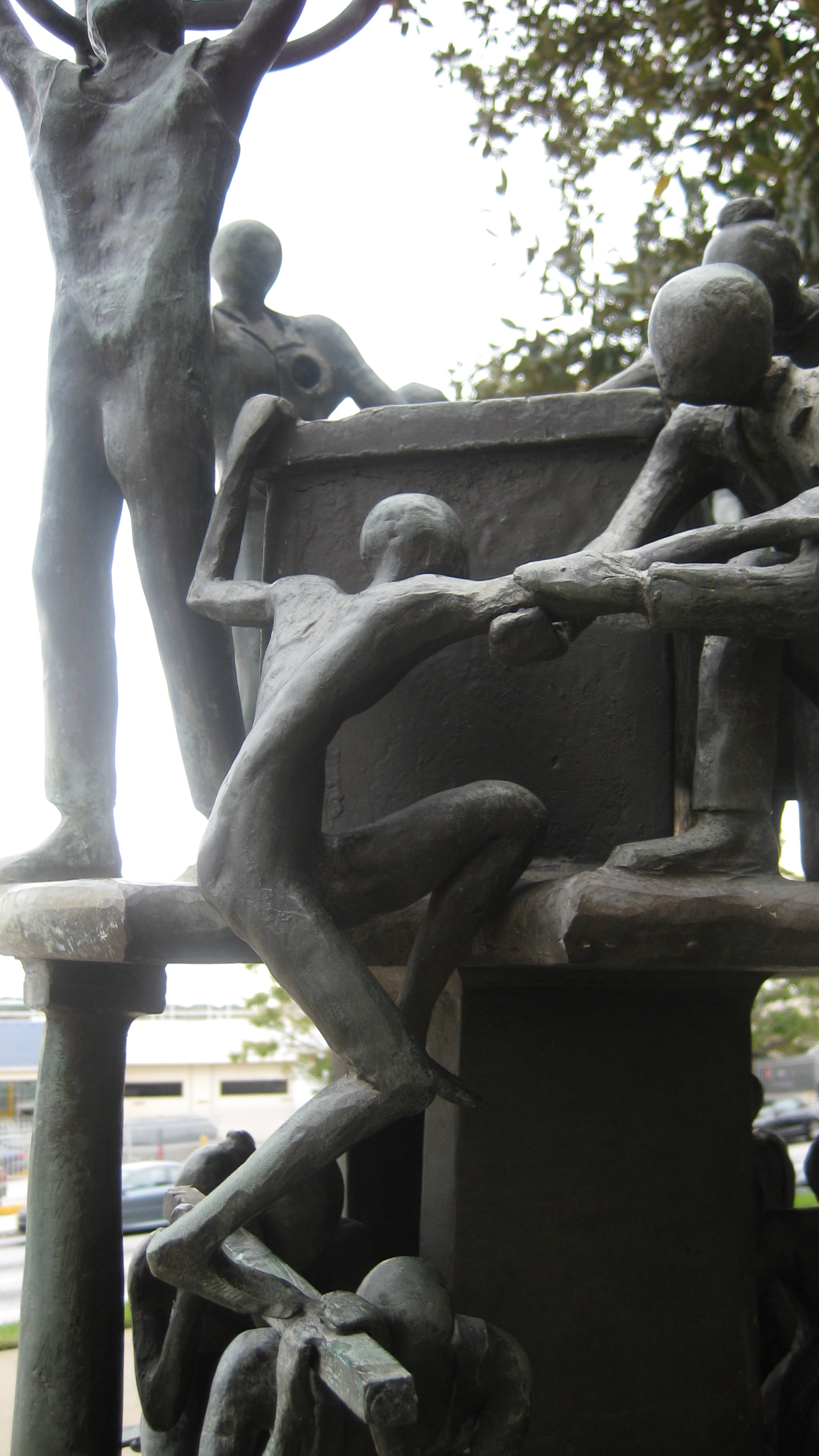
Instead of taking down Watson’s statue, the modern state of Georgia decided to erect a tiny display celebrating black suffrage.

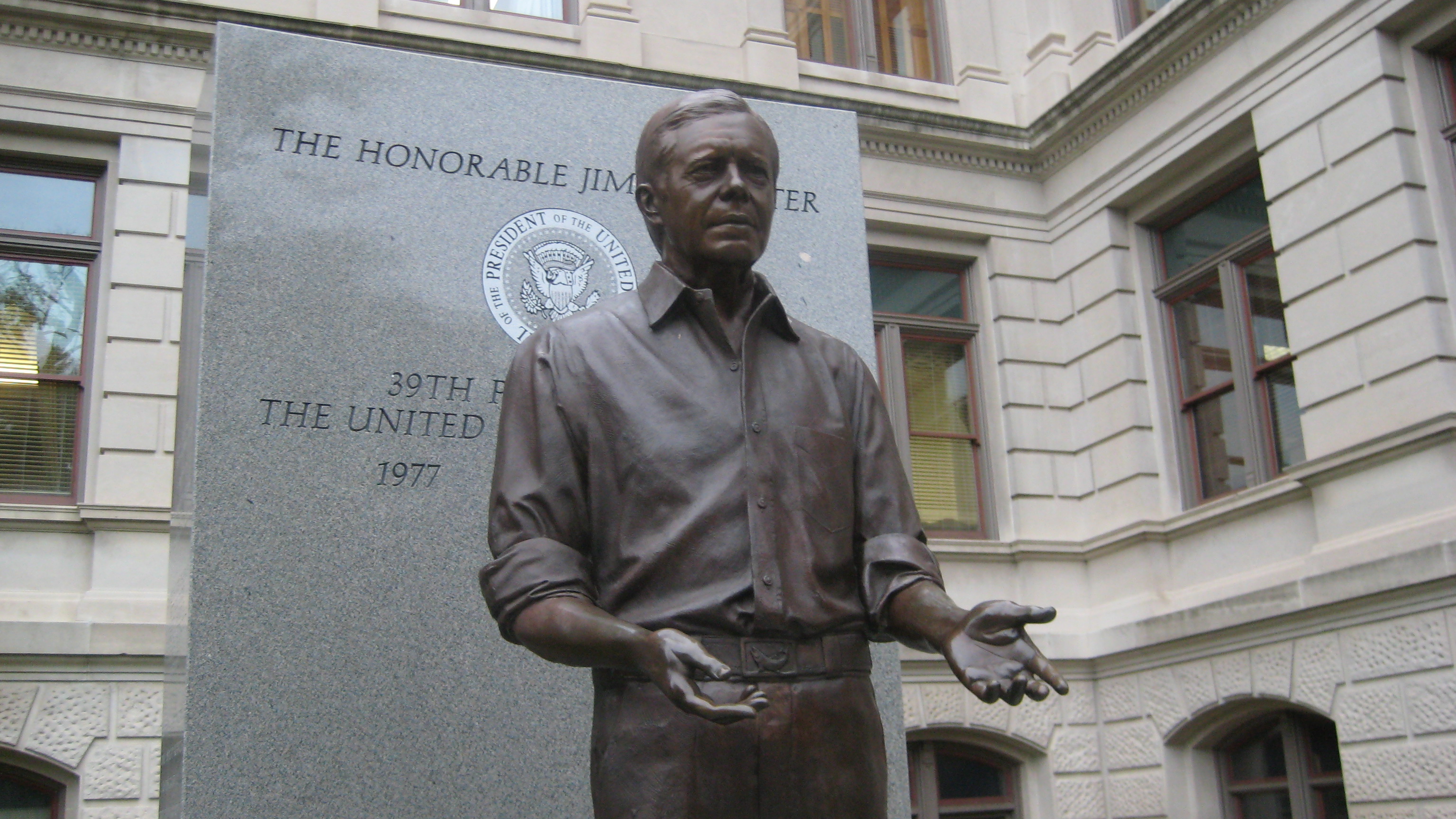
 There is also a statue of a young Jimmy Carter tucked away in a corner of the Capitol Building.  Carter’s monument is smaller and less prominent than Watson’s; I almost had the feeling that the current political regime is ashamed of the state’s most famous citizen.

 Jimmy Carter is commonly defamed as a weak and ineffectual president, but I suspect history will remember the Georgian more kindly than did his contemporaries.  Andrew Bacevich argues persuasively that Carter’s much-maligned “malaise speech”, delivered at the height of the first energy crunch, was a warning America ignored at its peril.  Carter told us we were addicted to fossil fuels and that we were spending beyond our means.  We didn’t want to hear it, so we elected Ronald “Morning in America” Reagan. 

Last night I had the odd sense that the state of Georgia is locked in a death match between the spirit of Jimmy Carter and the tragic legacy of Thomas Watson.  Carter’s Georgia wants to give Troy Davis a full hearing; Watson’s Georgia wishes Davis had been hung a few days after his conviction.

As Larry Cox emphasized last night, we can only claim that the State of Georgia may be executing an innocent man.  Until Davis receives a full hearing we can’t weigh the facts effectively.  That’s why a hearing is manditory.

But one thing is obvious to anyone who has read through the affidavits of the recanting witnesses in this case: law enforcement shaped testimony through threats and promises.  Police officers, outraged by the savage and merciless slaying of one of their own, rushed to judgment then shaped the “evidence” to support a hastily-reached conclusion.

Those who know Troy Davis best are convinced of his innocence.  He doesn’t fit the psychological profile of a man trying to save his skin.

Troy’s sister, Martina Correia, has no doubts about her brother’s innocence.  Tears streaming down her face, Ms. Correia told us of her long struggle withcancer.  “Every month the doctors have to pump poison into my veins to keep my alive,” she told us.  “I’ve been on chemotherapy for years, just trying to stay alive long enough to see Troy walk free.  And I just can’t understand why the State of Georgia wants to pump poison into the veins of my brother to take his life when they know their case against him has fallen apart.”

Did last night’s rally have any influence on today’s miraculous ruling from the 11th Circuit? 

All we know for certain is that Troy’s attorneys have fifteen days to file the necessary paperwork with the court.  The court then has ten days to respond. 

The great news is that the final decision will be made after a presidential election that is currently diverting attention from virtually everything else.   Sarah Palin’s hair stylist is getting more attention these days than the economy.  Soon we will be in a news cycle much more attentive to the Troy Davis story.  That shouldn’t matter, but it does.

Last night in Atlanta, the horror of an imminent outrage mixed with a strange kind of elation.  Several speakers talked about their sense that a movement was gathering momentum.  It’s not just about Troy Davis, and it’s not even restricted to the death penalty.  Ultimately, this new movement is about our broken criminal justice system and the urgent need for sweeping reform. 

Thomas Watson is now with the angels.  His statue may have been brimming with hate last night, but whatever survives of the complicated Georgia politician looks down on the world through the compassionate eyes of Almighty God. 

We don’t just need a new and better criminal justice system in America; we need a bigger God.  How the justice, mercy and humility of Jesus ever got twisted into the vengeful religion that dominates so much of America today I don’t know.  My hunch is that it started withthe extreme psychological tension of trying to reconcile slavery and Jim Crow segregation witha white-hot religious piety.  Religion adapted to hate.  Evangelical Christians need to come to terms with this legacy.  It’s not enough for Southern Baptists to apologize for slavey (although that marked a wonderful beginning); we need to understand that our entire religious outlook has been shaped by history.

Last night felt like the early stages of a religious revival.  As the evening grew late, one of the leaders looked out on the crowd and issued a dangerous invitation.  “We need to end this night with prayer,” he said.  “And God is telling me that there is a preacher with us this evening who has a word from God.”

Two people, a man and a woman, rushed to the stage without a second’s hesitation.  The woman looked out on the crowd, her face wrapped in rapture.  “In my church we believe in letting the Holy Spirit speak through us,” she said.  “And tonight the Spirit wants me to speak as he has given me utterance.”

With that she broke into “the tongues of men and of angels”, the language of ecstasy common among Pentecostals and “charismatic” Christians.  I’m not sure what the Episcipalians and Presbyterian preachers made of that, but I was touched.  I was reminded of my tongue-speaking parents and the Holy Ghost meetings they used to take me to back in the day.

If you are the praying kind, please continue to pray for Troy Davis and for the nation that isn’t sure what to do with him.

Rudy calls Obama soft on crime

I have frequently mentioned the lack of attention to the criminal justice system in this year’s presidential race.  It seems I spoke too soon. According to Politico blogger Jonathan Martin, Rudy Giuliani has recorded robocalls on behalf of John McCain featuring Obama’s opposition to manditory sentences and suggesting that the Democrat has been palling around with (shudder) “liberal judges”.

Rudy takes to phones to hit Obama on crime

Rudy Giuliani is portraying Barack Obama as soft on crime in robocalls being blasted out to swing states by the RNC and the McCain campaign.

The call comes on the heels of a mailer being sent out by the Florida GOP focused on crime, an indication that even while on the stump, John McCain focuses on contrasting himself with Obama on taxes and spending, his campaign and his party are using other wedge issues in a more targeted fashion as Election Day nears.

The focus is on the Democrat’s opposition to mandatory minimums, and the bill of particulars is tough.

“You need to know that Barack Obama opposes mandatory prison sentences for sex offenders, drug dealers and murderers,” Giuliani says. “It’s true. I read Barack Obama’s words myself.”

To legally ensure that the RNC can share the cost, the former New York mayor adds: “And recently congressional liberals introduced a bill to eliminate mandatory prison sentence for violent criminals, trying to give liberal judges the power to decide whether criminals are sent to jail or set free.”

One voter in Maine got the call this morning, a sign McCain is still pursuing the lone electoral vote in the state’s 2nd Congressional District.

Flying to Atlanta

Barring a miracle, Troy Davis will die by lethal injection on Monday night. With the election so close you can taste it, nobody wants to talk about an execution.   A rally is scheduled for 6:00 pm on October 23rd on the steps of the Georgia State Capitol and I plan to be there.  

The state-sanctioned death of Troy Davis will receive a few passing mentions in the major newspapers and thirty seconds on CNN.  Davis has some high-profile supporters (Jimmy Carter, Desmond Tutu, the Pope, Amnesty International) and that’s enough to warrant a few equal-and-opposite quotes from supporters and state officials. 

Then our eyes will drift back to the horse race between Barack Obama and John McCain and the plight of Troy Davis affair will be forgotten.

Don’t expect the presidential candidates to defend an innocent man.  John McCain has enough problems with the Republican base without taking up for a convicted cop killer.  This late in the game, the disciplined Obama campaign isn’t going to hand McCain a Willie Horton moment.

So I decided to invest money I don’t have in a protest no one will notice.  I’m flying to Atlanta because I can.  Many of you would stand up for Troy in Atlanta if you could, but you can’t.  If you want me to stand proxy for you let me know (all contributions gratefully received).

Politicians and quarterbacks think the same.  Up by ten late in the game, Team Obama is running the ball straight into the line while Team McCain runs trick plays and guns for the end zone.  The caution of the Democrat and the increasing desperation of his Republican challenger tell us things about America we’d rather not know.

Although Barack Obama styles himself as an agent of change, his campaign, from the outset, has been a model of disciplined caution.  Having studied the losing strategies of Democratic presidential campaigns over the last few decades, Obama understands that what you say isn’t nearly as important as what you don’t say. 

Any impression that you are weak on national defense and terrorism, soft on crime, insufficiently patriotic or too attentive to the needs of the poor and the underprivileged spells death for Democrats.  Which explains why a progressive politician from Chicago presents himself as pro death penalty, supportive of the war in Afghanistan, opposed to gay marriage and a champion of the middle class who rarely mentions poor folks and avoids all contact with Muslim Americans.

The Democrat has come to terms with the unpleasant realities of Middle America.  He tells us who we are.  Colin Powell can stand up for Muslim Americans (and thank God he did), but Powell isn’t running for president.

John McCain hates gutter politics, but the realities of American life give leave him with no alternative.  If he thought the high road would carry him to victory he would take it.  But his handlers gave him a choice: whine about Bill Ayres and socialism or wave the white flag.  And if the candidate is too principled to sing the praises of pro America real Americans, then you bring in the surrogates to do it. 

Watching this hate parade from the curb, we learn a few more unpleasant truths about America.  We are desperately afraid of terrorists, criminals and folks who don’t look, speak and pray like we do.  We aren’t all that way, but Republican strategists are hoping that more than 50% of us are. 

John McCain knows the low road probably won’t take him to the White House.  After sacrificing the last vestige of personal dignity he will be remembered as the guy who lost to Barack Obama in ’08. 

But maybe, just maybe, he can still turn this thing around.  That’s what keeps him going.

Obama’s caution tells us that America remains a fearful center-right empire heavily invested in military might and mass incarceration.  This year’s Democratic hopeful can’t rush back to Arkansas to preside over the execution of a mentally retarded man.  The last successful Democratic presidential candidate took no pleasure in this crude guesture, but the times demanded it.  Once elected, Clinton punted on health care reform and turned his attention to a massive omnibus crime bill he knew would enjoy bipartisan support.  Politics ain’t beanbag.

Barack Obama knows he can’t intercede for Troy Davis–politics is the art of the possible.

Fortunately, most of us aren’t preachers, politicians or bank presidents and are therefore free to follow the dictates of conscience.  My conscience tells me to get up at 4:30 tomorrow morning so I can be at DFW by 6:00.  To be honest, it feels like a futile gesture.  One more anonymous face at a Troy Davis rally isn’t going to change anything.  

But maybe, just maybe, we can still turn this thing around.  That’s what keeps me going.