Ted Cruz like you’ve never seen him before

I bet you didn’t know Ted Cruz was a criminal justice reformer, but it’s true.  It rarely benefits his partisan agenda to beat the reform drum, but in this essay written for the Brennan Center for Justice, he lays out some excellent policy suggestions.

How do we account for such enlightened prose from a man who is normally dismissed as a narrow-minded bigot? 

First, Cruz is smart.  They don’t let dummies on the Princeton debate team.  Secondly, the junior senator from Texas understands that the deep flaws in our criminal justice system could be turned on conservative Christians if anyone had a mind to do so.  I doubt this is likely, but when you live on the losing side of the culture war a measure of paranoia comes with the territory.

Here’s Ted’s critique of the demise of the jury trial.  I encourage you to read the entire essay.

The third problem, which is exacerbated by the first two, is the demise of jury trials. Plea bargaining has become the norm in our criminal justice system, while the constitutional right to a jury trial — which the Founders understood to be a bulwark against tyranny — is now rarely exercised. Contrary to popular perceptions, we no longer have a system where a jury determines a defendant’s guilt or innocence in a public trial. In 2013, 97 percent of all federal criminal charges that were not dismissed were resolved through plea bargains; less than 3 percent went to trial.

In this plea-bargaining system, prosecutors have extraordinary power, nudging both judges and juries out of the truth-seeking process. The prosecutor is now the proverbial judge, jury, and executioner in the mine-run of cases. Often armed with an extensive menu of crimes, each with their own sentencing ranges, federal prosecutors can wield their discretionary charging power to great effect by threatening the most serious charges that theoretically (if not realistically) can be proved. If the accused succumbs to the threat and pleads guilty, which often happens, the prosecutor agrees to bring lesser or entirely different charges that carry a lower sentencing range.

Given the risks involved in turning down a plea offer, it is not unheard of for people to plead guilty to crimes they never committed. Of the 1,428 legally acknowledged exonerations recorded by the National Registry of Exonerations since 1989, 151 (or roughly 10 percent) involved false guilty pleas. It is estimated that between 2 and 8 percent of convicted felons who have pleaded guilty are actually innocent. In a federal prison population of 218,000 — the number at the end of fiscal year 2011 — where 97 percent pleaded guilty, that means that anywhere from 4,229 to 16,916 people could be imprisoned for crimes they did not commit.

The plea-bargaining system is premised on the assumption that there is relatively equal bargaining power between the accused and the state. Nothing, of course, could be further from the truth. Mitigating the coercive effect of the plea-bargaining process will require empowering the defense. And one way to do that is to reduce the informational asymmetry between prosecutors and defense counsel. Plea offers are often foisted upon the accused before the defense has had enough time to investigate the facts, and the longer the investigation takes, the less generous the plea off may become. Congress should pass legislation that requires the government — whether constitutionally required or not — to disclose material exculpatory evidence before the accused enters into any plea agreement. This reform will reduce the risk of false guilty pleas by helping ensure that the accused is better informed before sealing his or her fate.

Not all criminal justice reforms benefit criminal defendants. I, for instance, strongly supported Sen. Kirsten Gillibrand’s (D-N.Y.) Military Justice Improvement Act, which would have transferred charging authority for many non-military-related crimes, including sexual assault, from unit commanders to independent military prosecutors — a change that may well make it more likely for charges to be brought against defendants. Such a reform will better serve the interests of justice. Likewise, the reforms discussed in this essay would serve the interests of justice by giving much-needed protection to individuals — many of whom are poor or minorities — who find themselves in the crosshairs of federal prosecutors

Public Schools are NOT a Godless environment: Charles Johnson tackles the critics of public education

Anyone shocked by the assault on public education this legislative session was delivered clear rationale for the attack by those closest to the one leading it, Lt. Gov. Dan Patrick.

On April 21, Patrick’s hand-picked advisory board condemned Gov. Greg Abbott’s emergency prekindergarten agenda item by labeling our public schools “a Godless environment.”

Pastors for Texas Children are compelled to strenuously confront this lie.

As ministers and faith leaders mobilizing in support of our neighborhood and community schools, we have been silent too long while those purporting to speak for God demean, belittle and slander Texas teachers as “Godless.” This could not be further from the truth.

Many public school educators are faith leaders themselves. They serve as pastors, ministers, elders, deacons, Sunday school teachers, youth leaders, committee chairpersons, mission and music directors, accompanists and in many other positions in their churches.

It is axiomatic among pastors that we often turn to public school teachers to provide religious instruction — to rely, for example, on teachers who work long hours for low pay all week to teach our Sunday school classes.

Further, it is common for the pastor’s spouse to teach in the local public school. Our sons and daughters also are employed in public schools as coaches, bus drivers, cafeteria workers and custodians.

My daughter-in-law, who is a public school educator, did not get the memo that God has been taken out of our schools. She takes the love she showers on our grandchildren into the classroom and pours it out on students all day long.

We see our local classrooms as a center of God’s love. Education is a gift from Almighty God accorded to every human being regardless of race, religion, economic status and special need. The public school, unlike the private school, receives and accepts every child and meets that child’s needs as sensitively and lovingly as possible.

Our loved ones and fellow church members carry the love and grace of God with them every hour of every day. Indeed, those who labor in our schools show love, unconditional acceptance and physical assistance to children who have special needs, come from emotionally deprived circumstances and suffer the ill effects of crushing poverty.

It’s what a teacher does. It’s a calling before God.

So, we are more than a little outraged to learn that those personally chosen to counsel Lt. Gov. Patrick on matters of public policy have determined that our public schools are Godless.

We have witnessed firsthand the attack on public education this session and heard it called a “monstrosity” by one member of the Senate Education Committee. We have heard loose talk, calling our schools “failed” and our teachers “incompetent.” When we testified our shock at this language, we were rebuked by two members of the committee.

When numerous rural Republican senators confessed to us their personal opposition to a tuition tax credit voucher bill, acknowledging it contrary to the will of their constituents, we were told they felt forced to vote for a policy that is harmful to their districts.

Then, when the Senate Education Committee began churning out bills designed specifically to demoralize teachers — opportunity school districts, A-F ratings, parent trigger — we came to the unpleasant conclusion that something more insidious was unfolding before our eyes — the intentional dismantling of a constitutionally mandated public trust: universal education.

The accusation from the lieutenant governor’s selected advisers that our schools constitute a “Godless environment” isn’t just the harmless political theater that hardened legislative observers often consider politics as usual.

Rather, it a lie designed to demonize a system in which educators do the Lord’s work most faithfully. Is this being done to allow public schools to be replaced, privatized and turned into a profit-making enterprise? In the buckle of the Bible Belt, would the accusers seek to turn our classrooms into markets and our kids into commodities by calling our local schools Godless?

We ask Lt. Gov. Patrick to publicly repudiate this absurd statement from his chosen advisers and issue an apology to all faithful women and men who serve God’s common good by nurturing and shaping the “least of these” among us — our precious children — as public school educators.

Johnson is pastor of Bread Fellowship in Fort Worth and the executive director of Pastors for Texas Children.

David Simon on Baltimore, the War on Drugs and the Freddie Gray saga

david-simon-on-the-death-of-freddie-gray-and-the-baltimore-riots-429-1430324586-crop_lede

If you want to understand what’s going on in Baltimore, David Simon is your man.  Simon worked on the crime beat in Baltimore in the 1980s and the relationship between the city’s cops and corner boys served as a muse throughout the 90s, culminating in The Wire (2002-2008), what many call the best TV series ever produced in America.

The Wire was all about the drug war, and the drug war, Simon says, provides the interpretive backdrop for the Freddie Gray story.

Simon recently sat down with his colleagues at The Marshall Project and laid out his perspective in great detail.  You can find the article here and, since it is a comprehensive piece, I have shared a few excerpts below.

David Simon on Baltimore’s Anguish

Freddie Gray, the drug war, and the decline of “real policing.”

BK: What do people outside the city need to understand about what’s going on there — the death of Freddie Gray and the response to it?

DS: I guess there’s an awful lot to understand and I’m not sure I understand all of it. The part that seems systemic and connected is that the drug war — which Baltimore waged as aggressively as any American city — was transforming in terms of police/community relations, in terms of trust, particularly between the black community and the police department. Probable cause was destroyed by the drug war. It happened in stages, but even in the time that I was a police reporter, which would have been the early 80s to the early 90s, the need for police officers to address the basic rights of the people they were policing in Baltimore was minimized. It was done almost as a plan by the local government, by police commissioners and mayors, and it not only made everybody in these poor communities vulnerable to the most arbitrary behavior on the part of the police officers, it taught police officers how not to distinguish in ways that they once did.

Probable cause from a Baltimore police officer has always been a tenuous thing. It’s a tenuous thing anywhere, but in Baltimore, in these high crime, heavily policed areas, it was even worse. When I came on, there were jokes about, “You know what probable cause is on Edmondson Avenue? You roll by in your radio car and the guy looks at you for two seconds too long.” Probable cause was whatever you thought you could safely lie about when you got into district court.

Then at some point when cocaine hit and the city lost control of a lot of corners and the violence was ratcheted up, there was a real panic on the part of the government. And they basically decided that even that loose idea of what the Fourth Amendment was supposed to mean on a street level, even that was too much. Now all bets were off. Now you didn’t even need probable cause. The city council actually passed an ordinance that declared a certain amount of real estate to be drug-free zones. They literally declared maybe a quarter to a third of inner city Baltimore off-limits to its residents, and said that if you were loitering in those areas you were subject to arrest and search. Think about that for a moment: It was a permission for the police to become truly random and arbitrary and to clear streets any way they damn well wanted.

How does race figure into this? It’s a city with a black majority and now a black mayor and black police chief, a substantially black police force.

What did Tom Wolfe write about cops? They all become Irish? That’s a line in “Bonfire of the Vanities.” When Ed and I reported “The Corner,” it became clear that the most brutal cops in our sector of the Western District were black. The guys who would really kick your ass without thinking twice were black officers. If I had to guess and put a name on it, I’d say that at some point, the drug war was as much a function of class and social control as it was of racism. I think the two agendas are inextricably linked, and where one picks up and the other ends is hard to say. But when you have African-American officers beating the dog-piss out of people they’re supposed to be policing, and there isn’t a white guy in the equation on a street level, it’s pretty remarkable. But in some ways they were empowered. Back then, even before the advent of cell phones and digital cameras — which have been transforming in terms of documenting police violence — back then, you were much more vulnerable if you were white and you wanted to wail on somebody. You take out your nightstick and you’re white and you start hitting somebody, it has a completely different dynamic than if you were a black officer. It was simply safer to be brutal if you were black, and I didn’t know quite what to do with that fact other than report it. It was as disturbing a dynamic as I could imagine. Something had been removed from the equation that gave white officers — however brutal they wanted to be, or however brutal they thought the moment required — it gave them pause before pulling out a nightstick and going at it. Some African American officers seemed to feel no such pause.

What the drug war did, though, was make this all a function of social control. This was simply about keeping the poor down, and that war footing has been an excuse for everybody to operate outside the realm of procedure and law. And the city willingly and legally gave itself over to that, beginning with the drug-free zones and with the misuse of what are known on the street in the previous generation as ‘humbles.’ A humble is a cheap, inconsequential arrest that nonetheless gives the guy a night or two in jail before he sees a court commissioner. You can arrest people on “failure to obey,” it’s a humble. Loitering is a humble. These things were used by police officers going back to the ‘60s in Baltimore. It’s the ultimate recourse for a cop who doesn’t like somebody who’s looking at him the wrong way. And yet, back in the day, there was, I think, more of a code to it. If you were on a corner, you knew certain things would catch you a humble. The code was really ornate, and I’m not suggesting in any way that the code was always justifiable in any sense, but there was a code.

The drug war began it, certainly, but the stake through the heart of police procedure in Baltimore was MARTIN O’MALLEY3. He destroyed police work in some real respects. Whatever was left of it when he took over the police department, if there were two bricks together that were the suggestion of an edifice that you could have called meaningful police work, he found a way to pull them apart. Everyone thinks I’ve got a hard-on for Marty because we battled over “The Wire,” whether it was bad for the city, whether we’d be filming it in Baltimore. But it’s been years, and I mean, that’s over. I shook hands with him on the train last year and we buried it. And, hey, if he’s the Democratic nominee, I’m going to end up voting for him. It’s not personal and I admire some of his other stances on the death penalty and gay rights. But to be honest, what happened under his watch as Baltimore’s mayor was that he wanted to be governor. And at a certain point, with the crime rate high and with his promises of a reduced crime rate on the line, he put no faith in real policing.

The situation you described has been around for a while. Do you have a sense of why the Freddie Gray death has been such a catalyst for the response we’ve seen in the last 48 hours?

Because the documented litany of police violence is now out in the open. There’s an actual theme here that’s being made evident by the digital revolution. It used to be our word against yours. It used to be said — correctly — that the patrolman on the beat on any American police force was the last perfect tyranny. Absent a herd of reliable witnesses, there were things he could do to deny you your freedom or kick your ass that were between him, you, and the street. The smartphone with its small, digital camera, is a revolution in civil liberties.

In these drug-saturated neighborhoods, they weren’t policing their post anymore, they weren’t policing real estate that they were protecting from crime. They weren’t nurturing informants, or learning how to properly investigate anything. There’s a real skill set to good police work. But no, they were just dragging the sidewalks, hunting stats, and these inner-city neighborhoods — which were indeed drug-saturated because that’s the only industry left — become just hunting grounds. They weren’t protecting anything. They weren’t serving anyone. They were collecting bodies, treating corner folk and citizens alike as an Israeli patrol would treat the West Bank, or as the Afrikaners would have treated Soweto back in the day. They’re an army of occupation. And once it’s that, then everybody’s the enemy. The police aren’t looking to make friends, or informants, or learning how to write clean warrants or how to testify in court without perjuring themselves unnecessarily. There’s no incentive to get better as investigators, as cops. There’s no reason to solve crime. In the years they were behaving this way, locking up the entire world, the clearance rate for murder dove by 30 percent. The clearance rate for aggravated assault — every felony arrest rate – took a significant hit. Think about that. If crime is going down, and crime is going down, and if we have less murders than ever before and we have more homicide detectives assigned, and better evidentiary technologies to employ how is the clearance rate for homicide now 48 percent when it used to be 70 percent, or 75 percent?

Read the entire interview here.

The marriage of Christ and anti-Christ

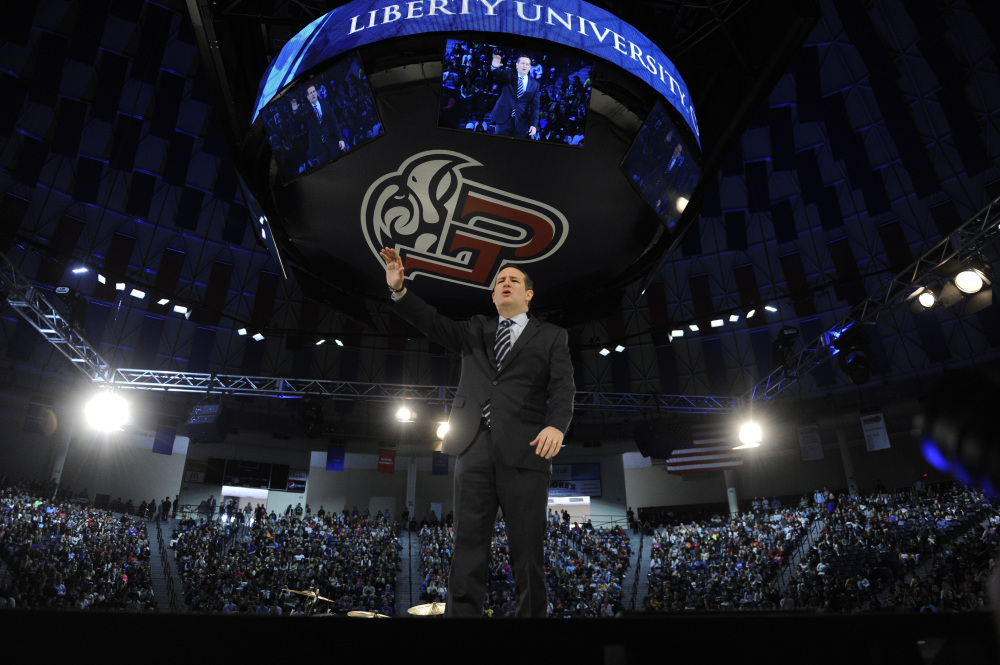
XXX TED CRUZ 2016 HDB327.JPG A  HKO USA VAWhen Ted Cruz launched his presidential campaign at Jerry Falwell’s Liberty University reaction on the left was predictable.  Some suggested that Liberty students were only in their seats because attendance at chapel is mandatory at Liberty. Liberals don’t like Ted and the feeling is mutual.

Libertarian response was mixed.  Ted’s political career is funded by billionaire libertarians Charles and David Koch, he despises Obamacare, and he wants to abolish the IRS.

Libertarians haven’t forgotten that Cruz’s famous filibuster speech against Obamacare was studded with Ayn Rand quotations.

Who could ask for anything more?

But hard core, “objectivist” libertarians are baffled by Ted’s fervent embrace of the religious right, in general, and his staunch opposition to abortion, in particular.  Why, for instance, did a lifelong admirer of Ayn Rand announce his candidacy at Jerry Falwell’s Liberty University?

Ayn Rand hated philosophical compromise as much as she hated Jesus; and she hated Jesus very, very much.  Consider this oft-quoted line from her novel, The Fountainhead:

The man who attempts to live for others is a dependent.  He is a parasite in motive and makes parasites of those he serves . . . this is the essence of altruism.

Jesus and Ayn share one quality: consistency.

Rand asserted that nothing beyond the demands of the detached and independent ego really matters.  Altruism, living in response to the needs of others, was thus the worst kind of heresy.  When we live in service to others, she taught, we become slaves.

Randian objectivists wish Ted would lose his religion so they wouldn’t have to qualify for their support.  But everyone, even libertarians, appreciate that Ted’s career arc would plummet to earth if he trampled on the cross.  In America, we are free to disagree with Jesus on every important point, so long as we’re singing “Oh How I Love Jesus”.

A cynic would assert that Ted Cruz embraces both Christ and anti-Christ because he is a pragmatic politician. But you can’t understand the Junior Senator from Texas apart from the culture that shaped him.  Religious superstars from Dwight L. Moody to Billy Graham embraced Wall Street for the same reason Ted Cruz courts the Koch brothers–publicity is expensive.

Ayn Rand
Ayn Rand

The best way to impress the wealthy is to tell them how wonderful they are, and Ayn Rand made a comfortable living singing paeans to the powerful.  They were the only people that mattered to her; everybody else she called ‘looters’, ‘moochers,’ and (when she was feeling kind) ‘parasites’.

Not all wealthy people enjoy praise and adulation, of course, but most of them do. Charles and David Koch love Ayn Rand and Austrian economist Joseph Schumpeter because they speak rapturously of the wealthy and contemptuously of everyone else.  No surprises there.

Ted Cruz grew up in a religious subculture in which Christianity and laissez-faire capitalism dovetailed neatly.  Mainstream evangelical Christianity soft-pedals Jesus’ teaching on money, greed and solidarity with the poor because, while no one was watching, we became a wholly-owned subsidiary of corporate America.  If you think this is overly-harsh, check out the Sermon on the Mount and you will see the problem.

But this marriage of Christ and anti-Christ goes deeper than political pragmatism and the lure of mammon.  Ted Cruz isn’t just a conservative Southern Baptist who occasionally shows up at Second Baptist Church in Houston, Texas; he is also an enthusiastic Dominionist.

This stealth enterprise goes by a variety of names: the Reconstructionist Movement, Dominionism or, more recently, the New Apostolic Reformation (I have written extensively on this subject).

Dominionism is rooted in the “presuppositional” theology of Cornelius Van Til and the political-religious musings of Rousas John Rushdoony.  (If you are unfamiliar with Cornelius and Rousas, this primer will come in handy.)

Think of it as the Reformed doctrine of election on steroids.  Rushdoony put it like this:

“The purpose of Christ’s coming was in terms of the creation mandate… The redeemed are called to the original purpose of man, to exercise dominion under God, to be covenant-keepers, and to fulfill “the righteousness of the law” (Rom. 8:4) . . . Man is summoned to create the society God requires.”

The theological category of “election” makes the marriage of Christ and anti-Christ possible.

Both Randian objectivists and Christian dominionists contrast the glories of “us” with the depravity of “them”.

It’s an anti-Christian species of Calvinism.  The wealthy and the powerful have the right to dictate to the poor and the powerless because, well, they’re so super.  Dominionists associate this authority with God (from whom all blessings flow).  For Randian objectivists it’s the law of the jungle: If the makers don’t rule the takers, the takers will rule the makers, and we can’t have that.  Both conservative Christians and anti-Christ objectivists dream of that great day when the elect will triumph and the unworthy will get a richly-deserved comeuppance.

I am not suggesting that everyone associated with the religious right thinks this way. They don’t.  But culture war logic ensures that conservative critics of this marriage of Christ and anti-Christ will be consigned to the outer darkness.

Liberals, for their part, don’t know enough about Ayn Rand or Christian Reconstructionism to discern the elephant in the room.  Besides, it’s too easy to lampoon politicians like Ted Cruz if you’re working with a liberal audience.  You can make jokes about Liberty University students compulsory attendance at the Cruz announcement speech in twenty quick seconds flat.  Liberty students wearing Rand Paul T-shifts is a great five-second sight gag.  So why do the hard work of answering hard questions that no one is asking?

Mainstream analysis, desperate to sustain the illusion of objectivity, eschews in-depth analysis of anything.  Cruz kicked off his campaign at Liberty University in an attempt to court religious conservatives.  End of story.  The marriage of Christ and anti-Christ rarely gets a mention on CNN or CBS.  It sounds mean-spirited and it smacks of liberal bias.  We don’t want to lose more conservative viewers to FOX.

But our silence comes with a price.  Ted Cruz holds this marriage of convenience together by pretending that neither Jesus nor Ayn Rand were serious.

They were; and they are.

Must we choose between belief-less Christianity and fundamentalism?

jesus-on-shroud

John Shuck is a Presbyterian pastor in good standing who doesn’t believe a single thing you learned in Sunday school.  In a recent Patheos post, Reverend Shuck issued a list of six affirmations designed to boil the blood of every right-thinking American:

  • Religion is a human construct
  • The symbols of faith are products of human cultural evolution
  • Jesus may have been an historical figure, but most of what we know about him is in the form of legend
  • God is a symbol of myth-making and not credible as a supernatural being or force
  • The Bible is a human product as opposed to special revelation from a divine being
  • Human consciousness is the result of natural selection, so there’s no afterlife

You may be wondering why, having jettisoned God, Jesus, the Bible and heaven, Rev. Shuck still wants to play church.  What’s the point? (more…)