It’s time to free Ramsey Muniz!

Irma and Ramsey Muniz

By Alan Bean

In this op-ed, Texas attorney Steve Fisher argues that you don’t have to believe that Ramiro “Ramsey” Muniz is the victim of a racist frame-up to advocate for his freedom.

Friends of Justice has spent hundreds of hours examining every facet of this case, and we heartily agree.

Was Ramsey Muniz framed by racists?

No.  Muniz is the victim of the same kind of federal narcotics conspiracy prosecution that put Ann Colomb and three of her sons behind bars in 2006.

Mr. Fischer says he would be surprised if Muniz is innocent.  Well, Steve, prepare to be surprised.

We will have much more to say about that in a few weeks.

Who is Ramsey Muniz, you ask.  Mr. Fischer provides an excellent introduction.

It’s time to free Ramsey Muniz

CORPUS CHRISTI —In the 1972 election for Texas governor, Ramiro “Ramsey” Muniz, a Corpus Christi and Waco attorney, and his La Raza Unida Party won 214,000 votes (6 percent) versus Dolph Briscoe (Democrat) and Henry Grover (GOP). In Nueces County 13,813 people voted for Muniz and he garnered another 1,388 voters in San Patricio County.

On this 40th anniversary of that election Mr. Muniz  celebrates his own 70th anniversary at the Federal Penitentiary in Beaumon.Muniz, a college football star and a Baylor law graduate, is serving life without parole for his third strike against our drug laws. He was sentenced in 1994.

I am certainly not the first to write about this. The Internet is replete with editorials, most by leftist and/or ethnically motivated organizations such as The Prison Abolitionist and  Chicano Mexicano Prison Project that proclaim Muniz’s innocence and denounce those who “framed” him,  demanding his release. It’s hard to discern the actual facts when they are obscured by hate and covered with venom. (more…)

A review of Charles Murray’s ‘Coming Apart’: do the poor suffer because they are bad or because they are dumb?

By Alan Bean

Charles Murray took so much flak for controversial The Bell Curve that he decided to write a book about white people rooted in much the same argument. 

Coming Apart, a book about the diverging fortunes of upper and lower class white Americans, begins where The Bell Curve ended.  The big factor driving the growing gap between the educated and the uneducated, Murray suggests, is “cognitive homogamy”, the fact that individuals with similar cognitive ability are having children.

In the old world, Murray says, most people lived and died in rural communities and small towns.  The smartest males might have left home for a few years of college, but they generally returned to marry the prettiest (not necessarily the smartest) girl in town.  The result, kids of normal cognitive ability.  Wealth was distributed largely on the basis of inheritance, not ability and the kids at Harvard weren’t much smarter than the kids at a good state school.

Since the early 1960s, however, smart people have been marrying other smart people and having smart kids.  The sons and daughters of these blessed unions have increasingly clustered in segregated neighborhoods in which “everybody has a bachelor’s or graduate degree and works in high-prestige professions or management or is married to such a person.”  Among this new elite, wealth is distributed on the basis of merit, the elite colleges compete for the brightest and the best and lesser institutions make do with students who will never be ready for prime time. (more…)

“Why do innocent people confess?”

by Melanie Wilmoth Navarro

For most people, it is difficult to imagine a situation in which you would ever admit to a crime you did not commit. However, psychological research suggests that innocent people do confess. In fact, according to the Innocence Project, in “25% of DNA exoneration cases, innocent defendants made incriminating statements, delivered outright confessions, or pled guilty.”

Anything from abuse or threats from law enforcement to ignorance of the law can make individuals more likely to make a false confession. This video from the Innocence Project gives a brief overview of the issue:


A recent New York Times article by David Shipler examines the role of police interrogation in false confessions. To get a confession, Shipler states, “officers are taught to use all the tricks and lies that courts permit.” Although juveniles, people with mental illnesses or disabilities, and people under the influence of drugs or alcohol are more likely to make false confessions, the average adult can be manipulated into a false confession as well:

In experiments and in interrogation rooms, adults who are told convincing fictions have become susceptible to memories of things that never happened. Rejecting their own recollections through what psychologists call “memory distrust syndrome,” they are tricked by phony evidence into accepting their own fabrications of guilt — an “internalized false confession.” (more…)

Scalia: Fed courts flooded with “nickel and dime” cases

At an American Bar Association meeting in New Orleans this month, U.S. Supreme Court Justice Antonin Scalia claimed that federal courts are increasingly bogged down with “nickel and dime” criminal cases as a result of  new criminal statutes enacted by lawmakers. The increase in criminal cases, Scalia argues, is turning the federal court into a “court of criminal appeals.” At the meeting, Scalia also offered his opinion on abortion, but avoided the topic of same-sex marriage. Check out coverage of the meeting by The Associated Press below. MWN

Scalia: Routine criminal cases clog federal courts

The Associated Press

The federal courts have become increasingly flooded with “nickel and dime” criminal cases that are better off resolved in state courts, U.S. Supreme Court Justice Antonin Scalia said Saturday.

Scalia told an American Bar Association meeting in New Orleans that he’s worried that the nation’s highest court is becoming a “court of criminal appeals.”

“This is probably true not just of my court, but of all the federal courts in general. A much higher percentage of what we do is criminal law, and I think that’s probably regrettable,” he said. “I think there’s too much routine criminal stuff that has been pouring into the federal courts that should have been left to the state courts.”

Scalia said civil dockets in some federal jurisdictions are lagging behind because criminal cases take precedence. He attributed the trend to lawmakers enacting new criminal statutes and bogging down the federal courts with “nickel and dime criminal cases that didn’t used to be there.” (more…)

The source of American punitiveness

by Melanie Wilmoth Navarro

Since the 1970s, the prison population in the U.S. has increased by 700%. Consequently, there are now over 2.3 million people behind bars. Friends of Justice believes that this shift toward mass incarceration was driven by a punitive public consensus. This punitiveness resulted in tough-on-crime policies that promote harsh punishment over rehabilitation and leave prisoners locked up and left out.

There are many theories that attempt to explain why the U.S. shifted toward punitive criminal justice policies over the last 40 years. A recent study by Unnever and Cullen (2010) explores the social sources of punitiveness among Americans by examining the efficacy of three prominent theories: the escalating crime-distrust model, the moral decline model, and the racial animus model.

The escalating crime-distrust model suggests that punitiveness is driven by the combination of an individual’s fear that crime is increasing, belief that his or her safety is at risk, and distrust in the government’s ability to protect him or her from crime. This theory also argues that an individual’s belief that courts put the rights of offenders over the rights of victims further contributes to a punitive attitude toward crime. The moral decline model suggests that punitive attitudes stem from an individual’s belief that society is in a state of moral decay. Therefore, only harsh policies toward crime will restore social cohesion. The racial-animus model argues that racial and ethnic hostility and intolerance is tied to punitiveness in the criminal justice system:

 “A sizable proportion of the American public perceives the crime problem through a racial lens that results in an association of crime with African Americans, especially Black men. This lens, mostly unique to Whites and especially to those who are racist, colors their view of crime. For these Americans, when they think about crime, the picture in their head illuminates a young, angry, Black, inner-city male who offends with little remorse. For them, this offender is the “superpredator” Black male.” (more…)

“Phony theology” idea didn’t originate with Rick Santorum

By Alan Bean

Rick Santorum didn’t originate the notion that Barack Obama’s environmental views are the product of an unbiblical “phony theology”.  According to Rachel Tachnick, a leading authority on the Religious Right, this idea is a staple within the emerging world of Christian Right “Dominionist” theology.  In this alternative universe (well-funded by big oil firms, the Koch brothers et al), “Biblical Capitalism” is considered holy and opposing views are denounced as demonic.  Sound strange?  Check out Ms. Tabachnick’s post.

I was interested to note that the continuing shift from a Hal Lindsey-style end-times theology to a “preparing the world for the return of Jesus” Dominionist view has created an excellent platform for collaboration between Protestant evangelicals and American Roman Catholics. 

The big roadblock: conservative religious leaders who object to the political appropriation of biblical teaching.

“What have we become?”

by Lisa D’Souza

A few days ago, the New York Times reported that 2,000 of the 11,000 people housed in Chicago’s Cook County Jail  have a serious mental illness.   Sheriff Tom Dart calls himself the “largest mental health provider in the State of Illinois.”  In the next two months, Chicago plans to close half of its mental health care centers.  This will exacerbate an already tragic problem.

It’s what I think of as the sordid secret of the criminal justice system: a lot of the people we lock up in jails and prisons aren’t criminals.  Many have untreated mental illness.  A mentally ill person is about three times more likely to be jailed than they are to be hospitalized.

The 1960s were a watershed for freedom in this country.  New laws enforced the rights of  all people, regardless of skin color, to vote, go to school and find employment.  People with mental illnesses and physical disabilities gained the freedom to live in the communities instead of the  institutions where many had been warehoused.  The Kaiser Family Foundation reports that from 1955 to 1980, the number of people institutionalized in state mental hospitals fell from 559,000 to 154,000.

But how well have we stood by our brothers and sisters who struggle with mental illness?  The National Alliance on Mental Illness gives the U.S. an overall grade of D, with 6 states earning a failing grade.

Our neighbors are in crisis.  They have health care needs going unmet.  Our current answer is to put them in jail.  We, like Sheriff Dart, must ask ourselves, “What have we become?”

Santorum meant exactly what he said

By Alan Bean

Rick Santorum has raised eyebrows with a comment about President Obama’s “phony theology”.  According to the surging presidential candidate, Obama’s worldview is driven by “some phony ideal, some phony theology. Oh, not a theology based on the Bible, a different theology, but no less a theology.”

Aked to explain this remark on Face the Nation, Santorum said he was referring to the president’s environmental views.  According to an AP article:

The former Pennsylvania senator said Obama’s environmental policies promote ideas of “radical environmentalists,” who, Santorum argues, oppose greater use of the country’s natural resources because they believe “man is here to serve the Earth.” He said that was the reference he was making Saturday in his Ohio campaign appearance when he denounced a “phony theology.”

But when reporters asked for an explanation of the “phony theology” remark immediately after it was uttered, the candidate made no reference to environmentalism, explaining instead that the president practiced one of the various “stripes” of Christianity.

So where does Mr. Santorum stand?  Does he think Barack Obama is a genuine Christian or doesn’t he? (more…)

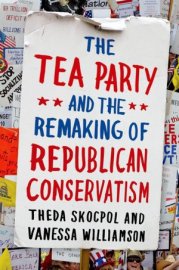
The Tea Party’s gravitational pull

By Alan Bean

Theda Skocpol (pronounced “Scotch-poll”) teaches sociology and government at Harvard University, hardly a hotbed of Tea Party conservatism.  But this nuanced account of the radicalization of the Republican Party carries her well beyond the breathless hysteria of the liberal blogosphere.

In her quest to understand Tea Party conservatism, Skocpol encounters three distinct movements with a common interest in driving Barack Obama into public life while pushing the Republican Party as far to the right as possible.

At the grassroots level, she finds, Tea Party people tend to be older, white conservatives who have no beef with big government programs like medicare, social security and generous veteran’s benefits; they just hate to see tax dollars squandered on the undeserving: welfare recipients, the undocumented, and losers who sign up for mortgages they can’t afford.

Secondly, there are the elite conservative lobbies and think tanks with a traditional small-government, pro-business agenda that want to slash government spending while eliminating many of the social programs grassroots conservatives endorse.

Finally, these uneasy bed-partners are being lionized and galvinized by an energized conservative punditocracy: FOX news, talk radio, and a growing right wing internet culture.  This adoring media attention exaggerates the cohesiveness of the contemporary conservative movement while extending its influence and elevating its stature.

These three expressions of Tea Party activism are at odds on many issues, Skocpol says, but their combined influence is radicalizing the GOP.  It is now impossible for a moderate Republican to succeed at the presidential level.

Will the 2012 election be a repeat of 2010, or are different forces at work?  Will America elect a movement conservative, or has the GOP veered too far from mainstream America? (more…)