“People wasn’t made to burn”: Joe Allen resurrects a lost story

By Alan Bean

In a three-month period shortly after World War II, 751 home fires killed fo urteen people in the city of Chicago.  The deadliest of these fires broke out in filthy, overcrowded tenement buildings in the city’s black district.  Joe Allen’s People Wasn’t Made to Burn tells the story of a fire on 1733 West Washburne Street that claimed the lives of four children and eventually placed the victim’s father on trial for murder.

Like scores of other Mississippi sharecroppers, James and Annie Hickman had migrated north in search of a better life.  In segregated Chicago, housing options were strictly limited for Black families like the Hickmans.  They were “forced to live in ‘kitchenettes’: dilapidated one-room apartments that in many cases had no heat, electricity, or running water.”  The kitchenette the Hickman family moved into was owned by Mary Porter Adams, a Black woman desperate to maximize her monthly profit, and managed by David Coleman, a white man determined to spend as little as possible on maintenance and repair work.

James Hickman paid Coleman a $100 deposit and moved into a 25 by 15 foot attic apartment on the understanding that more suitable accommodations on the second floor would soon be available.  “The Hickmans had to go down to the floor below them to get water from a neighbor to cook and clean with” Joe Allen tells us.  “They cooked on a Kenmore two-burner stove a few footsteps from their beds.  At a local store James bought two lamps to light the room, both fueled by kerosene.”

When James Hickman asked Coleman when the second-floor apartment would be ready, the manager initially put him off.  Hickman kept pressing the issue.  Finally, Coleman told Hickman he wasn’t going to rent him the better apartment and wouldn’t return the deposit money.  Moreover, Coleman said “he had a man on the East Side ready to burn the place up” if Hickman took him to court.    (more…)

Behind bars without proof of guilt: The case of Everton Wagstaffe

Everton Wagstaffe

by Melanie Wilmoth

You can find a NYT update on this story here.

Everton Wagstaffe has been in prison for over 18 years.

Since his arrest, Wagstaffe has unyieldingly claimed his innocence and fought for his release, yet he remains behind bars serving out a 25-year sentence for second degree kidnapping.

Although Wagstaffe completed his minimum sentence several years ago, he remains in prison, refusing to go before the parole board and admit guilt for a crime he did not commit. Several years ago, he qualified for a “conditional release” which would have set him free as long as he followed a strict set of rules and guidelines. Claiming his innocence, Wagstaffe refused to sign the release, not wanting to comply with the guideline requiring him to register as a sex offender.

The case against Wagstaffe began on New Years Day 1992. On this day, 16-year-old Jennifer Negron was kidnapped in Brooklyn, New York. Hours after the kidnapping, her body was discovered dead in the street. (more…)

Are we the 99%?

By Alan Bean

Bloggers quickly learn that most readers snap up posts on the hot stories of the day, so by now I should have written something on the Occupy Wall Street movement.  Thus far, the OWS people haven’t addressed the issue of mass incarceration, and I don’t expect that to change.  The big issue that has drawn thousands of people into the streets is economic inequality.  Some OWS protesters want to do away with free market capitalism; others simply resent living in a plutocracy where the politicians function as lap dogs for the wealthy and only well-financed opinions receive a public airing.

This resentment has been hanging in the air for decades, of course, but the economic meltdown of 2008 built a roaring fire under the winter of our discontent.  Everything is melting.  We see the very people responsible for the current fiasco assigned to key positions in Barack Obama’s cabinet and we are outraged.  These people signed off on the housing bubble and turned a blind eye to the massive fraud in the economic sector that kept the bubble afloat for so long.  They have been tainted by ubiquitous iniquity and they have demonstrated their incompetence, so why are they still calling the shots?  Why are they shaping public policy?  Why is the Tea Party intent on cutting their taxes and catering to their every whim? (more…)

Scot McKnight gets the kingdom all wrong

By Alan Bean

IVP Author Scot McKnight“Social justice outside the church is not biblical justice or kingdom work. It is social work. Fine, that’s a good thing. But let’s not call this kingdom work.”

So says Scot McKnight, author of “The Jesus Creed: Loving God and Loving Others“.  McKnight has no beef with works of justice performed outside the church, it just doesn’t qualify as kingdom work.  (You can find an extended treatment of his remarks in this Associated Baptist Press article.)

McKnight believes in justice, especially the kind of justice that mattered to Jesus.  But that’s just the problem, few churches share his passion.  Take the issue of mass incarceration, for instance.  Over the past four decades, churches have adopted a law-n-order, lock-’em-up stance.  We wanted to be on the side of the angels, and that meant supporting law enforcement force the bad people (particularly drug dealers) off the streets. (more…)

As one having authority

By Alan Bean

This week the Mustard Seed Conspiracy study is examining Jesus’ brief ministry in Capernaum as described in the Gospels of Mark and Luke.  In Luke, this material follows immediately on the heels of Jesus’ rejection in his hometown of Nazareth.  This is important for two reasons.  In Nazareth Jesus announced his agenda using the ancient words of Isaiah 61: “The Spirit of the Lord is upon me, because he has anointed me to preach good news to the poor; he has sent me to proclaim release to the captives.”  Now, in Capernaum, he makes good on his promise. 

Luke also uses the Nazareth-Capernaum contrast to make a second point: a prophet may be without honor in his own town, but the strangers down the road get it immediately.

The recurring theme of the Capernaum passages is authority.  Jesus takes authority over Shakespeare’s “slings and arrows of outrageous fortune”: the “unclean spirits of disease and disability (physical and mental). 

And Jesus takes authority over his audience–he has no interest in keeping the customers satisfied.

Let’s start with the unclean spirits.  On 23 occasions in the Synoptic Gospels, Jesus casts out unclean spirits (also referred to as demons).  There is something unseemly about these unclean spirits.  They twist their victims into grotesque shapes and exit the body with horrifying shrieks.  Why, we ask, couldn’t Jesus quietly heal people?  (more…)

“Lost in detention”: The criminalization of immigration

by Melanie Wilmoth

Earlier this week, PBS Frontline aired its documentary “Lost in Detention.” The documentary takes a hard look at the broken U.S. immigration system and the resulting increase in the number of detained and deported immigrants.

Under the Obama Administration, over 400,000 immigrants were detained and deported this year alone (which is a significantly higher number of deportations than in previous administrations). As Frontline suggests, much of this increase in detention and deportation is a result of Secure Communities, a partnership between U.S. Immigration and Customs Enforcement (ICE) and the FBI that uses fingerprint data to track criminal immigrants. Secure Communities allegedly aids in the deportation of immigrants who have committed serious crimes and, thus, pose a threat to public safety. According to ICE, Secure Communities prioritizes “the removal of individuals who present the most significant threats to public safety as determined by the severity of their crime, their criminal history, and other factors.”

However, the Secure Communities program has reached far beyond its stated purpose. Since its implementation in 2008, Secure Communities has successfully broken up families and incited fear in immigrant communities. Thousands of individuals, many of whom are non-criminals, U.S. citizens, and parents of children who are U.S. citizens, have been arrested. In addition, Latinos have been disproportionately affected by Secure Communities, making up 93% of those arrested through the program.

After arrest, 83% of individuals are placed in detention centers. Punitive in nature, the 250 detention centers in the country warehouse immigrants in prison-like settings until deportation. Reports of abuse in these centers run rampant.  (more…)

U.S. support for death penalty dips to 39-year low

by Melanie Wilmoth

A Gallup poll conducted last week reveals that support for the death penalty in the U.S. has dropped to a 39-year low. According to the poll:

“Sixty-one percent of Americans approve of using the death penalty for persons convicted of murder, down from 64% last year. This is the lowest level of support since 1972, the year the Supreme Court voided all existing state death penalty laws in Furman v. Georgia.”

The poll, conducted October 6-9, 2011, came in the wake of Troy Davis’ execution, which could explain some of the decrease in support for the death penalty. However, Gallup points out that “there have been high-profile executions in the news in previous years without concomitant drops in death penalty support, making it less clear that such events have a direct impact on attitudes.”

See the results of the poll below:


NYPD detective admits to fabricating drug buys to meet arrest quotas

Already in the spotlight for its racially biased “stop and frisk” tactics, the NYPD took another hit when Stephen Anderson, a former narcotics detective, admitted to falsifying drug buys and planting drugs on innocent people to meet arrest quotas. Based on Anderson’s testimony, NYPD supervisors put significant pressure on narcotics officers to meet buy-and-bust quotas. Check out the New York Daily News’ report on the issue below. MW

We fabricated drug charges against innocent people to meet arrest quotas, former detective testifies

by John Marzulli

A former NYPD narcotics detective snared in a corruption scandal testified it was common practice to fabricate drug charges against innocent people to meet arrest quotas.

The bombshell testimony from Stephen Anderson is the first public account of the twisted culture behind the false arrests in the Brooklyn South and Queens narc squads, which led to the arrests of eight cops and a massive shakeup.

Anderson, testifying under a cooperation agreement with prosecutors, was busted for planting cocaine, a practice known as “flaking,” on four men in a Queens bar in 2008 to help out fellow cop Henry Tavarez, whose buy-and-bust activity had been low.  (more…)

Canadian government toys with mass incarceration

By Alan Bean

I just returned from a nine-day trip to Edmonton, Alberta.  Whether I was attending my 40th high school reunion or visiting with friends and relatives, the nature of my work brought the conversation around to Bill C-10, “The Safer Streets, Safer Communities Act,” sponsored by the reigning conservative government.  In essence, the plan calls for lots and lots of prison construction

Consider the facts.  The United States currently incarcerates 743 people per 100,000 population; Canada incarcerates 117 per 100,000.  If the Canadian crime rate was on the rise there might be some rationale for prison construction but, as in America, the crime rate north of the 49th parallel has been dropping like the anvil in a road runner cartoon for years.

Is Prime Minister Steven Harper trying to shore up his political dynasty by playing the tough-on-crime card that worked so well for so long in the US of A?  Should we be talking about a “Northern strategy”?

This morning the Grits for Breakfast blog referenced an august gathering in which a number of guests from the lock-’em-up state of Texas explained to Canadian officials why massive spending on prisons is an economic and public safety disaster.  You can find the full article from the Canadian Broadcasting Corporation site here. 

Also, over at the Canadian version of the Huffington Post, Liberal MP Carolyn Bennett provides her own critique of Bill C-10.

I am rarely embarrassed by the country of my birth, but Bill C-10 is downright embarrassing.

Have we domesticated discipleship?

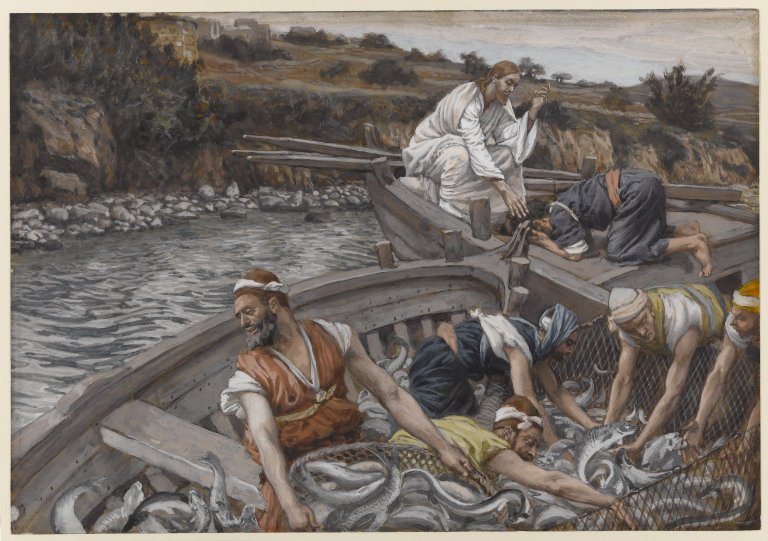
File:Brooklyn Museum - The Miraculous Draught of Fishes (La pêche miraculeuse) - James Tissot - overall.jpg

Then Jesus said to Simon, “Do not be afraid; from now on you will be catching people.” (Luke 5:10)

By Alan Bean

This week we consider Jesus’ calling of the first disciples. In Mark’s gospel, the subject is covered in five short verses; Luke’s account is twice as long and doubly detailed. The evangelists (a fancy word for the men who write the four gospels) inherited scores of traditional stories about the life and work of Jesus and used this material with great freedom.

In Mark’s gospel, Jesus appears to two groups of fisherman busy casting their nets into the sea. “Follow me,” he says, “and I will make you fish for people.” Without a word, the men drop their nets and follow.

In Luke, the action if far more complex. Right at the end of John’s gospel, we find a story about a miraculous catch of fish. Luke gives us the same story, but he places it in a very different setting. In John, the risen Christ appears to his disheartened disciples and asks them to let down their nets for a catch. In Luke, this request is extended right at the beginning of Jesus’ teaching ministry.

As a teenager growing up in McLaurin Baptist Church in Edmonton, Canada, I discussed Mark’s story with Sadie Beggs, an Irish Baptist. “Jesus just walks up and tells these guys to follow, and they do,” I said. “I wonder what was going through their heads.”

Sadie told me she had always been mystified by the disciples’ willingness to follow a perfect stranger. “It must have been a miracle,” she said.

In Luke, the decision to follow Jesus is more understandable. Jesus heals the mother-in-law of a soon-to-be disciple named Simon just shortly before the two men meet by the sea of Galilee. The call to discipleship doesn’t come from a complete stranger, in other words, Simon has already seen Jesus at work. (more…)