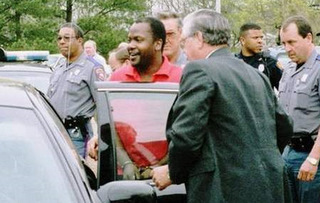
Michael Green is now a free man after 27 years in prison for a crime he didn’t commit. The Houston Chronicle article has links to some great video footage. AGB
The Dallas Morning News reports yet another DNA exoneration out of Harris County (Houston). According to the story, “Michael Anthony Green, 44, is expected to be released on bond Thursday, the district attorney’s office said in a statement. It remains only for the Texas Court of Criminal Appeals to clear Green’s conviction.”
Green has been in prison for 27 years for a crime he did not commit.
The culprits appear to be tunnel vision (investigators identify a suspect without examining alternative theories of the crime) and “confirmation bias” (potential witnesses are pressured to confirm the state’s theory).
According to Green’s attorney, Robert Wicoff, “It happened because the police didn’t take all the steps they needed to take to make sure they had the right man. They also used suggestive interrogation techniques when they questioned the victim that prompted her to identify my client.”
The good news is that Harris County has created a post-conviction review mechanism similar to the Conviction Integrity DA Craig Watkins created in Dallas County.
According to the district attorney’s office, four men abducted the woman from the Greenspoint district on April 18, 1983. They forced her into their vehicle and drove to a remote area, where three of the men sexually assaulted her.
Houston police pursued a stolen car resembling the description of the vehicle used in the abduction, and the car’s four occupants stopped and fled on foot in different directions. Police came upon Green, who was walking in the area. The victim could not identify Green in person when he was first detained, but later picked him from a photo lineup as one of her three attackers.
Green maintained his innocence. When Harris County District Attorney Patricia Lykos formed the new Post-Conviction Review Section, his case was among the first taken up.
“The evidence in this case had been sitting in the district clerk’s office for 27 years, and no one had taken the initiative to do anything with it in the past,” First Assistant District Attorney Jim Leitner said in the statement.
The 2009 shooting death of Oscar Grant certainly looked like murder. With Mr. Grant flat on his belly, his arms pulled in behind his back, officer Johannes Mehserle pulled his gun and fired. Mr. Grant died in the hospital several hours later.
At trial, Mehserle said he mistakenly drew his pistol when he meant to use his stun gun.
That could be true. Radley Balko of Reason Magazine, argues persuasively that the jury got it right this week when they found Mehserle guilty of involuntary manslaughter.
But Balko isn’t calling this an innocent mistake. Police officers are trained to leave their weapons holstered unless a life is on the line. That rule applies to tasers, not just firearms. Whenever a weapon is unholstered something tragic is likely to happen. Sometimes there’s no alternative. This wasn’t one of those times.
Blogger Eddie Griffin, like most African American bloggers, calls the killing of Oscar Grant cold-blooded murder.
A number of videos taken from several different angles have been circulating on the web for a year and a half now and both Balko and Griffin’s articles contain appropriate links.
The racial divide over this issue was created by yet another jury that looks a lot more like the police officer than the shooting victim. The Los Angeles jury that convicted Mehserle this week contained not a single African American. Would the outcome have been different if the jury didn’t contain a single white person?
Whenever possible, at least 33% of jurors should look like the defendant. There is much to be said for random jury selection; but the perception of fairness is lost when a racially charged case is tried by a jury with no racial balance.
I always believed that O.J. Simpson was guilty of killing his wife, Nicolle. Nonetheless, the jury got it right. The prosecution failed to make its case beyond a reasonable doubt. The dream team did it’s job well. Had Mr. Simpson been represented by an over-worked and underpaid public defender, the trial would have been profunctory, the verdict guilty and the sentence death.
I generally favor conservative verdicts. The “beyond a reasonable doubt” standard is intentionally high. The fact that juries are often far too easily convinced by weak cases doesn’t justify a harsh sentence in a case like this.
I have a hard time believing that Officer Mehserle intentionally killed a young man in his custody with dozens of cameras flashing in his face.
That in no way justies his actions, of course. He had no business pulling a weapon of any kind and must suffer the consequences of his unwarranted actions.
If African Americans refuse to accept this verdict it is because low-status black defendants and police officers typically receive two very different kinds of justice. Mr. Mehserle got the verdict he deserved. If young black men received the same kind of even-handed treatment from juries, we wouldn’t be hearing such an anguished outcry over this verdict.
It takes a lot of money to put a defendant on death row. Most capital defendants are poor and uneducated. Families are rarely in a position to foot the bill for a qualified defense attorney.
The issue of indigent defense has been getting some long-deferred attention since Lawrence Tribe was appointed as Senior Counsel of the Department of Justice. Tribe refers to the “justice gap” that makes it difficult for indigent defendants to get the justice the constitution demands. “The whole system of justice in American is broken,” he says. “The entire legal system is largely structured to be labyrinthine, inaccessible, unusable.”
In 1963, in a groundbreaking case known as Gideon v. Wainright, the Supreme Court ruled that legal defense was a fundamental right guaranteed by the constitution. After Gideon, defendants had the right to state-appointed defense counsel.
But how much defense is enough?
The American system of criminal justice is the most adversarial in the world. In theory, the state, after determining that a prosecution is appropriate, does its best to make a compelling case for guilt. Defense counsel then goes to the wall for the defendant, poking holes in the state’s case and working diligently for whatever seems to be the best outcome for their client.
This theoretical scenario can be incredibly expensive. A thorough investigation of a homicide, for instance, requires the examination of a wide range of leads, possible suspects and theories of the crime. If a suspect confesses and accepts a plea bargain, the state saves hundreds of hours and hundreds of thousands of dollars.
But suppose the “case facts” are complicated and the prime suspect maintains his innocence? Then you are looking at a lot of time and money. Prosecutors have limited resources. If you invest $100,000 and hundreds of hours investigating a single high-profile case, other cases will suffer.
Now you understand why 95% of criminal cases are settled by plea bargain. Cash-strapped investigators easily convince themselves that they can identify the perpetrator after a cursory investigation. In most cases, this involves breaking down the alleged perpetrator through a process of intense interrogation that can stretch over days. Investigators have been given the freedom of lie to suspects if they have no real evidence. They can tell suspects that friends, family members and associates have implicated them. They can lie about the results of polygraph tests. They can even invent fake case files purporting to contain the fruits of an elaborate investigation.
The goal is to break the suspect down by making it appear that resistance is futile. Once an admission of guilt is obtained, the goal is to get the suspect to write out a full confession so airtight, internally consistent and detailed that defense counsel will be completely disarmed.
The vast majority of homicide cases are solved through interrogation and plea bargain or become cold cases when the trail peters out.
You get the easy win or you give up. You can only give so much time and money to a single case.
What happens when the state believes it knows the perpetrator but the case evidence is sketchy and the guy won’t admit to the crime? This scenario haunts a prosecutor’s dreams. If the case is high-profile and the identity of the prime suspect is well known the state finds it virtually impossible to admit defeat.
The Curtis Flowers case only makes sense against this bureaucratic backdrop. For some reason, DA Doug Evans and John Johnson, the lead investigator in the Flowers case, made little attempt to interrogate Curtis. Maybe they thought it was a waste of time. Instead, they spent nine months going door-to-door on the black end of Winona, Mississippi, looking for people willing to confirm aspects of their theory of the case. Dozens of people were picked up at their jobs and carried down to the police station for an interview.
The goal was to pile up so many state’s witnesses that Curtis Flowers would realize his situation was hopeless.
But Curtis refused to fold.
He was offered life without parole in exchange for a guilty plea.
Curtis turned it down.
At some point prior to the first trial, Mr. Evans decided to make an example of Curtis Flowers. A single trial wasn’t enough. The plan was to try the defendant once for each of the four victims who died at the Tardy furniture store on July 16, 1996.
Unlike most capital defendants, Curtis Flowers was able to pay for legal counsel. Sort of. His first attorney was Billy Gilmore, a former police officer from Lexington, Mississippi. Gilmore had been a sheriff’s deputy in the 1960s when African Americans were trying to register to vote in the 1960s. Some local residents say Gilmore was present when the KKK firebombed the home of Hartman Turnbow in 1963. Gilmore admits he was chief sheriff’s deputy of Holmes County at the time, but denies involvement with the Klan.
Gilmore, assisted by his son John, did a reasonably good job of defending Curtis Flowers at his first trial in Tupelo. But reading through the transcript, you get the uneasy feeling that the Gilmores came to the facts late in the day. There was certainly no fresh investigation. Gilmore tried to poke holes in Doug Evans’ case, but made no attempt to introduce an alternative theory of the crime.
Curtis Flowers was convicted by eleven white jurors and one black juror and sentenced to death.
Unsatisfied with one conviction, Doug Evans took Flowers to trial in Gulfport.
Curtis Flowers and his family saw no reason to believe that using the same attorneys would produce a different outcome. With this in mind, they hired Chokwe Lumumba, a highly respected civil rights attorney from Jackson. But there was a problem. The Gilmores had been hired to represent Mr. Flowers in four trials and the Flowers family didn’t have the money to hire Mr. Lumumba and an investigator. At a pre-trial hearing, defense counsel requested state funds to pay for an investigator.
Judge Clarence Morgan told Lumumba that the record of the first trial should be a sufficient guide to the facts of the case.
Lumumba pointed out that the transcript of a trial that led to his client’s conviction was lacking by definition.
Judge Morgan said the defense had every right to an investigator if they wanted one, but the state wouldn’t be footing the bill.
Lumumba was incredulous. “I would say this to the Court. You know we cannot penny-pinch around these death penalty cases. I mean I don’t care what people’s view is about budget and all this kind of stuff. If you are a state and you take the responsibility where you say you are going to put people to death then at that point money becomes no object.”
But money was an object. A big object. Judge Morgan was willing to let the state go to the incredible expense of trying Curtis Flowers in four consecutive trials, but he wouldn’t give the defense money for an investigator.
The economic issue raised its head later in the pre-trial process when Frederick Veal, one of the jailhouse snitches the state had used to convict Flowers in the first trial, told defense counsel that he had perjured himself in exchange for a get-out-of-jail-free card. According to this new testimony, the sheriff of LeFlore County had sent Mr. Veal into a cell with Curtis Flowers by for the purpose of soliciting a confession.
Lumumba argued that the testimony of both snitches should be disallowed.
Judge Morgan was unimpressed. There was no way of knowing, he said, if Veal perjured himself or not.
Lumumba could scarcely contain himself. Why, he asked, would an ex-snitch contact defense counsel after being released from prison? “There is no reason in the world that Veal had to tell us what he told us other than the fact that it’s the truth. We couldn’t put him in jail. We couldn’t let him out of jail. We can’t give him thirty thousand dollars. We can’t put him in a hotel . . .”
Even if the state had granted the defense a few thousand dollars for an investigator, there would be no way to match the state’s intimidating influence over potential witnesses. When the state produces a dozen eye-witnesses, pointing out a few inconsistencies isn’t enough; you’ve got to put the entire investigation on trial. And that means a thorough investigation.
It is obvious from trial and hearing transcripts that Mr. Lumumba made a heroic effort to perform his own investigation prior to trial, but the situation demanded the services of a full-time investigator.
In Flowers 2, the defendant was tried by another jury comprised of eleven white jurors and one black juror. Once again, he was convicted and sentenced to death.
Shortly thereafter, the convictions in Flowers 1 and Flowers 2 were both overturned by the Mississippi Supreme Court. Doug Evans had over-reached. While only trying one specific murder, Evans had presented evidence relating to all four killings.
The case didn’t go to trial again until 2004. This time, Curtis Flowers decided he could get a better shake back in Montgomery County.
The indigent defense situation had improved significantly since Mr. Flowers first went to trial. A new state-funded office had been created in Jackson to ensure that indigent capital defendants would be fairly and competently represented.
Unfortunately, the new Office for Capital Defense had a limited budget and a daunting case load. The budget for investigation was strictly limited. The record suggests that no significant new evidence was sought or discovered in the Flowers case between three 2004 and trial six in 2010.
By now it was obvious that jurors exposed to testimony from the state’s eye-witnesses were inclined to convict. On the other hand, there had been no significant African American representation on juries one and two, so maybe there was hope.
But in trial three, the state created yet another jury with only a single black juror by using all fifteen peremptory strikes to exclude black residents from the jury. Predictably, the trial ended with another guilty verdict and another death sentence.
The Mississippi Supreme Court ruled that DA Evans had exhibited racial bias during jury selection. Once again, the conviction was overturned and the case was remanded for re-trial.
In Flowers 4, all five black jurors–to the surprise and horror of all right-thinking people in Winona–held out for acquittal.
Did the defense suddenly come up with new evidence or find previously undiscovered holes in state testimony?
Not really. Black jurors understood the impact reward money and implied threats could have on poor black folks. They also had trouble seeing the Curtis Flowers they knew perpetrating such a heinous crime.
Finally, black jurors understood the power of the state to manipulate reality. Many things had changed since the days of Jim Crow, but racial power dynamics in Montgomery County remained the same.
Trial five ended in another hung jury; but just barely. One of three black jurors held out for acquittal. He was charged with perjury. Although charges were eventually dropped by the Attorney General’s Office, potential black jurors in trial six eliminated themselves at an unprecedented rate.
Thirteen years since Flowers 1, the state was putting on essentially the same witnesses. Primed with transcripts of former statements, these men and women repeated the now-familiar stories, virtually word-for-word. When a jury of eleven whites and one black was selected, it was all over.
Over six trials, every single white juror who has heard the state’s witnesses has voted to convict and has sentenced Curtis Flowers to death. Single black jurors always go along for the ride.
After six jury trials, the resource gap remains intact. The state’s theory of the case has never been seriously challenged in the courtroom. You can’t place the state’s investigation on trial without matching state expenditures dollar-for-dollar and hour-by-hour.
The case against Flowers features unusually weak physical evidence bolstered by a large number of eye-witnesses.
Credibility, like beauty, is in the eye of the beholder. Shortly after the state rested in Flowers 6, I was approached by a dignified white gentleman who had driven to Winona to witness the trial. He had heard a lot about the case and wanted to see for himself what it was all about.
“Is that all the state has to offer?” he asked me. “I simply don’t find those people credible. In fact, most of them are downright ridiculous.”
“I agree,” I said. “But the folks in the jury won’t see it that way.”
“Are you certain?” he asked.
“You can never be certain of anything,” I replied. “But from where I sit, Curtis Flowers doesn’t have a chance.”
The legal system is like war and football; the side that brings the most resources to the table wins.
Why have so many people spent so many years repeating the same incriminating claims? Either Mr. Flowers is guilty as sin, or the state of Mississippi, through the ministrations of District Attorney Doug Evans, has manufactured false testimony on an extraordinary scale.
My money is on the second alternative.
Curtis Flowers, like most God-fearing residents of Winona, doesn’t fit the hardened-thug profile.
The idea that an unassisted individual could kill four people execution-style is counter-intuitive.
Why would a killer walk witness-laden streets to a murder?
Why didn’t a single witness come forward of their own volition?
I can think of a few provisional answers.
The DA from Grenada, Mississippi was under enormous pressure to find a suspect on the black side of town.
Moreover, Doug Evans is an unreconstructed product of the Jim Crow era who has repeatedly displayed a remarkable degree of racial insensitivity. There are plenty of Jim Crow alumni who experienced a come-to-Jesus moment later in life. The late Robert Byrd is an obvious example. But there is no evidence that Mr. Evans has made a clean break with the rigid worldview he was raised in. Shortly before the Tardy murders, Evans was giving speeches at events sponsored by the unapologetically racist Council of Conservative Citizens.
None of this is proof that Flowers is innocent, of course. But this case is riddled with questions that only an extensive re-investigation can answer.
This post was written in the immediate aftermath of the 2010 conviction of Curtis Flowers in a Winona, Mississippi courtroom. Now that the justices of the Mississippi Supreme Court are considering how to respond to this unprecedented case, a re-examination of the basic issues is in order. Who is Curtis Flowers, and why has he been tried six times on the same facts without a final conviction?
(Additional Information on the Flowers case can be found here.)
Bringing Justice to Winona Mississippi
Alan Bean, Friends of Justice
In June of 2010, a forty-year-old black man was convicted of killing four people in cold blood and sentenced to die by lethal injection. His name is Curtis Flowers.
Stories of black men sentenced through a perversion of justice cram the in boxes of CNN, NPR, the New York Times and the like on a daily basis. It is a quintessentially America story, but it is also without parallel.
Curtis Flowers is the only capital defendant in American history to be tried six times on the same evidence. The first three convictions were overturned due to prosecutorial misconduct; in the fourth, five black jurors held out for acquittal. Trial five also ended in a hung jury, with the single black juror who refused to side with the majority accused of perjury. The sixth trial yielded the sentence of death and is now before the Mississippi Supreme Court. (more…)
(This post is part of a series concerning Curtis Flowers, an innocent man convicted of a horrific crime that has divided a small Mississippi town. Information on the Flowers case can be found here.)
On June 7, 2010, Curtis Flowers becomes the first man in American history to go to trial six times on the same captial charges. But why should anybody care?
If you get your news from conservative blogs and Fox News, the plight of a black murder suspect probably isn’t high on your list of concerns. Curtis Flowers was found guilty by three separate juries, so he must be guilty, right?
If your taste runs to progressive politics you may have developed a mild interest in racial justice. But who can keep up with all the horror stories? After a while, compassion fatigue sets in. Besides, criminal cases are so damn complicated–who has time to absorb all the details?
Now, DNA cases are another story. They do the test, the guy is proven innocent, and you see him striding out of the courthouse sandwiched between jubilant attorneys. DNA don’t lie, so the details don’t matter. The state messed up–end of story.
This being the case, isn’t it best to give the DNA guys their half hour of fame and let the non-DNA folks fend for themselves? Makes sense, right?
Actually, it doesn’t.
Only 10% of violent crimes involve the kind of DNA evidence that points unambiguously to guilt of innocence.
Since most jurisdictions don’t save physical evidence, ten years down the road there’s usually nothing to test.
So if you want to know how the system goes off the rails, and why it happens so often, you’ve got to wrestle with the Flowers case. Here’s five good reasons to break down and pay attention.
1. Post DNA advocacy must expose the mechanics of wrongful conviction, and it’s all on display in the Flowers case. On May 23, 2010, the Dallas Morning News reported that “The flood of exonerations in Dallas County, where since 2001 more wrongfully convicted people have been freed through DNA testing than anywhere else in the nation, is slowing to a trickle. There are only so many cases where genetic evidence is available to test . . . The emphasis of the conviction integrity unit established by District Attorney Craig Watkins in 2007 is shifting toward challenging cases where there is no DNA to test, but where questions remain about an inmate’s guilt or innocence.”
The Curtis Flowers case represents all the legal flaws that led to wrongful convictions in the 254 DNA exonerations America has witnessed since 1989. If you want to see how these cases would have looked in the absence of DNA, the Flowers case is exhibit 1. DNA exoneration cases have made it possible to pinpoint the mechanics of wrongful prosecution: the manipulation of eye witness testimony, the abuse of inmate snitch testimony, the use of junk forensic science, a blatant attempt to maximize the number of white jurors, and prosecutorial tunnel vision. The Flowers case involves flagrant examples of each one of these elements.
3. The Flowers case demonstrates the corrosive effect of extremist politics on the judicial system. People like prosecutor Doug Evans and Lydia Chassaniol, (the State Senator sponsoring a bill designed to increase the chances of conviction in the Flowers case) freely associate with leaders of the paleo-conservative Council of Conservative Citizens without apology or regret. Chassaniol is a proud member of the organization. The CCofC is the successor organization to the Jim Crow era Citizen Councils and has never retreated from the old segregationist orthodoxy. Consider Article 2 of their “Statement of Principles”:
“We believe the United States is a European country and that Americans are part of the European people. We believe that the United States derives from and is an integral part of European civilization and the European people and that the American people and government should remain European in their composition and character. We therefore oppose the massive immigration of non-European and non-Western peoples into the United States that threatens to transform our nation into a non-European majority in our lifetime. We believe that illegal immigration must be stopped, if necessary by military force and placing troops on our national borders; that illegal aliens must be returned to their own countries; and that legal immigration must be severely restricted or halted through appropriate changes in our laws and policies. We also oppose all efforts to mix the races of mankind, to promote non-white races over the European-American people through so-called “affirmative action” and similar measures, to destroy or denigrate the European-American heritage, including the heritage of the Southern people, and to force the integration of the races.”
Thus far, the press corps in Mississippi is either unaware of these affiliations or considers them unworthy of mention.
4. The Flowers case proves that a prosecutor always gets another chance, and another, and another. The 1986 case Batson v. Kentucky established the principle that prosecutors are allowed to eliminate minorities from the jury using “peremptory strikes” so long as they can give a “race neutral” justification for each strike. In the third Flowers trial in 2004, District Attorney Doug Evans used all fifteen of his peremptory challenges to exclude African-Americans from the jury. Three years later, the Mississippi Supreme Court, after concluding that Evans violated the “Batson rule”, used unusually strong language in their concluding remarks:
“Because racially-motivated jury selection is still prevalent twenty years after Batson was handed down and because this case evinces an effort by the State to exclude African-Americans from jury service, we agree that it is “necessary to reconsider Batson’s test and the peremptory challenge system as a whole.” While the Batson test was developed to eradicate racially discriminatory practices in selecting a jury, prosecuting and defending attorneys alike have manipulated Batson to a point that in many instances the voir dire process has devolved into “an exercise in finding race neutral reasons to justify racially motivated strikes.” When Batson was handed down, Justice Marshall predicted that ‘[m]erely allowing defendants the opportunity to challenge the racially discriminatory use of peremptory challenges in individual cases will not end the illegitimate use of the peremptory challenge.’ As this case has shown, Justice Marshall was correct in predicting that this problem would not subside.”
If Doug Evans was guilty of gross racial bias during the voir dire phase of the third Flowers trial, why is he still prosecuting Mr. Flowers? Why didn’t the Attorney General’s office take over the prosecution of this case the minute prosecutorial bias was confirmed?
5. The Flowers case shows how race trumps objectivity. In 1994, two years before the Tardy murders, Stephen Bright, Director of the Southern Center for Human Rights in Atlanta, Georgia, criticized the unwillingness of jurists to admit the influence of racial bias in death penalty cases. “Some think racial discrimination is inevitable and impossible to prevent; others think the influence of race can be eliminated. The question must be answered, not avoided. If racial discrimination cannot be prevented, the death penalty should not be carried out. If discrimination can be eliminated, then it should be the highest priority of the courts. But to pretend that it does not exist, to deny a remedy, to deny even a hearing, is to give up on achieving the goal of equal justice under law. Tragically, that is what state and federal courts have done.”
In the 4th Flowers trial, all five African American jurors held out for acquittal while all seven jurors voted to convict. Racial bias has dictated the outcome of all five Flowers trials? But which side is getting it wrong, and why?
A single fact reveals the strength of the conservative movement in America: uncompromising liberal zealots like Dennis Kucinich become fodder for late night comedians (Jon Stewart of the Daily Show included) while uncompromising conservative zealots like Rush Limbaugh have taken control of the Grand Old Party.
Put another way, undiluted conservatism sells; straight up liberalism smells fishy to a majority of Americans.
True blue progressives like to think that, if the Democrats painted a glowing portrait of a fair, inclusive, compassionate America the electorate would tilt our way.
We aren’t likely to see that proposition tested any time soon. Our progressive President got elected by contrasting a good war (Afghanistan) with a bad war (Iraq). He offers a soft critique of the war on drugs but keeps pouring federal money down the same black hole. He caved in on the off shore drilling issue in advance of an unprecedented disaster that will become a big part of his political legacy. He let the public option die on the Senate floor without a word of protest.
I have observed these developments with dismay. But Barack Obama got where he is because he learned the primary lesson of the 20th century: conservatives flourish when they stick to a simple America-first, pro-business, limited government mantra; liberals survive by cleaving to the pragmatic (and intrinsically boring) center.
This should be the best of times for progressive politics. The big issues of the day, the health care crisis, the banking imbroglio, the mortgage mess and the BP oil disaster, are advertisements for federal regulation. So, why are Rush Limbaugh, Glenn Beck and the Tea Party Movement marching from glory to glory while progressives find themselves on the ropes?
It’s simple. The apocalyptic disasters befalling this country are scary. People are afraid. Fear creates an every-man-for-himself stampede to the life boats. Folks in the grip of a fight-flight complex snarl at moderation, balance, compassion and sacrifice.
Frightened people cling to old, familiar ways. They embrace the simple tenets they imbibed with their mother’s milk: unquestioning patriotism, biblical literalism, American exceptionalism and white hegemony.
Progressives are mystified by Glenn Beck’s quest for a lost golden age. In 1950, the freedom and professional aspirations of women and minorities were radically limited. Who’d want to go back there? Just look at the progress we have made!
Conservatives remember the sense of unity and common purpose created by World War II and the long, twilight struggle against international communism. Although they are loath to admit it in public, the architects of the conservative revival despise the civil rights movement for destroying the myth of national virtue. Rand Paul, fresh from his primary victory in Kentucky, told Rachel Maddow last night that he would have opposed laws designed to eliminate Jim Crow segregation in businesses. This concern was ostensibly rooted in Paul’s libertarian convictions, but there is a deep disdain on the hardcore Right for mushy words like “equality, justice, diversity and inclusion.”
Conservatives want to keep things simple: simple religion, simple economics, simple national mythology, simple moral standards and a simple system of social stratification in which everybody knows his place (and no one uses awkward phrases like “his or her”).
If Mexicans would go home, women would return to their traditional roles as primary parents and help meets, if the Bible returned to the classroom, if women and minorities would just be grateful we gave them the vote, if we could rebuild a common front against socialism, if little children could hear the glorious story of manifest destiny and American exceptionalism, and if entrepreneurs were free to make money and create jobs, America would once again control the world.
Old folks traumatized by rapid change, parents bringing children into the world, and suburbanites fleeing the crime and despair of the inner city are reassured by by the supermarket spirituality of the megachurch and by folks like Rush Limbaugh and Glenn Beck. Ultimately, the line between Beck-Limbaugh Americanism and Christian piety is hard to discern.
Can the simple tenets of American conservatism triumph perpetually?
Probably not.
Traditional Christianity, evangelical and mainline, has hit a wall: even the Southern Baptists are experiencing negative growth. This trend will continue.
The need for increased government regulation is now too obvious to ignore.
The political clout of ethnic minorities will continue to expand.
Women will continue to demand equality in the home, in religious communities, and in the workplace.
The war in Iraq has exposed the limitations of military power.
The banking industry and international corporations are no longer seen as engines of national prosperity.
The health care debacle wasn’t fixed by the half-measures that survived the political process.
The BP oil spill will spark a new environmental movement.
The price tag of mass incarceration is too high, the war on drugs is too futile, and the racial disparities in our legal system are too glaring to be ignored.
These factors will keep progressive politicians in the game. Just barely. But high levels of threat will generate a desire for simple religion, simple politics, simple history, simple economics and a simple social hierarchy.
Most liberals recoil in horror from the Religious Right. America would be better off, they say, if the Old Time Religion went the way of the Dodo. In the ivory towers of the American academy, this opinion has hardened into orthodoxy.
Folks can go secular if they choose, but millions of Americans have developed a hankering for a new kind of Christianity.
I am one of them.
The old evangelical verities are too captive to fear-based politics to be of much help to people who care about justice, equality and simple fairness.
Unfortunately, liberal religion is too amorphous, arid and academic to instruct the faithful or inspire the young.
We need a new kind of Christianity. A stout, unapologetically biblical, non-dogmatic, ecumenical, justice-loving, Jesus-centered, truth-celebrating version of the old, old story of Jesus and his love.
This kind of religion won’t appeal to everyone, and shouldn’t try to. But as things presently stand, educated young people growing up in the faith are generally forced to chose between a morally compromised and intellectually indefensible brand of evangelicalism and a sterile secularism that provides little foundation for ethical reflection and practical compassion.
Let’s be clear, I’m not looking for a new-and-improved Christianity to take the place of last year’s model. The churches currently in existence have compelling reasons for maintaining a steady-as-she-goes approach. Megachurches are in the mass marketing business. As such, they have to keep things simple, hip and uncontroversial. The Bible must be viewed as a perfect book that is utterly free of error or internal contradictions. That’s what I mean by simple. But megachurch religion must be limited to the perceived needs of the faithful, and the faithful aren’t overly concerned about issues like economic justice, criminal justice or the plight of poor people. Ergo, these subjects are pretty much off the table. A vague form of small government conservatism is embraced by most megachurch pastors because it allows preachers to sidestep all kinds of application issues. How does Christian piety relate to the social issues of the day? It doesn’t . . . unless we are talking about abortion or homosexuality.
I am arguing for an alternate version of Christianity that asks the hard questions and struggles to live out the answers. Can such a church get big enough to support a pastor? I’m not sure. This may sound like an odd question, but it explains why this new kind of Christianity generates a lot of talk and very little practical action. In religion, as elsewhere, money drives the game.
The new kind of Christianity I envision would NOT be in head-to-head competition with the established church, and it wouldn’t be interested in questioning or supplanting non-Christian religious traditions. Adherents of this new Christianity would have little interest in arguing with athiests and unbelievers. The goal would be spiritual growth coupled with an honest attempt to apply the teachings of Jesus to the challenges of the real world.
Brian McLaren
Tragically, as folks like Brian McClaren, Jim Wallis and Bishop NT Wright have learned from painful experience, attempts to reframe historical Christianity attract critics from both ends of the ideological spectum.
Furthermore, you can’t build a megachurch or a popular movement on this kind of religious foundation.
The religious awakening I have in mind won’t crave cultural hegemony. Let’s be honest, a viable religious counterculture dedicated to biblical justice won’t gain wide popular appeal.
Here’s the real test. Religious people, white Christians in particular, must come to the grips with the spiritual wickedness in the criminal justice system. Can we stand up for the victims of wrongful prosecution?
If we can, we’re beginning to get it.
If we can’t, we haven’t grasped the radicality of the Gospel Jesus died for.
My wife, Nancy, has long been a big fan of the original Law and Order, the 20-year-old NBC drama that was cancelled today.
Personally, I’ve always had mixed emotions. The pristine professional ethics of the L&O prosecutors set a high standard for real-world DA’s, but I haven’t seen that much moral hand-wringing from folks like Terry McEachern (Tulia), Brett Grayson (Lafayette), Reed Walters (Jena), or Doug Evans (Winona) that I have encountered over the past decade.
Naturally, the mission of Friends of Justice brings us into contact with the worst offenders . . . but still.
Law and Order almost always featured wealthy, socially prominent, white perps. If this was a realistic portrayal of life in your typical DAs office the prisons would be crammed with rich white guys. Sadly, the folks under suspicion on Law and Order rarely experience the tender ministrations of the criminal justice system. (more…)
(This post is part of a series concerning Curtis Flowers, an innocent man convicted of a horrific crime that has divided a small Mississippi town. Information on the Flowers case can be found here.)
Procrustes was an ancient inn keeper who thought his bed was just the right size. If guests didn’t fit the bed, Procrustes made the necessary adjustments–stretching his visitors on the rack or lopping off their legs—until he had a perfect fit.
Prematurely convinced that they have the right man, criminal justice professionals construct a theory of the crime that fits their guy. Once this narrative is firmly established, evidence to the contrary is ignored or altered to fit.
The technical name for this phenomenon is tunnel vision.
When evidence of guilt is solid (and it usually is) tunnel vision isn’t a problem.
Defendants who can establish innocence beyond a reasonable doubt are cleared.
It’s the cases in the middle that set the tunnel vision trap. The state has some evidence that tends to implicate their prime suspect, but contradictions are rife and nothing really hangs together. (more…)
(This post is part of a series concerning Curtis Flowers, an innocent man convicted of a horrific crime that has divided a small Mississippi town. Information on the Flowers case can be found here.)
The only piece of physical evidence linking Curtis Flowers to four murders is a bloody footprint discovered at the crime scene. But was the bloody print left by the murderer? Evidence suggests otherwise.
When Sam Jones arrived at the Tardy Furniture store on the morning of July 16, 1996, he didn’t see a bloody footprint.
Jones first worked for Tardy Furniture when John Tardy opened the store in the early days of World War II. Sam was still working for Bertha Tardy on a part-time basis in the summer of 1996, doing minor repairs and teaching new hires like Robert Golden and Bobo Stewart how to load and unload furniture. The two men had been on the job only a day or two when they died at the hands of a ruthless assassin.
Bertha Tardy had called Sam on the evening of July 15th asking if he could train her new hires. She called to confirm that arrangement at approximately 9:15 that morning. The murders, therefore, couldn’t have been committed prior to 9:15.
Sam Jones estimates that he arrived at Tardy’s between 9:30 and 9:45 and that he stayed in the building for about ten minutes.
Entering the store, Sam looked first for John Tardy. The founder of Tardy Furniture loved to sit near the front door so he could visit with the customers and Sam always exchanged a few friendly words with the old man who had given him a steady job back in 1942.
For some reason, John Tardy didn’t come to work on the morning of July 16, 1996. (more…)
(This post is part of a series concerning Curtis Flowers, an innocent man convicted of a horrific crime that has divided a small Mississippi town. Information on the Flowers case can be found here.)
Back in the days of Jim Crow, black people experienced few pleasures and were highly vulnerable to pain. It wasn’t that hard to bribe people who had nothing or to coerce people who knew they could be beaten or killed with impunity. A few brave souls bucked the system, but we can’t blame the overwhelming majority who didn’t.
The five (soon to be six) Curtis Flowers murder trials are all about the crude manipulation of ignorant poor folks willing to betray the truth for thirty pieces of silver.
In 1996 Winona, the street value of thirty pieces of silver was $30,000. That’s how much people on the poor side of Winona were offered for information leading to the conviction of Curtis Flowers. The man’s name didn’t appear on the posters that were stapled to every street post on the black side of town, but everybody knew who the law was after. (more…)

 The 2009 shooting death of Oscar Grant certainly looked like murder. With Mr. Grant flat on his belly, his arms pulled in behind his back, officer Johannes Mehserle pulled his gun and fired. Mr. Grant died in the hospital several hours later.




 My wife, Nancy, has long been a big fan of the original Law and Order, the 20-year-old NBC drama that was cancelled today.


 Friends of Justice