Category: death penalty

Why the Arizona Murders Should Trouble Christians

By Mark Osler*

This post originally appeared in the Huffington Post

A troubled loner with a gun decided to kill his Democratic Congresswoman outside a Tucson grocery store, and now six people are dead. As a former prosecutor who now trains future prosecutors, I grieve with a heavy heart. As a Christian, I am troubled. The blood in the desert will re-open two debates in which we Christians have strayed too far from the very teachings of Christ.

First, I am troubled because I know that this will re-open the discussion over whether incendiary political rhetoric, mere words, can inspire such violent acts. For Christians, there should be no debate on this subject. Our faith, like so many others, is built on the thesis that words do inspire action. (more…)

Faith and Mass Incarceration

By Dr. Charles Kiker

Faith played a major role in the Civil Rights movement of the 1950’s and 1960’s, and the concomitant dismantling of the old Jim Crow. To be sure, not all people of faith, maybe not even a majority and certainly not a majority in the South, held the Civil Rights movement in high regard. I remember hearing one active Baptist layman say shortly after the assassination of Martin Luther King, “He was a dadblamed communist, and somebody should have killed him a long time ago.”

But the faith and the liberation songs inspired by the Exodus from Egypt helped to sustain the civil rights movement through fire hoses, police dogs, beatings, and murders. And the civil rights movement insured the demise of Jim Crow I. The progress of the mid-twentieth century civil rights movement created an officially color blind society. (more…)

“The Confessions”: Frontline highlights the case of the Norfolk Four

I was out-of-town on a speaking engagement when “The Confessions” originally aired on Frontline.  I strongly urge you to watch the entire program online.  It won’t be a pleasant experience.  Listening to this twisted saga kept taking me back to the recent trial of Curtis Flowers–the stories are very different in some respects, but wrongful convictions follow a familiar pattern.
Two of the attorneys representing the defendents in this case, by the way, are Des Hogan and George Kendall, key members of the legal “Dream Team”  involved in the fight for justice in Tulia, Texas.

The story of the Norfolk Four revolves around aggressive interrogation, false confession, and prosecutorial tunnel vision.  Once the detectives responsible for the investigation latched onto a theory of the crime, they clung to it tenaciously–facts be damned. (more…)

Texas Court Halts Controversial Hearing


Judge Kevin Fine

To the surprise of no one, the Texas Court of Criminal Appeals has halted a controversial hearing in Houston designed to consider the constitutionality of the Texas death penalty.  Prosecution and defense counsel have fifteen days to present arguments.  

District Judge Kevin Fine is aware that the US Supreme Court has upheld the constitutionality of the Texas death penalty, but needs to be convinced that the statute can be fair in the case of John Edward Green Jr.

Bob Loper, one of the attorneys representing John Edward Green Jr, believes the hearing (originally scheduled to last two weeks) will continue.  “We’re confident we’ll get a ruling in our favor,” Loper told the Associated Press. “We think our cause is just.”

This quote reminds me of the “expert” who told NPR recently that the TCCA would likely turn a deaf ear to Tom Delay’s appeal because “the court has a conservative reputation.”  (Delay was recently convicted of conspiracy and money-laundering by an Austin, Texas jury.)  The ulta-conservative tilt of the state’s highest court is precisely why Tom Delay has a good chance of getting a reversal and why and the hearing in Judge Fine’s court is unlikely to resume. (more…)

Death penalty on trial in Harris County

Harris County Judge Kevin Fine

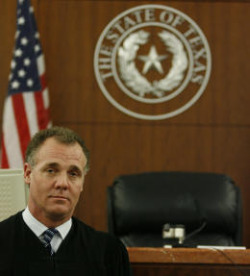
Harris County Judge Kevin Fine is presiding over a dramatic hearing that, in essence, has placed the Texas death penalty on trial.  (As the picture to the left suggests, Judge Fine is not your average jurist.  Do the tats suggest an affinity with the accused?)  

According to the Houston Chronicle, “Defense lawyers for John Edward Green are arguing that Texas has executed two innocent defendants, and the procedures surrounding the death penalty in Texas are unconstitutional because there are not enough safeguards.” (more…)

Making a stand in Grenada

Making a stand in Granada, MS

This is the 4th installment of a series.  The first three segments can be found here, here and here

By Alan Bean

In 1962, when Doug Evans was attending junior high school in Grenada, Mississippi, a black man named James Meredith enrolled at the University of Mississippi sparking days of riots aided and abetted by Mississippi State Troopers. Four years later, when Doug Evans was in high school in Grenada, James Meredith launched a march against fear, heading south from Memphis to Jackson. Shortly after setting out, Meredith was shot in the leg by a sniper and was unable to continue. Civil Rights leaders like Martin Luther King and Stokely Carmichael rushed to Mississippi to pick up where Meredith had left off.

When the marchers arrived in Grenada on June 15, 1966, City Manager John McEachin explained the situation to a reporter: “All we want is to get these people through town and out of here. Good niggers don’t want anything to do with this march. And there are more good niggers than sorry niggers.” (more…)

90 year-old jurist gives up on the death penalty

Justice John Paul Stevens

By Alan Bean

Retired Supreme Court justice John Paul Stevens was never enthusiastic about the death penalty.  Like a lot of Americans, he believed that some violent crimes are so horrific that capital punishment is the only appropriate response.  This abstract support for ultimate penalty was rooted in the assumption that the American criminal justice system is capable, first, of restricting capital prosecution to the very worst sort of crime, and, second, that with a man’s life at stake, jurors would hold prosecutors to the highest evidentiary standard: proof beyond a reasonable doubt.

Justice Stevens is still outraged by egregious acts of wanton violence, but he no longer trusts prosecutors to single out the very worst crimes for capital prosecution.  Moreover, he realizes that, in far too many cases, the more shocking the details of a crime, the lower the evidentiary standard becomes.  The intense desire to see justice done in a particular case easily trumps human reason and the principle of equal justice under law.  This is particularly true, Stevens discovered, when the defendant is black and the murder victim is white. (more…)

Kairos, Narrative, and Transformation

Mark Osler at work

By Mark Osler

Last week, I had the opportunity to speak at the Kairos Conference on the death penalty at Emory University.  It was organized by People of Faith Against the Death Penalty and Sister Helen Prejean, and featured a fascinating array of voices.  However, things didn’t go quite as expected, in a way that was wonderful, instructive, and encouraging to groups like Friends of Justice.

Frankly, I expected to go down there, give my lectures, and talk to like-minded folks about the death penalty. All that happened, but that wasn’t all.  Sometimes a conference like that goes off in a direction you don’t expect. (more…)

The Claude Jones saga: Did Texas execute an(other) innocent man?

Claude Jones

By Alan Bean

Note: Dave Mann has written a well-researched feature story on this case for the Texas Observer.

Not that most Americans would care, but it appears that Texas executed another innocent man in 2000.  This story from the Fort Worth Star-Telegram relates the sad fate of Claude Jones, a St. Jacinto man convicted of killing a liquor store clerk in the course of an armed robbery in 1989. 

Prosecutors showed the jury a single hair that they claimed belonged to Jones.  They couldn’t be sure, mind you, and no DNA test was conducted, but they were pretty sure. 

But that wasn’t enough for a conviction, corroborating testimony was required.  Enter Timothy Jordan.  In exchange for a lenient sentence, he testified that he had served as an accomplice and that Jones was the trigger man.

Three years after Jones was executed, Jordan recanted his testimony. Need you ask why?  He was threatened with dire consequences if he refused to cooperate with prosecutors.  We’ve seen this movie before, haven’t we?

George W. Bush was fixin’ to leave the governor’s mansion for bigger and better things when he gave Jones’ execution the thumbs up.  No one on his staff mentioned that the hair that so impressed jurors had not been tested.

Now it has and we know for a fact that the hair did not belong to Jones. (more…)