Category: prosecutorial misconduct

Does banning the noose change anything?

For the fourth straight year, Texas congresswoman Sheila Jackson Lee has introduced an anti-noose bill.  The Noose Hate Crime Act of 201 stipulates that “Whoever, with intent to harass or intimidate any person because of that person’s race, color, religion, or national origin, displays a noose in public shall be fined under this title or imprisoned not more than 2 years, or both.”

Hate crimes legislation, though admirable at first glance, raises serious First Amendment issues.  In practice, it will be difficult to prove that a specific noose hanger was motivated by a desire to “harass or intimidate”. 

Jackson Lee’s bill was first introduced as a response to the noose hanging in Jena Louisiana, but I’m not sure it would (or should) apply to that kind of situation.  What would have been gained by locking up the Jena noose hangers for two years?  Would this teach them a lesson they would never forget, or would it simply harden the racial resentment that motivated their act in the first place? (more…)

Simple Justice reviews “Taking out the Trash in Tulia, Texas”

“That Alan Bean chose to keep his narrative close to the vest, to let the facts do the talking for him rather than ram the moral of this sordid story down the reader’s throat, makes this book a fascinating and consuming read. Be prepared, as once you start reading Taking Out The Trash, chances are you won’t put the book down until you’ve finished.”

Scott Greenfield’s review of Alan Bean’s book, “Taking out the Trash in Tulia, Texas” originally appeared in Scott’s highly respected blog, Simple Justice.

Book Review: Taking Out The Trash in Tulia, Texas

I’ve never been to Tulia. There’s no particular reason why I would go there, and yet after reading Alan Bean’s book, Taking Out The Trash in Tulia, Texas, published by Advanced Concept Design Books, I feel as if I know the place well. (more…)

Death penalty dies a slow death in Illinois

By Alan Bean

Eight years ago, Illinois Governor George Ryan declared a moratorium on the death penalty when it was revealed that many “confessions” were coerced.  In Chicago, for instance, commander Jon Burge allegedly tortured one hundred eight men between 1973 and 1991.  Now, the Illinois legislature has voted to make Ryan’s moratorium permanent and hopes are high that current governor Pat Quinn will sign the legislation.

This Chicago Tribune editorial demonstrates that compassion for murderers has little to do with the demise of the death penalty in Illinois.  Few Americans want to be associated with rank injustice.  When the system is so broken that innocent men are certain to die, support for the ultimate punishment plummets.  (more…)

Key witness in Flowers case sentenced to federal prison

Patricia Hallmon's residence in Winona, MS

By Alan Bean 

The state’s key witness in the six (6) trials of Curtis Flowers will be spending the next three years in federal prison.

When the trial of Patricia Hallmon Sullivan was first reported in the Jackson Clarion-Ledger, her link to the Flowers case wasn’t mentioned.  Fortunately Jimmie E. Gates eventually connected the dots.

By coincidence, Patricia Hallmon Sullivan was represented by Mike Horan of Grenada, a former assistant to Doug Evans, the lead prosecutor in the Flowers case.  According to the Clarion-Ledger article (see below) Horan  told Barbour that Sullivan’s testimony led to Flowers’ convictions.

So it did.  Take Patricia Hallmon and her darling brother, Odell, out of the mix and the state’s case against Flowers fall apart.  (more…)

Major study examines prosecutorial misconduct

By Alan Bean

In another sign that the American mainstream is taking notice of a broken system of justice, USA Today has published “Justice in the Balance“, a series of articles focusing on prosecutorial misconduct, particularly in the federal justice system.  The series began in September of last year and the most recent submission was posted on December 29, 2010.

According to writers Kevin McCoy and Brad Heath, “USA TODAY documented 201 cases since 1997 in which federal courts ruled that prosecutors had violated laws or ethics rules.  Some of these violations put innocent people in prison, but in at least 48 cases defendants were later convicted, then had their sentences reduced or were even set free . . . Although those represent a tiny fraction of the tens of thousands of federal criminal cases filed each year, the problems were so grave that judges dismissed indictments, reversed convictions or rebuked prosecutors for misconduct.” (more…)

When the police knock down your door: more on the Richardson Raid

Vergil and Mark Richardson

By Alan Bean

Friends of Justice was first to bring you the troubling story of Mark and Vergil Richardson, but we certainly aren’t the last.  First we had Wade Goodwyn’s excellent story for NPR’s All Things Considered, and now Jordan Smith of the Austin Chronicle is using the Richardson story as an entre into the strange world of no-knock searches for The Crime Report.  Radley Balko, one of the experts interviewed for Smith’s story, reports that “the number of SWAT call-outs averaged 3,000 annual between the 1980s and 2005. Now the annual figure is roughly 50,000.”

When Police Break Down Your Door

Jordan Smith

December 15, 2010

An increase in the use of  ‘no-knock’ warrants around the country has alarmed civil liberties advocates.

On Nov. 17, 2007, Vergil Richardson was sitting at a table in the house he owns in the small northeast Texas town of Clarksville, playing dominoes with several relatives, including his half-brother Kevin Calloway, when the front door exploded inward and the living room was flooded with police.

“They just broke into the house,” Vergil recalled recently. “They had guns on us and threw me down on the floor.” (more…)

“The Confessions”: Frontline highlights the case of the Norfolk Four

I was out-of-town on a speaking engagement when “The Confessions” originally aired on Frontline.  I strongly urge you to watch the entire program online.  It won’t be a pleasant experience.  Listening to this twisted saga kept taking me back to the recent trial of Curtis Flowers–the stories are very different in some respects, but wrongful convictions follow a familiar pattern.
Two of the attorneys representing the defendents in this case, by the way, are Des Hogan and George Kendall, key members of the legal “Dream Team”  involved in the fight for justice in Tulia, Texas.

The story of the Norfolk Four revolves around aggressive interrogation, false confession, and prosecutorial tunnel vision.  Once the detectives responsible for the investigation latched onto a theory of the crime, they clung to it tenaciously–facts be damned. (more…)

Texas Court Halts Controversial Hearing


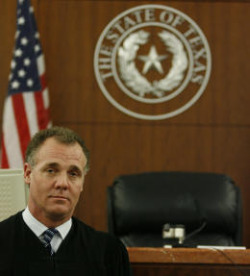
Judge Kevin Fine

To the surprise of no one, the Texas Court of Criminal Appeals has halted a controversial hearing in Houston designed to consider the constitutionality of the Texas death penalty.  Prosecution and defense counsel have fifteen days to present arguments.  

District Judge Kevin Fine is aware that the US Supreme Court has upheld the constitutionality of the Texas death penalty, but needs to be convinced that the statute can be fair in the case of John Edward Green Jr.

Bob Loper, one of the attorneys representing John Edward Green Jr, believes the hearing (originally scheduled to last two weeks) will continue.  “We’re confident we’ll get a ruling in our favor,” Loper told the Associated Press. “We think our cause is just.”

This quote reminds me of the “expert” who told NPR recently that the TCCA would likely turn a deaf ear to Tom Delay’s appeal because “the court has a conservative reputation.”  (Delay was recently convicted of conspiracy and money-laundering by an Austin, Texas jury.)  The ulta-conservative tilt of the state’s highest court is precisely why Tom Delay has a good chance of getting a reversal and why and the hearing in Judge Fine’s court is unlikely to resume. (more…)

Death penalty on trial in Harris County

Harris County Judge Kevin Fine

Harris County Judge Kevin Fine is presiding over a dramatic hearing that, in essence, has placed the Texas death penalty on trial.  (As the picture to the left suggests, Judge Fine is not your average jurist.  Do the tats suggest an affinity with the accused?)  

According to the Houston Chronicle, “Defense lawyers for John Edward Green are arguing that Texas has executed two innocent defendants, and the procedures surrounding the death penalty in Texas are unconstitutional because there are not enough safeguards.” (more…)

Making a stand in Grenada

Making a stand in Granada, MS

This is the 4th installment of a series.  The first three segments can be found here, here and here

By Alan Bean

In 1962, when Doug Evans was attending junior high school in Grenada, Mississippi, a black man named James Meredith enrolled at the University of Mississippi sparking days of riots aided and abetted by Mississippi State Troopers. Four years later, when Doug Evans was in high school in Grenada, James Meredith launched a march against fear, heading south from Memphis to Jackson. Shortly after setting out, Meredith was shot in the leg by a sniper and was unable to continue. Civil Rights leaders like Martin Luther King and Stokely Carmichael rushed to Mississippi to pick up where Meredith had left off.

When the marchers arrived in Grenada on June 15, 1966, City Manager John McEachin explained the situation to a reporter: “All we want is to get these people through town and out of here. Good niggers don’t want anything to do with this march. And there are more good niggers than sorry niggers.” (more…)