I spent last weekend attending a conference on “the Emerging Church” held on the campus of Texas Christian University. Below, I have reproduced my noted from three talks, two by Brian McLaren, a clear-sighted Protestant, and one by Father Richard Rohr, a Roman Catholic priest dedicated to the contemplative life. These three talks complement one another and inform our struggle with mass incarceration, but I will leave it to you to make the connections. My summary is taken from my notes, so, gentlemen, if you read this and think I misrepresented your ideas, I am open to correction.
Brian McLaren 1: Clenched Fists and Open Hands
Brian McLaren
The world runs on stories, McLaren says. It is the role of religion to provide us with our stories; but what happens when these stories no longer help us address the big issues: poverty, peace and the planet?
The primary religious narrative in Western culture, McLaren suggests, has been the domination story: stories of the clenched fist which could also be called conflict narratives, warrior narratives or sword narratives. Typically, empires appear as the heroes of domination narratives. (more…)
Over at Religious Dispatches, Daniel Schultz takes the religious Left to task for being too nice. Here’s a teaser:
“I’ve been asked a lot over the course of this fall why we don’t have a politically effective religious left in America. The short answer is that there’s a significant trade-off between being nice (or engaging in “civil discourse,” as it’s called these days) and being potent. All the commitment to moral suasion, to building consensus, to reconciliation between political opponents, all the commitment in the world to “speaking out” about your values isn’t going to accomplish squat.”
Pastor Dan’s “support the poor, or go to hell” theme is one of several semi-serious suggestions for giving progressive religious messaging some much-needed bite. (more…)
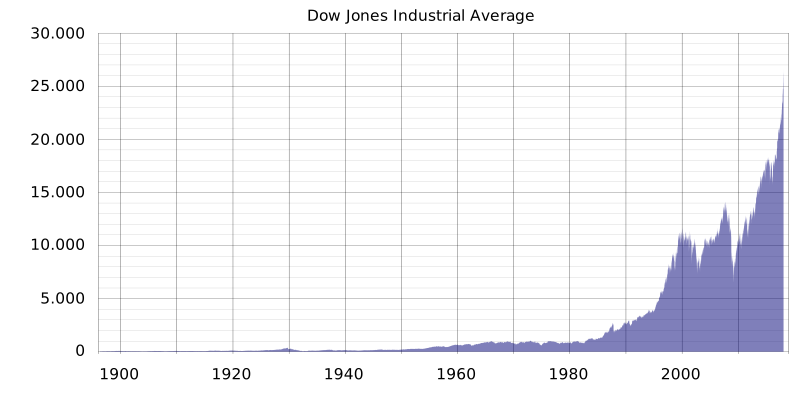
Check out the two graphs below. See any similarities?
Is it just a coincidence that the American incarceration rate and the Dow Jones Average have an identical trajectory between 1960 and 2000? In both cases we see decades of minor dips and blips followed by a rocket launch. (more…)
This is the 4th installment of a series. The first three segments can be found here, here and here.
By Alan Bean
In 1962, when Doug Evans was attending junior high school in Grenada, Mississippi, a black man named James Meredith enrolled at the University of Mississippi sparking days of riots aided and abetted by Mississippi State Troopers. Four years later, when Doug Evans was in high school in Grenada, James Meredith launched a march against fear, heading south from Memphis to Jackson. Shortly after setting out, Meredith was shot in the leg by a sniper and was unable to continue. Civil Rights leaders like Martin Luther King and Stokely Carmichael rushed to Mississippi to pick up where Meredith had left off.
When the marchers arrived in Grenada on June 15, 1966, City Manager John McEachin explained the situation to a reporter: “All we want is to get these people through town and out of here. Good niggers don’t want anything to do with this march. And there are more good niggers than sorry niggers.” (more…)
Retired Supreme Court justice John Paul Stevens was never enthusiastic about the death penalty. Like a lot of Americans, he believed that some violent crimes are so horrific that capital punishment is the only appropriate response. This abstract support for ultimate penalty was rooted in the assumption that the American criminal justice system is capable, first, of restricting capital prosecution to the very worst sort of crime, and, second, that with a man’s life at stake, jurors would hold prosecutors to the highest evidentiary standard: proof beyond a reasonable doubt.
Justice Stevens is still outraged by egregious acts of wanton violence, but he no longer trusts prosecutors to single out the very worst crimes for capital prosecution. Moreover, he realizes that, in far too many cases, the more shocking the details of a crime, the lower the evidentiary standard becomes. The intense desire to see justice done in a particular case easily trumps human reason and the principle of equal justice under law. This is particularly true, Stevens discovered, when the defendant is black and the murder victim is white. (more…)
This is the third excerpt from a speech delivered on the campus of the University of Chicago. Part one can be found here two can be found here.
The New Jim Crow comes to Jena, Louisiana
In 1991, the same year Larry Stewart was elected Sheriff of Swisher County, Texas, J. Reed Walters became District Attorney of LaSalle Parish in north central Louisiana, winning 52% of the vote. David Duke, the former Ku Klux Klan Grand Dragon who ran for governor that year, carried 70% of the vote in the parish, his best showing in Louisiana. Since the LaSalle Parish electorate is 86% white, this suggests that an unapologetic racist won over 80% of the white vote that year.
In 2008, 85.5% of LaSalle Parish voters supported John McCain; a likely indication that Barack Obama received zero support from white voters.
When Reed Walters passed his bar exams in 1980, Speedy O. Long was still District Attorney. Long took the young attorney under his wing and taught him the ropes. When Speedy went to his reward in 2005, Reed Walters called him a friend and mentor. (more…)
This is the second excerpt from a speech recently delivered at the Campaign to End the Death Penalty conference on the campus of the University of Chicago. The introduction can be found here. AGB
The new Jim Crow comes to Tulia, Texas
By Alan Bean
Sheriff Larry P. Stewart
To understand how radically our society has changed it is helpful to trace the life stories of the folks running the new Jim Crow machinery in small southern towns. The stories you are about to hear are taken from cases investigated by Friends of Justice, but they are symptomatic of a national disease.
I started talking about the new Jim Crow in Tulia, Texas when I realized that a drug bust that swept up half the adult black males in town was standard operating procedure.
There is a picture of Larry Stewart in an old copy of the Tulia Herald. It was Cowboy Day at the Tulia High School, circa 1960, and Larry came dressed as an old-time Texas Sheriff, badge and all. But Larry wasn’t supposed to grow up to be a lawman; like most local boys he wanted to farm like his daddy did before him. (more…)
Wade Goodwyn’s “Reporter’s Notebook” on the NPR site deals with a curious encounter with the black principal of Clarksville High School. I urge you to give Wade’s account your careful attention because it highlights a tension that exists within the African American community, especially in small southern towns where it is incumbent upon black professionals to remain in the good graces of the white establishment. I could relate similar stories from my work in places like Tulia and Hearne, Texas; Jena and Church Point, Louisiana; and Winona Mississippi.
It is easy to write off people like the principal described below as an Uncle Tom, and doubtless the shoe fits. But the economic and social consequences of denouncing injustice can be catastrophic. (more…)
Michael Vick’s performance against the Washington Redskins on Monday Night Football may constitute the most impressive single game by a quarterback in the history of the NFL. Nicole Greenfield gives the religious backstory of Vick’s remarkable post-prison turnaround at Religious Dispatches this morning.
But Washington Post columnist Courtland Milloy takes a different slant. Quoting copiously from Michelle Alexander’s game-changing The New Jim Crow: Mass incarceration in an age of colorblindness, Milloy points out that Vick’s “prison was just what I needed” testimony may be sincere, but his experience is hardly typical. The Eagle’s QB isn’t just adept at dodging would-be tacklers, his celebrity status and high-profile supporters allowed him to escape America’s new caste system. Here’s the normal pattern:
“Once swept into the system, one’s chances of being truly free are slim, often to the vanishing point,” Alexander writes. “The fact that more than half of the young black men in any large American city are currently under the control of the criminal justice system [or saddled with criminal records] is not – as many argue – just a symptom of poverty or poor choices, but rather evidence of a new racial caste system at work.” (more…)
Wade Goodwyn does his usual impeccable job of bringing an utterly outrageous story to national awareness. If you follow this blog you are already familiar with the basic outline of this story, but Goodwyn inserts the human element that is typically missed by the mainstream media. You can hear the original audio version at the All Things Considered Site.
At the end of the Richardsons’ story you will find brief summaries of three related Texas narcotics cases Wade Goodwyn has covered over the years, stories that provide some of the best New Jim Crow illustrations available anywhere in America. Friends of Justice didn’t just bring the Richardson fiasco to public attention, we were also involved in the other three cases (see my comments below at the end of the NPR piece).
One last word. Without the dogged determination and courage of the defendants (particularly Vergil and Mark Richardson) and attorney Mark Lesher, justice would never have been served in this case.