Category: Texas

Gay at Baylor: A Christian Challenge

This piece originally appeared in the Huffington Post

By Mark Osler

This past October, I wrote a piece in the Huffington Post entitled “Repentance of an Anti-Gay Bigot.”  Among the dozens of responses I received were many from my former law students at Baylor University, where I taught for ten years.  They were heart-wrenching, revealing the pain of attending Baylor in fear of being found out and expelled; of isolating themselves from their classmates; and ultimately their alienation from Baylor and even Christianity.  Baylor bars gays and lesbians from the faculty, and has fought hard to keep any gay student support groups from gaining recognition.  It has done this in the name of Jesus Christ, claiming the authority of the Bible.

I don’t teach at Baylor anymore.  This week I am starting my second year as a professor of law at a Catholic school, St. Thomas, in Minneapolis.  Though smaller than Baylor, it is similar in many ways.  It is strong in its faith identity, and the majority of faculty (at least in my department) and students are more conservative than you would find at most other schools.  Yet, there are differences, and at least one may be crucial to Baylor’s future.

 After a few weeks of teaching sentencing at St. Thomas, one of my students stopped by to see me right before lunch, so I invited him to join me.  He had a genuine interest in criminal law, and in particular wanted to work for the U.S. Department of Justice, my former employer.  I love talking about the DOJ, and asked him which division he would like to work in.

 He immediately told me he wanted to work in the Civil Rights Division in Washington, an important and often controversial office.  Looking over my sandwich at this middle-aged white male, I asked “Why Civil Rights?”

Mark Osler

He immediately responded, “Well, I’m gay.”  He then began to describe some of the work he had already done in the area, but I barely knew he was talking—after ten years at Baylor, I was in a state of shock to hear a student openly admit this to a professor in a public place.  I looked behind me to see if anyone we might know was around, and felt relieved when there were only strangers.

I need not have worried.  St. Thomas has a gay and lesbian student organization, my administrative assistant is openly gay, and two of my colleagues who are full professors are also openly gay and are welcome to (and do) bring their partners to law school events.  Yet, not only does the school survive, but the fact that we are welcoming to gays and lesbians does not in the least seem to be read as any kind of statement on the part of our sponsoring body, the Archdiocese of Minnesota.  We are a community that includes gay men and lesbians as faculty, staff, and students, and stand proudly together as Christians.

Baylor can accept gays and lesbians without sacrificing anything.  Yes, the student code of conduct bars pre-marital sex, but gays and straights are equally susceptible to breaking that rule; if potential for sexual relations is a reason to bar anyone, it is a reason to bar everyone.   That rule should be enforced evenly.  All evidence now is that it is enforced in the dorms, but not elsewhere.  If that is the case, then enforcement should be consistent, gay or straight.

Former Baylor President Abner McCall once told a good friend of mine that “Baylor can’t be a Christian.  Only people can be Christian.”  As Christian people we must be both honest and loving.  Honesty tells us that there have been, are now, and will be gays and lesbians at Baylor.  If the plan has been to exclude them, Baylor has done a lousy job.   Given that gay men and lesbians are and will be students at Baylor, love instructs us to help them grow in faith and to welcome them, rather than exclude or demean them.

 The time has come for Baylor to hire gays and lesbians who meet all other requirements; to lift the veil of fear from student life; and to allow gay and lesbian groups to establish themselves on campus.  Baylor is strong, proud, and Christian, and all of those qualities make such a change possible without a loss of identity.

 To remain an engaged and relevant institution, Baylor must change.  Its message to gays and lesbians has to be something other than what is perceived on campus now:  That if you are gay, there is no love for you, on Earth or in Heaven.  Christ promises more, and so should Baylor.

Rachel Tabachnick talks dominionism on Fresh Air (and why you should be paying attention)

By Alan Bean

Are Rick Perry and Michelle Bachmann part of a movement determined to forcibly Christianize every aspect of American culture?

If so, why does a blog dedicated to ending mass incarceration care one way or the other?

If Rachel Tabachnick is anything to go by, the answer to the first question is ‘yes’.  Tabachnick knows more about the dominionist strain within contemporary evangelicalism than just about anybody and you simply must check out her recent interview with Terry Gross of Fresh Air.)

I am still thinking through my answer to the “so what” question (and will have more to say on the subject as my thinking clarifies); but the rough outline of an answer came to me yesterday when a reporter asked me why Louisiana (unlike Texas and Mississippi) has done nothing to reform its criminal justice system.

The avuncular visage of Burl Cain sprang to mind.  Cain is slowly transforming the Angola prison plantation into a spiritual rehabilitation center.  Inmates (90% of them in for life) are repeatedly invited to get right with Jesus.  Life becomes a whole lot easier if they take the offer.

Then I thought of Ann Richards, the progressive Texas Governor who, during her ill-fated re-election campaign against George W. Bush, told the voters that she wanted to build more prisons so folks with addiction issues could get rehabilitated.

Burl Cain and his Louisiana fan club want to lock up more people every year so earnest evangelists can have a captive audience.

Friends of Justice works in Texas, Louisiana and Mississippi, three states that are gradually backing away from the punitive consensus that has controlled the American judicial system for more than three decades.  Texas was embarrassed into rethinking mass incarceration through a series of scandals: Tulia (the bizarre drug bust that gave birth to Friends of Justice), Hearne (the American Violet story), the Dallas Sheetrock scandal, the Houston crime lab, the Texas Youth Commission fiasco, an incredible string of DNA exonerations in Dallas County and Governor Perry’s botched attempt to silence the Texas Forensic Science Commission.  Thanks to a series of modest reforms, the Texas prison population has now plateaued in the 160,000 range (it was 40,000 in 1980) and will likely stay there for the foreseeable future.

Mississippi experienced a 3.5% drop in its prison population in a single year by deciding that inmates must only serve 25% of sentences before being eligible for parole (it had been 85%).

The old “lock ’em up” mentality is beginning to soften even in the state that boasts the highest incarceration rate in the free world.  Folks in Louisiana want to lock up as many people as possible out of a misdirected sense of compassion.  After all, isn’t it better to find Jesus in jail than to live an unregenerate life in the free world?  We don’t hate criminals in Louisiana; we just want what’s best for them.

This is precisely the kind of theocratic logic that politicians like Rick Perry and Michelle Bachmann have embraced.  They want to Christianize the nation (by force if necessary) the way Burl Cain has Christianized the Angola plantation.  And if the liberals presently controlling Hollywood, the recording industry, the public school system, the evening news and the political life of the nation don’t want to be Christianized, that’s just too bad.  Michelle, Sarah, Rick et al are God’s anointed apostles.  At Angola, to oppose Burl Cain is to oppose God; the New Apostolic Reformation wants to extend this kind of thinking to every aspect of our national life.

Do the politicians currently feeding at the trough of radical religion really believe that the eclectic vitality of a diverse nation can be homogenized by the blood of the Lamb?  Maybe not.  But they want to push the political envelope as far in that direction as the public will allow.  In these strange times, it’s smart politics.

If you think I’m overstating the case, please read Ms. Tabachnick’s conversation with Terry Gross.

The Evangelicals Engaged In Spiritual Warfare

August 24, 2011 – TERRY GROSS, host:

This is FRESH AIR. I’m Terry Gross. (more…)

Texas and the “school-to-prison pipeline”

By Melanie Wilmoth

A recent Washington Post article by Donna St. George sheds light on the increasing criminalization of student discipline in the US and the effect it has on Texas children.

As a result of zero-tolerance policies, schools have been funneling kids from the classroom to the cell-room through what some are calling the “school-to-prison pipeline.” Schools have increasingly turned to ticketing to deal with behavior issues that, in the past, were handled by school administration. It is not uncommon for students to receive school-based tickets for disruptive behavior such as cursing in class, tardiness, truancy, and fighting. Shockingly, a 2010 report by Texas Appleseed indicated that children as young as 6 have received tickets.

St. George points to some equally alarming facts:

[Texas] stands out for opening up millions of student records to a landmark study of discipline, released in July . The study shows that 6 in 10 students were suspended or expelled at least once from seventh grade on. After their first suspension, they were nearly three times more likely to be involved in the juvenile justice system the next year, compared with students with no such disciplinary referrals…Students who have been arrested or appeared in court are more likely to drop out of high school…Dropouts, in turn, are more likely than graduates to be incarcerated or unemployed.

The criminalization of student disciple has become such a prominent problem in the US, that national organizations such as the American Civil Liberties Union have made challenging the “school-to-prison pipeline” one of their key issue areas.

Texas students sent from classroom to courtroom

By Donna St. George

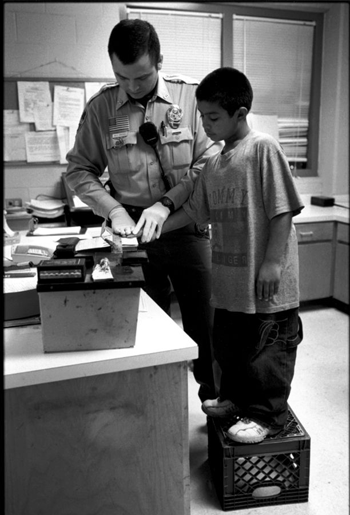
SPRING, TEX. — In a small courtroom north of Houston, a fourth-grader walked up to the bench with his mother. Too short to see the judge, he stood on a stool. He was dressed in a polo shirt and dark slacks on a sweltering summer morning.

“Guilty,” the boy’s mother heard him say. (more…)

Rick Perry’s Texas miracle…or not.

By Melanie Wilmoth

In the wake of his recent presidential candidacy announcement, Governor Rick Perry hasn’t been shy in reporting that, despite the ongoing economic crisis, Texas continues to create more new jobs than any other state in the nation. It’s a “Texas Miracle” as Perry calls it.

Perry attributes this job growth to his successful implementation of conservative principles such as low taxes and minimal government regulation. However, as Harold Meyerson points out, Perry neglects to mention the quality of the jobs created in Texas. According to the Bureau of Labor Statistics, Texas ties with Mississippi for the highest percentage of workers in minimum wage jobs.

Although low-wage jobs may bring more businesses to Texas (greater access to cheap labor will often do that), this type of job creation does little to break the cycle of poverty. It comes as no surprise that Texas ranks 4th highest in the percentage of individuals living below the federal poverty line. That’s some “miracle.”

Take a look at what Meyerson has to say:

The sad facts behind Rick Perry’s Texas miracle

By Harold Meyerson

Rick Perry’s Texas is Ross Perot’s Mexico come north. Through a range of enticements we more commonly associate with Third World nations — low wages, no benefits, high rates of poverty, scant taxes, few regulations and generous corporate subsidies — the state has produced its own “giant sucking sound,” attracting businesses from other states to a place where workers come cheap. (more…)

Rick Perry’s Big Gamble

By Alan Bean

It no longer matters whether Rick Perry’s The Response extravaganza draws 8,000 or 80,000 ardent Christians to Houston’s Reliant Stadium; the event will be remembered (if it is remembered at all) as a cynical attempt to build a base by driving another wedge into an already fractured religious community.

Perry’s big event would have been inconceivable during the nation’s formative years, and it is hard to imagine any 20th century presidential candidate thinking he could enhance his political stature by consorting with fringe elements on the religious right.  True, George W. Bush and Ronald Reagan courted these same people, but always behind closed doors.

The take-away from The Response is that a Republican presidential aspirant believes an event of this sort is in his political interest.  Rick Perry’s personal religion is irrelevant here; tomorrow’s event is pure politics.

Will the gamble pay off? (more…)

Is Rick Perry having second thoughts about The Response?

You may be wondering what happened to The Response, Texas Governor Rick Perry’s Christians-only pray-for-America extravaganza.  This article in the Texas Observer should bring you up to date.

One word of caution.  Although the Observer piece gives the impression that The Response has been an unmitigated disaster for Governor Good Hair (as Molly Ivans called him), Mr. Perry’s political fortunes have risen considerably since The Response hit the airwaves.  The folks associated with the event may sound silly to worldly sophisticates like Rachel Maddow, but it sends all the right signals to the conservative wing of the Republican Party.  In other words, the Texas Governor’s stock is rising with the most powerful political and social movement in recent American history.

Meanwhile, Perry has been balancing the political ledger by supporting New York’s support for gay marriage on states’ rights grounds.  AGB

Is Rick Perry Getting Cold Feet Over the Response? 


Forrest Wilder

You’ve gotta wonder if Rick Perry may come to regret “initiating” The
Response, his Christians-only prayer rally. As I documented in a cover
story
for the Observer, Perry has thrown in with a strange band of
fundamentalists from the bleeding edge of American Christianity. (more…)

When proof isn’t possible

By Chaka Holley

“Innocent until proven guilty is the old mantra”; but a convicted defendant is “guilty until proven innocent.” James Legate and his wife, Yolanda, are attempting to prove his innocence as he sits behind bars in Texas.

Legate was convicted of the murder of Eddie Garcia, a San Antonio businessman. Garcia, known as the “Bingo King” owned a home-health care business, tons of real estate and managed prize fighters. He is also known for giving a $35,000 bribe to former Congressman Albert Bustamante. The two of them were under FBI investigation. A federal jury found Bustamante guilty of racketeering but Garcia was never indicted. Friends of Garcia have also alluded to Garcia being involved in other illegal practices.

Legate, on the other hand, was the man on trial. His job repossessing cars landed Legate in the middle of a murder scene. It was like a scene from a television crime show. After having drinks at a sports bar, Legate reports going to Garcia’s office in search of Marilyn Maddox, a woman who had recently worked for Garcia and was behind on her car payments. Legate explained that he visited the office in an attempt to repossess her car. (more…)

Texas politicians choose prisons over schools

A recent article in The Economist argues that conservatives can call for criminal justice reform without appearing to be tough on crime.  The Lone Star State is held up as a prime example of conservative politicians turning away from mass incarceration:

Texas began tackling these problems in the last decade. In 2003 it started mandating probation rather than prison for first-time offenders caught with less than a gram of hard drugs. Two years later it gave the probation board more money to improve supervision and treatment programmes. In 2007, faced with predictions that it would need over 17,000 new prison beds by 2012, requiring $1.13 billion to build and $1.5 billion to operate, Texas allocated $241m to fund treatment programmes. Since 2003 crime of many kinds has declined in Texas. Between 2007 and 2008, Texas’s incarceration rate fell by 4.5%, while nationally the rate rose slightly. Both juvenile crime and the number of juveniles in state institutions have declined.

Over at Grits for Breakfast, Scott Henson isn’t convinced.  (more…)

Bob Moses: The White-Power Legislature

I’m not suggesting anything conspiratorial here—Heaven forbid!—but it does seem mighty suspicious that school funding is being decimated at a time when Texas schools are “browning” at a rapid pace. In the last decade, Hispanic enrollment in public schools jumped by 50 percent, with 775,000 more students. Meanwhile, 6 percent fewer Anglo students are enrolled, as well-off whites opt for private schools. Why is public-school funding less of a priority for Anglo legislators nowadays? You do the math.  (Bob Moser, Texas Observer)

Teachers in Texas are sighing with relief now that the Texas Legislature has cut “only” $4 billion from the public education budget.  That doesn’t sound so bad when some were forecasting cuts in the $8 million range.  But Mob Moser, writing in the Texas Observer, says the spirit of the current legislative session reflects a new and pernicious species of white supremacy.

 The White-Power Legislature

Published on: Monday, May 16, 2011

Back in February, at a rally protesting anti-immigrant legislation, state Rep. Lon Burnam raised some eyebrows by letting loose with the “R” word. “You are here,” he told the crowd at the Capitol, “to say no to the most racist session of the Texas Legislature in a quarter of a century.” The Fort Worth Democrat had in mind such bills as Voter ID, which suppresses minority votes, and “Sanctuary City” legislation, which would legalize racial profiling. It had been decades, Burnam argued, since so many laws were aimed at putting non-whites, you know, in their place. “All of this legislation is really directed that way,” he said. “Everybody knows it.” (more…)

US Navy names ship after Cesar Chavez

The US Navy has named a ship after civil rights leader Cesar Chavez.  Self-taught historian, David Barton, may think Chavez is unworthy of emulation and the Arlington School Board may think he doesn’t deserve to have a special day, but the Secretary of the Navy Ray Mabus takes a different view:

Cesar Chavez inspired young Americans to do what is right and what is necessary to protect our freedoms and our country.  The Cesar Chavez will sail hundreds of thousands of miles and will bring support and assistance to thousands upon thousands of people. His example will live on in this great ship.

I’m not sure Cesar and Ray would see eye-to-eye on “what is necessary to protect our freedoms”, but it is nice to see a man of honor and courage getting a little respect after serving several years as the unofficial pinata of Texas conservatives. (more…)