Category: The Religious Right

Did the Religious Right enable Guatemalan genocide?

Pat Robertson

In January, former Guatemalan military dictator José Efraín Ríos Montt was ordered to stand trial for his role in almost 2,000 deaths and 1,400 human rights abuses that occurred during his rule as de-facto president from 1982-1983. Montt, according to the New York Times, faces charges of genocide and crimes against humanity for his part in Guatemala’s brutal 36-year civil war which resulted in the deaths of nearly 200,000 people.

According to Bill Berkowitz of Talk2Action.org, televangelist Pat Robertson enabled the Guatemalan genocide.

Montt was a favorite among conservative evangelicals, including Robertson who “praised Montt for his ‘enlightened leadership.'” Berkowitz argues that the Religious Right played a large role in U.S.-Central American relations during the 1980s. In an attempt to end communism and expand evangelical Protestantism in Central America, the Religious Right supported military dictators and policies that were “responsible for the deaths of hundreds of thousands of people.”

Take a moment to read Berkowitz’s enlightening essay posted below. MWN

Guatemala’s Former Leader Charged with Genocide. Pat Robertson Enabled It.

by Bill Berkowitz

Nearly thirty years ago, Guatemala’s ruthless dictator, José Efraín Ríos Montt and televangelist Pat Robertson were practically tied at the hip. Now, Guatemala’s judicial system is debating how to handle charges of genocide against the former military dictator, while Robertson, who had praised Ríos Montt for his `enlightened leadership,’ appears to have turned his back on his old friend.

In the early 1980s, José Efraín Ríos Montt, a military general was a favorite of the Reagan Administration and U.S. Christian conservative evangelical leaders – particularly televangelist Pat Robertson — and organizations. Ríos Montt was one of a series of military dictators that masterminded the murders of perhaps as many as 200,000 Guatemalans — including tens of thousands of Mayan people — as well as the destruction of a numerous Mayan villages. (more…)

Franklin Graham and the black-white gap in American evangelicalism

Franklin Graham impersonates his famous father

By Alan Bean

I have never met Lisa Sharon Harper, but she’s been reading my mail.

Why, she asks, was Franklin Graham unwilling to apply the term “Christian” to president Obama?

Graham has trouble seeing the president as a fellow believer, Sharon Harper argues, because white Christians are rarely forced to wrestle with systemic injustice and are therefore uncomfortable with Christians who make this issue front and center.

I have a few minor quibbles with the argument below.

Many, perhaps most, black evangelical churches are just as fixated on personal salvation as white evangelicals.  Martin Luther King didn’t enjoy the enthusiastic support of most black Baptist churches in the South, and his social gospel remains suspect in many corners of the black church.

Secondly, Franklin Graham’s daddy, the iconic American evangelist Billy Graham, wasn’t quite as racially advanced as this post suggests.  True, he did open his crusades to black worshippers before most white evangelicals were comfortable with integrated evangelism, but as Darren Dochuk points out in his excellent study of California evangelicalism, Graham realized that segregation was becoming an embarrassment in America and thus an impediment to evangelism.  (more…)

A review of Charles Murray’s ‘Coming Apart’: do the poor suffer because they are bad or because they are dumb?

By Alan Bean

Charles Murray took so much flak for controversial The Bell Curve that he decided to write a book about white people rooted in much the same argument. 

Coming Apart, a book about the diverging fortunes of upper and lower class white Americans, begins where The Bell Curve ended.  The big factor driving the growing gap between the educated and the uneducated, Murray suggests, is “cognitive homogamy”, the fact that individuals with similar cognitive ability are having children.

In the old world, Murray says, most people lived and died in rural communities and small towns.  The smartest males might have left home for a few years of college, but they generally returned to marry the prettiest (not necessarily the smartest) girl in town.  The result, kids of normal cognitive ability.  Wealth was distributed largely on the basis of inheritance, not ability and the kids at Harvard weren’t much smarter than the kids at a good state school.

Since the early 1960s, however, smart people have been marrying other smart people and having smart kids.  The sons and daughters of these blessed unions have increasingly clustered in segregated neighborhoods in which “everybody has a bachelor’s or graduate degree and works in high-prestige professions or management or is married to such a person.”  Among this new elite, wealth is distributed on the basis of merit, the elite colleges compete for the brightest and the best and lesser institutions make do with students who will never be ready for prime time. (more…)

Santorum meant exactly what he said

By Alan Bean

Rick Santorum has raised eyebrows with a comment about President Obama’s “phony theology”.  According to the surging presidential candidate, Obama’s worldview is driven by “some phony ideal, some phony theology. Oh, not a theology based on the Bible, a different theology, but no less a theology.”

Aked to explain this remark on Face the Nation, Santorum said he was referring to the president’s environmental views.  According to an AP article:

The former Pennsylvania senator said Obama’s environmental policies promote ideas of “radical environmentalists,” who, Santorum argues, oppose greater use of the country’s natural resources because they believe “man is here to serve the Earth.” He said that was the reference he was making Saturday in his Ohio campaign appearance when he denounced a “phony theology.”

But when reporters asked for an explanation of the “phony theology” remark immediately after it was uttered, the candidate made no reference to environmentalism, explaining instead that the president practiced one of the various “stripes” of Christianity.

So where does Mr. Santorum stand?  Does he think Barack Obama is a genuine Christian or doesn’t he? (more…)

“The Power to Make us One”: Heather McGhee’s One-People America

By Alan Bean

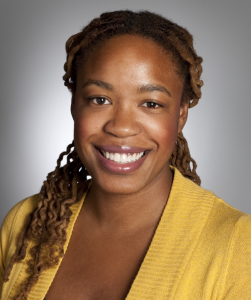
heather.mcghee – Netroots NationI recently heard Heather McGhee speak at the Samuel Dewitt Proctor conference in Chicago. She began with the obvious fact that America was not created to be one people, or one public.  Some folks were clearly part of the culture; others were not.  The primary dividing line was skin color.  Up until 1965, she reminded us, American immigration policy was built around strict racial quotas.  People of African descent were practically excluded altogether.  People from Eastern Europe were also subject to severe restrictions because they were considered ‘ethnic’.

That all changed in 1965.  In the wake of the civil rights movement, mainstream America was embarrassed by the undisguised racism implicit in the nation’s immigration policy.  The rules changed in fundamental ways.  Now, when you walk through an airport, you see every conceivable shade of skin color and you hear a wide variety of accents.  We have become, in a few brief decades, the world’s most audacious experiment in cultural diversity.

(more…)

Thinking and shouting in Chicago

By Alan Bean

Three Friends of Justice people are attending the Samuel DeWitt Proctor Conference at the Drake Hotel in Chicago this week.  Melanie Wilmoth and I are here, as is the Rev. L. Charles Stovall, Friends of Justice board member and associate pastor at St Luke United Methodist Church in Dallas.  Speaking of Methodists, a contingent of 40 United Methodists from across the nation, led by the indefatigable Rev. Laura Markle Downton, are in Chicago for the conference.  These are the folks who recently convinced their denomination to divest from for profit prisons.

I was bone weary when we entered the old fashioned elegance of the Drake Room for evening worship, but I left pumped and inspired.  The highlight of the evening was a stunning sermon on the familiar story of Daniel in the lion’s den from the Rev. Dr. Lance Watson, pastor of St. Paul’s Baptist Church in Richmond, Virginia.  Watson preaches in the traditional black style.  In the final ten minutes, brief bolts of organ music punctuated every phrase.  “I know it’s late,” he assured us, “and I ain’t gonna keep you long.  And I hope you know that, coming from a Baptist preacher, that don’t mean nothing.”

Dr. Watson didn’t just preach in the old time fashion, he interpreted the scriptures in the old time style, literally.  If God could deliver Daniel, the preacher told us, God can deliver you. 

Normally, this would bother me.  Isn’t this Daniel in the lion’s den thing just a folk story?  I mean, it didn’t really happen, did it?  And didn’t the author of the story refer to King Darius when it should have been Cyrus?  And can I really believe that if somebody threw me into a den of hungry lions I would emerge unscathed?

I wasn’t the least bit bothered by Dr. Watson’s straightforward exegesis, and I’ll tell you why.  So long as the preacher gets the application right, I don’t really care what school of biblical interpretation he follows.  Watson talked about the lions of mass incarceration and felon disenfranchisement.  He compared the steadfast obedience of Daniel to the grace Barack Obama has shown when the lions in his world insisted he produce a birth certificate.  When Watson came to the part where knaves use flattery to appeal to a king’s vanity, Watson talked about black politicians who don’t realize they are being used until the game is over.

The story of Daniel, like so many stories from the Bible, is about remaining faithful in the face of oppression.  Black America understands that message.  Earlier in the day, Susan Taylor, Editor Emeritus of Essence Magazine and the founder of a nationwide mentoring program for at-risk children, told us about her visit to one of the fortresses on the African coast where, for centuries, men, women and children waited for the slave ship to come.  In graphic detail, she described the horrors of the middle passage.  She said African Americans need to teach these things to our children and, if we have forgotten, to ourselves.

This is precisely the kind of stuff that makes white Americans profoundly uncomfortable.  All of that stuff happened so very long ago.  It was awful, to be sure, but why talk about it in polite company; it’s divisive, it just stirs things up.  I didn’t own any slaves and none of you have a personal experience with slavery so . . . let’s call the whole thing off. 

Black America needs to talk about the stuff white America needs to forget.  Or maybe we too need to remember, we just don’t know it yet.

Dr. Jeremiah Wright gave the benediction tonight.  Yes, that Jeremiah Wright.  Barack Obama’s former pastor.  The guy who enraged white America by suggesting that America’s chickens might be coming home to roost.  I was riding in a van with several black passengers when the towers fell in Manhattan.  Their reaction mirrored Wright’s.  Black and white Americans live in two different worlds, experientially and religiously.

There are plenty of white folks who share the ethical commitments of the Samuel DeWitt Proctor Conference.  We oppose the war on drugs, we think mass incarceration has been a disaster, and we want to address the conditions that foster violence and joblessness in poor urban neighborhoods.  But you would never hear a white person who believes these things preaching like the Rev. Dr. Lance Watson.  Most white progressives would be offended by biblical preaching.  If religion must be referenced at all, let it be generic religion, devoid of narrative content.   None of that Jesus stuff. 

White progressives (with a few blessed exceptions) associate words like Jesus, Bible, prayer, salvation and deliverence with the religious Right.  And, to be fair, the religious folk you see on the television and hear on the radio rarely reflect the kingdom priorities of Jesus.

Unlike their white counterparts, black progressives can, to paraphrase the Rev. Dr. Freddie Haynes, think and shout at the same time. “If you think,” he told us, “you will thank.  Think about how great our God is and you can’t help but get your shout on.”

Why do white Christians have such a hard time mixing kingdom ethics with shouts of praise.  I’m not sure, but the world would be a better place if we got over it.

The Californication of America: A review of Darren Dochuk’s “From Bible Belt to Sunbelt”

By Alan Bean

I received a copy of Darren Dochuk’s From Bible Belt to Sun Belt as a birthday present from my daughter, Dr. Lydia Bean.  She said I’d love it, and she was right.

Like me, Dochuk hails from Edmonton, Alberta, and, like me, his doctoral dissertation focused on Southern religion.  But while I was primarily interested in progressive Christians struggling for social survival in the Deep South, Dochuk turned his attention to evangelicals from states like Arkansas, Louisiana, Oklahoma and Texas who migrated in droves to southern California between the dust bowl thirties to the post-war period when the counties surrounding Los Angeles were booming as a result of massive government spending on military and aeronautical projects.

As a child, Darren Dochuk was driven to the vacation spots of Southern California every summer.  I dreamed of visiting Disneyland, but I never got there.  Still, the brand of Christian Right spirituality described in his book impacted my life in significant, sometimes painful ways.  The California-inspired Jesus People movement was in full flower when I attended the Baptist Leadership Training School in 1972.  It was around that time that my traditionally Baptist parents were attracted to the charismatic movement.  My father repeatedly invited me to luncheon meetings of the Full Gospel Business Men’s International, a loose affiliation of tongue-speaking, prophesying, faith healing neo-Pentecostals founded in Southern California by a layman named Demos Shakarian.

For me, these were bewildering experiences I had largely forgotten until I read From Bible Belt to Sun Belt.  Though I never understood the appeal of this style of religion, my parents informed me that my life would be transformed if I submitted to “the baptism” and received the “gift of tongues.”  I tried my best, but it didn’t take. (more…)

Dominionism sparks a nasty food fight

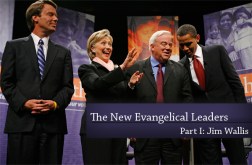
Jim Wallis with his conservative friends

A war of words has erupted on the web featuring self-described “secular liberal” Mark Pinsky and progressive evangelical Jim Wallis, on one side, and the consortium of scholars and columnists who write for Talk to Action on the other. 

Pinsky believes that critics of Dominionism and the New Apostolic Reformation have created the false impression that most evangelicals are dangerous theocrats. 

Next, Jim Wallis poured gasoline on the fire by claiming in a HuffPost piece, that “some liberal writers seem hell-bent on portraying religious people as intellectually-flawed right-wing crazies with dangerous plans for the country.”

Are Pinsky and Wallis making legitimate claims, or is something more sinister afoot?

Anyone familiar with the good folks at Talk to Action knows how carefully they distinguish Dominionism and mainstream evangelicalism.  Rachel Tabachnick, the most high-profile critic of the New Apostolic Reformation, grew up Southern Baptist and is well acquainted with the wild diversity within evangelicalism.  She is all about nuance.  She is saying that Dominionism has a long history (see my piece on the evolution and meaning of the movement), that it is a minority movement within evangelicalism that is growing rapidly and, most importantly, gaining the support of prominent politicians like Michelle Bachmann, Sarah Palin and Rick Perry.

Pinsky and Wallis refuse to engage this argument, preferring to publicly cudgel a silly straw man into submission.

How do we explain this unseemly assault on the Talk to Action people? (more…)

Bachmann’s Parallel Universe

Francis Schaeffer

By Alan Bean

How refreshing to read a piece about the Christian Right written by someone who once inhabited this world and retains an ear for nuance.  According the The Guardian website, “Karl Giberson is a science and religion scholar, speaker and writer. He is also a fellow of the American Scientific Affiliation.” 

Giberson came of age in the world of egghead evangelicalism.  

So did I.  Well, sort of.  As far as I can recall, I never heard sermons about creationism or any of the “alternative universe” constructions Giberson details below.  That stuff wasn’t as prevalent in my native country of Canada as it was in the American heartland.  Still, to the extent that Canadians take their intellectual cues from Great Britain or the United States, I couldn’t avoid the likes of Francis Schaeffer when I got to university. 

I wasn’t impressed.

When I arrived at Southern Baptist Theological Seminary in 1975, Schaeffer was regarded as a theological lightweight posing as an evangelical Renaissance Man.  As Giberson realizes (mercifully), not all evangelicals live in a tightly woven “alternative universe”.

But millions do, and these are the folks Rick Perry and Michelle Bachmann are currently courting.  In this parallel world, “scientists” preach an innerant Bible and assure the faithful that the world was created by the God of the Bible very, very recently.  Evolution is a myth, homosexuality is a disease and Christians are God’s chosen people.

So long as you never stray outside the carefully patrolled borders of this parallel universe, you are never forced to wrestle with opposing arguments or to consider alternative views.  But ishould you ever venture outside the fold, you will find yourself intellectually defenseless and intimidated.

Which is why hardcore evangelicalism works so hard to construct a social world offering cradle-to-grave protection from the demons of the secular world. 

The word “demons” in the previous sentence is not metaphorical–folks like C. Peter Wagner inhabit a demon (and angel) filled universe.  If old-school fundamentalists like J. Gresham Machen and William Bell Riley were steeped in the rationalistic canons of the modernism they opposed, this new breed of Christian soldiers are distinctly pre-modern.  In fact, they’re downright medieval, and proud of it.

Thinking evangelicals are an endangered species, but there are plenty of them still out there.  In 1994, evangelical historian Mark Knoll wrote The Scandal of the Evangelical Mind.  It has all been downhill since then.

Growing up in Michele Bachmann’s world

Millions of evangelicals, including GOP candidates, are trapped in an alternative ‘parallel culture’ with its own standards of truth

Michele Bachmann and I grew up in the same evangelical world. We heard similar sermons, read similar books – most importantly the Bible – and we followed the same anointed leaders.


By the time we were in college our generation of evangelicals had been educated into a profoundly different worldview than that of the secular, anti-Christian, Satan-following Ivy League elites we had been taught to fear. We understood the world to be a spiritual battleground with forces of good pitted against forces of evil. Real angels and real demons hovered about us as we prepared to wage these wars. We sang songs like Onward, Christian Soldiers in our churches. At summer camps and vacation Bible schools we stamped our feet, and waved our arms as we sang with good Christian gusto I’m in the Lord’s Army. We knew which side we were on.


Our religious literature was filled with the ideas of people like Francis Schaeffer, a fundamentalist Pennsylvania pastor who transformed himself into a guru by moving to the Swiss Alps, making himself look like Heidi‘s grandfather, and turning his home into a refuge for troubled pilgrims called “L’Abri“. Schaeffer, the intellectual architect of the religious right in America, helped a generation of young evangelicals understand that the corrosive forces of secular humanism were eating away at the foundations of the Christian west. We were heartened that such an impressive intellectual – a fundamentalist counter to Jacob Bronowski or Carl Sagan – was on our side.


Schaeffer’s 1976 bestseller, How Should We Then Live?, chronicled the decline of the Christian west, which had flourished with God’s blessing for centuries, but was now in decline. With broad brushstrokes, our alpine sage showed us how the west had sold its soul for a mess of secular pottage and sham materialism. Schaeffer’s million-selling manifesto was made into an impressive film series, narrated by Schaeffer. Clad in his iconic Swiss leggings, with a flowing mane of white hair and trademark goatee, Schaffer took viewers to all the great cultural spots in the west to help us understand what had gone wrong. The book and film series were widely used at evangelical colleges and universities across the country.


Michele Bachmann told the New Yorker recently that Schaeffer had a “profound influence” on her developing worldview as a young person. Millions of evangelicals would murmur “amen” to that. I read Schaeffer and watched his film series at Eastern Nazarene College in Massachusetts in 1979 as part of a capstone general education course required of all students.


Schaeffer was the most charismatic of the evangelical experts that shaped the world views of believers in the 1970s. There were many more with different specialities. We learned that evolution had no scientific support from young-Earth creationists like Henry Morris and Ken Ham. When Bachmann says that “evolution has never been proven” she is simply repeating what our generation has heard from evangelical leaders as we were growing. I enrolled at Eastern Nazarene College seeking credentials that would enable me to join the creationists in their fight against evolution.


We learned that homosexuality is a choice made by people to live in sin, under Satan’s influence. The reparative therapy – “pray away the gay” – used at the clinic run by Bachmann’s husband was something we all endorsed, under the influence of evangelical social scientists like James Dobson, who had a PhD in child development and thus knew what he was talking about. We grew up hearing about the “gay agenda” and how it was being used by Satan to destroy traditional morality and faith in the Bible.


Christian “historians” like Peter Marshall and David Barton helped us understand that America was a “Christian nation” and that recent travails, like the social upheaval of the 1960s that gave us drug abuse, promiscuity, and the homosexual agenda, were the result of abandoning America’s religious roots.

Many evangelicals, myself included, were fortunate enough to study under Christian scholars, like my professors at Eastern Nazarene College in the 1970s or my colleagues today at Gordon College, who see through the nonsensical claims of people like James Dobson, David Barton, Francis Schaeffer, and Ken Ham – who runs the preposterous Creation Museum in Kentucky. Even as a college student I recall Schaeffer being examined rather critically and young-Earth creationism dismissed out of hand.

There are, fortunately, many evangelical scholars – National Institutes of Health (NIH) director Francis Collins and historian Mark Noll come to mind – who are quietly raising alarms about all this dangerous anti-intellectualism, warning us about populist gurus who are marketing a “Christianised” version of knowledge that, on closer examination, turns out to be neither Christian nor knowledge.

Unfortunately, millions of evangelicals – and this would include much of the political base being courted by the GOP presidential candidates as well as the candidates themselves – are trapped in an alternative “parallel culture” with its own standards of truth. The intellectual authorities mentioned above – with the exception of Schaeffer who died in 1984 – all have media empires that spread their particular version of the gospel. Millions of dollars every year support the production of books, DVDs, radio shows, school curricula, and other educational materials. Very few evangelicals grow up without hearing some trusted authority – perhaps even with a PhD – tell them that the age of the Earth is an “open question”. Or that scientists are questioning evolution. Or that gays are getting spiritual help and becoming straight. Or that secular historians are taking religion out of US history.

Historian Randall Stephens and I have been interested in this alternative knowledge world for years. We grew up in it and emerged from it unscathed – as near as we can tell – but many of our evangelical students over the years have arrived at college with “truths” from this alternative knowledge world written on their hearts. Harvard University Press has just published our sympathetic insiders’ analysis of the parallel culture of American evangelicalism. Titled The Anointed: Evangelical Truth in a Secular Age, we look at how evangelical knowledge structures are exploited by media savvy authorities like those mentioned above.

And, as we watch the GOP candidates enthusiastically promote discredited ideas from this alternative knowledge world, we worry.

Dreaming a Christian aristocracy: The evolution and meaning of Dominionism

By Alan Bean

Our twenty-four hour news cycle doesn’t lend itself to careful analysis of complex social movements.  Rick Perry, the pugnacious presidential hopeful, raised eyebrows when he used a loose network of organizations associated with the New Apostolic Reformation to organize a big religious-political rally in Houston.  Interest quickened when the mainstream media learned that some of Perry’s friends were “Dominionists,” folks who want to bring secular politics (and everything else) under the dominion of God.

The questions couldn’t be avoided.  If elected, will Rick Perry pack his cabinet with Christian preachers?  Since that didn’t sound likely, the pundits too-easily assumed that politicians like Rick Perry and Michelle Bachmann are just standard-issue conservatives with close ties to the religious right.  (more…)