Category: Uncategorized

Alvin Clay update: The government rests

(If you want to know why the US government has invested over $1 million of your tax money in prosecutingt an innocent man, go to https://friendsofjustice.wordpress.com/alvin-clay/)

The government’s case against Alvin Clay wrapped up at 4:30 Friday afternoon; just in time for everyone to break for the weekend.  Jurors feared that they might have to work on Saturday, but the Clay trial has moved much more quickly than anyone expected.

The government has done a thorough and workmanlike job of making their case against Ray Nealy, the brains behind a real estate scam that hoodwinked buyers, sellers, mortgage firms, title companies and a Little Rock attorney. 

Since Mr. Nealy and his attorneys were not in the courtroom to counter the government’s case, the jury was treated to witness after witness laying out the manifold sins of Ray Nealy and his sidekick, Donny McQuien.  Defense counsel had little comment on this testimony, other than to point out that Alvin Clay was almost never mentioned. 

For four days of often tedious testimony it has been the Ray and Donny show.

The big exception to this rule was the testimony of the government’s star witnesses, Ray Nealy’s confidence man, Donny McCuien, and Nealy’s secretary and partner in crime, Jeron Marshall.

McCuien claims he never told a soul that rehab work was being done or that his company would be doing it, even though he gladly received $80,000 in checks from Alvin Clay for precisely that purpose.  According to McCuien, “Me, Ray and Clay,” would split up the proceeds after McCuien’s check had been cashed.

All the documentary evidence contradicts McCuien’s story, but the government has hitched its wagon to McCuien’s star nonetheless.  This is hardly surprising: the feds told McCuien what to say and how to say it.  In return, the star witness can expect lenient treatment at his sentencing hearing. 

Before the defense put on a single witness, it is clear to every observer (including, I pray, the jury) that McCuien is a pathological liar.  That doesn’t mean he finds it easy to bring down an innocent man.  A fellow spectator tells me Donny McCuien was sobbing in the witness room. 

Which is more pathetic: watching a compromised witness lying under oath, or watching an assistant US attorney suborning perjury?

Jeron Marshall is well acquainted with Alvin Clay; he used to be her boss.  In her Friday testimony, Marshall claimed she was fired because an illness kept her off the job.  The real story will come out when Mr. Clay takes the stand later this week.  Marshall was terminated for lying to her boss.

Now she’s lying about her boss–or at least she’s trying.

Marshall is desperate to cooperate with the government.  She resent Clay for firing her, and, by her own admission, she helped Ray Nealy fill out and fax fraudulent documents.  Names were forged, false claims were made and incomes were inflated.  Until I heard the government witnesses testify last week, I never realized how strong their case against Nealy and McCuien is.  Since Marshall was a willing participant, she is vulnerable to criminal charges, and she knows it.

Nonetheless, Ray Nealy’s secretary couldn’t come up with anything incriminating against Clay.  She shared the unremarkable fact that she sometimes saw Clay conversing with Nealy and McCuien.  Since Clay believed he was paying McCuien to rehab five properties, it is inevitable that a few quick discussions took place.

But Marshall couldn’t tie Alvin Clay to the fraudulent loan applications.  She testified that Clay never saw the applications, he never met the buyers or the sellers, and he made no representations, false or true, to loan companies.  Since these are the crimes the government has alleged against Alvin Clay you begin to wonder why this case is being tried.

(For answers, check out the document cited above.) 
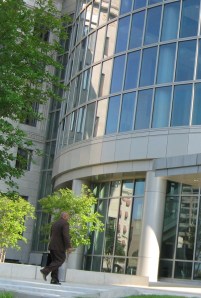
                                                           Alvin Clay enters the courthouse 

This doesn’t mean that Clay is home free.  All the government has to prove is that Alvin Clay knew a crime was being committed.  That is why Donny McCuien is so important to the government’s case–he is the only witness suggesting that Clay had the slightest notion that the real estate deals were bogus.

I have always wondered why the home buyers caught up in the Nealy-McCuien scam were willing to pay top dollar for run-down real estate.  The federal government has done an excellent job of answering that question. 

Buyers like Linda Jones were told they could flip the properties at a considerable profit within weeks of purchase.  If they asked why they were paying considerably more than the sellers were receiving, they were told that rehab work was being done to make the homes easier to re-sell.

Next, the buyers were given money to validate their financial standing.  Deposits and withdrawls were made on the same day and the money went back in Ray Nealy’s pocket.  Then, Nealy gave the buyers money to cover closing costs (none of these people had a dime to their names). 

The silence of the buyers was guaranteed in two ways.  Although they possessed only the dimmest understanding of the details, the buyers were willing participants in illegal acts; therefore it was unlikely they would complain.  Secondly, each buyer was given a single cash payment of between $1,500 and $3,000 a day or two after closing to cushion the shock of a monthly mortgage payment.

The most revealing testimony during four days of trial came from Marcus Patillo, a Burger King employee with a bachelors degree in political science.  Patillo is no budding intellectual, but he was smart enough to ask a few questions.

Remarkably, none of the buyers had seen the inside of the homes they were buying prior to purchase.  According to Patillo’s testimony, Donny McCuien promised him that Clay Construction had been hired to do rehab work on the property.  Since the home was uninhabitable in its current form, Patillo tried to contact Clay Construction. 

He couldn’t find a number.  Although Clay’s firm is legally incorporated and licensed, Clay only agreed to sub contract the work to McCuien on the understanding that Clay Construction would do no actual work.  Clay wasn’t looking for contracting work so his business wasn’t in the phone book.  In his mind, his agreement with Nealy was a paper transaction; Nealy and McCuien were paying a fee for using Clay’s contractor’s license.

Unable to locate Clay Construction, Marcus Patillo called Donny McCuien and asked when the rehab work would be done.  McCuien sent the buyer to Nealy.  Nealy sent him back to MCuien.  “They were just giving me the run-around,” Patillo testified.

Ultimately, Nealy and McCuien stopped taking calls from Patillo.

Here’s the critical question: why didn’t Nealy and McCuien direct Patillo to Alvin Clay?

If, as McCuien asserts, Clay was in on the scam, his co-conspirators would have forced him take the heat from Patillo.

There is only one answer to that question: Ray Nealy and Donny McCuien didn’t want Alvin Clay to talk to their unsatisfied customer.  So long as they were assuring Clay that rehab work was being done, he was in the same position as the loan and title companies.  Only the buyers and Jeron Marshall had any reason to believe that the representations made to them were false.  When Nealy told the loan companies that the applicants were wading in cash, the loan companies believed him.  When Nealy assured Alvin Clay that McCuien was doing the rehab work, Clay believed him.

If Nealy and McCuien had directed Patillo to Clay, their game would have been over.  Clay doesn’t like being lied to, especially when his professional reputation is on the line.  At first suspicion would have started asking questions, and, being the tenacious attorney he is, he would have made things right–even if that meant Ray and Donny went to prison.

Ray and Donny didn’t want to go to prison, so they never put Patillo in touch with Clay.

Patillo was convincing because he wasn’t trying to convince.  He doesn’t know Alvin Clay and has no interest in helping him out.  But his testimony is just one more indication that the US government has no case against Alvin Clay.

Nealy and McCuien were running a confidence game.  They used Alvin Clay because he was a respected attorney with a legitimate contractor’s license; he gave them credibility.

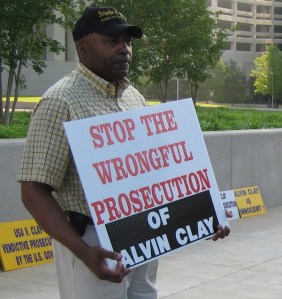
Twenty-five members of two Baptist churches lined Capitol street in front of the federal courthouse on Friday morning.  The signs said, “Alvin Clay is innocent!” and “US v. Clay: Vindictive prosecution by the U.S. government.”

The first printing company contacted to print the signs refused the business.  “I saw the story in the paper,” the man said, “we can’t get wrapped up in that kind of thing.”

This reaction demonstrates the kind of fear the American government can inspire in its own citizens.  It’s not supposed to be that way. 

An African American firm agreed to print the signs.

This demonstrates the dangers of an all-white jury.  White motorists driving by the demonstration grimaced in anger or averted their eyes; black motorists smiled and waved.  The perception gap between white and black America is enormous.

Trial resumed at 9:00 Monday morning and my next report will appear Monday evening.
 

Alvin Clay’s Father sends a message


Jena Judge on his way out?

Howard Witt gives us a brief overview of Friday’s hearing in Jena.  Although there was no ruling on the motion to recuse Judge JP Mauffray, the hearing is being viewed in a positive light by attorneys and the Jena 6 families.  Mauffray admitted that he has made repeated comments that appear to pre-judge the defendants; something a judge cannot do. 

Lawyers in Jena 6 case seek judge’s ouster

By Howard Witt

Tribune correspondent

8:40 AM CDT, May 31, 2008

HOUSTON—Lawyers for the five remaining defendants facing trial in the racially divisive Jena 6 incident in Louisiana presented evidence Friday of what they said was bias on the part of the judge presiding over the cases and sought his removal.

After four hours of testimony, a visiting judge appointed by the Louisiana Supreme Court to hear the recusal motion against LaSalle Parish District Judge J.P. Mauffray asked for more evidence and postponed a ruling until at least July.

Defense attorneys have long asserted that the white-dominated justice system in the small central Louisiana town was biased against their African-American clients: six high school students who were initially charged with attempted murder in the December 2006 beating of a white classmate.

That beating capped months of racial tensions set off after three white students hung nooses from a tree at the high school. Last September, more than 20,000 demonstrators traveled to Jena for a march to demonstrate their concerns about the case against the six defendants.

District Atty. Reed Walters reduced the charges against the black youths to aggravated second-degree battery and conspiracy, and the first defendant to face trial, Mychal Bell, pleaded guilty to a lesser charge of second-degree battery last December.

According to some of those present during Friday’s hearing, defense attorneys testified that Mauffray had made prejudicial comments to them about their clients on multiple occasions. David Utter, who represents defendant Jesse Ray Beard, said Mauffray had labeled the Jena 6 defendants “a violent bunch” and had asserted that “crime has gone down” in the months after the youths were jailed on the beating charges.

When he was called to the witness stand, those present said, Mauffray appeared to concede that he had made such statements, testifying at various points that “I probably said that” and “I might have said that.” But the judge maintained that he had not formed an opinion as to the guilt or innocence of the accused youths.

Mauffray “has proven through his testimony that he does harbor prejudice and prejudgment in these cases,” said Derwyn Bunton, an attorney for Theodore Shaw. “We want a fair trial with a fair judge, and the hearing illustrated we cannot have that with Judge Mauffray.”

Louisiana noose bill

I hold the Lafayette Daily Advertiser in high regard.  In 2006, they published my trial blogging on the Colomb case and gave the trial extensive coverage.  Inmates reading this coverage were motivated to step forward and inform defense counsel that perjury mills were running within the prison system.  Now the Daily Advertiser is editorializing in favor of legislation designed to make the hanging of the noose (except on private property) a hate crime.

The article makes specific reference to Jena and disimisses the notion, popular in that central Louisiana town, that the message of the noose symbol is ambiguous and relatively innocuous. 

I would direct you, however, to the comments at the bottom of the editorial . . . just more racist blather.  The coverage of the Colomb trial received the same response; everybody was sure they were guilty because they had been charged.  Three months later they were released and fully exonerated.  There are solid grounds for opposing restrictions on speech, but the folks commenting here just don’t think hate is a big deal.  The solution, it appears, is to focus even more attention on the behavior of black folks so that even more African Americans can go to prison. 

It is hardly surprising that Louisiana has the highest incarceration rate in the world.

Prosecutorial Puppetry

Just pull them little strings and I’ll sing you a song, I‘m your puppet
Make me do right or make me do wrong, I’m your puppet.
Treat me good and I’ll do anything
I’m just a puppet and you hold my string


It is becoming increasingly obvious that Alvin Clay is just one in a long list of people who were scammed by Ray Nealy and his sidekick, Donny McCuien.   Mortage lenders, title companies and sellers all believed that Nealy and McCuien were operating in good faith.  So did Alvin Clay. 


Clay was repeatedly told that rehab work was being done on the five real estate transactions Ray Nealy was brokering.  On that understanding, the Little Rock attorney submitted invoices to title companies stating that the work was being performed.  When he received a check from the title companies, he immediately paid Donny McCuien, his subcontractor, the lion’s share of the funds, keeping a small portion for Clay Construction.  Finally, he issued an IRS 1099 to Mr. McCuien to ensure that a complete paper trail of the these transactions was on record. 

This should have been a simple case to prosecute.  If the government had gone after Ray Nealy and Donny McCuien they could have obtained easy convictions without setting foot in a courtroom.  The documentary evidence against Nealy is overwhelming.  The buyers and the sellers were all recruited by Donny McCuien.  Ray Nealy filled out five fraudulent loan applications.  Go after these two men and the tax payers would be several hundred thousand dollars ahead.

The government wanted to prosecute Clay and Nealy together.  Then, two weeks before trial, Nealy’s attorney withdrew from the case and Judge Leon Holmes ruled that it was in the legal interest of both defendants that the cases be severed.  Jurors must be asking themselves why all these witnesses are testifying about Ray Nealy when Alvin Clay is the guy standing trial.

In the normal course of events, Alvin Clay would never be prosecuted on such flimsy evidence.  A natural reading of documented facts suggests that Clay was duped along with everyone else.  Driven by a weird desire to render an unnatural reading of the facts, the government embarked on a five-year quest to manufacture a case out of thin air.

Donny McCuien was the key to their plans. 

The former Burger King manager took the stand today and the results were deeply embarrassing for the federal government.  That the US attorney’s office chose to associate itself with a grotesque individual like McCuien proves that this has been a vindictive and warrantless prosecution from the start.

McCuien didn’t want to lie for the government, but they made him an offer he couldn’t refuse.  The pathetic street hustler has already been convicted of wire fraud, but he has yet to be sentenced.  The government has told him that, so long as he tells the story their way, he will get the olive branch at his sentencing hearing.  If he sticks with the story he originally related to FBI agent Rodney Hayes, he will get the arrows–straight through the heart.

So Donny decided to sing in harmony with the feds.  Unfortunately, he didn’t know the tune. 

He got off to a pretty good start; he had been well coached by agent Hayes and he had his mantra down cold.  “Clay would give me a check, then me, Ray and Clay woudl go to the bank, I’d cash the check, and we’d split it up.”

That’s hasn’t always been McCuien’s story.  Originally, he said he suspected that Ray and Alvin had split up the money–now he saw them do it.

Then George Hairston asked Donny to provide jurors with a step-by-step description of how the money was divided, Mr. Burger king was suddenly at a loss.  With no actual memory to fall back on, he couldn’t describe the scene in concrete terms.

Worse still, McCuien was so desperate to please the feds, he actually invented a real estate deal the feds didn’t know about.  According to a statement defense counsel received two days ago, McCuien claims that Clay and Nealy did a did with a woman named April Flowers and cut him out of the action.

Unfortunately for McCuien and his handlers, the government seized Ray Nealy’s completge financial records.  You can’t do a real estate deal without leaving a copious paper trail, and there is no documentary record of a deal involving April Flowers.

Caught in a lie, McCuien would ask, “Where did you get that?”  When it became clear that Mr. Hairston was reading from agent Hayes notes, Donny said, “If it is in black and white, that’s what I said.”

Presumably, if it hadn’t been in writing, he didn’t say it.  McCuien seems to be suffering from an acute case of amnesia; unless we are talking about Alvin Clay.

McCuien admitted that, at Nealy’s suggestion, he incorporated as McCuien Property Management and Construction, Inc.  That fact, however, was meaningless.  He never did any rehab work, he never hired anyone to do rehab work, and he never agreed to act as Alvin Clay’s subcontractor, even though the checks Alvin write to Donny clearly stipulate that Donny was being paid as a subcontractor.

McCuien accused Clay of giving him a 1099 for far more money than he actually received.  All the documentary evidence backs up Clay’s story.  Nothing reinforces McCuien’s account.  And yet the government, desperate to convict Clay, has chosen to go with the hamburger man.

The presumption of innocence is often derided as “a legal fiction”.  We don’t really consider defendants to be innocent until guilt is proven beyond a reasonable doubt.  Regretably, there is a great deal of truth to this position.

A second kind of legal fiction that is even more sinister: the use of arrows and olive branches to mold testimony to the government’s will.  By promising leniency and threatening dire consequences, people like Rodney Hayes and US Attorney Steven Snyder can line up witnesses willing to say virtually anything.   If they choose to abuse the power vested in them, they can create a virtual world completely dissociated from the bricks and mortar, flesh and blood world you can touch and taste and smell. 

Today in the courthouse, playing Pinnochio to the government’s Gepetto, Donny McCuien created a legal fiction so bizarre it will inevitably come back to haunt the corrupt public officials driving this inane prosecution.

There was some truth mixed in with the fiction, of course, and some of it was quite revealing.  McCuien admitted to paying the buyers a kind of honorarium after the deals closed–sort of a thank you gift for allowing themselves to be defrauded.

It seems that McCuien promised his marks that they could make good money flipping the properties they were buying.  He also admitted that Ray Nealy was completely responsible for filling out and submitting fraudulent loan applications. 

Alvin Clay’s only crime was trusting a couple of two-bit hustlers.  He has plenty of company in that regard, including some of the most prominent lending institutions in the nation.  The lending industry is learning some painful trust-and-verify lessons; so is Mr. Clay.  Naivete is not a crime; suborning perjury is.

Donny McCuien will return to the stand next week as a defense witness.  It will not be an easy ride for the prosecution.

The arrows and the olive branch

Background on the Alvin Clay story can be found here.

Alvin Clay just dropped me off at my motel room. He’s feeling strong and his spirits are high. “I’m not going to quit, even if they convict me,” he said as I shook his hand in farewell. “They’ve taken five years of my life and they need to pay for that.””I’ll be fighting with you,” I assured him.

Today was document day at the federal courthouse in Little Rock. Six well-groomed white women in business suits and high heels took the stand; they were all associated with firms from California, Kansas City, Missouri, and Little Rock that lent money to Ray Nealy’s clients.

“What would you do if you knew that an applicant was giving you fraudulent information?” the government repeatedly asked.

“We wouldn’t make the loan,” the bean-counters replied.

The prosecution was trying to show that Ray Nealy and Donny McCuien had faxed in fraudulent loan applications. That doesn’t take much effort; the fraud is obvious and blatant.

Just one problem: when all the puzzle pieces are painstakingly assembled they don’t look like Alvin Clay; they look like Ray Nealy.

“Did Alvin Clay send you any documents?” defense attorneys asked the well-groomed white women in high heels.

“No, sir, he didn’t” came the inevitable reply.

“And these were as-is loans, weren’t they?” defense counsel would ask.

“Yes, sir.”

“So, your approval of the applications was not tied to Alvin Clay’s rehab work in any way?”

“No, sir,” the women replied dutifully, “that had absolutely no bearing on our decision to release funds.”

This was bad news for the government. Clay is charged with faxing fraudulent loan applications to lenders. But Clay didn’t meet the buyers or the sellers, and he played no role in arranging financing or filling out the applications.

The jury didn’t learn much about Clay, but, as the testimony unfolded, document by dreary document, they witnessed a workshop on America’s mortgage mess.

The loans offered to Ray Nealy’s clients were “stated income” mortgages. In theory, these loans are for folks who want to maintain their privacy or for affluent folks who have trouble documenting income. In reality, these financial instruments were aggressively marketed to people with shaky credit, low incomes and no collateral. It was time for the lending industry to boldly go where no lender had gone before.

“Was there an assumption by these companies that this was an invitation to fraud?” attorney George Hairston asked one well-groomed white woman.

She shook her head vigorously. “The assumption was that people were going to be honest with one another,” she said. “We certainly didn’t want people to commit fraud with us.”

That is true. Lenders simply discounted their shaky stated income loans and passed them on to the highest bidder. With interest rates two or three points above market norms, lenders could afford to take a small loss.

It was also disclosed that Ray Nealy was tying his customers to variable rate mortgages that start at 8.5% and balloon to a much higher rate after two years.

All of this explains why seventeen of the nation’s largest lenders are currently being investigated for fraud. These companies didn’t just beg clients to defraud them; most of the hanky-panky was internal.

“This is a case in which everybody is scamming everybody else,” Hairston told me in his Morgan Freeman baritone. “Ironically, the only innocent dupe happens to be my client.”

Before the parade of well-groomed white women began, the government spent a couple of hours painting Alvin Clay as a liar and a cheat. In 2001, Clay and a friend named Pat Joyner started a non-profit 501 (c) 3 organization dedicated to making decrepit homes habitable for low-income renters. Clay lined up a couple of handy men to work with him, but first he needed a Contractor’s License.

Although he scored 94% on the written test, Alvin had no actual experience. He was informed that, if he applied as a corporation, he could enter the experience of employees on his application as his own.

But Alvin’s company didn’t have any employees-not yet. So he decided to use the experience of two men whom he planned to hire. This was stretching the rules to the breaking point, but the regulations were so elastic that it is hard to say if he stepped over the line. His questionable tactic left him legally vulnerable when he and Joyner had a falling out and he was unable to follow through with his plan to hire workers for Clay Construction.

In 2007, FBI agent Rodney Hayes told a grand jury that Clay had forged the signatures of three people on his contractor’s application. Was he lying, telling the truth, or is Hayes living in a magic kingdom where terms like “true” and “false” don’t apply?

Asked if she had signed her name as a reference on Clay’s contractor’s license, Joyner looked like a deer caught in the headlights. She said that a friend named Earl Jones did the work ascribed to Clay Construction on Alvin’s application.

Asked if she had attributed the work to Clay construction, Joyner hesitated before answering. “I don’t remember doing that?” she said.

“Is this your signature?” the government asked.

“No, it’s not,” she said.

The witness was passed to Ron Davis, one of Clay’s attorneys.

“This is your signature, isn’t it?” Davis asked.

Joyner paused. “Yes,” she said at last.

“And didn’t we have a conversation just yesterday in the hall outside this courtroom in which you told me that when agent Hayes interviewed you, you told him you signed Alvin’s application?”

“Yes,” she said, a look of silent terror spreading across her face.

Slowly, the story about the non-profit organization came out. An architect had even been hired. Alvin Clay fully intended to work as a contractor.

“Unified CDC [the name of the company] was intended to do legitimate real estate transactions, was it not?” Davis asked.

Joyner admitted it was so.

Next it was time for Earl Jones, a retired AT&T shipping clerk who did handy man work on the side, to testify. Questioned by the government, he insisted that he had never signed Clay’s application.

Seconds later, Ron Davis had Jones admitting that he had agreed to serve as a reference for Clay and that a signature on his application was a necessary part of that process. “You had no problem having Clay use your name on the document,” Davis said.

“No,” Jones admitted.

Then Allan Nelson was on the stand. “You said your son could use your name as a reference,” Davis told Nelson.

Nelson acknowledged that it was true. After a good deal of back-and-forth, it became clear that Allan Nelson had allowed his son Kristian to sign his name. There is nothing illegal about that, Davis pointed out. It’s isn’t forgery unless your name is signed without your knowledge or consent.

Absolute power doesn’t buy you the truth; it buys you what you want to hear. Water-boarding victims don’t tell dark secrets; they say whatever will make the torture stop.

Joyner, Jones and Nelson are no different.

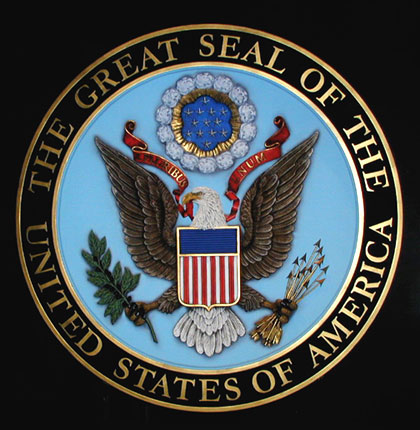
Like the fearsome eagle on the Great Seal; federal officials come with one hand bristling with arrows and the other hand extending an olive branch. “Which will it be?” they ask, “the arrows or the olive branch?”

Joyner, Jones and Nelson didn’t want to go to prison over a simple signature; so they told agent Hayes what he wanted to hear. FBI agents, CIA operatives and federal prosecutors are very good at getting people to say the right words; they aren’t much good at getting the truth.

One of the well-groomed white women in high heels said she became unemployed when her subprime mortgage firm declared bankruptcy. The day came when no one would buy their worthless loans at any price.

The implied message had been simple: “Tell us what we want to hear. Please! Say you’re drowning in cash; that you’re hauling down 100K a year; that your credit’s rock solid, and we’ll give you all the money you want.”

Agents of the federal government have worked the same scam on the weak, fearful people associated with the Clay case.

If you really want to see the arrows and the olive branch in action, stay tuned for the testimony of Donny McCuien, that man Alvin Clay paid $80,000 to rehab Ray Nealy’s houses.

The Jena 6 are in good hands

If you’ve been wondering whatever happened to the Jena 6, this report from the Huffington Post will tell you everything you need to know.  When I first intervened in this case in January of 2007, my primary goal was to get good attorneys for these kids.  I knew this would require media attention, but I never anticipated 40,000 people surrounding the courthouse.

As we all know, the big crowds came and went, the locals dug in their heels, and a long standoff ensued between DA Reed Walters (assisted by his tag-team partner, JP Mauffray) and the strong team of attorneys who have rallied to the defendants. 

I wish I could attract this kind of attention to the Alvin Clay case because it is much more representative of business-as-usual corruption in the legal system.  I know that isn’t realistic.  Ultimately, it didn’t matter how many people flocked to Jena; this was a legal fight and there are times when only good lawyers can help you.  My activisim was designed to bring legal experts like Jim Boren and David Utter into the fight.  That done, the work of Friends of Justice was accomplishyed.  

Still, I wish I could attend Friday’s hearing–there should be a lot of drama.

Friends of Justice specializes in narrative intervention–telling the big story when prosecutors want to keep it small; telling the true story when the system is peddling deceptive half-truths.  For most victims of wrongful prosecution there is no DNA exoneration; they just do their time.  That’s why we like to intervene before and during the trial phase.

We will be following the Friday hearing with great interest.  As this article suggests, Color of Change is doing a great job of handling the media and the legal team is loaded for bear.  The Jena 6 are in good hands.


Ghosts, colors and symbols

(Background on the Alvin Clay story can be found here.)

Our furled banner wreathed with glory

And though conquered we adore it

Weep for those who fell before it

Pardon those who trailed and tore it


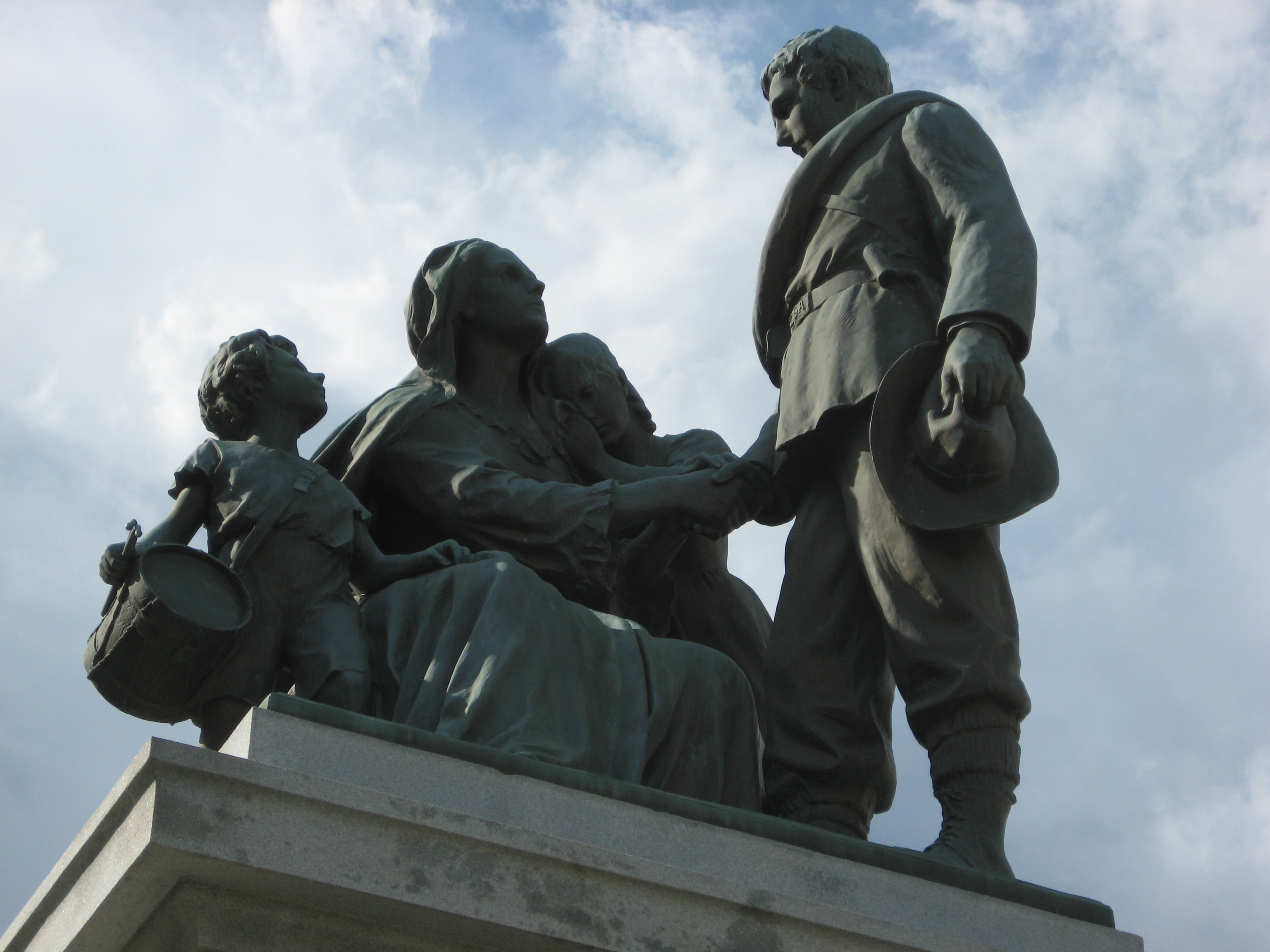
On the fortieth anniversary of the night they drove Old Dixie down, a monument to the stars and bars was erected on the grounds of the State capitol building in Little Rock. In the glory days of Jim Crow it was finally possible to “pardon those who trailed and tore it.” Why not? By then, the forces of Reconstruction had been overthrown as surely as the Confederacy had been destroyed in 1865. Jim Crow was the almost as good as the Peculiar Institution-slavery by other means.

I happened upon this impressive monument this morning as I walked from Central High School to the new federal courthouse: “Arkansas remembers the faithfulness of her sons and commends their example to future generations.”

What do future generations make of this message? We can certainly admire the bravery of the Confederate soldiers and the grave dignity of Robert E. Lee; but can we forget what these men were fighting for?

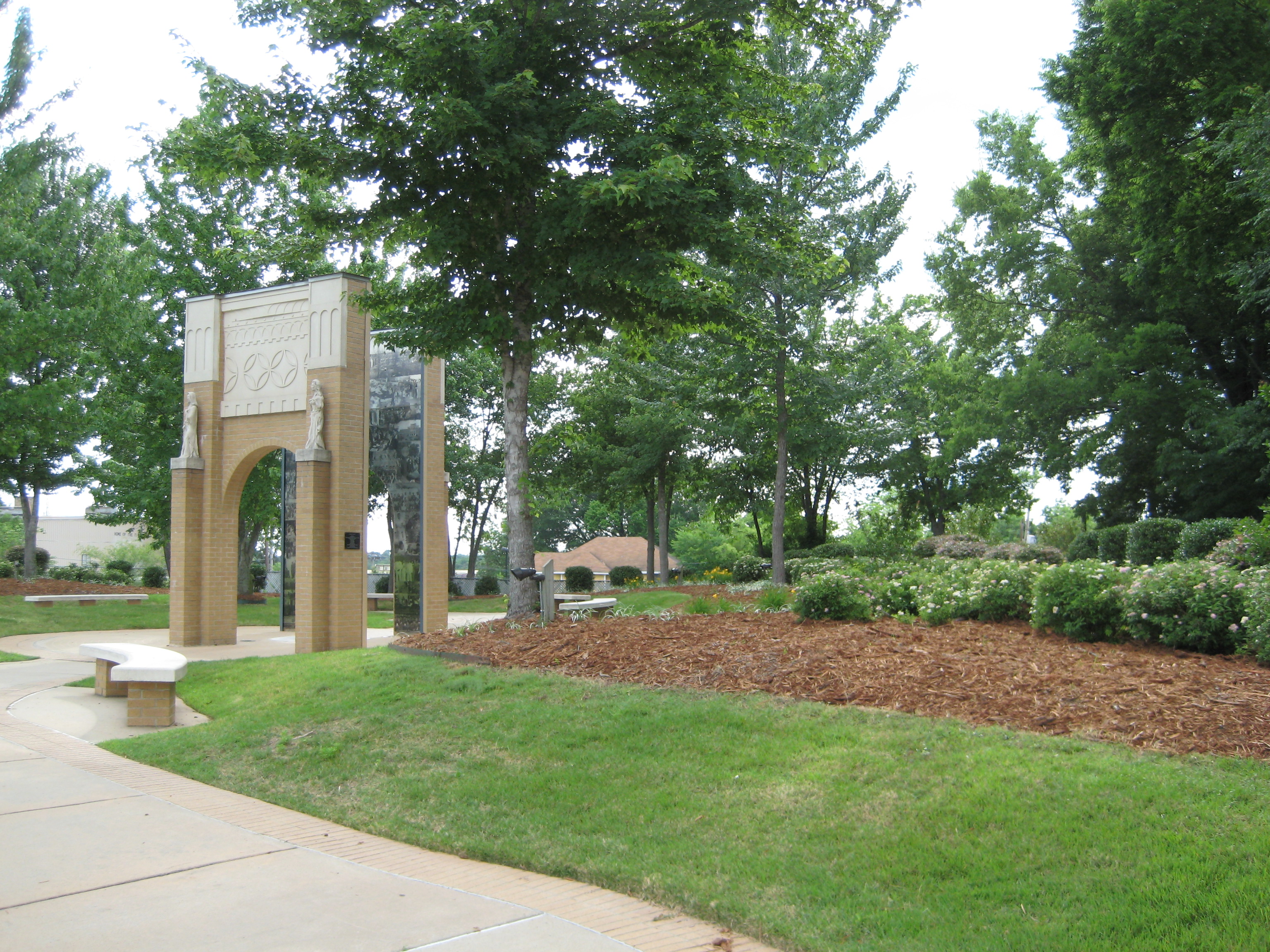
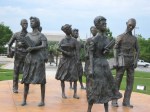
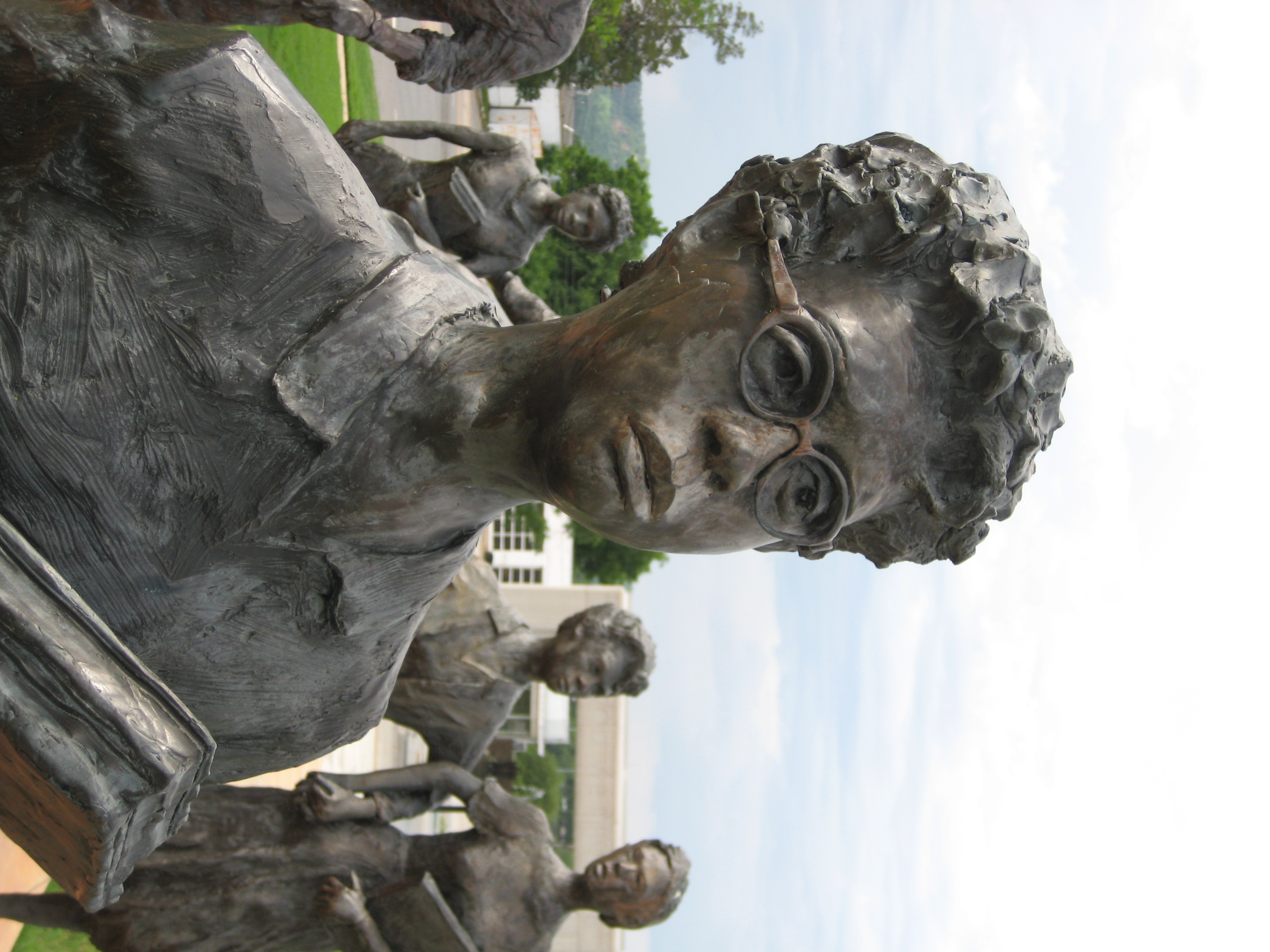
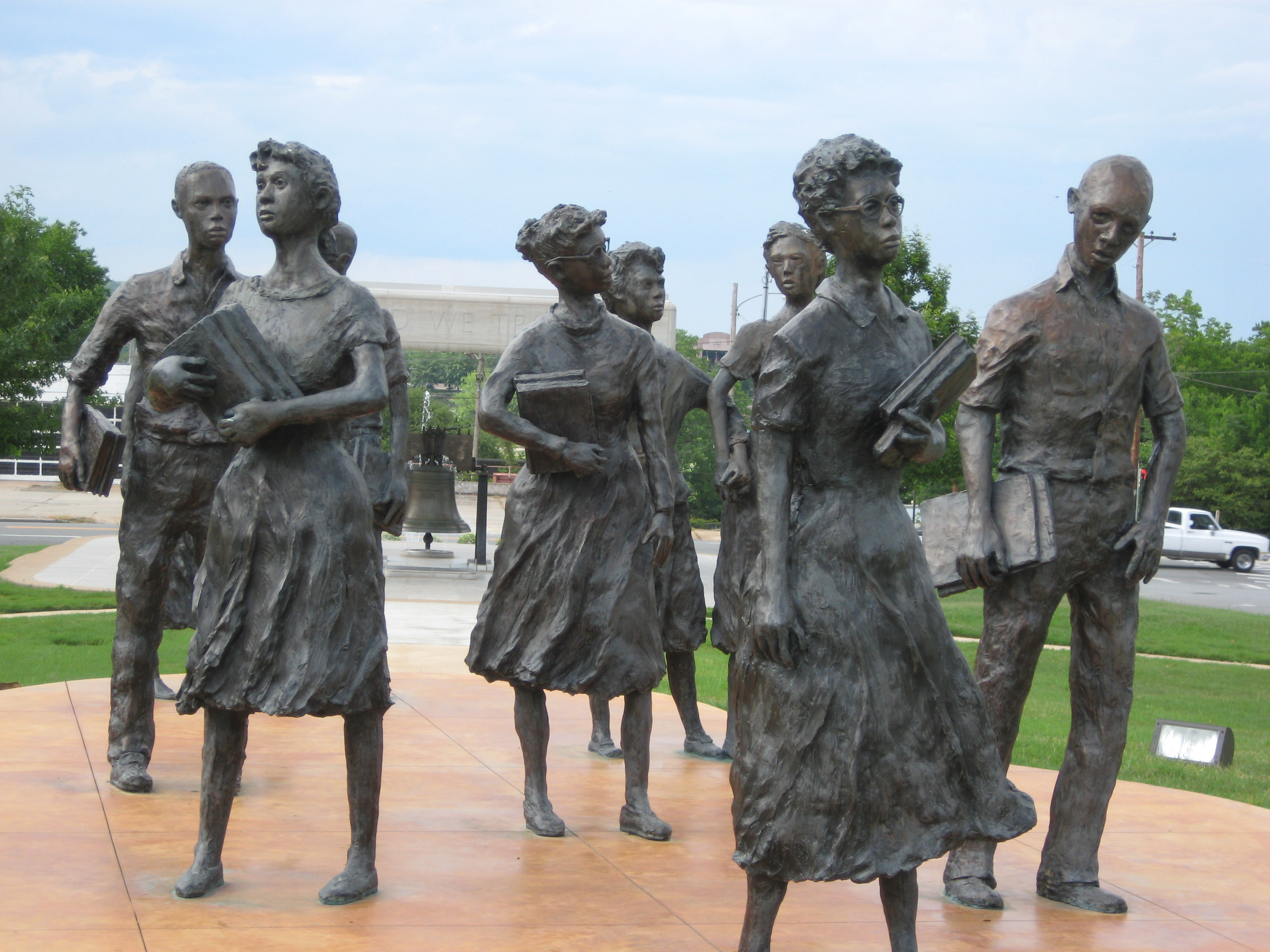
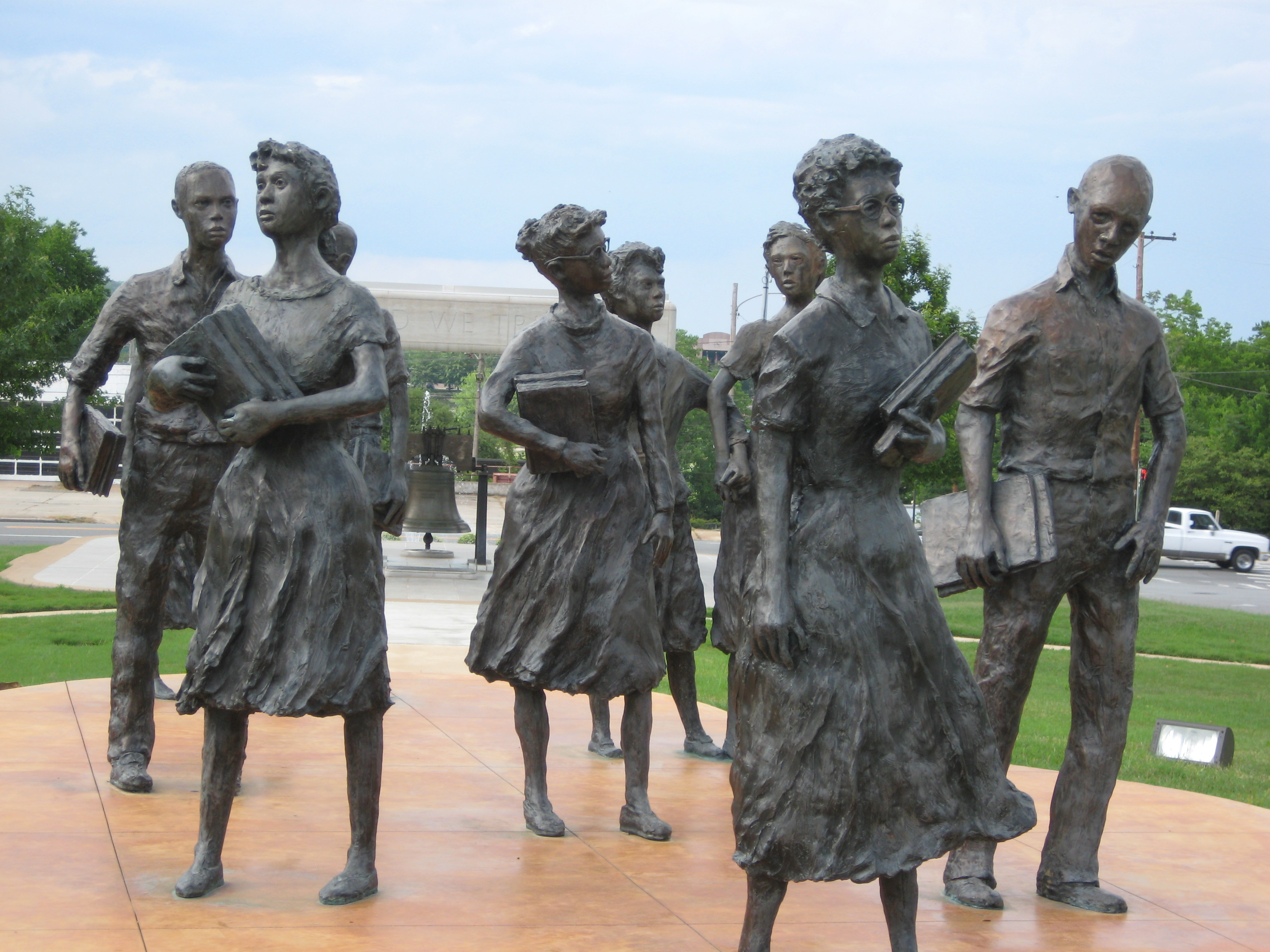
As I walked to the courthouse this morning I once again passed by the statues of the Little Rock 9. Both fear and determination flicker in their eyes. No attempt was made to glamorize these kids; they were caught up in events they could only dimly understand and they knew it. The statues were unveiled in 2005, the year before the federal courthouse was dedicated-almost fifty years after Yankee soldiers returned to Little Rock in 1957.

Neither the Little Rock 9 statues nor the Confederate memorial were erected immediately after the events they commemorate. Cultures change, but at a glacial pace.

As I walked the final half mile to the courthouse the air was thick with ghosts. We have not arrived; our world remains in flux. We still live in the agonizing tension between Jim Crow and Dr. King’s dream. We have traveled far, but we have much further to go.

The racial contrasts in the courtroom were stark. Of the 54 potential jurors called, only three were African American. Pulaski County is two-thirds white . . . but still.

By early afternoon we were down to twelve white jurors and two white alternates. They didn’t look the slightest bit like Alvin Clay’s peers. On the positive side of the ledger, they fit the color scheme established by four white prosecutors, a white FBI agent, a white judge, a white court reporter, a white bailiff and several white security officials.

Alvin Clay and his three black defense attorneys were awash in a sea of white.

You notice things on foot that drivers miss. When I struck out from Central High School at 7:30 this morning, I was in an all-black world. The motorists, the folks rocking on unpainted porches, the young girls heading for school, the old man standing in front of Missionary Baptist Church–all were black.

I reached a hospital a few blocks later and everything changed. Now I was in a white world. The shift wasn’t gradual; it was like crossing an invisible line.

I’m not suggesting that men like Judge Leon Holmes or lead prosecutor Steven Snyder are driven by racial animus. Not in the crude, overt sense, at least. Snyder’s opening was devastating. He is a small man, about my height but twenty pounds lighter. He appears to be pushing 60, but his hair remains jet black. He almost never smiles-a fact that adds to the earnest effect. Molten righteousness smoldered in his eyes.

Snyder has mastered the art of the declarative sentence. Most prosecutors begin their opening remarks with equivocal phrases like, “I believe the evidence will show that . . .” Snyder told the jurors that Alvin Clay was guilty. Moreover, Clay is craven, greedy, heartless and wicked to the core. He said it with utter conviction; like a man convinced.

I can only imagine what the jury made of Snyder’s hour-long philippic. During voir dire (the jury selection process), Judge Holmes reminded the venire that an indictment is not evidence of guilt; that the testimony of a police officer should be given no more weight than the testimony of a civilian; and that respect for the flag should not dispose the jury in the government’s direction.

Nobody was buying. In fact, a few people even confessed as much. One woman allowed that she couldn’t help attaching a high degree of credibility to the testimony of a police officer because “I would figure that they had all the evidence.”

Another woman was disqualified for admitting that the mere fact of Clay’s indictment made her think he was probably guilty of something. “You can’t help but think there’s got to be a reason,” she said.

Every juror was thinking the same thing; they just knew they weren’t supposed to admit it.

Physical symbols are enormously powerful: a statue in honor of the confederacy, an officer’s uniform, the rough equivalence between the prosecution and the eagle on the Great Seal. The case is officially styled, “The United States vs. Alvin Clay.”

What true patriot wouldn’t be pulling for the United States?

Everywhere you look in the courtroom, the eagle is clutching an olive branch in one talon; a sheaf of arrows in the other. The United States government thinks Alvin Clay is guilty and the eagle is nodding in agreement. The courtroom layout tips juror loyalty in the direction of the government. Whatever pious niceties we repeat to ourselves during voir dire, this isn’t supposed to be a fair fight. That’s why the defendant loses 95% of the time.

The rulings from the bench fell consistently in the government’s direction. The prosecution is free to argue that Alvin Clay obtained his contractor’s license in furtherance of the conspiracy alleged in the indictment, even though Clay didn’t meet Ray Nealy and Donny McCuien until a year later.

The defense, on the other hand, cannot suggest that Alvin Clay is the victim of a vindictive prosecution. This is a major blow. As the honest juror said, there must be some reason why Clay is standing trial. If the defense can’t present their explanation, the natural assumption is that Clay must be guilty as charged. Why else would the government invest hundreds of thousands of dollars to put him away?

Just before lunch, the defense team got its first peek at the grand jury transcript. There wasn’t much time to digest it all, but a few facts leapt off the page. The present indictment is based entirely on the testimony of Rodney Hayes, the man who repeatedly perjured himself three years earlier. Hayes claims that Clay forged the signatures of the three references on his contractor’s application. A quick call to one of the women yielded an anguished response. “I told him I signed that thing,” she said.

When Judge Holmes learned that the government’s star witness was perjuring himself again, he told the government that they could only claim two forged signatures. Later in the day, a second signatory gave the lie to Hayes’ bizarre testimony. By tomorrow morning we will probably be down to one forgery. How blatant must the perjury become before Judge Holmes tosses the entire indictment? We may soon find out.

From the schoolhouse to the courthouse

There’s a lot of open country between Dallas and Little Rock. Texarkana goes by in a flash, as does the once-famous town of Hope. The Little Rock metro area boasts just under half a million souls, but just over 180,000 live in the city, about 55% of them are white and 40% black. But in the older parts of town you don’t see many white faces.

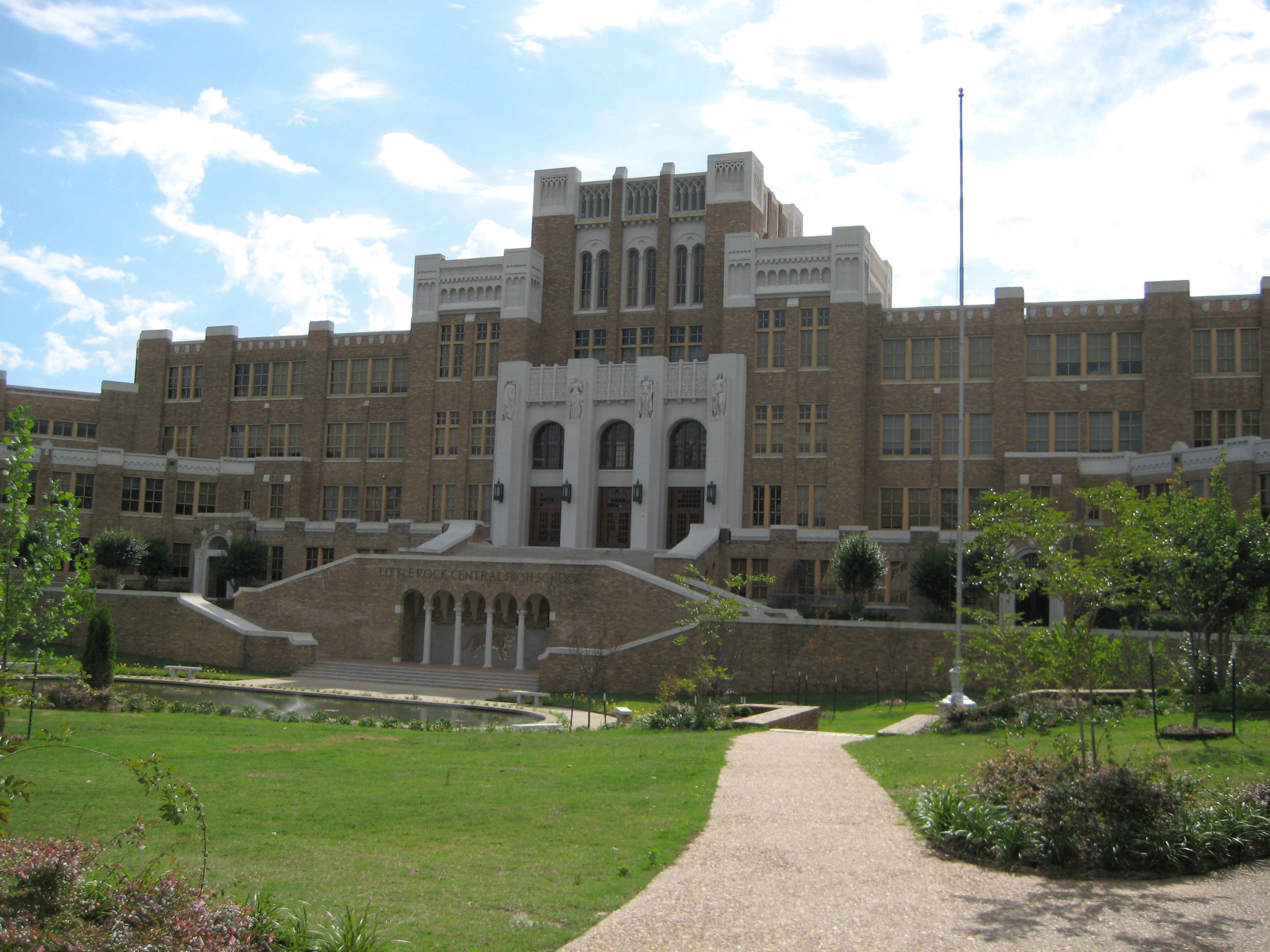
Physically, the Central High hasn’t changed much since Dwight D. Eisenhower sent in the military to protect nine black students from a howling white mob fifty years ago. As high schools go, Central is an architectural marvel. Classic statues representing Ambition, Personality, Personality and Preparation peer down from the ornate façade. There’s a reflecting pool on the front lawn surrounded by limestone benches donated by alumni. In 1957, Central was a white institution in a white neighborhood.

Things have changed. The neighborhood surrounding Central High School appears to be over 80% black. A few of the older homes have white folks on the front porch; but not many.

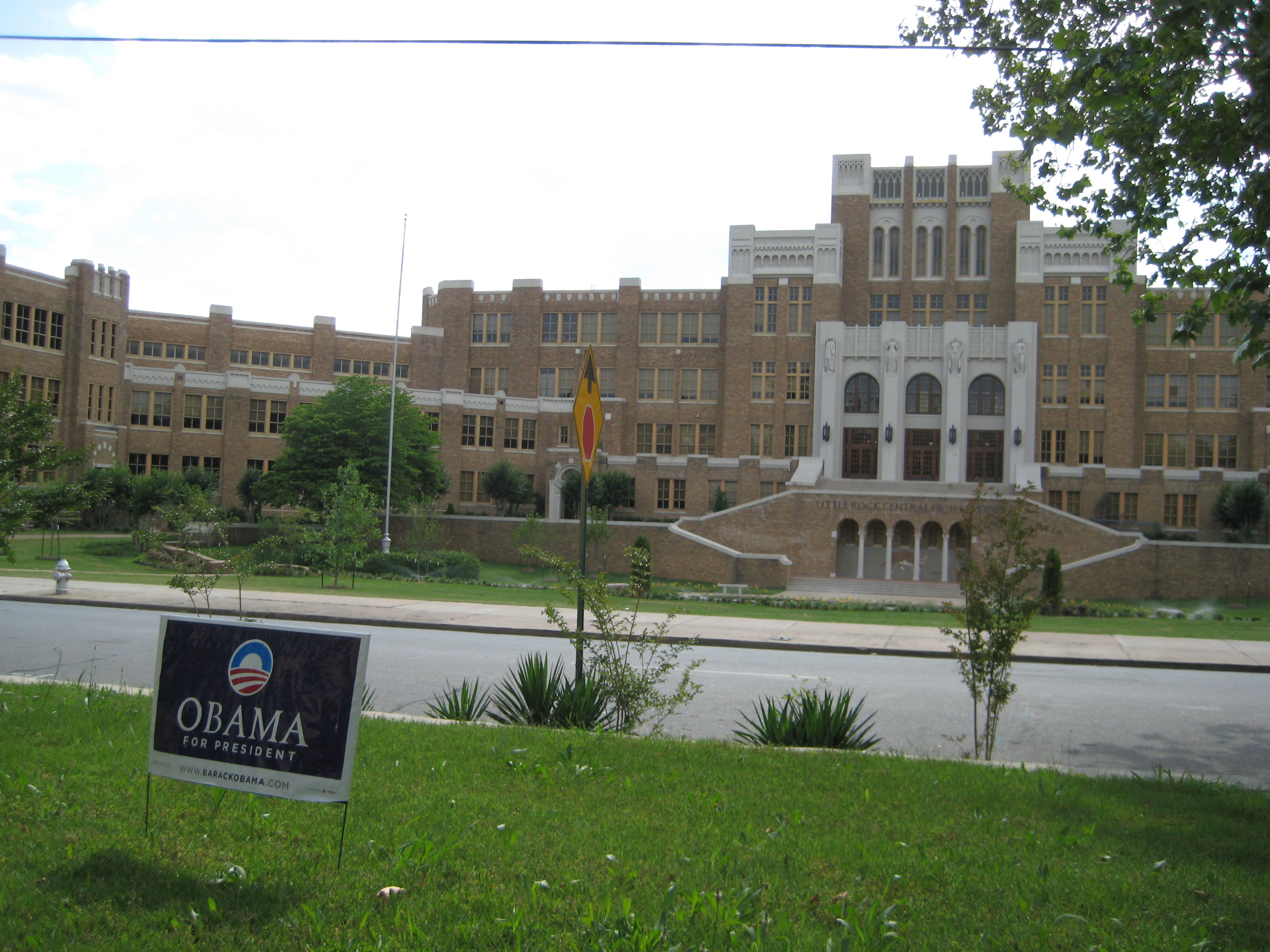
The Little Rock Nine have evolved into home grown heroes-much like Rosa Parks in Montgomery, Alabama. Across the street from the school, a tiny national park has been erected in their honor. There’s even a visitor’s center to satisfy the curiosity of tourists (that’s where you can find me at 7:45 tomorrow morning). On one corner, an old gas station has been preserved in immaculate condition as if time had stood still. But glance down the street and you will see an Obama lawn sign right across the road from Central High School.

A few blocks away, Martin Luther King Blvd takes you across I-630 to the state capitol where a striking set of lifelike Little Rock Nine statues are prominently featured. Former Governors Bill Clinton and Mike Huckabee have worked hard to associate their names with these public memorials.

On the opposite side of the state capitol, another statue celebrates the heroism of “The Confederate Women of Arkansas, whose pious ministrations to our wounded soldiers soothed the last hours of those who died for the object of their tenderest love.”

This statue was erected by the State of Arkansas and the Confederate Veterans.

The horrendous suffering of the Civil War explains why federal troops were so deeply resented by Little Rock residents in 1957-“the war of northern aggression” had not been forgotten.

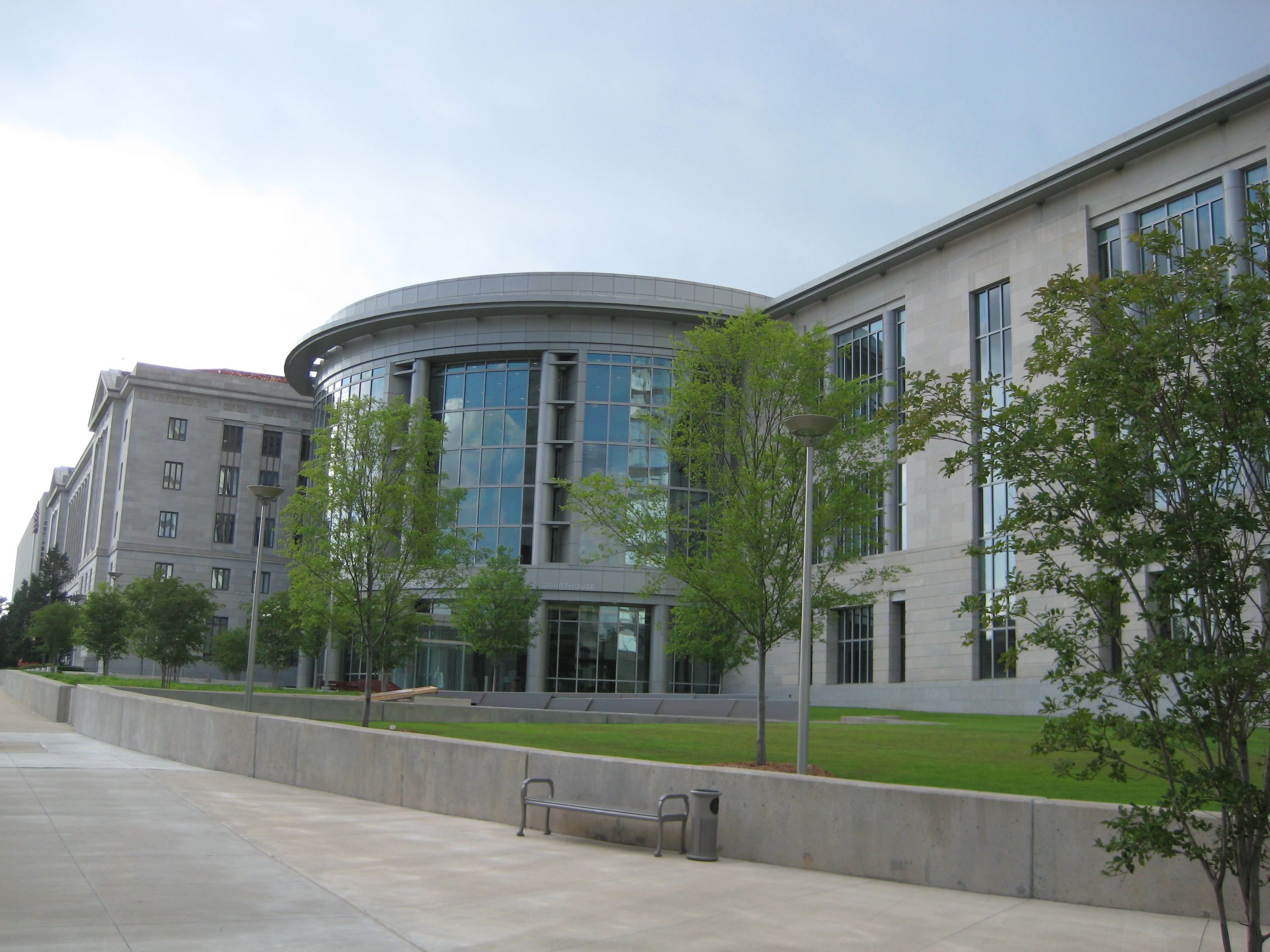
The federal courthouse where Alvin Clay’s trial begins tomorrow is a few blocks down from the state capitol. It’s a spanking new facility, erected in 2006, two years after the government of the United States used perjured testimony to secure a fraudulent indictment against Clay.

Everyone wants to know why I am walking the 1.8 miles (I measured this afternoon) between Central High School and the federal courthouse tomorrow morning. Have I contacted the media? Have I made placards? Have I devised a nifty chant?

No I haven’t. If I have some company tomorrow I will be pleased; but I’m not trying to draw attention to myself or grab a cheap photo opportunity. If I end up walking alone, that’s just fine. I am making this walk because I need to. The accomplishments of 1957 were remarkable, but I need to remind myself that the battle lines have shifted dramatically in past fifty years.

The Little Rock Nine scored a smashing victory and we are right to honor them. But the new civil rights movement, when it comes, will not be about segregated schools, drinking fountains, buses and lunch counters; it will be about our broken criminal justice system.

Prosecutors at the state and federal level are largely unaccountable. In an abstract sense, we all ascribe to the principle of equal justice under law. But in the concrete world, it is commonly assumed that the folks protecting us from the bad guys should be as nasty as they wanna be.

I am not suggesting that all federal prosecutors are rogues.  It’s just that, when they choose to misbehave, they get a pass.  In some circles, the willingness to engage in underhanded behavior is highly prized.

The government has asked federal judge Leon Holmes to bar any mention of vindictive prosecution from the courtroom. If the government gets its way, none of the crimes and misdemeanors I have catalogued in my seven-part series will reach the ears of jurors.

And the government will almost certainly get its way.

I received a lot of hate mail over the long weekend.  People can’t believe that Alvin Clay could have been indicted if he wasn’t guilty. My critics seem willing to stipulate to everything I have alleged against the government; they just don’t care.

You know Clay is guilty; the reasoning goes, because the government wants to convict him. And since Clay is guilty, the government is justified no matter how many laws are broken and no matter how many constitutional principles are ground into the dust.

Friends of Justice was similarly vilified when we stood up for the Tulia defendants, the Colomb family and the Jena 6.

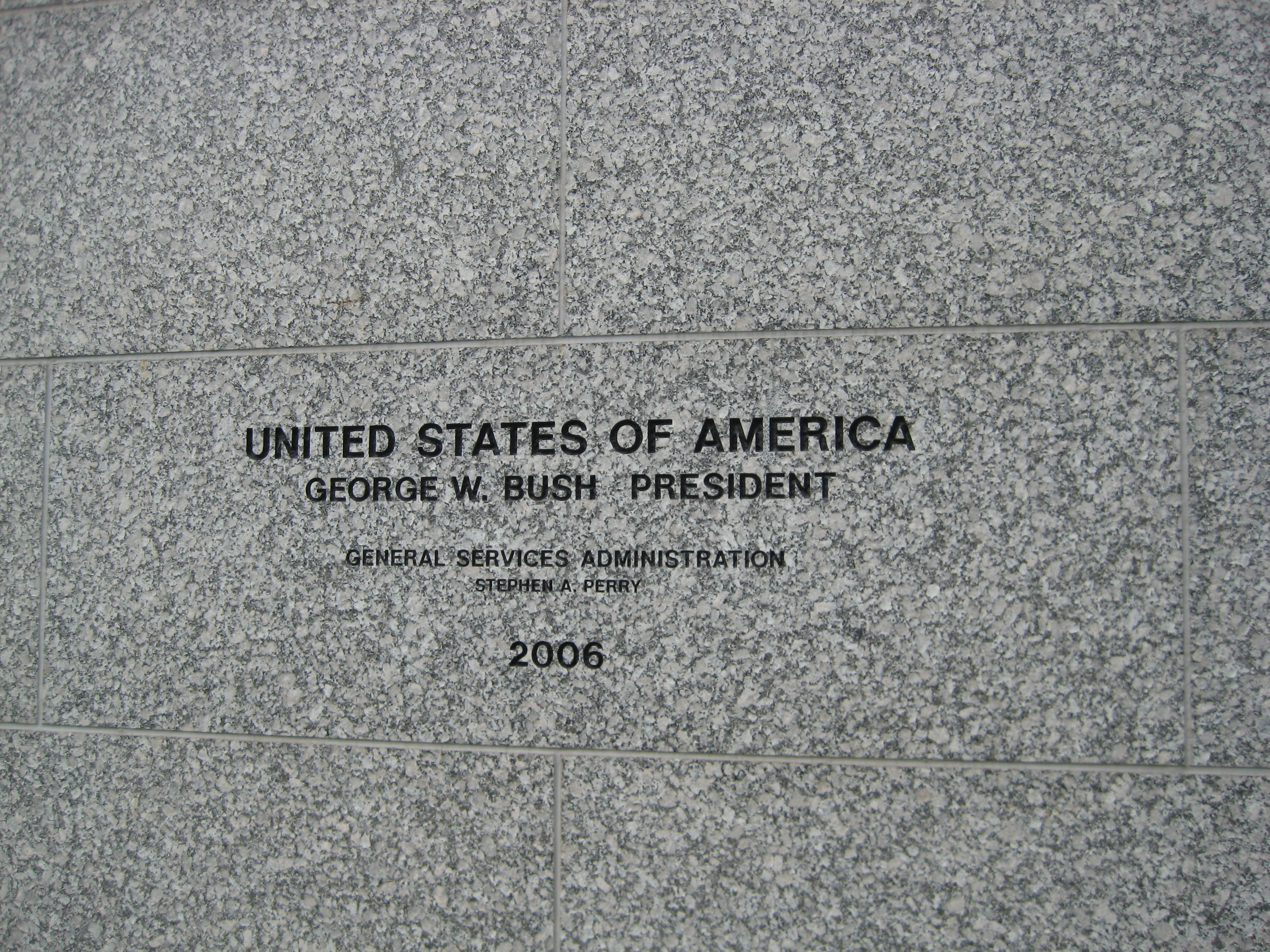
As I passed by the federal courthouse late this afternoon, I noticed the inscription on the cornerstone: “United States of America: George W. Bush, president, 2006.”

Within a few months of the building’s completion, United States Attorney Tim Griffin, (the highest ranking law enforcement official in Eastern Arkansas) had resigned in the wake of allegations that he had suppressed black votes in the Florida general election in 2000. It has subsequently come to light that Griffin was the genius behind the Swift boat Veterans for Truth episode in 2004. His latest assignment is digging up dirt on Barack Obama.

The previous United States Attorney, Bud Cummins, was fired to make room for the president’s hatchet man.

Griffin has never been asked to answer for his actions.  He never will be.

This time tomorrow, I will be reporting on the first day of Alvin Clay’s trial.  Please stay tuned.

Alan Bean


Alvin Clay: The Short Version

Alvin Clay is an innocent man and federal prosecutors can’t prove otherwise. But the government’s criminal behavior in this case has been gross, obvious and persistent. Vindictive federal officials investigated Clay when there was no evidence of guilt; they committed perjury to get Clay indicted, and when their bogus indictment unraveled, they unleashed a campaign of dirty tricks to bring Clay down. Sadly, little of what follows will be allowed into the federal courtroom when Mr. Clay goes to trial on May 27th.

The Clay fiasco is best envisioned as a three-ring circus.

The center ring involves the details of a vindictive prosecution: investigation without evidence of wrongdoing, indictment-by-perjury, and illegal smear campaign.

Ring three features a strange story from Lonoke County in which Bob Govar, the federal prosecutor who inspired this mess, reveals his vindictive temperament and proves to be much more vulnerable to guilt-by-association prosecution than Alvin Clay).

In ring one we find Operation Wholesale, a remarkably corrupt undercover operation that, thanks to Alvin Clay, brought Bob Govar, the US attorney’s office, and the FBI within a whisker of national scandal.

Courtroom Collission

Alvin Clay is a brutally honest, broad-shouldered, hard-charging defense attorney.

For thirty years, Bob Govar has served as a federal prosecutor. Until recently, he was chief of the criminal division of the US Attorney’s office, Eastern Division, in Little Rock, Arkansas.

Eight years ago, Govar and Clay collided in a federal courtroom in Little Rock. Bob Govar was trying to salvage a massive drug sting dubbed “Operation Wholesale”. The idea was to use a black cop and a black informant to nail fifty black drug suspects in central Arkansas. After the big roundup, the confidential informant confessed that the sting had degenerated into a scam to defraud the federal government: three-quarters of the cases were pure inventions.

The undercover cop stood by the sanctity of the operation.

Ethically, the government had no choice but to scrap every indictment associated with Operation Wholesale. Instead, Bob Govar decided to salvage two dozen cases in the hopelessly tainted cop claimed to have witnessed the deal.

The informant was charged with perjury and obstructing justice and Alvin Clay was assigned as defense counsel.

The defendant could have accepted a plea deal for eight months, but he took his case to trial because he didn’t want to accept sole responsibility for a corrupt operation. He was convicted and sentenced to ten years of hard time in a federal penitentiary.

It was obvious to any sensible observer that Bob Govar was sacrificing innocent black defendants to save the government from acute embarrassment. One defendant proved he was incarcerated at the time of the alleged deal. Charges were dropped. Another defendant had an affidavit from the informant saying the deal didn’t happen. A clergyman produced documentary evidence that the house trailer mentioned in the police report wasn’t moved to the property until months later. Nonetheless, a jury convicted.

In the course of a four-day trial, Alvin Clay accused the government of prosecutorial misconduct in the furtherance of an inherently racist drug investigation.

Fortunately for Bob Govar, the media gave his office the benefit of the doubt. But Bob Govar knew that Alvin Clay’s impertinence had brought the U.S. Attorney’s Office and the FBI within a hairsbreadth of disaster.

Suborning Perjury

Two years later, Alvin Clay accused the government of prosecutorial misconduct in second case. Bob Govar called in the FBI to investigate his impertinent rival. There wasn’t much to work with. Clay ran a real estate agency as well as a law office-but there was no evidence of wrongdoing.

A quick investigation revealed that Clay’s contractor’s license could be connected to five suspect real estate deals. At the time, Clay had been working a full roster of legal cases while supervising six real estate agents. He had received a modest fee for allowing a subcontractor to use his contractor’s license. None of the witnesses interviewed linked Clay to illegal activity.

Govar and his subordinates obtained a grand jury indictment by portraying Alvin Clay as the mastermind of fraudulent operation. FBI Agent Rodney Hayes left grand jurors with the false impression that Clay was directly responsible for performing rehab work-no mention was ever made of a subcontractor.

Hayes testified that Clay and his co-conspirators had inflated the appraised value of the properties-a patent falsehood.

He testified that Clay Construction “wasn’t a real company” when he knew it was.

He testified that Donny McCuien played only a minor role towards the very end of the process when McCuien was intimately involved from the beginning.

He told the grand jury that Clay hadn’t paid McCuien as much as the IRS 1099s suggested. In fact, Hayes knew that Clay had paid McCuien every penny of the money he owed him.

Much of this testimony came in response to questions posed by Govar. Both men were willing to feed the grand jury a diet of lies if that’s what it took to get an indictment: garbage in-garbage out.

When Clay’s defense team cried foul, Govar denied that he had played a role in presenting the case to the grand jury. Judged Leon Holmes took the chief of the criminal division at his word.

Cover-up in Lonoke County

When grand jury transcripts proved that Govar was lying; Holmes wrote it off as an innocent error.

Bob Govar and the Eastern Division of the US Attorney’s office were quietly recused from the case and the Western Division dropped the false charges from the indictment. The new indictment tacitly acknowledged that Clay’s role was peripheral. He was now charged with knowing that his co-defendants were up to no good.

While this legal fiasco was playing out in the federal courthouse in Little Rock, a parallel drama was unfolding in nearby Lonoke County.

Jay Campbell was one of several public officials Bob Govar had shielded from the consequences of their actions over the years. After being fired from the Pulaski County (Little Rock) Sheriff’s Department in 2000, Campbell was elected Lonoke police chief. Six years later, the roof caved in on Campbell and his wife Kelly. In addition to a laundry list of drug-related crimes (buying, selling and using) Jay Campbell was accused of hiring out state prisoners for personal profit.

Campbell’s well-heeled customers included his old friend Bob Govar. A man with thirty years experience as a federal prosecutor said he didn’t know it was illegal to hire inmates to clear his land.

DA Lana McCastlain begged the FBI to investigate this impossible tangle of criminal allegations but she was rebuffed. Garrick Feldman, editor of the Arkansas Leader accused Govar and the FBI of knowing that an overburdened district attorney would lack the resources to shift the investigation in their direction.

Bob Govar reacted to Feldman’s challenge the same way he reacted to Alvin Clay’s persistent allegations. In an email written on the official stationery of the U.S. Attorney’s office, Govar accused Feldman of damaging his professional reputation. After threatening to sue the feisty editor for $50 million, Govar said he looked forward to owning the Arkansas Leader.

Garrick Feldman forwarded the email to Govar’s superior and the Govar was immediately demoted from his position as chief of the criminal division.

Govar couldn’t make his malice toward Feldman stick. Alvin Clay wasn’t so lucky.

The weight of history

The Alvin Clay case shows how easily bad public policy translates into human misery. Men like Bob Govar don’t prosecute low-status black drug defendants while shielding their influential white counterparts because they are bigots; they are just trying to protect the dignity and prestige of the federal government from the absurdities of the war on drugs. When men like Clay and Feldman threaten to bring down an exceptionally fragile house of cards they must be dealt with.

The Clay case shows why ideologically rigid people make poor candidates for the federal judiciary.

Judge Leon Holmes won congressional confirmation by the slimmest of margins. Questions during the nomination process focused on Holmes’ tendency to brand pro-choice activists as Nazis, denigrate feminists, and endorse the subordination of women.

Not enough attention was paid to Judge Holmes’ statements about race.

Judge Holmes believes fervently in the principle of racial equality. But he has referred to the “providential” impact of American slavery, he has suggested that civil rights activism becomes a negative influence when it loses the support of the white majority, and he has argued that the federal government lacked the authority to end the segregation of southern public schools.

Does Holmes believe that Arkansas Governor Orval Faubus was justified in fighting for a segregated public school system? So it appears.

Judge Holmes is typical of a generation of educated white southerners who affirm the principle of racial equality while celebrating their southern heritage. To a man like Judge Holmes, Alvin Clay’s allegations, however well grounded, have a subversive ring.

Fortunately, Judge Holmes is driven by a passionate desire to do the right thing. Whether good intentions can override profoundly conservative instincts remains to be seen.

Unmonitored Domestic Surveillance

The Alvin Clay case shows the tragic consequences of reducing judicial oversight over domestic surveillance. For the past eighteen months, the FBI has used a tap on Alvin Clay’s phone to spread suspicion, dissension, heartache and confusion throughout his entire social network.

Clay’s day-to-day experience reads like a Hollywood screenplay. The allegations would read like a psychological thriller if they weren’t so carefully documented.

Friends old and new, intimate and casual, professional and private, have received intrusive calls from FBI operatives. Federal agents have disguised themselves as Alvin’s ex-wife, as former business partners, and as drug defendants. Girlfriends have been informed that Alvin is HIV positive (untrue), and that he is a convicted felon (also untrue).

A girlfriend received a phone call consisting of an intimate tape recorded conversation between Clay and another woman.

Potential clients have received calls warning them not to hire Clay and his debtors have been dissuaded from paying their debts.

Psychological Torture

In recent months, six drug defendants have informed Clay that agents with the FBI, the ATF and the US Attorney’s office have been pressuring them to implicate Clay in some form of drug crime. It is natural to assume that dozens of equally compromised individuals have received the same treatment.

It is not unusual for drug suspects to receive this carrot-and-stick, “I-can-be-your-best-friend-or-your-worst-enemy” treatment from federal agents. It’s a form of crude psychological torture that often induces the victim to say whatever it is the government wants him to say. It’s a recipe for wrongful prosecution.

Ever since Bob Govar was recused from the Clay case, the federal government has unleashed its full fury against Alvin Clay. In the process, dozens of innocent people have been traumatized in a failed and futile attempt to manufacture a crime against an innocent man.

A simple process of elimination identifies the FBI as the prime mover in this campaign of illegal surveillance. No one else has either the authority or the ability to do this kind of mischief.

Is this dirty tricks campaign illegal or merely immoral?

The ravages of 9-11, the invasion of Iraq, and the murky provisions of the Patriot Act have severely undermined standards of accountability in the intelligence world. The moral lines have blurred and patriotic Americans like Alvin Clay are routinely treated like enemy combatants.

An Invitation

This is not the first dark night of the American soul, nor will it be the last.

Fifty years ago, the first black student graduated from Little Rock’s Central High School. Governor Orval Faubus responded by shutting down the entire public school system.

Alvin Clay’s May 27th trial coincides with the 50th anniversary of these events. On the first day of trial, friends of justice will be walking the mile of sidewalk between Central High School and the federal courthouse. Can you join us?

Dr. Alan Bean
Friends of Justice
817-457-0025
817-688-6765 (cell)
https://friendsofjustice.wordpress.com

Alvin Clay 7: By Any Means Necessary

The new USA PATRIOT Act has brought into being an unprecedented merger between the functions of intelligence agencies and law enforcement. What this means might be clearer if we used the more straightforward term for intelligence–that is, spying. Law enforcement agents can now spy on us, “destabilizing” citizens, not just noncitizens. They can gather information with few checks or balances from the judiciary.

-Patricia J. Williams, November 8, 2001.

Public policy train wrecks are driven by group madness.  Even highly intelligent people stop thinking critically as hard work and dogged determination are chained to a lunatic purpose.

Consider the peculiar groupthink that gave us the invasion of Iraq . . . or the government’s wrongful prosecution of Alvin Clay.

Attorney Bob Govar. Govar hired state prisoners to clear his property but swears he didn’t know it was illegal. Does anybody believe a veteran federal prosecutor could be that ill-informed?

Nonetheless, while it seems likely that Govar broke the law, it is difficult to prove beyond a reasonable doubt what he knew and did not know. When personal freedom is on the line there is no room for educated guessing. The case could not be proven, so no charges were filed. That’s the way the system is designed to work.

Only Alvin Clay can know for certain whether he knew that fraudulent applications were being faxed to lending institutions. Clay says he had no idea. At the time he was pursuing careers in law and real estate and lacked the time or the inclination to monitor Ray Nealy’s business practices.

The explanation is elegant in its simplicity. It cannot be disproven. And yet Alvin Clay is going to trial next Tuesday morning.

In the early days of 2007, you may recall, Clay’s attorneys stumbled upon grand jury transcripts showing that perjured testimony had been twisted to obtain a bogus indictment.

Suddenly, the prosecution of Alvin Clay became a high stakes game the government couldn’t afford to lose. Alvin Clay had to be destroyed by any means necessary.

Three years after his indictment, Alvin Clay was trying to inject some normalcy into his chaotic existence. In early 2005, three months after being indicted, he sought refuge in an ill-considered marriage. His new wife wanted to live in a large urban center, so Clay bought a home in Houston. When the closing date arrived the marriage was over. Abiding by the terms of the divorce settlement, Clay allowed his wife to occupy the home on the condition that she would eventually buy it in her own name.

He stayed on in Houston for 18 months, flying back to Little Rock only when his legal work demanded it.

Despite his unhappy marriage and the stress associated with the indictment, Clay tried to stay socially active. He met a woman in Little Rock in October of 2007 and the two would date when Alvin was in town. He was also dating occasionally in Houston. His two social worlds were entirely separate and, unprepared for another long-term commitment, Clay preferred it that way.

Then it started.

On March 1, 2007, a Houston woman Clay had briefly dated received a phone call from a woman claiming to be Clay’s ex-wife. The woman refused to see Alvin again and wouldn’t discuss the details of the call she had received.

“How could my ex-wife get this woman’s phone number,” Alvin asks. “I was guarding my privacy very closely at the time. I had an unlisted, unpublished number that I only divulged to friends. I hadn’t contacted my ex-wife since we separated.”

A day later, Clay’s Little Rock girlfriend also received a disturbing call. A practicing attorney, she had the presence of mind to take notes.

“May I speak to Mr. Clay,” the voice said.

“I’m sorry, but he’s not here.”

“Can you tell me when he will be in?”

“I’m not sure because he doesn’t live here.”

The voice wanted to know how long she had known Clay, where she met him, and the nature of their relationship.

“We’re friends,” she said.

The questions kept coming.

“Has Mr. Clay ever asked you to deposit any money?”

“No.”

“Do you know which banks Mr. Clay has accounts with?”

“No.”

“Do you know anything about Mr. Clay’s construction company?”

“No, I don’t.”

“Do you know anything about Mr. Clay being indicted?

“Not really.”

“Would it shock you if I told you Mr. Clay is married?”

“We’ve never discussed the nature of his marital situation.”

The caller identified himself as an agent with the Little Rock FBI office.

A month later, shortly after depositing some substantial insurance checks in her bank, she received a second call.

“Did Mr. Clay give you $325,000 to deposit for him?”

“No. He’s never given me any money. We’ve never even exchanged lunch money.”

The voice repeated asked her to come into the Little Rock FBI office for an interview.

“I told you I don’t know anything about Alvin’s case or personal business,” she replied. “I don’t have anything to tell you.”

“Rodney Hayes had to be behind both of those calls,” Alvin insists. “No one in my social world knew this woman-we had just started seeing each other. The FBI could have learned about her banking information by issuing a subpoena, but where was the probable cause? If they used a wiretap or an inside source at the bank they were breaking the law.”

It wasn’t long before one of Alvin’s workout buddies got a call asking if he knew that Alvin’s girlfriend had deposited a large sum of money in her bank account. He was then asked if he had ever held money for Alvin.

In May of 2007, everyone associated with the Clay case was exposed to an embarrassing line of questioning from Clay’s legal team. The Eastern Division of the Attorney General’s office recused itself from the case and it was assigned to Assistant U.S. Attorney Steven Snyder with the Western Division. Within days the harassment campaign accelerated noticeably.

A second woman Clay had dated in Houston got a call from a woman claiming to be Alvin’s ex-wife. The caller claimed that Alvin had AIDS, that he had been indicted by the federal government, and that she was going to testify against Alvin at trial.

A month later, Alvin’s Little Rock girlfriend picked up the phone and heard a recording of Alvin talking to another woman.

Only someone with a tap on Alvin’s phone could have made such a recording, and that meant the FBI. No one else had either the motive or the opportunity. “They were trying to separate me from my social network,” Alvin explains. “Agent Hayes knew that I didn’t have a steady source of income because my office was closed. If he could turn my closest friends against me, he could reduce me to a homeless person; people without resources and basic necessities are ill equipped to withstand the full weight of the government. It was pure psychological warfare; he wanted to break me.”

Next, Alvin’s girlfriend in Little Rock received a call, purportedly from the health department, informing her that Alvin had AIDS. Not surprisingly, she wasn’t reassured until he was tested and showed her the negative results.

Then she got a call from someone claiming to be one of Alvin’s clients. He said Alvin owed him $5,000 and he wanted his money. When Alvin called the number the caller had left, a confused former client insisted that he had never called Alvin’s girlfriend.

In late September of 2007, one of Clay’s business partners in Houston received a voice message from an unidentified woman. “We understand that you are getting ready to pay money to Alvin Clay,” the message said, “and we are advising you not to pay Mr. Clay, because he has taken money from a lot of people and because he is a felon.”

Shortly thereafter, FBI agent Rodney Hayes contacted the man with some follow-up questions. “The only way the FBI could have traced me to this man,” Clay says, “is by taping my cell phone or infiltrating my email. Both were illegal because there was no evidence of illegal activity.”

In October of 2007, a woman called Alvin asking if he would represent a relative in a guardianship matter. Days later, she was contacted by an unidentified caller advising her not to give Clay any business because he had been suspended from the practice of law after being indicted.

The Eastern Division of the Arkansas U.S. Attorney’s office may have been bumped off Clay’s case, but they clearly wanted back in. Assistant U.S. Attorney, Pat Harris, Bob Govar’s replacement as chief of the criminal division, was deeply involved in this effort, as was FBI agent Rodney Hayes and an ATF agent named David Oliver.

The government’s interest was piqued when Clay got a call from Dan Caffey, a defendant in a state drug case. The state’s case was based on the uncorroborated testimony of a confidential informant who wanted to recant his testimony. Alvin took a statement from the informant, recording it as a precautionary measure.

Almost immediately, the feds picked up the case against the Caffey brothers. When Alvin attempted to play the tape it had been erased.

In September of 2007, a colleague told Clay that one of his clients claimed that Pat Harris and David Oliver had played him a taped conversation between Clay and the informant.

How did Harris and Oliver get their hands on a tape recording of a private and privileged interview? By this time, Clay was sending complaints to the Department of Justice in Washington as each new outrage was perpetrated.

In February of 2008, AUSA Pat Harris asked Nigel Caffey if he had personal knowledge of Alvin Clay giving anyone money for drugs. According to Caffey’s affidavit, he told Harris: “I don’t have any personal knowledge of attorney Alvin Clay being involved in any illegal drug activity, or any illegal activity of any kind.”

To date, six individuals have informed Clay that the feds had asked them f they had purchased drugs from Alvin. History suggests that Pat Harris, Rodney Hayes and David Oliver will eventually find defendants willing to perjure themselves at Alvin Clay’s expense. But what do they intend to do with this “evidence”? Will they make it available to the Steven Snyder (the prosecutor currently handling Clay’s case); will they try to indict Clay on fresh charges; or are they simply trying to pressure Clay into taking a plea bargain prior to trial?

In March of 2008, I was sitting in a Little Rock restaurant talking to Alvin Clay about his impending trial when a chirp from his cell phone signaled that a text message had arrived. The message named three men who were supposedly ready to testify at trial. “They all made statements about you stealing their money. You are going to the penitentiary where you belong.”

“Who are these people?” I asked. “Might they actually agree to testify?”

Clay shook his head slowly before answering. “One guy was supposed to get a cut of the profits in the Jermain Taylor fight I promoted, but the fight lost money. We settled out of court years ago. The others are clients I represented in drug case. They owe me money, and they know it. This is just Rodney Hayes trying to mess with my head.”

The Alvin Clay story may be ending where it began: with the federal government using perjured testimony to obtain false convictions in Operation Wholesale. If the feds drag narcotics allegations into the courtroom during Alvin Clay’s trial the wheel will have come full circle.

How hard will it be to convince a jury that a big black guy is guilty of selling drugs? Police officers, prosecutors and defense attorneys are unusually vulnerable to this sort of allegation because, thanks to the war on drugs, they spend an inordinate amount of time in the presence of drugs dealers.

But the federal government wouldn’t think of pressing that kind of a case against most public officials unless the evidence of guilt was overwhelming and the public was demanding action. So why are they so eager to tie Alvin Clay to the drug underworld?

Alvin Clay is an attorney but he is also a big, black guy. Convince a jury that the law degree is just a dangerous criminal using a clever front and a conviction is in the bag. The feds couldn’t do this to a white attorney, and they know it. But in a street fight you employ whatever weapon comes to hand. The government is so desperate to convict Alvin Clay that no tactic, no matter how illegal or patently racist, is off the table.

The Department of Justice has been apprised of every illegal move the feds have made-they have taken a hands off approach. Judge Leon Holmes is fully aware that the government committed perjury to obtain a bogus indictment-thus far he has refused to address the implications.

In the autumn of 1957, Central High School in Little Rock was the epicenter of an emerging civil rights movement. When black students signaled their intention to attend Central High, Governor Orval Faubus ordered the National Guard to surround the school, so only white students to enter the building. President Eisenhower responded by dispatching 101st Airborne Division paratroopers to Little Rock and placing the Arkansas National Guard under federal command.

As the eyes of the nation drifted from Little Rock and the military presence dwindled, life for the black students became almost unbearable. When school closed in the spring of 1958, exactly fifty years ago, Governor Faubus announced that the public schools would be closed until the feds backed down.

The Alvin Clay case ought to be ground zero for a new civil rights movement. The demons of the New Jim Crow haunt the courtrooms of America, but few have eyes to see them. Everything wrong with our criminal justice system is reflected in the tragedy unfolding around Alvin Clay.

Next week in Little Rock, the irresistible force of truth will go head-to-head with the immoveable object of state-sponsored injustice. On the morning of May 27th, I will walk the mile of sidewalk separating Central High School from the federal courthouse. I know most of you can’t drop everything and come to Little Rock to stand with Alvin Clay; but some of you can and I am praying that you will.