When police officers look like Star Wars Storm-troopers they begin to act the part.

When police officers look like Star Wars Storm-troopers they begin to act the part.

By Alan Bean
Ann Coulter wrote an offensive column suggesting that Christian missionaries who work in third world countries like Liberia are driven by narcissism. They are too gutless to fight the culture war in America, she asserts, so the “slink off” to Africa. If they contract the Ebola virus as a consequence of their cowardice they deserve to die.
Like everything Coulter writes, the post was designed to spark outrage in all right-thinking people. “Just look what that terrible woman is saying now,” liberals shriek as they race to their computers to spread the word on Facebook.
Soon thousands of outraged right-thinkers are telling the world that Ann Coulter is the worst human being on the planet.
The script is straight out of the old World Wrestling Federation. It’s Cassius Clay taunting Sonny Liston so the white rubes would pay to see him get knocked out. (more…)
 America can’t be an honest broker in the Middle East until we celebrate the full humanity of all God’s children.
By Alan Bean
As the body count mounts in Gaza, accusations of biased coverage, and corresponding denials, are piling up in America. Desperate to appear unbiased, mainline media outlets in the United States are working hard to provide equal time to both sides. As a result, “we stand with Israel” propaganda competes with evening news footage of mangled Palestinian children. The debate is being controlled by one-sided commentary that ignores the legitimate demands of both Israelis and Palestinians.
The deadly conflict between Israelis and Palestinians is mired in regional history. Unfortunately, Palestinians and Israelis preach irreconcilable versions of this history and few Western correspondents know enough to adjudicate the conflicting claims. Besides, why should the evening news bother with the detritus of yesteryear when there’s such wonderful footage of Hamas rockets, bombed out buildings, and grieving mothers?
I won’t attempt an exhaustive history of the Middle East in the 20th century, but will confine myself to three issues. First, the claim that the Palestinians of Gaza can’t be taken seriously because they embrace Hamas, a terrorist organization dedicated to the eradication of Israel. Secondly, how a virulent strain of near-universal Antisemitism made the creation of the modern state of Israel necessary. Finally, why America can’t serve as an honest broker in the middle east until “we stand with Israel” rhetoric is shelved in favor of a more cumbersome but more gracious slogan: “we stand with Israel and we stand with the Palestinians too.” (more…)

By Alan Bean
A few years ago,Michelle Alexander reminded me of a curious fact. English translations of the Bible almost always translate the Greek word for justice, δικαιοσύνη (dikaiosune) as “righteousness” instead of justice. This is curious for two reasons.
First, in classical Greek–Plato’s Republic for instance–δικαιοσύνη is almost always translated into English as “justice”.
Second, Romance languages (Italian, Spanish etc.), lacking the word “righteousness” (from the German “recht”), unwaveringly translate δικαιοσύνη as “justice” simply for lack of an alternative.
So, how do we explain the preference for “rightousness” over “justice” in English translations?
For some background, check out Fred Clark’s helpful post on the subject, On justice vs. ‘righteousness’ in which he shares Yale professor Nicholas Wolterstorff’s answer to the “why” question. Here’s the heart of the discussion (my emphasis):
It goes almost without saying that the meaning and connotations of “righteousness” are very different in present-day idiomatic English from those of “justice.” “Righteousness” names primarily if not exclusively a certain trait of personal character. … The word in present-day idiomatic English carries a negative connotation. In everyday speech one seldom any more describes someone as righteous; if one does, the suggestion is that he is self-righteous. “Justice,” by contrast, refers to an interpersonal situation; justice is present when persons are related to each other in a certain way.
… When one takes in hand a list of all the occurrences of dik-stem words in the Greek New Testament, and then opens up almost any English translation of the New Testament and reads in one sitting all the translations of these words, a certain pattern emerges: unless the notion of legal judgment is so prominent in the context as virtually to force a translation in terms of justice, the translators will prefer to speak of righteousness.
Why are they so reluctant to have the New Testament writers speak of primary justice? Why do they prefer that the gospel of Jesus Christ be the good news of the righteousness of God rather than the good news of the justice of God? Why do they prefer that Jesus call his followers to righteousness rather than to justice? I do not know; I will have to leave it to others to answer that question.
Consider the familiar admonition from the Sermon on the Mount in Matthew: “Seek ye first the kingdom of God, and his righteousness.” How would our interpretation of that seminal Jesus-saying change if we were read it the way non-English speakers read it: “Seek first the kingdom of God, and God’s justice”?
The most charitable synonym for “righteous”, as Wolterstorff points out, is “upright”. Or we may refer to the “moral rectitude” of someone we admire. But are upright people persecuted, Wolterstorff asks. In his experience, and in mine, upright people are either admired or ignored. We may find them annoying, but we don’t persecute them. No one is persecuted for keeping the rules.
The reason is obvious. Uprightness refers to being law-abiding, or morally pure. Justice is interpersonal; it refers to the way we interact with other people. In particular, it deals with how the poor and vulnerable are treated by the powerful. Only when δικαιοσύνη is used in a context suggesting the criminal justice system do English translators translate it as “justice”.
In other words, we have no quibble with courts passing sentence on miscreants; but we are uncomfortable with the notion that powerful people must protect the rights of poor and vulnerable people because God insists they must.
A simple suggestion: when you come across the word “righteousness” in an English translation of the New Testament, substitute “justice” and watch things change. “Righteousness” is the rhetoric of the status quo; “justice” is revolutionary.
 By Alan Bean
While politicians apportion blame for the thousands of unaccompanied Central American children arriving at our border, the faith community looks for ways to help.
I over-simplify, of course. We confront a complex tangle of rhetoric and response, and there are plenty of exceptions on both sides of the politician/people divide.
Not all politicians want to send these unaccompanied children back to the chaos and violence that brought them to our border.

A few weeks ago, I heard Dallas County Judge, Clay Jenkins, announce that we would be welcoming at least 2,000 “border children” to our community. Jenkins told the crowd that 85% of these children would be released into the safe keeping of family members as soon as they were processed by immigration officials; but the remaining 15% needed a safe place where they could receive food, shelter and basic services. Last week, I attended a religious gathering hosted by a prominent Baptist mega-church at which Jenkins repeated his message to a room dominated by evangelical Christians.
On both occasions, the audience responded with a mixture of enthusiasm, surprise and relief. If felt so strange to hear a politician speaking from sheer conviction. Jenkins knew his initiative would be controversial, but when his own children asked him what he was going to do about the kids being warehoused at the border, his faith forced the issue. He knew what Jesus would do, and didn’t dare take the opposite position.

And then there’s Texas state representative David Simpson, a telegenic Tea Party conservative with a cowboy hat and a smile. Simpson outraged his constituency last week by urging a compassionate response to the border children. “I don’t believe in treating people who’ve crossed the border as a murderer,” Simpson told a town hall gathering dominated by anti-immigrant activists. “I do think there should be a path, a legal path, for naturalization or citizenship. We’re a nation of immigrants.”
Like Clay Jenkins, David Simpson is taking his cue from his religion. He quoted Proverbs 20:28, Deuteronomy 10:18-19 and Leviticus 19:33, passages that call for compassionate treatment of resident aliens, “for you were aliens in the land of Egypt.”
Unfortunately, Jenkins and Simpson are bucking the political consensus. The prevailing view is that we should send the children back to their homes without delay even if we have to rescind the 2008 William Wilberforce Act to do it.
The Wilberforce Act passed in the dying days of the George W. Bush administration, thanks to the tireless efforts of an unlikely coalition of conservative and liberal organizations. President Bush welcomed the legislation and it enjoyed the enthusiastic support of evangelical Christians. Immigrant children from Central America were being targeted by human traffickers and backers of the Wilberforce Act wanted the abuse to stop.
Six years later, Washington is on the verge of scrapping the bill. No one anticipated tens of thousands of children fleeing north to escape violent drug gangs in Honduras, El Salvador and Guatemala. Why should we care whether the children huddled in our detention centers are being forced into sexual slavery or into the drug trade. Children are children; pain is pain.
Prominent politicians on both sides of the ideological divide are holding their hands over their ears to block the elegant logic of compassion. These kids fled their homes because they feared for their lives and only in America can they be protected. But Barack Obama, Hillary Clinton, Ted Cruz, John Boehner, and both Democratic and Republican candidates for Texas governor want to toss the children back into the fire.
But the tide is turning. You can feel it. Last week, rallies were organized across the nation to protest the compassionate treatment of the border children. In some localities only a handful of protesters showed up at these events, and in many cities proponents of compassionate immigration reform outnumbered anti-immigration people two or three to one.
And the surprises just keep coming. Glenn Beck, the conservative firebrand, organized a caravan of provisions for the border children a few days ago. Beck feared his followers wouldn’t like the idea (they didn’t), but his heart forced his hand.

And then there’s the conservative curmudgeon, George Will, telling the Sunday talk shows that America should welcome the border children with open arms.
“We ought to say to these children, ‘Welcome to America, you’re going to go to school and get a job and become Americans. We have 3,141 counties in this country. That would be 20 [children] per county. The idea that we can’t assimilate these 8-year-old ‘criminals’ with their teddy bears is preposterous.”
Sure, Will is taking a lot of flak for his outspoken views, but I suspect he is buoyed by a tangible shift in the public mood.

Much of the credit for changing hearts and minds on this issue goes to conservative Christians. Recently, a contingent of Southern Baptist leaders and Roman Catholic bishops toured the overcrowded immigration facilities at the border. Speaking at Parkhills Baptist Church in San Antonio, Russell Moore, the outspoken president of the Ethics and Religious Liberty Commission of the Southern Baptist Convention, pared the issue back to its theological core:
“As a follower of Jesus Christ, I recognize the answer to this question is going to be very complex politically and very complex socially. But what is not complex is the truth and reality that every one of these children are created in the image of God, and every one are beloved by God and they matter to God. That means they matter to us.”
The tidal wave of compassion is building deep in the heart of Texas. Cindy Noble Cole, a Dallas nurse, saw televised pictures of frightened children housed in what appeared to be dog kennels. So she filled 50 hygiene boxes for the kids and delivered them to Catholic Charities of Fort Worth. What began as a simple “this is what I’m doing” post on Facebook, quickly blossomed into Operation Matthew 25, a movement that has already sent 500 boxes of hygienic supplies, blankets, activity boxes and school supplies to the border.
 I first became aware of Operation Matthew 25 when scores of Facebook friends replaced the usual Glamour shot on their homepage with a little picture that reads, “I stand with refugee children: they are children.”
The folks highlighted above are all over the map politically and theologically, but they understand the elegant logic of Matthew 25: “Inasmuch as you did it unto these, the least of my brothers and sisters, you did it unto me.”
The growing people/politician divide on this issue is driven by a simple fact: politicians are running on fear; most people, when they’re sane and centered, are running on faith.
Compassion for the stranger and the alien is central to Jewish, Christian and Muslim religious teaching. Jesus opened his public ministry with a quotation from Isaiah, “The Spirit of the Lord is upon me, because he has anointed me, to preach good news to the poor,” and he closed out his public ministry with the parable of the sheep and the goats. In the kingdom of God, Jesus says, many who are first will be last and the last will be first.
Distracted by politics and our ubiquitous culture war, Christians frequently lose sight of this teaching. But then we have all these children on our doorstep, and the words of Jesus come flooding back to us. And when that happens, we do what must be done.
 By Alan Bean
When I reflect on the self-immolation of Charles Moore, I can’t help thinking about the Palestinians.
Neither Moore nor the leaders of Hamas have found a way to change circumstances they consider intolerable.
Rev. Moore’s response was to set himself on fire in his home town of Grand Saline, Texas.
Hamas reacts to the seeming omnipotence of the Israeli military by lobbing rockets in the direction of Jewish cities and settlements.
Both actions are deplorable; but I’m not sure I have a viable alternative to offer either Charles Moore or the Palestinians.
Like Jesus and the prophet Jeremiah, Charles Moore experienced the besetting sins of his own people in a horribly visceral way. Most of us shrug off the racism and homophobia infecting our culture with an air of ironic resignation. Sure, it’s disturbing that little towns like Grand Saline are still riddled with racial resentment fifty years after the Civil Rights Act passed Congress, but change is always slow and incremental. And it is truly unfortunate that for centuries our GLBT brothers and sisters were forced into the closet and ridiculed and scorned whenever they dared step out; but we’re making progress, right?
Charles Moore wasn’t wired to think that way. He dreamed of things that never were and asked “why not?” And if he couldn’t understand why sin should prevail with only token opposition, it bothered him in a way that few of us can comprehend.
Perhaps you have been too troubled by the specter of self-immolation to think very deeply about Moore’s motivation. Many have concluded that the United Methodist pastor suffered from depression,but that was clearly not the case. (more…)
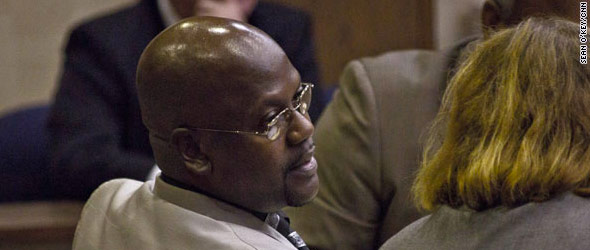
This afternoon at 1:30 pm (Central time), Sheri Lynn Johnson, the Assistant Director of the Cornell Death Penalty Project, will be making oral arguments on behalf of Mr. Flowers, and you can watch the proceedings live. If you have ever wondered if a prosecutor could conjure up a case simply by manipulating weak and vulnerable witnesses, you will want to check out Professor Johnson’s presentation of the facts.
Tied up at 1:30 and can’t tune in live? Read the text version of the appeal here. As legal documents go, it’s a page-turner.

Since 1997, the state of Mississippi has put Curtis Flowers on trial six times for the same crime. But they have never been able to lay this case to rest. Either the jury deadlocks along racial lines, or the state overturns the conviction on the basis of flagrant racial bias. On Monday, July 21 at 1:30 pm, Sheri Lynn Johnson, the Assistant Director of the Cornell Death Penalty Project, will be making oral arguments on behalf of Mr. Flowers and you can watch the proceedings live.
You can find the hearing by clicking here. The feed will likely go “live” about 5 minutes before the 1:30 scheduled start at the Mississippi Supreme Court.
If you can’t watch live, you can find the text version of Professor Johnson’s beautifully crafted appeal here.
The text of Flower’s appeal quickly zeroes in on the salient issue: “Flowers’ sixth trial bore the essential hallmarks of the three proceedings whose outcomes were previously reversed by this Court: weak and unreliable evidence of guilt, and prosecutorial misconduct undertaken to overcome that weakness.”
We are dealing with a case of prosecutorial tunnel vision bathed in racial bias. Shortly after 9 am on July 16th, 1996, four people were found brutally murdered, each with a bullet to the back of the head, in a furniture store in Winona. Three hours later, investigators had ruled out the man tied to the alleged murder weapon and, without a shred of evidence, credible or otherwise, made Curtis Flowers their sole suspect. (more…)

Thank you for attending Tuesday’s Information Meeting. Below are some highlights from that meeting as well as new next steps for the faith community in Greater Dallas.
The Situation
 By Alan Bean
The Rev. Robert Jeffress thinks Jesus would build a fence at the U.S. border so desperate children from violence-ridden countries would be discouraged from heading north.
“Yes, Jesus loved children,” Jeffress admits, “but he also respected law. He said, render unto Caesar the things that are Caesars.”
In other words, Christians shouldn’t trouble themselves with immigration policy; that’s Caesar’s concern.
Jeffress, pastor of First Baptist Church, Dallas, once suggested that Barack Obama is preparing the world for the coming of Antichrist, so his “Caesar” reference probably doesn’t mean that we should leave immigration policy in the hands of the presiding president. He means instead that everything Jesus said about welcoming children, and all the warnings he pronounced against those who harden their hearts against the pain of young ones, is irrelevant to American immigration policy.
Sure, Christians must be kind to the children they encounter within the suburban bubble, but the boys and girls of Honduras simply are on their own.
Since nothing can be done for the unaccompanied migrant children on our doorstep, the most compassionate course is to build a border wall so thick and so tall that the poor little blighters will have no choice but to return to the violence and squalor that drove them into the arms of America.
That young girl of seven or eight, carrying her two-year old sister on her back has spawned a crisis of conscience among American Christians.
On the whole, we have responded admirably. “This is an unfortunate, even awful, situation for everyone,” said David Hardage, Executive Director of the Baptist General Convention of Texas. “So much of what has happened and is happening is out of our control. What we can control is our response to human need. We will try to be the hands and feet of Jesus to those in need.”
Hardage sees Jesus standing on the side of desperate children, an assumption shared by most Texas Baptists.
Terry Henderson, state disaster relief director for Texas Baptist Men, compressed the issue to a simple question: “If Jesus was standing here with us, what would he tell us to do? That sounds kind of basic, but that’s the deal.”
That’s supposed to be a rhetorical question, but Robert Jeffress doesn’t provide the expected answer. He thinks Jesus would slam the door. Call it tough love. (more…)
 Friends of Justice