Category: Uncategorized

DEA officials gave Mexican cartel permission to bring narcotics into Chicago

drugsBy Alan Bean

A Mexican newspaper has published a thoroughly documented expose that makes a stunning case.  Beginning in the 1990s, the American Drug Enforcement Administration (DEA) made a deal with one of Mexico’s deadliest drug cartels.  If the Cartel gave the DEA accurate information on rival cartels, the DEA would allow the Sinaloa Cartel to import narcotics into Chicago.

I know this sounds crazy.  If the goal was to staunch the import of illegal drugs into the United States, what difference did it make which cartel was bringing in the drugs?

But, as anyone associated with the Drug War realizes, the goal has never been to stop, or even slow the importation of illegal narcotics into the United States; the goal has been to make a series of highly publicized drug busts in order to justify the continual flow of federal funds to the DEA.

That was the the game in its entirety.

When I published “The Law Falls Silent” in May of 2012, many found it difficult to believe that the American government would allow a Mexican drug kingpin to leave the United States in exchange for setting up an innocent man, Ramsey Muñiz .  In that case, neither the US Attorney who prosecuted the case, nor any one who testified at the 1994 trial, understood the first thing about the relationship between Donacio Medina (a Mexican drug dealer) and Ramsey  Muñiz, a para legal based in Corpus Christi.  No one questions that Muñiz drove Medina’s vehicle from one motel to another.  But did  Muñiz know the car, which he claimed to be moving as a favor to Medina, contained $800,000 worth of powdered cocaine?

Muñiz says Medina approached him because the Mexican national was looking for an attorney to assist two family members who were incarcerated in federal prisons.  Although no one involved with the trial knew it at the time, the feds arrested Medina in Houston and told him he was going to prison unless he could give them something or somebody of value.  Medina set up the scenario in Dallas that brought Muñiz down and told his DEA handlers to arrest the guy driving the Camry.  As soon as the trunk was opened, Medina was allowed to leave the country a free man.

The story Ramsey Muñiz told at trial sounded incredible to the jury.  Why would the federal government put a man in prison for the rest of his life unless they knew for certain he was a dangerous drug dealer?  More to the point, why would the feds release a man they knew was importing millions of dollars of cocaine into the United States knowing full well that he would continue his illegal activities?  It made no sense.

Read the story below and you will know why neither the DEA nor the DOJ cared who put the drugs in the car or whether Ramsey Muñiz knew he was driving a hot car.  It didn’t matter.  Medina gave them a high-profile narcotics case on a silver platter. The fact that Muñiz, two decades earlier, their suspect had run for Governor of Texas only sweetened the story.

Once again, the legitimization of the drug war, and the vast sums of money that came with it, were all that mattered.  If you doubt that, read on.

CONFIRMED: The DEA Struck A Deal With Mexico’s Most Notorious Drug Cartel

By 

Business Insider

January 13, 2014

An investigation by El Universal has found that between the years 2000 and 2012, the U.S. government had an arrangement with Mexico’s Sinaloa drug cartel that allowed the organization to smuggle billions of dollars of drugs in exchange for information on rival cartels.

Sinaloa, led by Joaquin “El Chapo” Guzman, supplies 80% of the drugs entering the Chicago area and has a presence in cities across the U.S.

There have long been allegations that Guzman, considered to be “the world’s most powerful drug trafficker,” coordinates with American authorities. (more…)

The shame of a defrocked priest raises painful questions

By Alan Bean
The still-unfolding story of Father John Salazar is tragic in almost every detail and raises all manner of disquieting questions.  Especially for me, because I am personally acquainted with almost everybody on both sides of this mess.  (You might want to read the story first, and my reflections second.)
While living in Tulia, my wife and I got our hair cut at the beauty shop run by Yolanda Villegas (pictured below).  We still drop by for a trim when we’re in town.  These are good folks.
One of our children was good friends, maybe even best friends, with Beau Villegas, the young man who was molested by John Salazar.
During the years of controversy surrounding the Tulia drug sting, Salazar and Bishop Leroy Mathiessen were extremely kind and supportive to those of us who sided with the defendants.  That meant a lot at a time when support was hard to find.
This article in the Los Angeles Times brings out the human dimensions of a messy story.
Can a single man be both a devoted priest and a child molester?
The easy answer is no.  But John Salazar was, in many respects, a good priest.  He may be somewhat self-deluded, but he has a conscience.  The first time I visited with him, I asked myself how a man this gifted could end up in such an isolated parish.  Now I know.
A similar question must be asked regarding Bishop Mathiessen and the hundreds of other Roman Catholic officials across the nation who bestowed grace on troubled priests.  Can a Catholic bishop be both heroic and hopelessly naive?  Mathiessen took a stand against the nuclear madness in Amarillo, Texas, the town where many of these weapons were being built.  That took guts.
We must also understand that, to a significant extent, Mathiessen was displaying the grace of Jesus Christ when he gave Salazar, and many other priests haunted by similar demons, a second chance.  Mathiessen was also a bureaucrat forced to find priests for isolated parishes when even the most flourishing congregations were understaffed.  Grace, pragmatism, and an odd form of moral blindness flowed into the decision to send John Salazar to Tulia.  Good men, even the best of men, can get things horribly wrong.  That appears to be the hard lesson here.
Finally, this is a story about institutional crisis.  The tradition of priestly celibacy, coupled with a bar on the ordination of women, has created problems for the Roman Catholic Church for which there is no solution.  If talented young men had been streaming into Catholic seminaries, men like John Salazar would never have been given a second chance.  Moreover, most of the damaged men who tormented innocent young parishioners across the nation would have been identified and forcefully dealt with.   But administrators like Leroy Mathiessen were forced to decide between a host of competing evils.  In many cases, they chose badly and they must be held accountable for those decisions.   But there is a sense in which these religious bureaucrats are mere symptoms of institutional crisis.
When one bad commits commits a bad act, we may be dealing with an isolated instance of moral failing.  When thousands of well-intentioned people commit the same bad act, repeatedly, we are dealing with a systems failure.
Father John Salazar-Jimenez, left, accused in 2002 of abusing two boys in Los Angeles in the 1980s, appears at his arraignment in L.A. County Superior Court. Yolanda Villegas, right, treated her pastor in Tulia, Texas, as a member of her family, but she did not know about his past. (Associated Press, Los Angeles Times) More photos

One troubled priest who got a second chance

After he left Los Angeles, Father John Salazar-Jimenez became a trusted figure in a small Texas parish. But few there knew his history.

By Ashley Powers

Reporting from Tulia, Texas

December 30, 2013

 He was given a second chance here, in the High Plains of Texas, where a patchwork of cotton and wheat fields unfurls beneath a giant blue sky.

He was no longer Father John Salazar, a name typed across yellowed newspapers and courthouse microfilm more than a thousand miles away in Los Angeles. He was Father John Salazar-Jimenez, the face of Catholicism in this town of emptied grain elevators and darkened shop windows. (more…)

Friends of Justice receives Pollination Project grant

By Alan Bean

Last year, Dallas-based real estate developer, Ari Nessell, gave away $1,000 a day to small non-profit organizations across the nation.  Friends of Justice is the proud recipient of one of these Pollination Project grants and are using it to kick-start our Common Peace Community program.  Last week, the Dallas CBS radio affiliate ran a story that featured our work.  You can find the audio here.

Should philanthropists make lots of small grants or a handful of large grants?  I suppose that is up to the philanthropists–they don’t ask us.


A Thousand Dollars A Day

By Emily Trube | KRLD

DALLAS (KRLD) – How much of a difference can $1,000 make? For almost 400 organizations around the world, a thousand dollars has been the start of something big.

Ariel Nessel

Dallas-based developer and philanthropist Ari Nessel gave away $365,000 in 2013, a thousand dollars at a time as part of the Pollination Project. The grants were given to start-up non-profit organizations and individuals who are bringing new ideas to the challenges of environmental sustainability, social justice, and community health and wellness.

KRLD’s Emily Trube spoke with Nessel and some of the people in North Texas who were recipients of the Pollination Project grants.

My Christmas Eve Epiphany

By Alan Bean

I have been driven to a startling conclusion: the God who burns with compassion for the outcast is our salvation.  That simple message fueled the ministry of Jesus.

Jesus’ solidarity with the poor wasn’t stressed much in the churches I knew as a child.  No one denied that the Savior cared for the poor or that charity was a Christian virtue; but we were taught that Jesus came to save our souls for heaven.  Period.  End of story.  That being so, the Savior’s compassion for the poor and marginalized was theologically irrelevant.

Charity was never disparaged, understand.  Saved people were expected to show kindness to vulnerable and needy people; but these acts of kindness had nothing to do with “getting saved” or, more precisely, salvation had nothing to do with these acts of kindness.  Despite what Paul said in 1 Corinthians 13, concern for “the less fortunate” was optional.  Technically, if Ebenezer Scrooge, in full bah- humbug mode, had believed that Jesus Christ died for his sins, he had his ticket to heaven.  Good works might suggest that you were being sanctified, but they had nothing to do with salvation, so Ebenezer, the unrepentant sinner, was saved.  God might not like it; but those were the rules.

Then we stumble into the Gospels, a world where salvation means deep identification with the poor.    We don’t earn our salvation by caring for the poor; God’s love for a broken humanity is our salvation.  In this we see the glory of God.

This came home to me in a powerful way this Christmas eve in a weird, stream of consciousness collage.  Given the season, we might as well call it an epiphany. (more…)

Socialized medicine saves money


By Alan Bean

A quick glance at this graph and you would think you were looking at a comparison of murder rates, incarceration rates, or the use of the death penalty.  America, in so many instances, is an outlier; we have our own unique ways of doing things.  We lock up far, far more of our citizens than other nations.

Although our crime rates generally aren’t that high, we kill each other at an astonishing rate.

Then we execute many of our murderers (especially in Texas and the South) while most other western democracies do not.

Unlike other nations of similar affluence, we make it progressively easier to buy a gun and progressively more difficult to vote.

And then there’s healthcare.

Americans believe that a comparatively privatized health care system offers more effective, efficient and inexpensive medical services.   It only seems natural.  After all, we know that government services are always less efficient and cost-effective than services produced by the private sector.  Right?

In some cases, this is likely true.  Competition can produce low cost, high quality goods and services.  Governments, for instance, don’t make good cars.

But when it comes to healthcare, American insistence on privatizing services whenever possible comes with an extremely high price tag.  The following charts (you can find plenty more at the CSM site) demonstrate just how different the US system is, and how much we are paying for that difference.

Although premiums under the Affordable Care Act are reasonable by American standards, we are still paying far more for medical insurance than nations with single-payer systems.  The phrase “socialized medicine” is misleading.  Parts of the medical system in Canada, for instance, involve the private sector and America covers millions with Medicare, Medicaid and the military medical system.  Still, it appears that involving the government more, in this one instance at least, does wonders for the bottom line.

Bogus Obamascare story reveals the impact of staff cuts

No editor's note. No comment. No clarification.

By Alan Bean

Maggie Mahar knew something was wrong when she read in the Fort Worth Star-Telegram that a local woman’s health insurance policy had been cancelled and that the premium if she signed up for Obamacare would be $1,000 a month.  Mahar did some quick checking and learned that the woman qualified for insurance at one-third the price.  When she informed the Star-Telegram of this fact, she learned that the newspaper had been notified, shortly after the article went to print, that the woman had signed up for a new policy under the Affordable Care Act at a cost of only $350 per month.

That was a month ago, and the paper still hasn’t published a correction.

It doesn’t end there.  According to Mahar, most of the dissatisfied health insurance customers quoted in the expose were Tea Party activists who were eager to believe the worst about the ACA.  It isn’t clear if these people contacted the reporter who wrote the story or if she initially reached out to them.

This isn’t a story about conservative media bias in North Texas.  The Star-Telegram is about as moderate a newspaper as you can reasonably expect hope to find in deep red Tarrant County.  This kind of colossal screw-up is happening across the country on stories large and small because newspapers don’t have enough reporters to cover important stories well, nor, in many instances, do they have the luxury of fact-checking.  When reporters are doing the work of three people the temptation to cut corners becomes overwhelming and mistakes are inevitable.

There is no sense pointing fingers at individuals.  Staffing cutbacks are a function of declining readership and a corresponding drop in advertising revenue.  Even the New York Times would be out of business by now had it not been purchased by a wealthy benefactor.

Still, it is unforgivable for the Star-Telegram to maintain a stony silence when the editorial staff knows they dropped the ball.  When it comes to health care reporting, be very skeptical about what you read, especially when only folks on one side of the issue have been asked for their opinion.

Note: Since this story aired, Jim Witt, the executive editor of the Star-Telegram, has printed an editorial apologizing for the newspapers’ failure to publish a correction to the story Maggie Mahar cites below.  Witt points out, correctly, that the Star-Telegram has maintained a neutral and unbiased stance toward the Affordable Care Act.  He also denies that one of the women quoted in the story belongs to the Tea Party (although her mother leads the Parker County chapter) and the woman has published a letter in a Tea Party friendly paper repeating her inaccurate claim that her premium would be almost $1,000/month.  Will mentions that the S-T published a story by a reporter who says he had no trouble signing up for insurance on the government site.  Witt has made a good initial attempt to set the record straight, but he needs to correct the grossly inaccurate claims about the high cost of premiums that constitute the heart of the original S-T story and Mahar’s critique.  Witt is right to claim that Tea Party members need good health care just like everybody else, but that’s not the point.  As Mahar makes clear, reasonably priced policies (by inflated American standards) are available, so the point is moot.

Anatomy of an Obamacare ‘horror story’

Texas daily went digging for victims of the ACA and Surprise! Reporter unearthed three Tea Partiers who hate the new law.

By 
January 3, 2014

For months, health reform’s opponents have been feasting on tales of Obamacare’s innocent victims – Americans who lost their insurance because it doesn’t comply with the ACA’s regulations, and now have to shell out more than they can afford – or go without coverage.

Trouble is, many of those stories just aren’t true.

Yesterday I posted about a Fort Worth Star Telegram article that leads with the tale of Whitney Johnson, a 26-year-old new mother who suffers from multiple sclerosis (MS). Her insurer just cancelled her policy, and according to Johnson, new insurance would cost her over $1,000 a month. (more…)

Murder rates plummet . . . but why?

U.S. Violent Crime Rate, U.S. Justice Department Statistics, 1973-2010

By Alan Bean

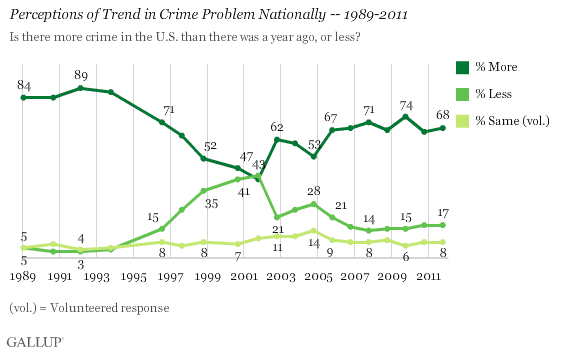
Ask most people if violent crime rates are rising or dropping and most will pick the pessimistic option.  The chart above shows how dramatically violent crime rates have been dropping since the early 1990s.  If you get most of your information from watching television, you’d think the nation was drowning in a tidal wave of blood.  Sex and violence, often in lurid combination, grab and hold the attention of prime time viewers, so that’s what we get, all the time.  The more bizarre, twisted and disturbing the better.  The acting and story lines in the Sopranos, Dexter, Boardwalk Empire and Breaking Bad are unsurpassed, but minus the gratuitous violence,  these programs would lose much of their audience appeal.  The entertainment world’s fascination with serial murder is particularly over the top.

Falling crime rates are bad for the ratings, but the latest outrage is a sure headline grabber.  So the average American can be forgiven for thinking that crime is getting worse every year.

Perceptions of Trend in Crime Problem Nationally -- 1989-2011

(more…)

Top ten posts of 2013

Blogging is an ephemeral medium: you get a lot of hits (if you’re lucky) the day you write something, but interest immediately wanes.  For the most part, it’s just as well.  Hot, topical stuff always gets the most attention, and every blogger knows that nothing sells like a good scandal or controversy.  That said, if bloggers have something important to say on subjects of timeless importance, the hits will keep piling up over the years.  Most posts, deserve to be immediately forgotten, but some stand up.  This explains why, over the course of a year, some posts that were written prior to 2013 got more attention than more recent contributions.   For this reason, we will just be featuring the stuff our readers liked the most in 2013.  Here’s the list.

1. Don’t blame Al Mohler, it was all God’s idea.  This post hit a nerve with people who studied at the Southern Baptist Theological Seminary before it became an indoctrination academy.  In the picture below, James Petigru Boyce, the school’s founder, is pictured in the Confederate uniform he war on formal occasions during the Civil War.

Thumbnail
James Petigru Boyce

2. Cliburn gives his regards to Broadway.  Broadway Baptist Church said farewell to its most acclaimed member this year.  I talked about the renowned pianist’s relationship with Broadway Baptist Church, a church committed to great music.

Van Cliburn plays in Moscow in 1958

3. Curtis Flowers.  Curtis Flowers lives on death row in the notorious Parchman prison in the heart of the Mississippi Delta.  He has stood trial for murder six times, more than any American defendant in history.  Flowers is innocent, and the appeal of his 2010 conviction demonstrates how he was framed by an incompetent and lazy prosecutor.  Friends of Justice has been working on Mr. Flowers’ behalf since 2007.  Flowers is from Winona, Mississippi, the town where civil rights icon Fannie Lou Hamer was beaten half to death in 1963.

The old train depot in Winona, Mississippi

4. Ayn Rand: the mother of American satanism.  The title notwithstanding, this post doesn’t suggest that Ayn Rand was a satanist; but her insistence that her philosophy is the antithesis of Christianity was the inspiration for the pop satanism of Anton LeVey.

Ayn Rand and Anton LeVey

5. Stories we believe in: Learning from Walter Fisher’s narrative paradigm.  What did Ronald Reagan understand about the power of story that liberals never seem to grasp?

6. Money for nothing: how racial bias destroyed six lives, stymied a black-owned business and outraged a congregation.  This narrative was written at the end of months of careful research.  This case sheds light on the disastrous rollout of the Obamacare website; this is what always happens when a single website tries to bring too many players together.  The men and women at IRP believed they could help a long list of federal law enforcement agencies share data.  For their trouble, they were investigated, raided, and tried for, essentially running a fake business.  After all, the government implied, who ever heard of a black-owned IT company?  This case would have been lost to memory if the six defendants hadn’t belonged to the same Pentecostal congregation in Colorado Springs.  These people don’t quit!

7. Tom Berry: Ten years of waste, immigrant crackdowns, and new drug wars.  If you want to know why America’s immigration policy is so badly broken, this article by Tom Berry is a great starting place.  “Continuing down the same course of border security buildups, drug wars and immigration crackdowns will do nothing to increase security or safety,” Berry says.  “It will only keep border policy on the edge – teetering without direction or strategy.”

8. Songs got us through: Fannie Lou Hamer in Winona, Mississippi. The sadistic brutality Hamer and her friends endured in Winona beggars comprehension unless you understand the times.  In 1963, only 6.4% of Mississippi’s eligible black voters were registered.  In Montgomery County it had been years since the last African-American had voted.  It took men like Sheriff Earl Wayne Patridge to maintain this unnatural state of affairs.

Fannie Lou Hamer

9. Of hell and hell fire, it’s not what you think.  We are taught that God is love.  We are taught that God consigns the wicked to hell for eternity.  Surely both can’t be true?

image
A young C.S. Lewis

10. Welcome to the Parchman plantation.  This post, written following a failed attempt to visit Curtis Flowers at Parchman prison in 2010, keeps getting a lot of attention.

Cotton fields outside Parchman prison


Evolution and the politics of brand loyalty

By Alan Bean

Four short years ago, a slim majority (54%) of Republicans believed in some form of biological evolution; now only 43% hold that opinion.  You rarely see this kind of dramatic opinion swing in such a small time frame, so what’s driving it?

This is an important question because, in the Pew survey I am citing, the alternative to belief in biological evolution is that “humans and other living things have existed in their present form since the beginning of time.”  We can debate the details of evolution–how it happened, whether the hand of God was guiding the process, etc.–but the notion that all living things have existed in their present form since the dawn of time is demonstrably false.  To persist in this opinion is to deny the overwhelming consensus within the scientific community–that is, the folks who know what they are talking about.

On Sunday morning, a member of my Sunday school class expressed his amazement that educated people could assert that the universe simply appears to be ancient because God created a world that looks much older than it really is.  “The man who signed my PhD diploma believes precisely that,” I informed the class. (more…)

Tulia, Texas hires African American police chief

Google Tulia, Texas and you will be bombarded with references to the ill-fated drug bust of 1999.  By the time Rick Perry pardoned thirty-five defendants in 2003, Tulia had earned the unofficial title of the most racist town in America.  I have long argued that what happened in Tulia was simply the most obvious example of wrongheaded policies playing out nationwide.  By hiring Jeffrey Yarbrough as the town’s first African American police chief, Tulia shows that it has learned from painful experience.  If anything, Yarbrough is over-qualified for the position and the Panhandle community is fortunate to have a man with his background overseeing its police department.

City of Tulia Hires Jeffrey Yarbrough as Next Chief of Police

Jeffrey Yarbrough
Jeffrey Yarborough

Jeffrey Yarbrough has been selected by City Manager Andrew Freeman as the next police chief for the city of Tulia. Yarbrough currently works in the Austin area and is a 19 year law enforcement veteran. He has accumulated extensive law enforcement, leadership, and investigative experience from his service in municipal, county, and state agencies. “I am truly humbled to be selected to serve as Tulia’s next police chief. It is important to me to get to know the citizens of Tulia in order to develop and strengthen lasting partnerships within our community,” said Yarbrough.

Most recently, Yarbrough served as senior investigator for the Chief Disciplinary Counsel of the State Bar of Texas. Yarbrough previously served as a sergeant with the Texas Attorney General’s Office, investigator with the Bastrop County Sheriff’s Department, captain with the Lee County Sheriff’s Department, and patrolman for the city of Giddings.

“I am excited about the opportunity to work with the officers within our police department,” Yarbrough said. “I have no doubt that together we can enhance the quality of life for all members of our community. I look forward to making myself available and serving our city, as we work together to make Tulia a great place to live, work, and play.”

Yarbrough holds a master peace officer license and instructor certification. He earned a Bachelor of Science degree in Criminal Justice from the University of Texas at Brownsville and a Master’s of Science degree in Human Resource Development from Texas A&M University at College Station. Yarbrough is pursuing a second Master’s degree in Public Administration from Sam Houston State University. He also attended Northwestern University Center for Public Safety’s Senior Management Leadership Program, in Evanston, Illinois, and the Law Enforcement Leadership Program at Blue Ridge Community College in Flat Rock, North Carolina.

Yarbrough is expected to begin his tenure with the Tulia Police Department mid-January 2014.

For any questions, please contact Andrew Freeman at afreeman@tulia-tx.gov