Category: Uncategorized

Michelle Alexander: hard times won’t end the drug war

With America wrapped in the coils of a budget crunch, can we afford a drug war?  Shouldn’t the appalling cost of mass incarceration be giving us a terminal case of sticker shock? 

Many pundits are looking for modest cutbacks in prison populations and narcotics task forces in the years ahead.  No need to worry, they suggest, the new Jim Crow will soon collapse under its own weight.  It might be a slow process; but change is inevitable.

Michelle Alexander isn’t convinced.  Her article, “Obama’s drug war,” will appear in the December 27th edition of  The Nation along with several shorter pieces written by notable drug war critics like Bruce Western and Marc Mauer

Most of the articles in this series advance common sense public policy arguments construing the war on drugs as a misguided attempt at crime control.  Most of the writers know it ain’t that simple, but when you’re writing for the Nation you reach for arguments that click with white liberals.

Michelle Alexander comes bearing bad news.  The war on drugs and mass incarceration cannot be scaled back, she says, “in the absence of a large-scale movement—one that seeks to dismantle not only the system of mass incarceration and the drug war apparatus but also the habits of mind that allow us to view poor people of color trapped in ghettos as ‘others,’ unworthy of our collective care and concern.” (more…)


Clenched Fists and Open Hands: McLaren and Rohr get real about religion

By Alan Bean
 
I spent last weekend attending a conference on “the Emerging Church” held on the campus of  Texas Christian University.  Below, I have reproduced my noted from three talks, two by Brian McLaren, a clear-sighted Protestant, and one by Father Richard Rohr, a Roman Catholic priest dedicated to the contemplative life.  These three talks complement one another and inform our struggle with mass incarceration, but I will leave it to you to make the connections.  My summary is taken from my notes, so, gentlemen, if you read this and think I misrepresented your ideas, I am open to correction. 

Brian McLaren 1: Clenched Fists and Open Hands

Brian McLaren

The world runs on stories, McLaren says. It is the role of religion to provide us with our stories; but what happens when these stories no longer help us address the big issues: poverty, peace and the planet?

The primary religious narrative in Western culture, McLaren suggests, has been the domination story: stories of the clenched fist which could also be called conflict narratives, warrior narratives or sword narratives. Typically, empires appear as the heroes of domination narratives. (more…)

Body discovered hanging in a tree in Greenwood

In a follow-up to this post, civil rights leaders in Mississippi are beginning to question the official “suicide” hypothesis in this case.

Update from AP follows original story

Body discovered hanging in a tree in Greenwood

Posted: Dec 03, 2010 10:29

GREENWOOD, MS (WLBT)- The body of a man in his twenties was discovered hanging in a tree in a field in Greenwood.

The Leflore County coroners office says the unidentified black male was found about 12:30 Friday afternoon by two men who work nearby.

The coroner is trying to identify the man before the body is sent to the Mississippi Crime Lab in Jackson.

The FBI is investigating the case. (more…)

Challenging the New Jim Crow, conclusion

This is the concluding segment in a five-part series.  Earlier posts can be found here, here, here, and here.

Larry P. Stewart

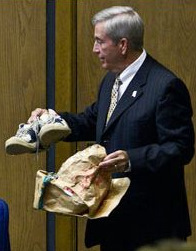
Swisher County Sheriff Larry Stewart, Jena District Attorney Reed Walters and Mississippi prosecutor Doug Evans were raised in a culture that wore its racism like a badge of honor. As young children, Stewart, Walters and Evans were exposed to ideas, attitudes and experiences that left them deeply scarred. There is no sense condemning such men as if their adult behavior was exceptional or uncharacteristic of the larger society; it was not. Stewart, Walters and Evans were grown men with fully formed opinions when, suddenly and without warning, the racial rules changed. By 1991, the year all three men ascended to positions of power, public officials were officially colorblind. Now, two decades later, only those who use the n-word and publicly and embrace the principle of white supremacy are deemed worthy of the epithet “racist”.

Welcome to the colorblind world of the new Jim Crow, where nobody, black or white, Democrat or Republican can “see color”. The policy of mass incarceration is now too firmly entrenched to be questioned inside the American mainstream. Seven million Americans are “in the system” (prison, jail, probation and parole) another seven million Americans benefit, directly or indirectly, from the mass incarceration of American citizens.

J. Reed Walters

If other western democracies are anything to go by, America should be incarcerating just over 380,000 people; but we’re locking up six times that number. Either we have a lot more criminals than other countries, or something sinister is afoot.

Tragically, the criminal justice reform movement is splintered into hundreds of single-issue advocacy groups pressing for piecemeal and incremental “best practice” reforms. Some of us focus on juvenile justice, mandatory minimum sentences, the war on drugs, the death penalty or a dozen other worthy issues.

We have won a few isolated battles, but we are losing the war. Until we understand and expose the dynamics of the new Jim Crow, positive change is impossible. Our challenge is to change the way American thinks about race, crime and justice. With a goal that daunting, only a unified movement with a clear message can prevail.

Doug Evans

The mass incarceration of poor people of color is strictly hush-hush. You will rarely hear it mentioned on the evening news or by hip comedians like Jon Stewart on the Daily Show. But this isn’t somebody else’s nightmare; it belongs to you, and it belongs to me. Mass incarceration must end, brothers and sisters; the new Jim Crow has got to go.

Goodwyn: The price of speaking out


Wade Goodwyn

Wade Goodwyn’s “Reporter’s Notebook” on the NPR site deals with a curious encounter with the black principal of Clarksville High School.  I urge you to give Wade’s account your careful attention because it highlights a tension that exists within the African American community, especially in small southern towns where it is incumbent upon black professionals to remain in the good graces of the white establishment.  I could relate similar stories from my work in places like Tulia and Hearne, Texas; Jena and Church Point, Louisiana; and Winona Mississippi. 

It is easy to write off people like the principal described below as an Uncle Tom, and doubtless the shoe fits.  But the economic and social consequences of denouncing injustice can be catastrophic.    (more…)

School board says ‘no’ to Chavez holiday

Cesar Chavez

By Alan Bean

Arlington school students will still have a holiday in May, but it won’t bear the name of Cesar Chavez.  Last night, a series of eloquent Latino activists (many of them in their teens) made the case for naming this anonymous holiday after the great labor organizer and civil rights activist.  Gloria Peña, president of the board of trustees, presented a motion in favor of the change.  I even made a little impromptu speech of my own.  It made no difference.

For me, this issue is personal and therefore emotional.  First, the local fight for a Chavez holiday is being led by Luis Castillo, am Arlington LULAC president, Friends of Justice board member, and friend.  (more…)

Bob Herbert brings us down to earth

By Alan Bean

Let’s face it folks, William Wordsworth was right:

The world is too much with us; late and soon,
Getting and spending, we lay waste our powers;
Little we see in Nature that is ours;
We have given our hearts away, a sordid boon!

How many of us understand what’s going on out there?  Does anyone comprehend the economic crisis raging around us?  Really? 

We listen to the pundits mutual-contradictions and say (if we are honest), “You might be right, but what do I know?  More to the point, what do you know, and how do you know it?”

This being the case, it is refreshing to find an opinion piece that limits itself to the obvious facts about which there can be little controversy.  Consider this:

“People traveling in the real world understand that the federal budget deficits are sky high because of the Bush-era tax cuts, the costs of the wars in Iraq and Afghanistan, and the spending that was needed to keep the Great Recession from spiraling into another Great Depression.” 

Bob Herbert could have added the huge welfare program known as mass incarceration to the list, but he’s essentially on target.  How many Americans understand these obvious facts?  Judging by the recent election, not many.  (more…)

Brian McLaren’s “New Kind of Christianity”


Brian McLaren

By Alan Bean

Brian McLaren knows how it feels to grow up “born again”.  Raised within the legalistic and apocalyptic tenets of the Plymouth Brethren, McLaren grew up worshipping an omnipotent Christ who would soon return to wreak vengeance on the enemies of God.  Gradually, over a period of decades, McLaren’s theology fell apart.  Then, just as gradually, it was replaced by what he calls “a new kind of Christianity.”  In fact, that’s the title of his latest book. (more…)

Journey Back to Parchman, Hank Thomas

Hank Thomas in 1961

Fifty years ago, Hank Thomas entered Parchman prison as a Freedom Rider.  I highlighted this distressing chapter of the Mississippi civil rights struggle in a post designed to establish historical context for the Curtis Flowers case.  Recently, I shared a personal encounter with Parchman when I unsuccessfully attempted to visit Curtis Flowers.  Last week, Hank Thomas was greeted with smiles and handshakes; in 1961 he was welcomed to Parchman by sneering guards.  

Reilly Morse, a senior attorney and a founding staff member in the Biloxi office of the Mississippi Center for Justice, has shared his reflections on Hank Thomas’s return to the notorious plantation prison.  Hank’s personal account is pasted below.  Both articles appear in the most recent edition of Facing South, a publication of the Institute for Southern Studies. (more…)