Category: Uncategorized

Our readers respond

(This post is part of a series concerning Curtis Flowers, an innocent man convicted of a horrific crime that has divided a small Mississippi town.  Information on the Flowers case can be found here.)

Not everyone in Winona, Mississippi is a big fan of Friends of Justice.  Our presence has generated some angry feedback in the comments section.  Since we have been critical of people like Judge Joseph Loper and District Attorney Doug Evans, it is only fair to give our critics a little airtime.  Below, in no particular order, are some of the strongly worded comments we have received in the last few days.

“Shirley” writes:

I was at trial Tuesday for continuing the selecting of the jurors. You couldn’t ask for a better judge. Judge Loper is doing his job, going exactly by what the law says to do and what he is suppose to do. So you young interns need to learn from Judge Loper or you won’t get very far with your life. Your telling all of these lies about the District Attorney, Winona Law Enforcement and Judge Loper, well honey, you have to answer to only one person…. and guess who that person is ….. Jesus!!!! You should get to know him and then you will see things a lot different.

The only people who are making this a racist thing is the blacks. It has always been that way. We had nothing to do with the past. We weren’t even born then, were you???? You are white, does that make you a racist?? Just because we are white, doesn’t mean we are racists. If you are a christian, it doesn’t matter what color you skin is.

“Justice” says, “You all are in winona and all you’re doing is causing termoil….stop thinking of yourselves and think about all the families (both sides)..stop trying to make it a racial issue…you are the ones holding this town up..not us.”

“Not your business” weighs in:

This is seriously the most pathetic website I’ve ever seen. The story about the young african american woman being pulled over and treated like that by law enforcement in winona is nothing but a made up LIE!! I’ve lived around Winona my whole life and law enforcement around here is nothing but nice. Its pretty sad that a lie like this was made up and brought into the courtroom. The people of this website should get a life and report the TRUTH if they’re going to report anything at all. For the record, I AM BLACK!!!!!

Tylert speaks his mind:

Alan bein you are a dumbass.

Holly says her piece:

I realize a person is innocent until proven guilty, but Curtis Flowers has been PROVEN GUILTY TWICE!! I don’t really believe it is a race issue. I believe this trial has become a race issue in the media, but the crime is that FIVE families have suffered for way too long – 14 years without closure. I have not sat on this jury, nor would I be so inclined, but it appears to me that justice has been robbed of all family members in this case. My prayers are that this will be the FINAL FLOWERS (Tardy Furniture Murder) TRIAL.

TCostilow says:

If it is so hard to find Blacks that are willing to serve on the jury, why doesn’t Curtis Flowers’ attorney request a change of venue? I believe that it is impossible to prove Curtis Flowers innocent, because he is not. His attorney knows that if he can get some Blacks on the jury, then it will probably be a hung jury again. I read your postings and other articles about the trial and it makes me believe that these are all tactics that the defense is using to manipulate the judicial system. As far as “Fear stalks a Mississippi Town”…the only fear that will stalk this town is if a murderer is set free just because he is successful in using his race to manipulate the system. There has been very little mention of Robert Golden, the one black victim. I met his wife soon after the murders and I hope that she and her family are not being isolated or discriminated against by the Black community.

L. Jones contributes this opinion:

If it were a white man being accused of these crimes, he would either be on death row at this point or already executed.

Finally, “Shirley” shares these thoughts:

There wasn’t even a $30,000 reward for years. There wasn’t even a reward at first. So don’t say the witnesses are doing it for the money and the district attorney offered them money. It took time to raise that reward. Curtis Flowers is the only one that had a reason to kill those people, which was a bad reason to kill 4 people. People are in the choir and churches claiming to be real Christians and are hypocrites. Only God knows who killed those innocent people and that person will pay some day.

He was found guilty the first time tried and the Supreme Court threw it out, what an embarrassment to our state. To have people in office like this is costing us tax payers a lot of money. If it wasn’t for the Supreme Court, this trial would have been over years ago and the family of the victims could move on with their lives, instead they have to relive this nightmare over again. The victims and families are the ones suffering and the killer is living it up.

The blacks are the only ones making this a racial thing, not the whites. A black man was killed too, one of their own. Whoever did this crime will answer to God and Thou shall not kill is what he will probably say to the one person who did kill more than once.

African American Mississippi Man Starts Record Sixth Murder Trial

(This post is part of a series concerning Curtis Flowers, an innocent man convicted of a horrific crime that has divided a small Mississippi town.  Information on the Flowers case can be found here.)

by Bill Quigley, Audrey Stewart and Davida Finger

An African American man, Curtis Flowers, made history this week when he became the first person in U.S. history to ever go on trial for murder six times for the same crime. Mr. Flowers has been in jail in Mississippi since 1996, accused of the murder of four people at a furniture store. Jury selection started this week in tiny Winona Mississippi, population 5,482. (more…)

Lili Ibara reports from Mississippi

(This post is part of a series concerning Curtis Flowers, an innocent man convicted of a horrific crime that has divided a small Mississippi town.  Information on the Flowers case can be found here.)
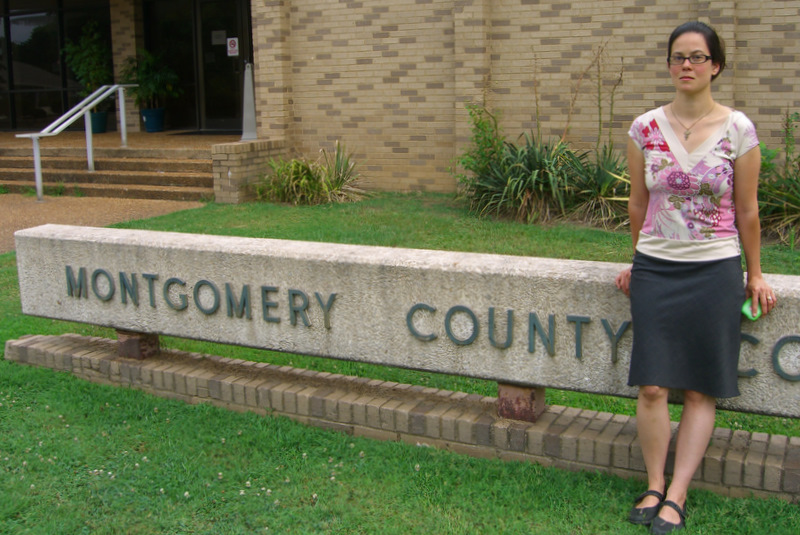
Lili Ibara has been working with Friends of Justice since January 16, 2000, the day we met her in Plainview, Texas.  Lili got the ball rolling in Tulia by alerting the Texas Observer to the grave injustice unfolding in our community.  This week she flew down to Winona to join the Friends of Justice contingent at the Curtis Flowers trial.  Tomorrow, Lili flies back to her husband, Jeremy, and her 10-month-old baby, Iris.  Here’s her account of her first three days in Winona.
Lili Ibara in front of the Montgomery County Courthouse
Lili Ibara outside the Montgomery County Courthouse during the sixth trial

Things aren’t looking so good in Mississippi. Here’s a quick update.

It’s been really draining to be in the courtroom, to realize people are talking about killing a man who is sitting right there at the defense table; to know his parents are sitting next to me watching as people say they would consider killing their son. It would be hard enough if I thought Curtis had killed four people. I really believe he is innocent though, and I know he’s already spent 14 years in jail (where, by the way, he’s been a model prisoner–no disciplinary write-ups, a lot of respect from the guards, and a leader of church services).

The whole thing is making me physically sick. I keep waking up in the middle of the night thinking about what it would be like if a courtroom full of people were talking about killing my baby.

It’s also incredibly sad to know the victims’ families are right there too. They really believe we’re here to free the person who killed their family members. The husband of one victim angrily confronted Friends of Justice director Alan Bean in the courtroom yesterday, calling him a “sapsuck’n liar” and told him he “wasn’t going to get away with this.” Alan was angry but could sympathize with him too. These people really believe they are right.

Unfortunately they also have a lot of supporters who seem to be wheedling their way onto the jury.

There are so many details that show Curtis isn’t getting a fair trial, that potential black jury members are afraid to be on the jury (one already formally asked to be excused because he was afraid of being arrested if he misspoke, as happened to this black juror from Curtis’s last trial who held out for an acquittal) and that the judge is favoring the prosecution (he’s allowing close friends of the victims to be on the jury, including one who admitted to attending two of the previous trials).

Wait, I need to repeat that bit, the judge thought there was no cause to dismiss a juror who had actually WATCHED two of the previous trials.

There’s also the inherent craziness of our criminal system, where the only people who can be on the jury are people who say they would consider imposing the death penalty. In this case the jurors are interviewed individually for this part, so potential jurors have to be willing to look right at Curtis and his family and say that yes, they could consider killing him. Most of the black jurors interviewed yesterday couldn’t do it, while most of the white ones, including close family friends of the victims, said yes, and also noted they could be absolutely fair and impartial to Curtis.

It’s my understanding that Curtis decided not to change venues because local people might know him and because he could not control where in Mississippi the trial was moved (the judge, the one who tried him last time, would get to decide that).

Yesterday the defense tried to present evidence that black jury members were afraid to be on the jury. In describing a climate of racial intimidation, the defense attorney pointed out that her African-American intern was stopped while driving into town. The intern was told to keep her hands on the wheel and her eyes on the road. She was asked what she was doing in town and told not to make any trouble. There was no answer when she asked what law she had broken. The judge was visibly outraged by this story, saying it was preposterous and the intern was probably speeding or otherwise breaking the law. The intern told me it took everything she had to keep quiet while the judge called her a liar.

There are also a lot of ridiculous details about the case itself that make me crazy. For example, the state’s big piece of physical evidence is the gunpowder residue found on Curtis’s hand hours after the shooting. It makes you at least seriously question Curtis’s innocence, right? But Alan Bean explained the police had found only a single micron of residue on his hand, and that the FBI doesn’t use this kind of evidence any more because small amounts of residue can easily be picked up by doing things like say, touching handcuff or furniture at a police station or, even during the testing process itself.

The eyewitness testimony would also seem to reasonably place Curtis at the crime scene, or at least not preclude the possibility, until you learn there were no willing witnesses until the state posted a $30,000 reward and went knocking on doors to ask people to testify. Once you know that, you understand why the physical descriptions by eyewitnesses are contradictory. One said he was wearing long pants and a jacket. A JACKET . . . IN MISSISSIPPI . . . IN JULY. Another said it was shorts and a t-shirt).

I don’t know if the prosecutor and judge really believe Curtis is guilty, or if they both just want to satisfy the victims’ families that the murderer has been found.

I do believe what we’re doing here is helpful though. When I worked on a Friends of Justice case in Tulia, Texas ten years ago I really sort of thought all the time we spent getting media attention and the time Alan later spent reviving media interest was pretty futile, but then miraculously the media attention turned into pressure on the legal system which turned into, um, justice. It’s also what Alan did with Jena – took a story local people told him and made it into a national story and now the kids arrested in Jena are in college, not prison. So, I’m trying to be hopeful.

Thanks for everyone for the donations to Friends of Justice and the babysitting help and covering my cases at work. It means so much for me that I get to be here and try to help.

Come to Jesus Time: Curtis Flowers trial, day four


(This post is part of a series concerning Curtis Flowers, an innocent man convicted of a horrific crime that has divided a small Mississippi town.  Information on the Flowers case can be found here.)

The record-setting sixth trial of Curtis Flowers will be tried by eleven white jurors and one African-American juror.

It could have been worse.  At the conclusion of the jury selection process, only ten black jurors remained standing.  The state had fifteen peremptory strikes.  Had DA Doug Evans so chosen, we could have had an all-white jury.

Doug Evans did not so choose.  A jury bereft of black jurors in a county that is 45% black would have looked . . . tacky.  When the prosecutor in question has a well-earned reputation for racial bias you need at least one African-American in the judicial mix.

In Flowers 3, Evans had to use all fifteen peremptory strikes on African-Americans to get eleven white jurors.  This time, Winona’s black community did Evans’ work for him by stampeding, lemming-like, over a cliff.  They claimed they were too convinced of Flowers’ innocence to be fair and impartial.  They said they couldn’t consider the death penalty under any circumstances.  They couldn’t judge a fellow human being under any circumstances.

Several of the ten black jurors left standing at the end of voir dire were barely rescued by skillful rehabilitation work from defense attorney Ray Carter.  “You don’t have to commit to the death penalty,” Carter explained, “you must simply be willing to consider it, to think about it, to weigh it as an option.  Do you think you could do that?”

More often than not, black jurors answered in the negative.  They simply didn’t want to be on a jury with ten or eleven white-people-on-a-mission.

There was an eloquent sadness in Carter’s eyes as he returned to his chair.

Black jurors have been reluctant to serve in previous trials held in Montgomery County–but nothing like this.

Don’t get me wrong, most black jurors are perfectly sincere in their disavowal of the death penalty.  In Flowers 4, the state didn’t ask for capital punishment and five black jurors were seated.  All five held out for acquittal.

But something new is in the works in Flowers 6.  The brutal treatment of Flowers 5 juror, James Bibbs sent a tidal wave of fear through Winona’s black community.  Judge Joey Loper pitched a conniption-fit when Bibbs held out for acquittal.

The judge has a nasty temper.  He doesn’t just overrule defense motions; he buries defense counsel under a great heap of pejoratives, as in:  “That has to be the most bizarre motion I have ever heard.”

But the honorable Mr. Loper has nothing but praise for the perspicacity and prudence of his legal tag team partner Doug Evans, as in: “Once again, I find myself concurring entirely with the state of Mississippi”.

Ideologically, Loper and Evans are joined at the hip.  Defense counsel was uncomfortable with a juror who had an opinion regarding the guilt or innocence of Mr. Flowers and had Googled the case the moment she received her summons.

“I don’t see a problem with that,” Evans said.  “I mean there are liberal blogs out there and then there are legitimate blogs.”  Judge Loper beamed appreciatively.

I got the feeling that the Friends of Justice blog was being consigned to the illegitimate category.

With eleven white jurors and an unabashedly pro-prosecution judge is a conviction inevitable?

Precedent isn’t promising.

Not a single white juror in five prior trials has voted to acquit Curtis Flowers.

Juries in trials with a single black juror have convicted and imposed the death penalty.

But there are positive signs.  Defense counsel was able to strike most of the people with intimate ties to murder victims and a firm conviction that Curtis Flowers is a mass murderer.  Again and again, jurors of this type swore they could “set aside” their feelings and opinions if the judge asked them to.  This emotional naïvete was stunning.

William James, the nineteenth century American philosopher, explained why “older truths” are rarely abandoned. “Their influence is absolutely controlling,” he wrote. “Loyalty to them is the first principle – in most cases it is the only principle; for by far the most usual way of handling phenomena so novel that they would make for a serious rearrangement of our preconceptions is to ignore them altogether, or to abuse those who bear witness for them.”

Defense counsel in the Flowers is trying to convert eleven white jurors to a novel reassessment of long-accepted fact.  In Winona’s respectable white community, the guilt of Curtis Flowers is an “old truth”, a maxim so well established that it passes for common sense.  Getting a single juror to re-evaluate the state’s case  is like trying to convert a Baptist to Islam.  The new idea, if accepted, would impact an entire web of social relationships.  Friendships would be lost.  Business opportunities would vanish.  The doors and windows of polite society would slam shut.

How much easier to ignore this new truth while abusing those who bear witness to it.  This explains the contempt Judge Loper has been heaping on Ray Carter and Alison Steiner this week.  They represent a new truth which, if accepted, would reduce Winona’s white civilization to ruins.

In the next few days we will be witnessing a form of spiritual warfare in the courtroom.  Loper and Evans will be reassuring the jurors that the old truth deserves their continued trust.  Carter and Steiner will be preaching a new truth. At least one juror must experience a Damascus Road conversion in the next few days.

The challenge is formidable but not hopeless.  Several of the jurors in this case were children back in 1996 when four people were killed execution-style in Winona Mississippi.  Several other jurors are relatively new to Montgomery County.  One juror is African American.  Half the jury lives outside the comforting rhythms of the white mainstream.   If we see a come-to-Jesus moment, it will likely come from this half of the jury.

If opening arguments are any indication, Curtis Flowers’ attorneys will be preaching for conversions.

White Answers: Curtis Flowers Trial, Day Three

(More information on the case of Curtis Flowers can be found here.)

Nationally, only 40% of African Americans support the death penalty, compared to 68% of whites.  In Mississippi the racial divide is even greater: only 25% of black adults in Mississippi favor capital punishment compared with over 70% of white adults.

When you understand the history of lynching in the South this discrepancy isn’t surprising, but it works to the disadvantage of black defendants like Curtis Flowers.  Curtis is currently on trial for the sixth time on the same evidence—the first time that has happened in the history of American jurisprudence.  Today, fifteen black jurors were asked if they could consider the death penalty in the event that Curtis is convicted; six said they could and nine said they could not.

In these United States, opponents of capital punishment are excluded from juries if the prosecution is asking for the death penalty.

Black jurors were also far more likely to admit that they had a fixed opinion on the guilt or innocence of the defendant.  Were black jurors sincere in their answers, or were they simply frightened by the prospect of serving on a majority white jury?  I don’t know.  Perhaps they don’t know themselves.

James Bibbs, the retired school teacher who hung the jury in trial five, was prosecuted for perjury.  Fortunately, attorney Rob McDuff was able to get both Loper and DA Doug Evans recused from the case, but the message got through to Winona’s black community.

Today, as if to drive home the point, Mr. Evans accused a black juror of lying about how often she sees Curtis Flowers’ sister at work.  The juror reported that she works at the opposite end of the assembly line and rarely speaks to the defendant’s sister.  Evans brought in a white woman who works at the plant to testify that the two women work nine inches apart.

Message: another black person is lying to get on the jury.

Ironically, the juror in question had already eliminated herself from contention by stating her opposition to the death penalty.

Later today, I called up Charita Flowers and asked her who had it right.  The woman Evans dragged into the courtroom, Charita told me, works in another part of the building and rarely observes the work arrangement on the line.  “Most of the time we [Charita and the juror] are at opposite ends of the line,” she explained, “but every once in a while we will be standing right next to each other, so both sides are telling a part of the truth.”

A trivial point in a trial of such moment, I know.  But Evans was making a not-so-subtle point.  Any black person who ends up on this jury can expect to be accused of perjury.

For the past two days, jurors have been entering the courtroom alone to be asked if they could consider the death penalty as a “punishment option”, if they could leave everything they had heard about the Tardy murders at the courtroom door, and if they could be fair and impartial.

A solid majority of white jurors have been giving the right answers.  They all know practically nothing about the Tardy murders, they can consider either capital punishment of life without parole in the case of a conviction, and they can be completely fair and impartial.

Again, it’s hard to know if these people believe their own statements.  A relative of sheriff Earl Wayne Patridge (the man who had Fannie Lou Hamer beaten half to death in 1963) swore up and down that even though he goes to church with Benny Rigby (husband of murder victim Carmen Rigby) he could be entirely fair and objective.

He was followed by the best friend of the slain baseball standout Bobo Stewart.  He too could give Curtis Flowers a fair shake.

Then came an old friend of Carmen Rigby who got teary-eyed on the witness stand whenever the vicious crimes of 1996 were mentioned.  She too swore that she could be fair to every last person on earth . . . even Curtis Flowers.

Some of these claims strained the credulity of even Judge Loper (Loperland, it seems, has its limits).  He agreed that Bobo Stewart’s best friend and the woman who got emotional on the stand, though undoubtedly well-intentioned, would probably have a hard time seeing past their grief and loyalty.

But the rest of the folks giving what I started calling “white answers” to the judge’s questions were left on the jury.  Defense counsel can use their peremptory strikes on them if they choose, but there are dozens and dozens of these people—you can’t strike them all.

African American jurors, on the other hand, are becoming a rare breed.  Eight black jurors and only two white jurors eliminated themselves from consideration by claiming that they couldn’t sit in judgment under any circumstances.  Nine black jurors and only two white jurors disqualified themselves on the death penalty question.  Four black jurors and only one white juror admitted that they have a fixed opinion on the guilt or innocence of Curtis Flowers too strong to be altered.

Plenty of the white jurors (mostly men) freely admitted to having an opinion on the guilt-innocence question (just guess what that opinion might be).  But they all smiled sweet Southern smiles and promised that they could set those opinions aside and just consider the evidence presented in the courtroom.  If they said it, Doug Evans was prepared to believe them.

Are white jurors trying to get on the jury so they can send Curtis Flowers to death row?

Some undoubtedly are.  They have adapted to the rules of Loperland.  So long as they say the magic words they are in (it’s a lot like getting saved at revival time).

But a lot of these people are completely sincere.  They truly believe that Curtis Flowers murdered Bertha Tardy, Carmen Rigby, Robert Golden and Bobo Stewart in cold blood because he believed, wrongly, that $82 had been deducted from his pay check.  They also believe that they can wipe this belief (and the bitterness it naturally inspires) from their minds if the judge tells them to.

You can’t help but like these people–many of them are delightful–but this is madness.  In the wrong hands, the legal system takes on a perverse Alice-in-Wonderland quality.  And believe me, folks, the legal system in Montgomery County is in the wrong hands.

If you’re the praying kind, please say a prayer for Curtis Flowers and his family.

If you’re not the praying kind, swallow your pride and say a prayer anyway.  The situation is that desperate.

Law Student harassed by Montgomery County Deputy

Alan Bean and Lajuanda Williams

(This post is part of a series concerning Curtis Flowers, an innocent man convicted of a horrific crime that has divided a small Mississippi town.  Information on the Flowers case can be found here.)

Lajuanda Williams had just arrived in Winona when she saw a police car pull in behind her.  “I think he noticed me because I was driving slowly,” she says.  “I was unsure of my location and I didn’t want to stop and ask directions.”

Lajuanda had driven from Jackson to Winona on the morning of July 8th to observe the trial of Curtis Flowers.  A second year law student at Mississippi College in Jackson, she is spending the summer as an intern with the Office for Capital Defense.

“The police car had been following me for a mile, and I was turning off of Highway 82 onto Highway 51 when he put on his blinkers,” Lajuanda says.  She wasn’t speeding, weaving or committing any traffic violations.  “That’s when I became a little nervous, there was no reason for the stop.”

“When I rolled down the window he told me to place both hands on the steering wheel and look straight ahead.  The only thing I know about the officer was that his car said ‘Montgomery County’ and he had very hairy arms.”

“He asked me where I was going and I said, ‘Have I broken any laws?’   He said, ‘That’s not the question I asked you.’”

“There should be some reason why you pulled me over,” the law student replied softly.

“I’m going to ask you again,” the officer said, “where are you going?”

“I said I was going to the courthouse and he said ‘what’s your business in Winona?’  I said ‘It’s not any of your business why I am here in Winona’.”

“If that’s where you’re going, you need to drive straight to the courthouse and stay out of trouble,” the officer replied stiffly.  He followed Lajuanda for about 500 feet then veered onto a side street.

“At first I just felt angry, as if my rights had been infringed upon,” Lajuanda says.  “Physically, I am African American.  Secondly, my tag says Mississippi College School of Law, and I think that in some way contributed to my getting pulled over.”

“What really got to me was that statement: ‘you need to stay out of trouble’; where did that come from?”

I asked Lajuanda why she thought a police officer would make such a bizarre traffic stop.  “I think it came from the trial,” she said thoughtfully, “and the injustice that has been permeating this town for years.  You can cut the tension in Winona with a knife.”

The next day, Allison Steiner, one of Curtis Flowers’ attorneys, brought the incident to the attention of the Judge Joey Loper.  District Attorney Doug Evans was indignant.  “I object to these bogus accusations,” he shouted.

“I submit that Mr. Evans doesn’t know if the accusations are bogus or not,” attorney Ray Carter fired back.

“They’re bogus until there is some evidence,” Evans said.

Allison Steiner asked permission to put Ms. Williams on the witness stand.

“Your honor,” Assistant DA Clyde Hill interjected, “this has nothing to do with this trial.”

“We’re entering the theater of the absurd here,” Judge Loper interjected.  “I’m going to continue with voir dire.”

Lajuanda Williams sat impassively on the front of the courthouse, but she was fuming.

“For them to say my claim is bogus without even hearing from me makes me think the judge and the DA are really one person,” she told me later.  “The prosecution was laughing.”

“Why do you think this is important?” I asked.

“I could not sleep last night,” she explained slowly.  “I kept thinking about my daughter, she’s three years old and I kept thinking I had to do something so that she doesn’t have to go through what I just went through.”

Flowers case featured on Public Radio

The Takeaway

(This post is part of a series concerning Curtis Flowers, an innocent man convicted of a horrific crime that has divided a small Mississippi town.  Information on the Flowers case can be found here.)

The Curtis Flowers case was featured Monday night on “The Take-Away” a public radio program.  According to their website, “The show is a co-production of WNYC Radio and Public Radio International, in collaboration with The BBC World Service, New York Times Radio and WGBH Boston.”  Guests Charlie Smith of the Greenwood Commonwealth and Shaila Dewan, the author of a recent NYT piece on racial bias in jury selection appear as guests.

For fourteen years this case has languished in obscurity.  Those days may finally be over.

Trouble in Loperland:Curtis Flowers Trial, Day Two

(This post is part of a series concerning Curtis Flowers, an innocent man convicted of a horrific crime that has divided a small Mississippi town.  Information on the Flowers case can be found here.)

While Winona’s black community runs scared, would-be jurors are running a scam.

It started early.  District Attorney Doug Evans was working through his standard voir dire questions. “Anything you’ve heard outside the courtroom needs to be dropped at the door,” he told the six dozen jurors remaining in the jury venire. “Does anyone think they couldn’t do that?”

An earnest-looking white woman raised her hand. “I don’t think I could,” she said.  She had formed an opinion about the case, she explained, and no evidence she heard in the courtroom could possibly change her mind.

A black woman’s hand shot into the air. “I don’t think I could either,” she reported.

Seconds later, three more black jurors were saying the same thing.

Then the prosecutor asked if there was anyone who didn’t feel they could stand in judgment of another human being.
Eleven hands were raised, two white and nine black.

Ray Carter, Mr. Flowers lead counsel, used all his lawyerly skills to rehabilitate most of these people—if only for the time being. Most of them were desperate to avoid jury duty.

“Mr. Flowers is not guilty,” Carter told his captive audience. “In fact, Mr. Flowers is innocent.”

“This is improper,” Doug Evans roared, his voice dripping with indignation.

Carter was undeterred. He had expected this response.

“Judge,” he explained calmly, “I don’t want anyone to think that just because Curtis Flowers has been tried over and over again, that he’s guilty.”

Then the black attorney turned his attention to the jurors who claimed they couldn’t stand in judgment. Carter knew what they were thinking. Most of them didn’t believe Curtis Flowers was guilty, but they feared a powerful backlash from leading lights within the white community if they voted their conscience.

Almost all the “couldn’t-sit-in-judgment” people are economically dependent on influential white people, but it goes deeper than that. They wonder what would happen if their children or their grandchildren got cross-ways with the law. Would the authorities retaliate against the-guy-that-hung-the-jury-in-2010? Maybe not, but how can you be sure?

“I know some of you are uncomfortable being here,” Carter said. “But sometimes in life we are asked to do things we don’t like to do.”

Carter called one of the jurors who used the can’t-sit-in-judgment dodge by name. “Did you tell Mr. Evans you couldn’t sit in judgment, or did you just say you didn’t want to?”

“I didn’t say I couldn’t,” the woman explained, “I said I didn’t want to.”

Several black jurors adjusted their earlier comments, but others refused to budge. “I couldn’t do it,” one woman explained. “The ones who are in there, the decision that they would make, I couldn’t agree with it.”

Translation: “All those white folks are going to convict, I wouldn’t be able to go along, and I’m afraid I’d pay dearly. Either that, or I’d cave in to pressure and hate myself for the rest of my life.”

Most of the remaining white jurors are sincere Christians struggling to do the right thing. Everyone in their social world believes Curtis is guilty. It’s settled orthodoxy, like believing in God. A healthy percentage of white jurors freely admit that, from where they sit, Curtis Flowers looks guilty and no amount of evidence is going to change that belief.

Another subset of white jurors is capable of maintaining an open-mind on the guilt-innocence issue. They live on the borders of Winona’s social mainstream and haven’t been directly affected by the wagon-circling and the rush to judgment.

Then we have the smiling members of the juror class. These folks are desperate for a conviction but know they can’t admit as much. They attend church with the victims’ families, they see them socially, and, back in the day, they went to school with them. Nonetheless, they could put all that aside. They could wipe their minds of all prejudgments and remove every twinge of empathy and compassion from their hearts.

These men and women are perjuring themselves to get on the jury.

But the slightest suggestion that these folks might be less than sincere is greeted with howls of protest (literally) from Evans and Loper. If white jurors claim to be fair and impartial, they are.

At one point, Ray Carter tried to explain to the jurors that white people sometimes have trouble identifying black people, and vice versa.

Doug Evans bellowed his objection and Judge Loper sustained. “This trial isn’t about black and white,” Loper sermonized, “it’s about right and wrong and it’s about guilt and innocence.”

Really? Does the Judge believe his own rhetoric?

On some level, I think he does. Loper spent most of Day Two defending the white con artists working the room. Loper and Evans worked like experienced tag team partners.

There is something unnerving about DA Evans and his pet judge. Joey Loper lives in a world of legal platitudes and fair-and-impartial jurors who know instinctively when the state has passed the threshold of reasonable doubt.

Race is never an issue in Loperland. All-white juries are fine and dandy because race doesn’t matter. State witnesses can be trusted because they’re just doing their civic duty (at $30,000 a pop).

In Loperland, jurors work in pristine isolation from their peers—there is no such thing as jury psychology or a herd mentality, just earnest citizens motivated by persuasive evidence.

In Loperland, race is a myth and social class is a mirage. There is no history and no sociology.

In Loperland, prosecutors always operate in good faith, defendants are always guilty and defense attorneys (if they know what’s good for them) yield gracefully to the inevitable.

But while Judge Loper and DA Evans turn a blind eye to the obvious, I am beginning to wonder if a credible jury can be selected from this kind of venire.

Fear stalks a Mississippi Town: Flowers Trial, Day One

(This post is part of a series concerning Curtis Flowers, an innocent man convicted of a horrific crime that has divided a small Mississippi town.  Information on the Flowers case can be found here.)

At the end of the fifth Curtis Flowers trial, Judge Joey Loper pitched a hissy fit.  A black juror named James Bibbs sparked Loper’s outrage by holding out for acquittal.

Judge Loper told DA Doug Evans to charge Bibbs with perjury.  Then he ordered Evans to cobble together a new law that would enable the prosecution to expand the jury pool beyond the borders of Montgromery County.

Evans complied on both counts.

The Mississippi Attorney Generals Office frustrated plan one by dropping the perjury charges against James Bibbs.

Then the black chair of the House Judiciary Committee frustrated plan two by refusing to let “The Flowers bill” make it to the house floor.

But there was method in the Judge’s madness.  He wanted black jurors to learn from James Bibbs’ example.  Message: if you hang a jury in my courtroom you might find yourself on trial.

You could feel the fear in the courthouse in the Montgomery County courthouse today.

The jury pool had already been cut from 600 to 156 when we arrived for day one of Curtis Flowers’ trial; by the end of the day only 76 jurors remained.

There were four categories of people in the room: category one people were the folks decent enough to admit that they had formed an opinion about the case too strong to be shaken by the evidence produced at trial; category two people in were desperate to be on the jury; category three folks weren’t fussy about jury duty but were willing to serve if their number came up; finally, category four people were desperate to get off the jury.

The eighty people eliminated from consideration today were a mixture of category one and category four people.  It was refreshing to hear jurors freely admit that they couldn’t be objective.  Black jurors and white jurors generally disagreed about the guilt-innocence issue, but they knew they weren’t going to change their minds.

Then there were the category four people–the ones scarecd to death of ending up on the jury.   One woman said that if her elderly pastor testified she might give too much weight to his testimony.  Fortunately, that didn’t qualify as a strike for cause–but she’ll think of another reason she can’t be on the jury, rest assured.

Category two people had no such qualms–they were willing to say whatever it took to stay in contention for a coveted jury slot.  One man admitted that he was really, really close to three of the innocent victims murdered at the Tardy Furniture Store in 1996, but swore he could still be trusted to weigh the evidence fairly and objectively.

Judge Loper, as the law demands, took these people at their word.

Some white jurors want to escape jury duty because they are terrified by the prospect of sentencing a human being to death.  Many black jurors imagine themselves staring into the faces of nine, ten, or eleven white folks who think Curtis Flowers done the deed.  It’s a no-win proposition.  Stand your ground and you are a perennial social outcast; cave in and you’ve got to live with your conscience.

If Curtis Flowers was white, no DA in the state of Mississippi would try to convict him.  You can’t pin a case this weak on a white man.

If Curtis Flowers went to trial in Jackson, he would likely be acquitted by a true jury of his peers.

But Curtis is a black man going to trial in Montgomery County.  Most black residents think he’s innocent, but it might not matter.

If white jurors do what they are inclined to do (convict), they consolidate their standing in the community.  If black jurors do what they are inclined to do (acquit) they become outcasts along the lines of James Bibbs.

That’s why the small number of black jurors who survive the rigors of voir dire will be tempted to cast their lot with the white majority.

Day one of the Curtis Flowers trial had its high points.  At least ten observers were in the courtroom; some responding to an invitation from Friends of Justice, others attending on their own initiative.  I met some splendid people and ate some great Southern cooking.

But my eyes kept wandering to the man on trial.  Newcomers kept mistaking Curtis for a lawyer–he certainly looked the part.  But he’s got to be frightened.  After asserting his innocence for fourteen years and enduring five jury trials the fatigue must be crushing.

At the end of the day, Curtis is the only person in the room who can justify his fear.

CNN covers the Curtis Flowers trial

(This post is part of a series concerning Curtis Flowers, an innocent man convicted of a horrific crime that has divided a small Mississippi town.  Information on the Flowers case can be found here.)

CNN’s Emanuella Grinberg has written an excellent primer on the case of Curtis Flowers on the verge of his sixth trial.  Five out-of-town observers have already arrived in Winona and more are on the way.  For your convenience, I have pasted the story below, but I urge you to go to the CNN website and add your comment to the unfolding discussion.  While it is impossible to touch on all the jaw-dropping aspects of this story, Ms. Grinberg has clearly done her homework and has unpacked most of the big issues.

More on the Flowers case can be found here.

Mississippi man faces sixth capital murder trial in 1996 shootings

STORY HIGHLIGHTS

Curtis Flowers is accused of shooting and killing former employer, 3 others in 1996

Three convictions reversed due to prosecutorial misconduct, racial bias in jury selection

Two more trials ended in hung juries that split along racial lines

Montgomery County District Attorney says evidence is there to convict Flowers

CNN) — Curtis Flowers has stood before five juries in the past 13 years on capital murder charges, accused of killing four people in a Mississippi furniture store.

This week, prosecutors are hoping his sixth trial will be the last.

Flowers, 40, is believed to be the only person in recent U.S. history to be tried six times on the same capital murder charges.

Bertha Tardy, the owner of Tardy’s Furniture in downtown Winona, and three employees were shot execution-style in the head the morning of July 16, 1996, inside the store, court records say.

The shootings rattled the sleepy central Mississippi town, with a population of about 5,500 that has declined in the 14 years since then. Like most of the businesses still operating in downtown Winona, Tardy’s was a relic of another era, having opened its doors in the 1940s. Bertha Tardy and her husband were prominent members of the community, and nearly everyone in Winona could claim some connection to the victims.

After months of interviews and a $30,000 reward for information, Flowers was arrested in January 1997 on four counts of capital murder. He has been in custody ever since.

Flowers has been convicted three times and sentenced to death twice, but the Mississippi Supreme Court reversed those verdicts and ordered a new trial each time. His two most recent trials ended in hung juries, leading his supporters to question why the Montgomery County District Attorney’s Office continues to seek a conviction.

The prosecution’s case is based largely on circumstantial evidence. There is no DNA, the alleged murder weapon has not been found and eyewitnesses who say they saw Flowers the day of the shooting have provided conflicting accounts.

Still, Montgomery County District Attorney Doug Evans says it’s a straightforward case of a disgruntled worker taking out his anger against his former employer.

Others, who believe Flowers is innocent, say the case has turned into a crusade and suggest that race has played a major role in the prosecution and convictions of Flowers.

“The fact they’re trying this case for the sixth time suggests to me there’s some racial motivation here, because there’s no way in the world I can see a white guy accused of doing the same thing being tried six times to procure a conviction,” said Jackson City Councilman Chokwe Lumumba, who represented Flowers in his second trial in 1999.

Flowers’ supporters say it is a classic example of a case built upon weak circumstantial evidence and shaky eyewitness testimony intended to blame an easy target: a poor black man.

“What does it say about the prosecution that they have chosen to ignore two jury verdicts?” said Alan Bean, executive director of Friends of Justice, a nonprofit organization that monitors due process violations in the criminal justice system.

“I really think the only way to save Winona from this nightmare is to force the Montgomery County district attorney to step aside and appoint the attorney general’s office. If you did that, I am convinced you wouldn’t see the prosecution of Curtis Flowers, because the evidence just isn’t there.”

To Evans, though, Flowers’ prosecution is about seeking justice for the victims and bringing closure to the community.

“Any time that we feel there is evidence to prove a case, we’re going to pursue it,” said Evans, who tried the five previous cases and will lead the prosecution this time.

Evans declined to elaborate on lessons learned from the previous trials or to say if his strategy will be different this time around, but he said the two hung juries did not affect his decision to try Flowers again.

“Any case that’s on the docket I want to try and dispose of it,” he said.

Evans and Flowers’ current lawyer, Ray Carter, said they expected much of the evidence to be the same this go-round as it has been in previous trials.

In all five trials, Sam Jones, an employee of Tardy’s since it opened in 1942, testified that Bertha Tardy called him around 9 a.m. on July 16 about coming in to train two new employees. When Jones arrived at the store around 9:30 a.m., he discovered the bodies of Tardy, bookkeeper Carmen Rigby and Robert Golden lying near the counter in pools of blood. Nearby, Jones saw 16-year-old Derrick “Bobo” Stewart on the floor, blood pouring from his head with each labored breath. He died a week later.

Prosecutors allege that Flowers, a former employee, stole a gun from his uncle’s car and shot Tardy because she had fired him two weeks before the killings and docked his pay for damaging a pair of batteries. He allegedly shot the others to eliminate witnesses, and then took money from the cash register, which elevated the offense to capital murder and made him eligible for the death penalty.

The .380-caliber pistol used in the shootings has not been found, but investigators matched bullets at the scene to shell casings from the gun owned by Flowers’ uncle, which has also not been recovered. Another witness who came forward months after the shooting and said she saw Flowers “leaning” on his uncle’s car around 7:15 a.m. the day of shootings. The same day, his uncle, Doyle Simpson, reported that a gun had been stolen from his car.

A neighbor said she saw Flowers around 7:30 a.m. outside his home wearing Fila sneakers. Another witness testified that he saw two men standing across the street from Tardy’s around 10 a.m., and that one of them was Flowers. Another woman said she saw Flowers running out of the store the morning of the shootings while she was driving toward the store with a friend.

A trace analyst expert determined that a bloody footprint at the scene came from a size 10.5 Grant Hill Fila sneaker; investigators found a shoebox for a 10.5 Grant Hill Fila at the home where Flowers lived with his girlfriend, but found no sneakers.

The three different teams of lawyers to represent Flowers have argued that witnesses who said they saw him that morning came forward with shaky stories months after the shootings, enticed by a $30,000 reward. They also said prosecutors failed to conclusively link Flowers to the weapon or the crime scene through the bloody footprint, and questioned whether the evidence proved that money was taken from the cash register.

“The reward offer really poisoned the case by giving rise to fabricated eyewitness testimony,” said defense lawyer Lumumba. “I don’t think the witnesses recognized the consequences of what they were doing, that they were going to help put this man to death.”

In Flowers’ second through fifth trials, the defense called witnesses to dispute eyewitness accounts of the woman who said she saw Flowers running out of the store.

Prosecutors at first attempted to try Flowers separately for each murder, but the first two convictions were reversed after the Mississippi Supreme Court found that evidence of the other deaths was improperly introduced. The court found that prosecutors used excessive displays of crime scene photos and testimony regarding the nature of the other deaths.

“By using this tactic or trial strategy, the state improperly prejudiced the jury and denied Flowers his fundamental right to a fair trial,” the justices wrote in two nearly identical opinions issued in 2000 and 2003.

The third trial in 2004 also ended in a conviction that was later reversed after the state Supreme Court ruled that prosecutors dismissed black jurors based on race, fueling allegations of racial bias against the district attorney’s office.

In the case of one black female whom the prosecution voted to dismiss because of her attitude toward the death penalty, the court noted that her views “were nearly indistinguishable from those of two white jurors who ultimately served on the jury, suggesting disparate treatment.”

The next two trials — Flowers 4 and 5, as they are called by the lawyers who tried them — ended in hung juries after the panelists failed to reach a unanimous decision. The first jury was split along racial lines, with five black jurors voting to acquit and seven white jurors choosing to convict. The lone black juror on the panel in the fifth trial, who voted to acquit Flowers, was charged with perjury, but the charges were ultimately dismissed.

Flowers’ supporters say the first three convictions and the racial divides in the last two trials can be attributed to the racist attitudes that still prevail in Mississippi, especially when a low-income black person is accused of killing a prominent white member of the community. Tardy and two of the other victims were white; the fourth victim was black.

“I’m not accusing white jurors of overt racial prejudice — maybe some racial insensitivity — but I think the real problem is they don’t have enough social knowledge to evaluate the credibility of testimony and I think black jurors do, and that’s what disturbs me about this tendency to eliminate black jurors and to disregard the black jurors’ verdicts,” said Bean.

There will be a few differences in the sixth trial. Among them, the absence of two jailhouse informants from Flowers 1, who testified that the defendant admitted to the shootings. The two later admitted to lying under promises of monetary reward from law enforcement, according to Lumumba.

Another difference involves the testimony of Charles “Porky” Collins, the man who said he saw Flowers across the street from the store around 10 a.m. with another man. It will be read to the jury, because Collins is dead.

Bean, who plans to observe the trial, said he is especially looking forward to the jury selection phase, in which prospective jurors are questioned on their beliefs.

“The racial dynamics are right there on the surface. There’s no pretense of equal justice, so I’m hoping this story can be instructive in that regard, whatever the outcome may be.”