Category: Uncategorized

Curtis, Kelvin, and the City of New Orleans


Two bizarre murder investigations raise questions about the state of the American criminal justice system.

Who dat, who dat, who dat say gonna beat dem Saints? 

If I had a dollar for every time I heard the Saints famous chant during a long and involved Super Bowl night I could fund Friends of Justice in perpetuity.  

I was in Slidell, LA investigating the Kelvin Kaigler story (and a host of related complaints) when I got an invitation from Will Harrell to join him in New Orleans for the big game.  I met Will back in the summer of 2000 when he called me in Tulia to see if there would be any more drug trials.  I told him Kareem White was up on September 7 and a few days later Will, the newly minted Executive Director of the Texas ACLU was walking into the Swisher County Courtroom. 

Although Will and I have spent a lot of time together over the years (he is a very bad influence on this preacher boy) I didn’t know his personal biography very well.  Turns out he hails from Yazoo City, Mississippi and lived as a boy in New Orleans.  He cheered for the Saints when Archie Manning (father of Payton and Eli) quarterbacked the team.  With all the other Saints fans, Will invested most of his life, boy and man, watching the pride of New Orleans slinking off the field in disgrace. 

Not surprisingly, Will was captivated by the football game; brimming with hope, bristling with dread.  A few former neighbors from Austin had shown up to watch the game at his house, but they met some girls in a bar and never returned.  That sort of thing happens a lot in New Orleans.  

So it was just me and Will.  He showed me the paper mache statue of San Simon he was given during his days in Guatemala, and lit the candles he had placed on either side of the icon.  Maybe the patron saint of Latin American freedom could bring the Saints a victory. 

With the Colts down by seven and plenty of time on the clock, Paton Manning trotted onto the field.  “He thinks he’s gonna win,” Will told me.  “There is no doubt in his mind; that’s what makes him so dangerous.” 

But the future hall of famer felt the heat from his left side and fired the ball into first-down territoty a second earlier than he would have liked to.  Tracy Porter, New Orleans fleet defensive back, cut in front of Manning’s receiver, picked off the pass and raced for the end zone.  Forty-three years of frustration had ended.  
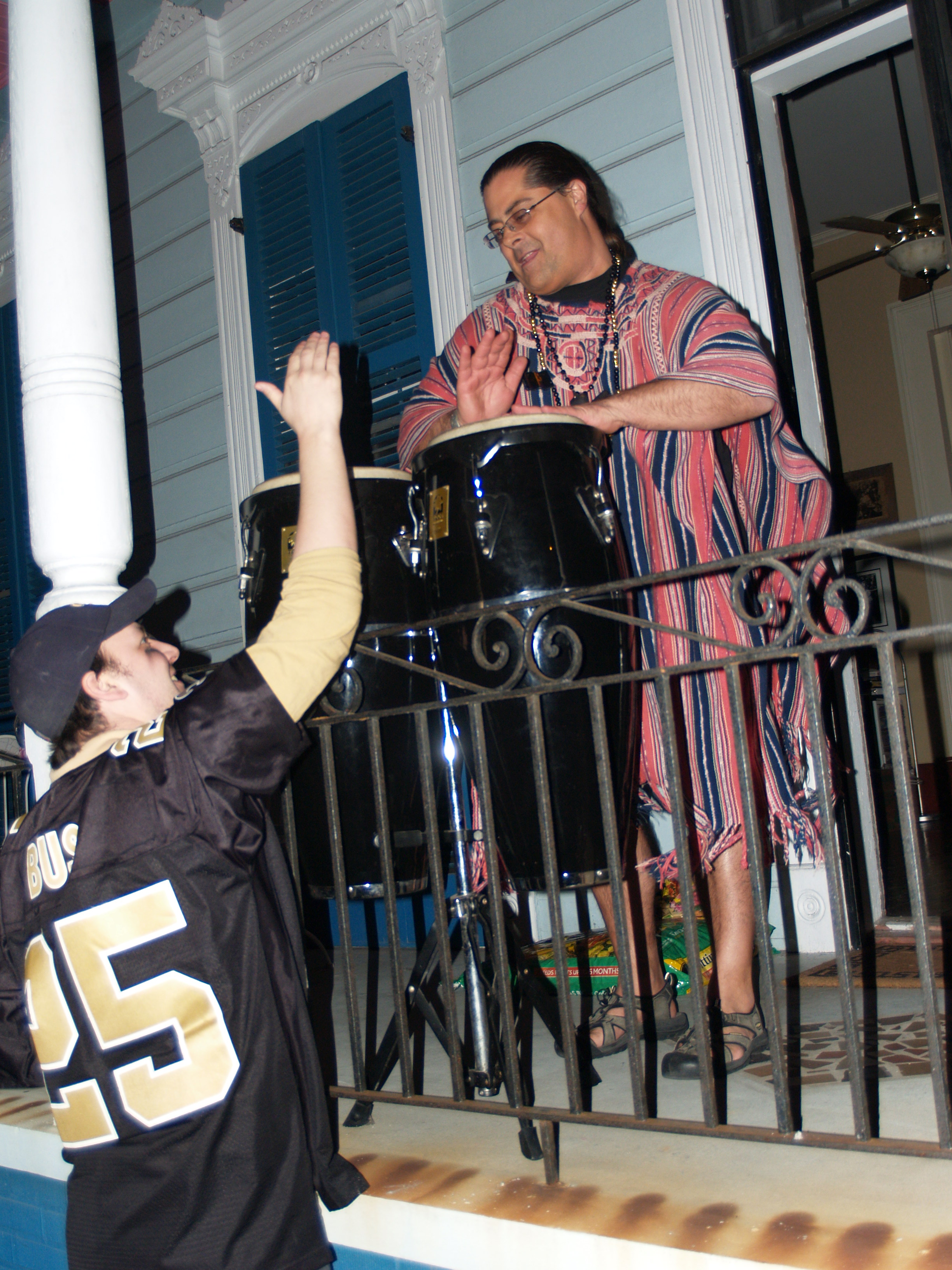
A triumphant Will Harrell, bowed to St. Simon, grabbed his double bongo drum, and headed out to the porch.  A stream of jubilant humanity was already flowing down Rue Dauphine toward the French Quarter.  I crossed the street to take a picture of costumed kids with “NOLA” scrawled across their foreheads in black marker.  They grinned for the camera and tossed me some Mardi gras beads. 

By the time I was back to Harrell’s porch he had a smaller bongo slung over his shoulder and was ready to hit the streets.  It was only 10:00 pm so I figured I’d tag along for a while–this was history in the making.  It never occurred to me that we wouldn’t get back to Will’s place until 5:00 am.  

You don’t see real celebration up close very often.  This wasn’t your run-of-the-mill championship celebration; this was Easter morning.  This was redemption.   

As Will and I followed the growing crowd I couldn’t stop thinking about Rodney (Jack) Strain and the anti-New Orleans rant he had delivered three years earlier, particularly the part I failed to quote in my recent Kelvin Kaigler post: “I don’t want to see temporary housing because of Katrina turn into long-term housing for a bunch of thugs and trash that don’t need to be in St. Tammany Parish. We don’t want to wake up one day and find out that New Orleans has been damn successful at running all of the trash out of the city and it end up roosting in St. Tammany.” 

At a meeting earlier that day at the Holy Ghost and Fire World Outreach Center in Slidell, Prophetess Kathleen Bacon told me that the High Sheriff was likely referring to the FEMA trailers that sprouted north of Lake Ponchartrain in the wake of hurricane Katrina.  Conservative white folk have been fleeing New Orleans for generations.  First they fled to the suburbs of Metairie and when upwardly mobile blacks followed suit, folks started moving to the North Shore, settling in places like Covington and Slidell. 
 

Thinking back on Sheriff Jack’s anti-New Orleans rant I was struck by the man’s confidence–it was as if he saw himself as the embodiment of a people scared to death that their righteous way of life was being contaminated from without.  I had sensed the same paranoid spirit in a sermon delivered by a Baptist pastor in Jena Louisiana shortly after a white student was beaten senseless at the high school.  After celebrating the glories of small town life, the pastor warned his flock that big city vice and violence had invaded their holy Zion in the piney woods.  He was referring, of course, to the Jena 6.  
 

  But Strain’s revulsion for New Orleans transcended race.  Every race under the sun was on the streets of the French Quarter Super Bowl night, but white folks predominated.  But these were not your Grandma’s white people.  As Will and I followed the joyful throng we passed by an old-time jug band that was sitting in the doorway of a neighborhood bar.  Looking for all world like Charles Manson, the guitarist was strumming his Epiphone guitar and wailing that old Louie Armstrong standard, The Saint James Infirmary Blues: “I went down to the St. James Infirmary, saw my baby there, stretched out on a cold white table, so sweet, so cold, so fair.” 

I wondered if Louie Armstrong had ever performed the song in that very establishment.  If not, he had sung it within a stones’ throw of the place.   St. James Infirmary is a song about the tragic death of a young woman.  The song hints that the singer’s “baby” was the victim of foul play.  That sort of thing happened in old New Orleans.  You run into death on the streets of old New Orleans.  A mad waltz between life and death drives the spirit of celebration for which the town is famous.  Jack Strain’s St. Tammany Parish is all about light and life (to hear Jack tell it anyway); New Orleans lives in the shadowlands between the light of life and the dark shroud of death.  

 
There is nothing subtle about this death dance.  You see it on the walls of the little bars: skulls, skeletons and other harbingers of death.  There is more than a hint of threat and intimidation in some of the costumes I saw on the street Super Bowl night.  People were not trying to look pretty or sexy; they were trying to look grotesque and slightly dangerous.  And they succeeded. 
   
Still, most of the folks in the pink hair and garish costumes live relatively normal lives and are in little danger of driving over the cliff.  Their regular celebrations of animal appetite are only one side of the picture; they are also parents with children to care for and employees with jobs to go to.  Moreover, the rules to New Orleans Bacchanalia are solidly anchored in the history of the town–these folks know what to do and how to do it–even when dem Saints win de big game.  What could be more reassuringly innocent than a sousaphone blaring out When the Saints go Marching in?
   
And then there is the traditional role of New Orleans religion.  These sinners are also saints.  Mardi gras provides one last celebration before Ash Wednesday ushers in the somber season of Lent.  There is a rhythm to these things.  New Orleans is far more than a party town–at least for those who live there long enough to soak in the history.
   
On the other hand, Sheriff Jack Strain has a point; a lot of people go off the rails in New Orleans.   In fact, many were never on the rails in the first place.  Take away the counterbalance of work, family and religion and big cities like New Orleans can get pretty bleak.  Thousands of people are too captive to their addictions to celebrate anything.  The demand for booze, marijuana and hard narcotics will always be supplied.  In the booze category, a rough and ready set of local and state rules apply.  For the illegal stuff, only the threat of violence keeps folks honest.  When people don’t hold up their end of the contract you can’t take them to small claims court.  Bones must be broken–and that’s just for starters.
   
Back in 1986, Clyde Simpson, a Mississippi boy, was asked to store bales of marijuana in his garage in exchange for $50,000.  Clyde had a little painting business at the time and his brother Doyle had come down from Winona to help him.  One day somebody broke into Clyde’s garage and stole a few bales of marijuana.  That made things contractually complicated.  Did the big boys still owe Doyle his $50,000, or did he now owe them?  To settle the issue, the big boys decided to take out a hit on poor Clyde. 
   
One morning in December, Doyle Simpson pulled up to Clyde’s place and waited in his car in the driveway for his brother to come out.  Doyle didn’t know that a man with a knife and a gun was hiding behind the fence at the side of the house.  When Clyde emerged, the man slit his throat like a watermelon and pushed him inside the house.  Clyde was in shock.  He rushed to the refrigerator to find ice for his throat, but two bullets put him on the floor.  As a puddle of blood began to form on the kitchen floor, the man with the knife burst out the front door and caught sight of Doyle waiting in his car.  Thinking on his feet, the man climbed into the car, held his gun to Doyle’s head, and told him to drive.
   
When Doyle had driven fifteen miles west, the man with the knife told him to stop the car.  Doyle was handcuffed to a tree.  His throat was cut.  Two bullets were fired and both found their mark.  The man went back to the car to reload his weapon, then, deciding Doyle was dead, climbed into the car and attempted to drive away.  But the car was helplessly stuck in the mud, so the man ended up hitching a ride on the highway.
   
Doyle Simpson found a broken bottle and was able to saw off the limb that tethered him to the tree.  He then staggered to the highway, collapsing on the roadway just as a trucker rounded the bend.  The driver drove Doyle to the hospital just in time to save his life.
   
The killer, a hired thug named Horace Toppins Jr, was charged with several counts in two Louisiana parishes and eventually sentenced to 30 years.  It looked for all the world like an paid hit, but the victims were low status so nobody traced the crime back to its source.
   
Ten years later, in 1996, Doyle was back in Winona, Mississippi when somebody sold him a gun.  Two months later, four people were gunned down in Tardy’s Furniture Store in Winona, the very morning Doyle reported his gun had been stolen from the glove compartment of his car.  Ballistics tests demonstated that whoever killed Bertha Tardy and three employees had used Doyle Simpson’s gun.  Doyle was picked up and asked who sold him the gun.  Doyle said he got the gun from his step-brother, Robert Campbell.
   
It was a lie.  
   
Confronted by investigators, Doyle said he had purchased the gun from a friend named “Ike”, but Doyle didn’t know the man’s last name. 
Surprisingly, no one has ever pressed Doyle on the Ike question, perhaps because everybody knows its pointless.  

But Robert Campbell, Doyle’s half-brother, believes that the mystery man who placed the murder weapon in Doyle’s hands is connected to the Tardy murders.  Moreover, Campbell argues that the folks that paid to have Clyde Simpson murdered in 1986 were behind the murders in Winona in 1996.   

Independently, I have come to the same conclusion.  I have no idea why anyone would want Bertha Tardy dead; but somebody did.  Since its hard to find an experienced hitman in Montgomery County, Mississippi, it was natural to look to a big city like Memphis or New Orleans.  And if you wanted access to hired killers in the Crescent City, Doyle Simpson (a man who had worked at Tardy Furniture in the past) would be the man to approach.  

I am not suggesting that Doyle Simpson was the trigger man, or even that he anticipated the horrible crime.  But anyone who has seen the man testify or, like me, read through the transcripts of all five trials, knows that Doyle Simpson makes a frightened witness.  

Did anyone steal the murder weapon from Doyle Simpson’s car the morning of July 16, 1996?  We have only Doyle’s  word for it and, as we have seen, he is not a credible witness.  Was the gun stolen at all, or did someone from Doyle’s New Orleans past make an offer the Winona boy couldn’t refuse?  

There is little evidence that these questions have ever been asked.  Certainly not by Doug Evans, the Mississippi prosecutor who decided the day Bertha Tardy died that an ex-employee named Curtis Flowers did the deed.  No other options were ever considered.  Evans didn’t want to ruffle feathers in Winona’s white community by suggesting that somebody held a grudge against a well-respected local merchant.  Of course, prosecuting Curtis Flowers has ruffled plenty of feathers in Winona’s black community, but Mr. Evans can live with that.  

As we have seen, the fabled dark side of New Orleans received national attention ten years after the Tardy murders.  As in Winona, four people had been killed execution style in the North Shore town of Slidell.  Investigators speculated that Roxy Agoglia, a heroin addict and heroin dealer with roots in New Orleans, had angered the kind of people that came after Clyde Simpson twenty years earlier.  Jack Strain certainly thought so.  St. Tammany Parish had never seen a quadruple murder. New Orleans trash, Sheriff Jack told the cameras, had invaded the fair precincts of St. Tammany Parish and somebody was going to pay.  A young witness told investigators that one of the killers had a scar on one cheek, a tatoo on his arm, and wore dreadlocks.  To Sheriff Jack, that description had New Orleans Trash written all over it.  

This explains why the first year of the murder investigation into the quadruple murders in Slidell focused on New Orleans heroin dealers with a penchant for violence.  An investigator named Scott Davis was focusing his attention on a white heroin dealer who used two black men for “muscle”, one of whom had dreads, a tatoo and a scar.  This fit witness testimony perfectly: a white guy waiting in the car while two black assailants pulled off the hit.  

Then Gus Bethea had a chat with a Slidell drug dealer named Frank Knight.  Frank was one of those denizens of New Orleans who never had a shot at the straight life.  His mother was shooting heroin and dealing on the streets when Frank was born.  In fact, it was Frank’s mother who suggested that her darling boy should confess to the police.  

I know this sounds odd.  Why would anyone say they were party to a notoriously violent drug hit if they had nothing to do with the crime?  Well, if you are looking at 60 hard years for a multitude of drug-related felonies and the nice man in the uniform is hinting that you might be on the streets in seven years if you sign a confession, you sign the paper.  Then you ask what you are signing so you will know what to say on the witness stand.  

The New Orleans connection disappeared and Scott Davis was busted from detective to street patrol.  The DA’s office had a confession and they knew a St. Tammany jury would buy it.  So what if Frank Knight was fabricating a story in exchange for a get-0ut-of-jail-free card; a difficult case would be closed.

Once again, investigators refused to ask the obvious questions.  Why would a young man like Kelvin Kaigler murder Roxy Agoglia and three innocent relatives?  True, in High School, Kelvin always told his friends that he was from New Orleans; Slidell sounded so uncool.  He dropped out of High School, got a job on the riverfront in New Orleans, fell in with the sort of people Jack Strain rails about, and began experimenting with crack cocaine.   

Debbie Callens and Gloria Kaigler

Then, about a year before the quadruple murders in Slidell, Kelvin Kaigler’s life underwent a dramatic reversal.  He developed a love for Christian rap music and cut off all contact with his former friends in New Orleans.    “Kelvin was working in New Orleans when he had a car accident,” neighbor Debbie Callens, told me.  “He totalled his car and didn’t want to replace it.  He was doing landscaping work aroun the neighborhood and my husband and I had him work in our yard.  When that kid smiles, everything lights up.  He has a very bkind spirit, very gentle.  When you see Kelvin, you can see into his soul.  He told me he didn’t want a car because it wanted to stay close to home.”  

“We felt like he was turning the corner,” Kelvin’s brother Earl tells me.   “The guys he had been hanging with in New Orleans were kind of sketchy; the kind of people that would make money and blow it.  But once he settled down, every penny Kelvin made was going into his music and his CD.”  
The lyrics on the CD Kelvin released prior to his arrest are an earnest testimony to the dramatic conversion playing out in his soul.   

Kelvin Kaigler

“Something’s missing inside,” he sings.  “I’m tryin’ to think of what it could be.  All the pain that I’m feeling, all the death that’s all around me.  Lookin’ at myself up in the mirror, thinking where I went wrong.” 

“No more chains holding me down,” Kelvin declares in another song, “bustin’ loose, flying free.  I’m so weak, but the Lord kept me by his side, and brought me through all the rain, no more pain, and from that day, my life could never be the same.  No more chains.”  

Then everything fell apart.  “The first week in August, Mr. John (that’s my father) closes down his barber shop in New Orleans, rents a van, and drives the whole family to Cairo, Georgia, to pick up my mother’s 90 year-old mother.  Then we all drive up to Gatlinburg.  It’s mostly white tourists up there, but we always have a good time.  In 2007, Kelvin came along for the first time in a long time, and that’s when he was arrested.  He saw them coming and told Mr. John he might want to open the door.  These deputies busted into the room witht their guns drawn the second night the family was up there.  One of them said he knew Kelvin didn’t do it, but they thought he might know something.  But in the papers they made it look as if Kelvin was a fugitive from justice.  

Kelvin Kaigler and Curtis Flowers have a lot in common.  Both men love gospel music: Kelvin likes rap and Curtis (a generation older) prefers the traditional sound.  Curtis leads the singing at prison church services and Kelvin continues to write rap songs behind bars.  When I talked to him in the company of his attorney, Martin Regan, Kelvin was radiant.  Like Curtis Flowers, Kaigler has no doubt that he will one day be exonerated.  Martin Regan agrees, but knows they face a difficult legal fight.   

Kelvin and Curtis share more than a love for gospel music; neither man is capable of killing four people in cold blood and neither man possesses the slightest motive for doing so.  Roxy Agoglia, the woman who was murdered in Slidell in 1996, was a heroin dealer murdered because she couldn’t pay her debts.  Kelvin Kaigler has no connection to the heroin trade.  Neither does James Bishop, the second man Frank Knight says was with him on the fateful night.  

Curtis Flowers had no reason to wish any harm to Bertha Tardy.  True, Tardy and Flowers had a disagreement over some damaged batteries.  “I was with Curtis more than once when Miss Bertha called him,” Robert Campbell told me today.  “She was begging him to come back to work, but he wasn’t interested.  He told me, ‘I don’t want a job where I deliver a piece of furniture and then, three days later, I go out and haul it back to the store.'”  

Curtis Flowers held no personal animus toward Bertha Tardy.  The woman gave him an $30 advance on his salary so he could enjoy the Fourth of July Holiday and begged him to return when the work week resumed.  But Curtis had already decided to move in with his sister in Dallas where he could make twice the minimum wage salary he was pulling in Winona.  The idea that he would kill four innocent people (two of them personal acquaintances) over a minor salary dispute is simply preposterous.

While two innocent men languish in prison the real perpetrators of mass murders in Slidell, Louisiana and Winona, Mississippi continue to ply their dangerous trade, likely on the streets of New Orleans.

Flowers bill passes Mississippi Senate

As the article posted below suggests, the “Flowers bill” designed to expand the jury pool from a single county to a five-county district has passed by a comfortable margin.  

There are several pertinent facts this article mention.   First, among white senators the bill passed 33-4; among black senators it was rejected 11-1.  This suggests that the racial divide so evident in Winona and Montgomery County is reflected in the Mississippi Senate.

Secondly, the article doesn’t mention that the bill’s sponsor, Senator Lydia Chassaniol (R-Winona) is a proud member of the Council of Conservative Citizens and addressed the groups’ state convention in Jackson last June.  The picture to the left is taken from a brief report on the Jackson event on a white supremicist site called Stormfront.org.  Under the picture you will find a charming quotation from the late-great Charles Lingbergh that nicely sums up the CCC attitude toward diversity: “We can have peace and security only as long as we band together to preserve that most priceless possession, our inheritance of European blood, only so long as we guard ourselves against dilution by foreign races. It is time to turn from our quarrels and to build our White ramparts again. This alliance with foreign races means nothing but death to us. It is our turn to guard our heritage . . . before we become engulfed in a limitless foreign sea.”

In the comments box below the Linburgh screed there is an endearing comment from a person who attended the CCC conference.  “During the supper break, I rode over to a KFC just up the street. While there I was approached by one, then another scuzzy looking hood rats asking: “Hey man, ya got any spare change?” Prompting me both times to snarl out a definate NO. Upon reflection, I think that I should have at least tried to have a little by by having the bros earn their chump change by doing something such as crawl around & squeel like a pig.”

These people aren’t subtle, folks. 

Lydia Chassaniol would have you believe that the Council of Conservative Citizens is just a group of well-intentioned school-boosters.  The Mississippi media must buy this explanation because Miss Lydia’s link to the CCC has sparked little negative publicity.   

Or could it just be that, in a state with a traumatic racial history, references to gross racism in high places is considered indelicate?

Chassaniol’s bill, if it becomes law, could create a slight uptick in the number of white jurors serving on Curtis Flower’s next jury, but that is a secondary issue.  In the fourth of five trials in this amazing saga, five black jurors voted to acquit while all seven white jurors voted to convict.  This was the only Flowers trial in which African-American representation on the jury rose to the one-third level that many experts cite as the point at which minority jurors begin to take their cues from one another instead of the majority group. 

But the real issue in Winona is familiarity with the social facts apart from which this case cannot be understood.  Black residents in Winona associate the Flowers family (Curtis included) with gospel singing and church life.  In addition, black jurors are in a much better position to evaluate the credibility of the largely black witnesses the state is using in this case.  On the black side of Winona, these folks aren’t generally taken seriously.  White jurors, on the other hand, easily buy the state’s portrayal of Flowers and don’t know enough about the witnesses to judge their credibility.  We are talking about witnesses who had no information until police officers showed up offering a $30,000 reward for anyone who remembered seeing Curtis Flowers on the day of the Tardy murders. 

If folks from outside Montgomery County dominate the next jury pool it will be much easier for the prosecution to sell its theory of the crime.  American defendants, in theory at least, have a right to be tried by a jury of their peers.  The Chassaniol bill denies that right to Curtis Flowers.

February 4, 2010

Slayings trigger jury pool expansion bill

The Associated Press

Mississippi lawmakers are considering a bill that could have an impact on the long-running capital murder case of a Montgomery County man accused of killing four people at a furniture store nearly 15 years ago.

Curtis Flowers is set to be tried a sixth time later this year for the 1996 murders at Tardy Furniture store in Winona.

The case has nearly depleted Montgomery County’s jury pool, and is one of the reason legislators have been asked to approve a proposal to expand the area from which jurors are selected, said Circuit Court Lanelle Martin.

The Senate on Wednesday approved a bill that would allow counties to pull prospective jurors from an entire multicounty circuit district. Currently, jurors are sought from the county in which the crime occurred.

Flowers is charged with capital murder in the shooting deaths of Winona furniture store owner Bertha Tardy, 59; store employees Derrick “BoBo” Stewart, 16, and Carmen Rigby, 45; and delivery man Robert Golden, 42.

Flowers has had three trials in Winona, one in Tupelo and one in Biloxi. Two resulted in mistrials and three in convictions that were later overturned. Prosecutors have said they will seek the death penalty in the trial scheduled for June at the Montgomery County Courthouse.

Martin said the county has fewer than 8,000 registered voters. The jury pool shrinks with the exclusion of those who choose not to serve and anyone who’s under the age of 21.

“You’re depleting the pool even more with relatives of the victims and relatives of the defendants,” she said. “That is one of the things that brought that bill on.”

Senate Judiciary A Committee Chairman Joey Fillingane, R-Sumrall, said Montgomery County has spent $300,000 on the case so far. He said the costs are higher when the case is heard outside the county.

Sen. David Jordan, D-Greenwood, and Sen. Johnnie Walls, D-Greenville, opposed the measure.

Walls said there’s already a mechanism in place to ensure defendants are treated fairly because judges can order that the cases be heard outside of the county in other areas of the state.

“The biggest problem I see is that we’ve been asked to do it because of one case because a person could not be convicted in the way the prosecution wanted the case to go,” Walls said. “They seem to be trying to get a special consideration for this case.”

Walls said the proposal would have statewide implications even though it’s been filed for only one situation. A similar bill filed last year passed the Senate, but was killed in the House.

Jordan said he’s concerned about limiting the potential of placing blacks on the jury in Flowers’ case. Flowers is black. Three of his victims were white. One was black.

Jordan said if the entire district is considered, jurors from Carroll and Grenada counties could be pooled. He said those areas have a small black population.

Census figures show Montgomery County has a 46 percent black population. The other counties in the circuit court district and their black population percentages are: Carroll County with 35 percent; Grenada County with about 42 percent; Webster County with about 21 percent; Attala County with 41 percent; Choctaw County with 31 percent and Winston County with 45 percent.

St. Tammany Tragedy: The Kelvin Kaigler Story

Kelvin Kaigler

St. Tammany Parish Sheriff, Rodney “Jack” Strain has had his fair share of attention from the national press in recent years.  A year after Hurricane Katrina sent thousands of desperate New Orleans residents into exile, Sheriff Jack launched into a rant against trashy black people that attracted national headlines.

“For some reason, New Orleans chooses to coddle criminals in that area that tend to get away with a great deal,” Strain told a local news reporter while the camera rolled.  “We will not coddle that trash in St. Tammany Parish. If they come to St. Tammany Parish, we’re gonna pursue them, we’re gonna arrest them, our prosecutors are gonna prosecute them, and our judges are gonna convict them.”  

Technically, of course, judges don’t do the convicting unless you waive your right to a jury–but, no matter.  The Sheriff was just getting warmed up.

“If you’re gonna walk the streets of St. Tammany Parish with dreadlocks and chee wee hairstyles, then you can expect to be getting a visit from a sheriff’s deputy,” Strain advised.  “You can guarantee that things that you got away with in the city will not be tolerated in this Parish.”

Strain’s anti-dreadlock rant quickly caught the attention of advocacy groupls. “As you are no doubt aware,” the ACLU’s Katie Schwartzmann wrote in a letter of formal protest, “the vast majority of persons wearing dreadlocks, twists or braids are African American. Your stated policy of targeting persons with these hairstyles is overtly racist and we request a retraction stating that you will comply with the requirements of the law.”  Furthermore, Schwartzmann noted, “Your comments routinely equate ‘trash’ and ‘thugs’ with ‘evacuees’ and ‘public housing residents.’ It is neither fair nor accurate to intimate that all New Orleans evacuees are thugs and criminals.”

Sheriff Jack was unrepentant.  His comments about folks in dreadlocks were inspired by a horrific quadruple murder that has just taken place in the Tammany Parish town of Slidell, and Strain was certain that trashy people from New Orleans were responsible.

That explanation satisfied Britt Hume of Fox News and the Jack Strain controversy receded rapidly.

While it is difficult to understand how context sanitizes such a god-awful screed, Strain was right about the murder investigation.  On June 27, 2006, short days before Strain’s bigoted Jeremiad, known heroin dealer Roxann Agoglia, her daughter Erika Agoglia,  Andrew Perreand and his uncle, Eric Perreand, had all been found murdered, execution style in a Slidell trailer park.  All the victims were white.

A young girl who had survived by hiding in a bedroom reported that the assailants were two black men, one with short hair, the other sporting dreadlocks and a tattoo on his arm.

Anthony “Tiger” Schwankhart, a neighbor who lived across the street from Roxann Agoglia’s trailer, told police that two black men left the car engine running and the doors open when they entered the home.  They then raced back to the vehicle and raced from the scene.

Progress on the case was slow.  Police claim they conducted hundreds if not thousands of interviews with drug dealers and street hustlers of every description, but their hard work failed to generate leads.

In retrospect, there is little doubt that Jack Strain was thinking of the dreadlocked murderer his deputies were searching for when he made his revealing comments about New Orleans trash.  In fact, Strain had a special word for anyone interested in defending the eventual suspects in the case.  “I know you have some slick lawyers on both sides of the Lake (Pontchartrain),” the Sheriff observed, “who make a tremendous living off of getting these people out of jail. We’ve proven in this Parish that’s it’s pretty difficult challenge for them to make a good livin’ (defense attorneys, that is). My personal opinion is that’s the first people we should put on a rail and get out of here.”

frank-knight.JPGIn July of 2007, over a year after the quadruple murders in Slidell, state trooper Gustave Bethea (a former Tammany Parish deputy) had an intriguing chat with Frank Knight, a habitual criminal with a long string of drug-related convictions.  Bethea figured that a street hustler like Knight might have an interesting story to impart.  It didn’t hurt that the notorious drug dealer was looking at a virtual life sentence (60 years, hard time) as a repeat offender. 

Sure enough, Knight had a story.  He hadn’t pulled the trigger of course (everybody knew the killers were black guys), but he was sitting in the back seat of James “Scarface” Bishop’s Honda Accord when the deal went down.  It was Bishop and Kelvin “Dreads” Kaigler that did the shooting.

On August 2, 2007, Kelvin Kaigler was arrested while vacationing with his family.  Jack Strain told reporters that Kaigler opened the motel door and surrendered without incident. 

Two and a half years would pass before District Attorney Walter Reed (not to be mistaken for Jena’s Reed Walters) had the case ready for trial.  In mid-January, 2010, a Tammany Parish jury found Kelvin Kaigler and James Bishop guilty on all four murder counts.  The jury wasn’t unanimous, but in Louisiana the state needs only eleven cooperative jurors to convict.

“The evidence in this case was centered around the admissions of one of the perpetrators, Frank Knight,” Assistant DA Rick Wood told reporters shortly after the verdict was announced.  “The jury was satisfied with his testimony, and we believe he was credible and truthful during his two hours on the witness stand.”

 But what was it about Frank Knight that so impressed eleven jurors?  He repeatedly failed to get his story straight, changing the color of the car and the time of day the shooting took place. 

Besides, investigators were well aware that a reputed drug dealer named Michael Coates had a tattoo on his arm and wore his hair in dreadlocks.  Reportedly, Coates shaved the dreads the day after the quadruple murders.  Local officials showed no interest in Coates–they already had Kaigler.

According to Martin Regan, Kelvin Kaigler’s silver-haired attorney, the case comes down to simple self-interest.  Frank Knight faced a simple choice: a lifetime in prison or few years behind bars.  Knight accepted a fifteen-year plea bargain that made him eligible for parole after half that time elapsed.  Moreover, the man had already served two and a half years, so he would be back on the streets in less than five years. 

All Knight had to do was admit to being an accessory after the fact and a lifetime of incarceration disappeared.  

Anthony “Tiger” Schwankhart told the jury that he saw the car parked across the street from the murder scene with the doors wide open and there was no white man in the back seat.  Nobody took poor Tiger seriously.  Police had discovered that their inconvenient witness had a history of mental illness and had bullied him into silence.  Prior to trial, Schwankhart signed a statement admitting that he sometimes makes things up.  At trial he was back to his original story, but no one was listening. 

As usual, the regional media swallowed the prosecution story–the alternative is too disturbing.  Consider this comment from Benjamin Alexander-Bloch of the New Orleans Times-Picayune: “While Regan threw punches with his black and blue markers, holding one or the other in his right hand, like a gun, ready at a moment’s notice to scurry to an easel and shoot, Bishop’s attorney John Lindner largely stayed in his corner, taking a silence-is-golden approach. Regan has an impressive record with New Orleans juries, but several local defense attorneys filtering in and out of courtroom’s gallery questioned whether north shore jurors will take offense to such intense grilling of St. Tammany’s boys in blue.”

This bit from a Times-Picayune story drips with pro-prosecution bias.  “Both admitted Slidell drug dealers, Kaigler and Bishop were largely convicted through their co-perpetrator’s testimony, Frank Knight, 33, who cut a plea agreement a week before the seven-day trial.”

First of all, Kelvin Kaigler has never admitted to being “a  Slidell drug dealer”; he has admitted using drugs–a fact that hardly distinguishes him from his peers.  Kaigler was once convicted of possessing drug paraphernalia when the police pulled over a car with several occupants and found a crack pipe; but he has never been convicted of dealing drugs. 

Secondly, the word “co-perpetrator” assumes the guilt of the accused.  In a strict legal sense, the Times-Picayune writer is on solid ground: post-conviction, a defendant is technically guilty.  But it isn’t a journalist’s job to side categorically with the prosecution in cases where the sufficiency of the “evidence” is highly questionionable.   

Sheriff Jack Strain reflects his community.  After all, the good people of St. Tammany Parish elected the man and they like his style.  Strain was preaching to the choir when he launched into his bigoted rant.

Is Sheriff Jack an old-time, unreconstructed, Jim Crow era racist? 

St. Tammany Parish Sheriff Jack Strain, centtr, speaks at a news conference on the woman's death while KKK materials seized at the scene are displayedNot exactly.  Last year, in the wake of the Obama election, a lost soul named Cynthia Lynch made her way to Tammany Parish to join up with a Ku Klux Klan-related group called The Sons of the Dixie Brotherhood.  half way through an increasingly bizarre initiation rite, Lynch decided she didn’t want to join up after all.  Enraged,Brotherhood leader Raymond Foster knocked Lynch to the ground and shot her dead with a handgun. 

Jack Strain held a news conference a few days later with racist paraphernalia confiscated from the Sons of the Dixie Brotherhood draped over folding tables for the media’s viewing pleasure.  The Sheriff dismissed the Brotherhood boys as a group of dimwit losers that weren’t a threat to anyone.  He didn’t explain why a harmless group of imbeciles killed a woman in cold blood.

While the Klan once ruled places like Tammany Parish, their glory days are now ancient history.  Well, perhaps not ancient, exactly.  Former Grand Dragon (and neo-Nazi) David Duke calls Tammany Parish home.  Duke’s website proudly proclaims that he was “Elected in 1996 to the Parish Executive Committee of the largest Republican Party District in Louisiana, St. Tammany Parish where the other elected members chose him unanimously to serve as chairman of the District. He served as chairman until 2000.”

I suspect that, like Jack Strain, David Duke would renounce the violent tactics of groups like the Dixie Brotherhood.  But that’s as far down the road to tolerance as Jack and David care to travel.

On the other hand, Jack Strain’s famous rant wasn’t just about race–it was about the association between social status and human rights.  Trashy people, in Strain’s view, have surrendered the right to due process.  They can be profiled by the police and, even if they are fortunate enough to afford a first-class attorney like Martin Regan, they will be convicted.  They are guilty of occupying the lower rungs of the social ladder as that ladder is defined by the good people of Tammany Parish.

Benjamin Alexander-Bloch, the Times-Picayune reporter, was surprised by the composition of the jury.  “Unusual for St. Tammany,” he noted, “there were two black females and two black males on the jury. Typically, a black defendant in St. Tammany is lucky to have one black juror.”  The bias on display in this case goes deeper than race.  It’s about the “thug narrative” that makes it difficult for people like Kelvin Kaigler to get a fair trial.  Once defendants are defined as “trashy” by the prosecution and the media, the evidence (or lack thereof) doesn’t matter. 

Attorney Martin Regan and Kelvin Kaigler’s family aren’t finished.  This case is bigger than a single defendant; it exposes the mechanics of wrongful conviction with a clarity that is seldom seen.  Kelvin Kaigler is suffering the same fate as Troy Davis and Curtis Flowers and Friends of Justice will have much more to say about this grotesque miscarriage of justice in the weeks and months to come.

Perry gets away with it

In September, Texas Governor Rick Perry was scared to death that the Texas Forensic Science Commission was about to denounce the questionable science used to convict and execute Cameron Todd Willingham.  So the governor hastened the departure of several board members while appointing board members (like the aggressively conservative prosecutor John Bradley) who were favorable to his side of the Willingham debate. 
No one could believe that a sitting Governor could manipulate the composition and priorities of a state commission with such shocking audacity.

He’s getting away with it. 

According to an AP story, when the commission reconvenes this evening, “The Willingham case is not on the agenda . . . Nor is Craig Beyler, the renowned fire expert who authored the report in question”.

According to Barry Scheck, co-director of the New York-based Innocence Project that focuses on overturning wrongful convictions, this is “an agenda that deflects attention from what everybody wants answered.”

But is anybody paying attention?  In September, the Willingham story was national news; now it’s just an afterthought.  By this summer, when chairman Bradley insists they will finally evaluate the forensic science utilized in the Willingham case, will any one care?

The Willingham case played a minor role in the hotly-contested Texas Republican primary back in September, but Kay Bailey Hutchison, Perry’s most prominent opponent, has largely dropped the subject.  That’s likely a good move.  Evidence suggesting that the state of Texas executed an innocent man isn’t welcome in the conservative slice of the electorate Hutchison and Perry are wooing. 

The Willingham case demonstrates the need to move beyond a single-minded focus on actual innocence cases.  Willingham may have set the fire that killed three of his children; or he may be as innocent as he always claimed.  But was the evidence the state of Texas used in the case, properly evaluated, sufficient for a conviction?  Or did a state prosecutor employ junk science to mislead the jury? 

Willingham’s guilt or innocence shouldn’t be the issue in this case.  If junk science was used to convict Willingham, we’ve got a problem. 

Too often, advocacy groups look only for cases where innocence can be empirically demonstrated.  When DNA evidence proves a convicted man is innocent, no one dispute that a miscarriage of justice has occurred.  DNA-innocence cases have made important contributions to the reform fight.  They have demonstrated that far more defendants are wrongfully convicted than most Americans thought possible.  They have shown that misguided and coerced witness testimony is the number-one culprit in wrongful convictions.  Finally, these cases have shown that people of color are disproportionately victimized by wrongful conviction.

But our infatuation with actual innocence comes at a price.  For one thing, there aren’t a lot of DNA cold cases in the pipeline.  The exoneree torrent will soon slow to a trickle.

Secondly, in the 85% of criminal cases that involve no meaningful DNA evidence, it is virtually impossible to prove actual innocence.    We know wrongful convictions are widespread, but apart from a DNA smoking gun, we have a hard time proving it.

Finally, DNA cases raise more questions than they can answer.  They show that some species of racism is at work in the justice system, but they can’t tell us what kind.  The dynamics of prejudice hasn’t been traced.

That’s why the future lies with cases like Tulia, Todd Willingham, Troy Davis and Curtis Flowers.  If we simply use these cases as a soapbox for our pet opinions little of value will be gained.  But if we sift and dissect these narratives with objective persistence, patterns will emerge and lessons will be learned.

Curtis Flowers: a brief introduction

This brief summary of the Curtis Flowers case now introduces the extended version of the story on the Friends of Justice website. 

A brief introduction to the Curtis Flowers case

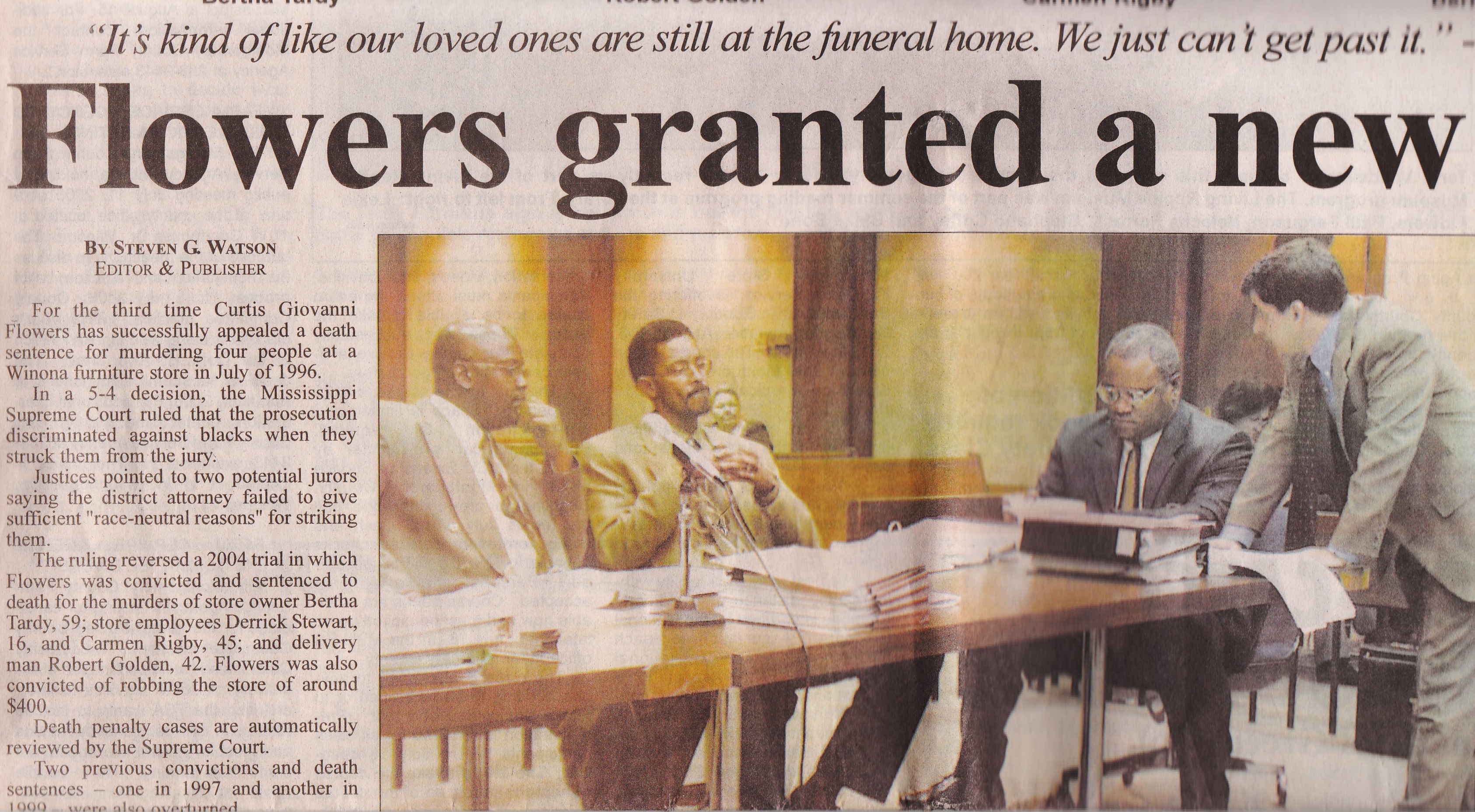
On the morning of July 16, 1996, four people were brutally murdered at a furniture store in the small Mississippi town of Winona.  By 11:00 am everybody had heard the news: Bertha Tardy, the proprietor of Tardy ‘s Furniture, had been killed execution style.  Carmen Rigby, Tardy’s longtime bookkeeper, had suffered the same fate, as had hired hands, Bobo Stewart and Robert Golden. Golden was black, the other three victims were white. Six months later, Curtis Flowers, a young black Winona resident who had worked three days for Bertha Tardy, was arrested and charged with the brutal murder of four innocent people.

Thirteen years, $300,000 and five trials later, Mr. Flowers remains behind bars and the state has been unable to obtain a final conviction.

The first trial was held in Tupelo, MS in 1997 and the second trial was in Gulfport two years later.  District Attorney Doug Evans was determined to convict Curtis Flowers four times: once for each cold-hearted murder.  It was a risky strategy.  To pull it off, Evans had to limit the evidence in each trial to a single victim and that was a virtual impossibility.  Evans won guilty verdicts and death sentences in Tupelo and Gulfport, but both trials were overturned by the Mississippi Supreme Court.

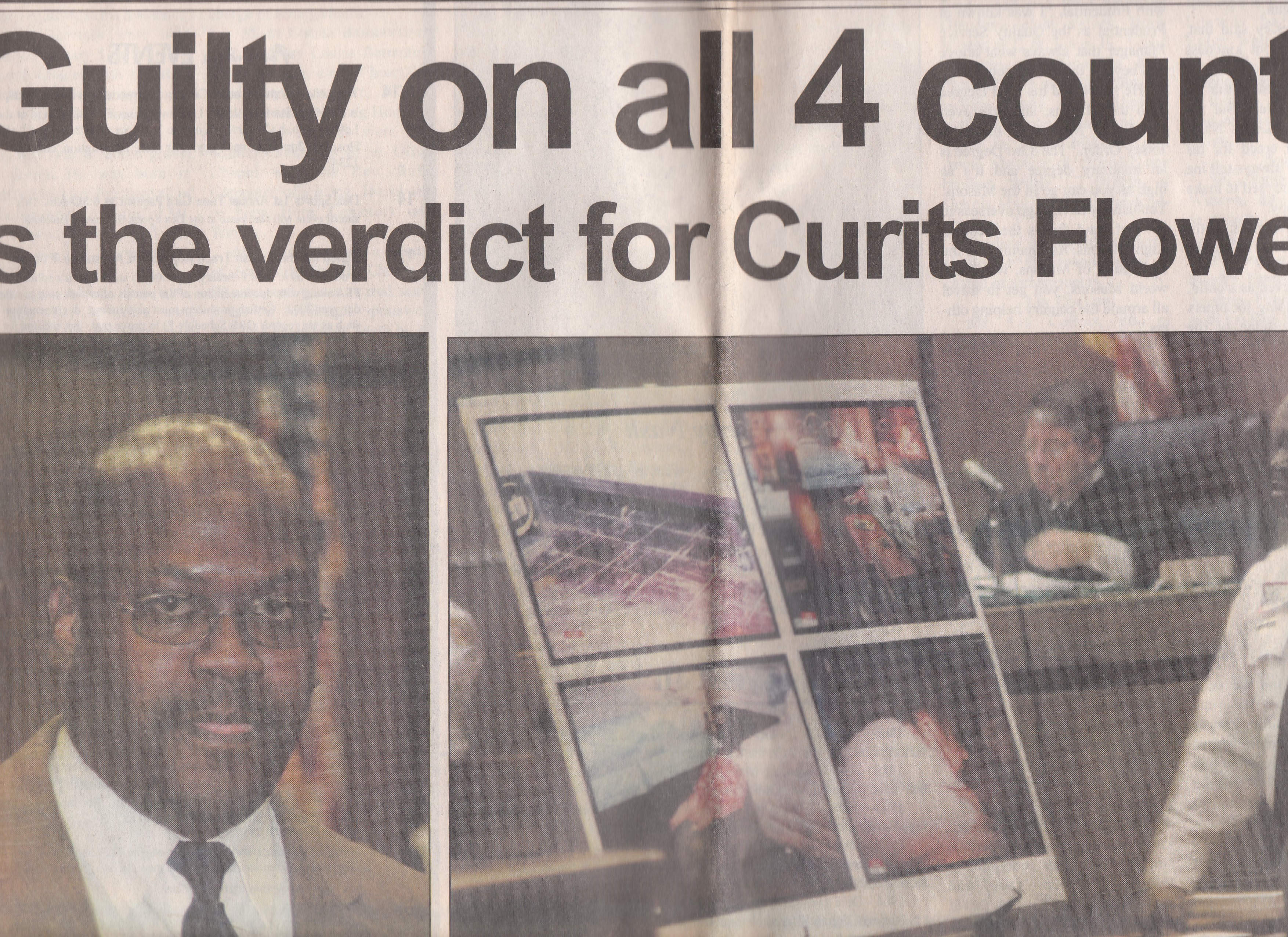
In February of 2004, Curtis Flowers was found guilty, yet again, on four murder counts.  The trial was held in Winona, the county seat of Montgomery County.  The Winona Times ran a special edition featuring a large head shot of Flowers beside graphic pictures from the murder scene. Victims were shown lying in their own blood. Several residents were outraged by the pictorial spread and wrote angry letters to publisher, Dale Gerstenlager. Gerstenlager responded that, apart from the photographs, readers couldn’t appreciate what a terrible deed Flowers had done.

The verdict would not stand.  According to former Supreme Court Justice Oliver Diaz, “We reversed because the jury selection process ended up not being fair. Every challenge the state had was used against African Americans and the only African American that was seated was when the state ran out of challenges and could not challenge anymore and one was seated.”

Doug Evans knew he would have a hard time getting a conviction in Winona if even a single African American was seated on the jury.  In a county that is half black, a jury with eleven white jurors couldn’t be produced legally, so Evans broke the law. 

It was an act of desperation.  In Winona’s white community, Flowers’ guilt is a no-brainer–as obvious as the sun in a clear blue sky. 

Black jurors have been much harder to convince.

The case against Flowers is circumstantial.  He can’t produce a convincing alibi for his activities the morning of the murders.  A gunshot residue test taken three hours after the murders found a single micron of residue on the web of his right thumb.  But the real clincher was the bloody footprint found at the scene of the crime.  Tests prove it was made by a size 10.5 Grant Hill Fila tennis shoe, and a box for precisely that shoe was found in the dresser drawer of the girlfriend Flower’s was living with.  Granted, there were no shoes in the box (it was filled with hair ribbons), but the shoe box in the dresser has been the heart of the state’s case.

Doug Evans had the shoe box evidence nailed down within a few weeks of the murders, but Flowers wasn’t arrested until January of 1997, half a year later.  In the interim, Evans and his invgestigator, John Johnson, cobbled together a list of witnesses who could trace Flowers’ movements on that fatal morning.

The state’s theory of the crime is relatively simple.  Curtis Flowers was angry because Bertha Flowers wanted to deduct $400 worth of damaged batteries from his paycheck.  Set on revenge, Flowers rose early on the morning of the crime and walked to the Angelica garment factory, five-to-ten minutes from his home.  There, shortly after 7:00 am, Flowers stole a handgun from the car of his uncle, Doyle Simpson.  Flowers returned home for a brief period.  Then, just after 9:00 am, he walked to the Tardy’s furniture store, killed four people in cold blood, stole $400 from the cash register, ditched the gun, ran home, disposed of his clothes and the Grant Hill Filas he was wearing and stuck the $400 in the headboard of his girlfriend’s bed.

It took six months to find witnesses who could place Flowers at the Angelica factory and along the various routes the state believed he traveled on the day of the crime.

On the surface, this looks like an airtight case, and it has generally been reported as such (to the extent it has been reported at all).  But at Flowers’ fourth trial in December of 2007, all five black jurors voted to acquit while all seven white jurors voted to convict.

A frustrated Doug Evans returned to the Montgomery County courthouse in Winona less than a year later for the fifth trial.  Three black jurors were selected, but they were all solidly middle class and well-connected to the white community.  Two of the black jurors were willing to trade a guilty verdict for a life sentence.  But James Bibbs, a retired Winona school teacher, hung the jury.  Judge Joey Loper embodied the outrage of Winona’s white community.  He had Bibbs dragged into the courtroom.  Loper told the recalitrant juror that he had lied to get on the jury and demanded that DA Evans file perjury charges.  Loper then insisted that Evans lobby other Mississippi prosecutors in support of a law that would allow the state to file motions for a change of venue (something only defense attorneys could do). 

A bill giving prosecutors the right to call a jury from a multi-county district in cases that went to trial three times without a final conviction was supported by state senator Lydia Chassaniol and state representative Bobby Howell.  The bill was introduced in the 2009 legislative session and sailed through the Senate without serious opposition.  In the House, however, it was killed in committee by the African American chairman of the house judiciary committee.

The same bill is currently being debated in the Mississippi Legislature.

Meanwhile, Judge Loper and DA Evans were forced to recuse themselves from the case against James Bibbs.  The Mississippi Attorney General’s took over the case and promptly dropped the charges due to a lack of evidence. 

A sixth trial is scheduled for June 7, 2010.  This time, the world will be watching.

Doyle Simpson and his 380 automatic

The gun that ended the lives of Bertha Tardy, Carmen Rigby, Bobo Stewart and Robert Golden belonged to Doyle Simpson.  All are agreed on that point.  Simpson made two visits to his car on the morning of the crime and reported that his gun had been stolen from a locked glove compartment shortly before the crime was committed.  Catherine Snow, one of Simpson’s co-workers, claims she saw Curtis Flowers leaning against Simpson’s car at 7:30 that morning.

But is Doyle Simpson credible under oath?  When first interviewed, he told investigators that he bought the weapon from his brother Robert.  When that story fell apart, Simpson testified that he bought the gun from a friend named “Ike”.  Simpson calls Ike a good friend but doesn’t know his last name.

The murder weapon belonged to Doyle Simpson–that much seems clear.  But was the gun in the glove compartment of Simpson’s car the morning of the murders? 

Doyle Simpson is no stranger to the streets.  He has used drugs and has probably been involved in the drug trade.  Back in the day, Simpson’s throat was slit and his body was unceremoniously deposited in a tree outside New Orleans.  Miraculously, the Winona hustler survived.  But whoever tried to kill him had no regard for human life and dignity.  Much like the person who pulled the trigger five times in the Tardy Furniture Store.

On the witness stand, Doyle Simpson has the demeanor of a scared rabbit.  Did he make his gun available to some very bad people who made him an offer he couldn’t refuse?  In the most recent trial, in September, 2008, Simpson made an interesting slip.  Asked to specify when he put the gun in his car, Simpson replied, “The day before they stole it.”

Who, we are left to wonder, are “they”.

More to say on this later.  Stay tuned.

White Power USA

Is there a link between Neo-Nazis, Birthers, Tea Party enthusiasts and mainstream conservatism?  The producers of this video think there is. 
White Power USA was produced for Al-Jazeera English by American journalists drawing on the same sources you would expect to see in the mainstream press.  Except, for some reason, the MSM hasn’t shown much interest in the racist roots of the Tea Party crowd. 

The White Power leaders depicted in this documentary are desperate for media attention.  Although groups displaying the swastika and the stars-n-bars are enjoying rapid membership growth, most extremists have learned to mainstream the message.

The producers of “White Power USA” aren’t suggesting that everyone involved in America’s most dynamic populist movement is racist.  But can mainstream Christian conservatives attend Tea Party events without noticing the overtly racist symbols and sentiments on display?

Those following my posts on the Curtis Flowers case will be particularly interested in the extended interview with Council of Conservative Citizens co-founder Gordon Baum.  Members of a CCC chapter in northern Mississippi also get a few minutes of camera time.  If we’re known by the company we keep, Senator Lydia Chassaniol needs to find better company

In this post-9-11 world, some won’t be interested in viewing a  documentary associated with Al Jazeera, and that’s okay.  On the other hand, this may be the perfect time to heed the gentle call of Wee Robbie Burns: “O would some power the giftie gie us to see ourselves as others see us.”

Clay prosecution shows the origins of the mortgage mess

Alvin Clay

 Congress, finally, has turned its attention to mortgage fraud.  According to the New York Times, The F.B.I. is presently investigating more than 2,800 mortgage fraud cases, almost five times the 534 inquiries in 2004. Attorney General, Eric Holder, feels the current efforts to fight financial crime will foster confidence in the system. 

But merely increasing the number of prosecutions isn’t enough–the feds must address the quality of their mortgage fraud cases.  According to the Times, “Of the 2,800 mortgage fraud investigations under way at the Federal Bureau of Investigation, most — 1,842 — were classified as major cases, which meant they involved more than $1 million in losses.” 

Guess how much money was lost in the five real estate deals at the center of the Alvin Clay prosecution?  When all five properties had been re-sold, the total loss to buyers, sellers and the financial system was $16,000.  

 That’s it. 

This doesn’t mean that the Donny McCuien and Ray Nealy, the two men at the heart of the Little Rock scam, weren’t worthy candidates for prosecution.  They were.  But small-time hustlers like McCuien and Nealy were always incidental to the FBI.  They G-men were after an attorney and real estate broker named Alvin Clay.  

Nealy and McCuien turned to real estate fraud because government oversight was virtually non-existent.  Banks were willing to make “stated” loans and the con artists came running.  In a stated loan, a financial institution agrees to believe that a prospective buyer possesses the assets indicated in a loan application.   Call it the honor system.  This extreme degree of credulity was driven by a desire to make as many loans as possible, a dynamic fueled by greedy managers and corporate executives hell-bent on maximizing bonuses.  Nobody was paying attention–it was bad for business. 

The financial institutions involved in the McCuien-Nealy scam were begging to be exploited.  Alvin Clay made the same mistake the banks and trust companies were making–he took McCuien and Nealy at their word.  

On the sixth day of Alvin Clay’s trial, I said that t federal government was avoiding embarrassing questions because it didn’t have any good answers. 

•Why has the government hitched its wagon to a man who lies when the truth would sound better?

•Why has the government spent five years and a million dollars pursuing an innocent man?

•Why did the government initiate an investigation of Alvin Clay before they had any evidence of wrongdoing?

•Why has the government used the threat of pain and the promise of relief to suborn perjury from its star witness?

•Why did FBI agent Rodney Hayes lie to a judge to get a search warrant and perjure himself before a grand jury to get an indictment?

•When the Eastern District of the US Attorney’s Office was forced to recuse itself from this case; why did the Western District pick it up?

The answer to most of these questions is the same: the federal government, represented by Assistant US Attorney Bob Govar, noticed that a combative defense attorney named Alvin Clay was involved in a series of real estate deals and decided to look into it.  There was no initial evidence of wrongdoing; FBI agent Rodney Hayes was sent on a fishing expedition.  The goal was to nail Clay, an attorney with a longstanding adversarial relationship with Govar.  The ambitious Hayes understood the nature of the game.

It never occurred to the feds that the McCuien-Nealy scam was driven by systemic regulatory gaps, or that financial industry was willing to tolerate a high degree of corruption if it increased the overall level of activity.  The real crime was staring the FBI in the face; but they were so intent on busting a single black attorney they couldn’t see the obvious.

Hopefully we have all learned something from the mortgage fiasco.  The Clay case demonstrates how much there is to learn.

Harry Reid isn’t racist, he’s just old

Harry Reid: Barack Obama receives race apology after book tells all about 2008 election campaign Everybody knows what Harry said.  Barack Obama had a good shot at the presidency because he was “light skinned” and spoke “with no Negro dialect, unless he wanted to have one”. 

Reid and Obama both concede the words were poorly chosen.  But are we dealing with racism?

Republican politicians think so.  Or rather, they feel that if the senior Democrat in the Senate gets a pass on this one, America should apologize to Trent Lott.

No one on either side of this dust-up is suggesting that Reid’s observations were factually inaccurate.  True or not, it is suggested, the remarks was indelicate and insensitive.

To whom?

African Americans, for the most part, don’t seem to mind.  Reid was merely stating the obvious–some white Americans are more comfortable with people of color so long as they don’t have too much color.

Morever, middle class African American parents stress to their children that a mastery of standard English (the way folks talk on the evening news) is a prerequisite to a good job. 

Whites from the rural South face a similar challenge, although to a smaller extent.

If Harry Reid thinks it’s okay for white voters to prefer light-skinned black candidates who could pass for white over the telephone, I’ve got a problem with that.  It isn’t okay.  Lyndon Johnson didn’t need to transcend his Texas dialect to get elected.  In fact, his “Muh fella Amuricans” was reassuring to a lot of people.  So why should a black candidate have to sound white to get elected?

On the other hand, if Reid was merely admitting the regrettable fact that many potential African American candidates look and sound too black to make it to the White House I defy anyone to argue.  Whether he should have said what he said is another matter.  If he had slipped in a few qualifiers like “unfortunately” or “I wish it were otherwise, but . . .” no one would have taken offense.

Of course, the word “Negro” suggests that Mr. Reid is every bit as old as his pictures suggest.  The use of the old n-word is more likely to offend young African Americans who didn’t grow up hearing it and have never used it themselves.

According to the Telegraph (a British paper), the book “Game Change”, by Mark Halperin and John Heilemann, “alleges that when efforts to persuade the late Edward Kennedy to endorse his wife’s presidential bid fell flat when the former president reportedly told his old friend that just a few years ago Mr Obama would have been serving them coffee.”

Yuck!  No wonder Kennedy threw his weight behind Obama!

Clinton’s “coffee” remark suggests that because African Americans were once relegated to servile jobs, Barack Obama is an uppity Negro who wants too much too fast.  If Reid shared that perception he would deserve the negative press he is getting.  But the Senate majority leader was clearly excited about Obama’s candidacy.

I suspect Mr. Clinton would have shared Mr. Reid’s enthusiasm for Barack Obama if Hillary Clinton hadn’t been in the primary race.  Politics makes strange bed fellows and strains long-established friendships.  If Bill had no horse in the presidential race (and no, I am not calling Hillary Clinton a horse) I suspect he would have been thrilled that his party had a strong candidate. 

On the other hand, opinions we don’t dare acknowledge, even to ourselves, can slip out when we’re hurt or angry. 

I am too concerned about the millions of white Americans (most of them over fifty) who are unprepared for an African American president to worry about folks who artlessly rejoice in the upward trajectory of a black politician.  Had Reid been forty years younger, the right words would have sprung naturally to his lips. 

Trent Lott addressed a meeting of the racist Council of Conservative Citizens and explicitly endorsed their views.  Lott wished that segregationist Dixiecrat Strom Thurmond had been elected in 1948.  Lott was raised to believe in the goodness of segregation and no one in the social and political circles he moves in has ever suggested he change his mind.  If that’s the way Mr. Lott thinks he might as well shout it to the world.  But don’t expect the rest of us to give him a pass.

Like Trent Lott, Harry Reid is the product of a racist era.  The difference is that Reid knows the old ways were wrong, even if his off-the-cuff remarks suggest he hasn’t outgrown his roots as much as we, or he, might like.

No place for truth

Law professor, Stanley Fish thinks the law is more concerned with right answers than with true answers.   

To illustrate, Dr. Fish tells the story of Leonel Torres Herrera. 

“Found guilty of murder, (Herrera) claimed that because new evidence proving his innocence had emerged his case should be reconsidered. Chief Justice William Rehnquist, writing for the majority, replied that innocence or guilt was not a question for his court to consider absent a demonstration that the original trial was infected by error. Justice Sandra Day O’Connor, in a concurring opinion, agreed. Petitioner, she said, does not appear before us an “innocent man,” but as a “legally guilty person” who is not “entitled to get another judicial hearing” given his failure to demonstrate that the trial he received was unfair. The trial was fair, and the question of his guilt has been determined in a constitutionally correct procedure. That procedure provides the right (if not the true) answer to the question, “was he guilty?” (Herrera was later executed.)

In the picture above, Ms. O’Conner mourns the passing of her old pal, Bill Rehnquist.  I doubt she shed a tear, or even noticed, when Mr. Herrera breathed his last.

Fish is right.  The legal system is so fixated on correct procedure that the truth pften runs a poor second.  The prosecution in the Curtis Flowers case has been reversed three times, but it wasn’t because DA Doug Evans’ case against Flowers is a jumble of circumstantial evidence and wild conjecture held together with perjured testimony.  If Mr. Evans hadn’t been guilty of blatant prosecutorial misconduct, Curtis Flowers would no longer be in the land of the living. 

Leonel Torres Herrera

 Leonel Torres Herrera died without getting a chance to present credible evidence of actual innocence in open court. 

Fortunately, Troy Davis will get to tell his story. 

The criminal justice system can value the true answer over the merely right answer if it so chooses.  But if judges decide the rules were followed during the original trial, the fact that the truth was given short shrift can be ignored as irrelevant.  From a legal standpoint, once a defendant has been found guilty at the conclusion of an error-free trial, he is guilty and should be treated as such.

Troy Davis has faired better than Mr. Herrera because the public has lost confidence in legal system’s ability to establish the truth.

Baptists and the Death Penalty

Hear the word “Baptist” and what words spring to mind: narrow, fundamentalist, bigoted, judgmental, moralistic? But Baptists, like every other religious group, represent a complex configuration of all things human.  Traditionally, Baptists have been America’s greatest defenders of religious liberty (yes, really) and, in theory at least, Baptist preachers are unrestrained by dogma or denominational hierarchy and are thus free to speak from conscience. 

Occasionally, we exercise that right.

As Bob Allen points out in an excellent article for the Associated Baptist Press, Americans–Baptists included–are gradually becoming disenchanted with the death penalty.  The Baptist Standard, the voice of Texas Baptists, picked up Allen’s article, which should tell you something.  True, they didn’t print the excellent chart showing that the southern states accounted for 87% of American executions in 2009 and 95% in 2008, and that Texas, as always, leads the parade.  But you’ve got to cut these guys a little slack–they’re writing for Baptists in Texas.

Baptists are associated with punitive policies because the hardline traditionalists in our ranks have done an excellent job of marketing their views.  Still, it is very difficult to make a consistent theological case for the death penalty or mass incarceration from the Bible.  Proof texts can be found for any position, but the overwhelming thrust of both the Hebrew and Christian Scriptures is in the direction of mercy, compassion and restoration.  Unfortunately, those of us who take the Bible straight have done a lousy job of getting the word out. 

Although Bob Allen doesn’t realize it, he is the first mainstream reporter in America (outside Mississippi) to publicize the case of Curtis Flowers.  Tom Mangold did an excellent report for BBC Radio, and I have spoken to several reporters who intend to do something with the Flowers story in the near future–but Allen is the first to mention Flowers by name, albeit in connection with the widely reported Troy Davis story.  Here’s the relevant portion of the article:

In August the federal Supreme Court ordered a hearing to receive testimony about whether new evidence establishes the innocence of Troy Davis, an African-American man on death row for the 1991 murder of a white police officer in Savannah, Ga.

Seven of nine witnesses who testified they saw Davis shoot and kill Officer Mark Allen McPhail later recanted, saying police pressured them into falsely fingering Davis. One of two witnesses who did not recant allegedly told family and friends that he is the actual murderer.

Supporters of the fallen officer say Davis was convicted on physical evidence and should be executed in the name of justice. But Alan Bean, an ordained American Baptist minister who runs a criminal-justice-reform organization called Friends of Justice, said manipulation of eyewitness testimony is a problem in the court system nationwide.

“Not only do police officers and investigators coerce ‘eyewitnesses’ into cooperating with the government’s theory of the case,” said Bean, a white man who helped bring national attention to a noose-hanging incident that revealed racial tensions in Jena, La. “There is growing evidence that even sincere and well-intentioned eyewitness testimony is far less reliable than is generally believed.”

Bean started Friends of Justice in response to an infamous drug sting in Tulia, Texas, in 1999, in which more than half of the town’s black male residents were arrested and convicted on the questionable testimony of a single undercover officer. Bean said he is monitoring the Troy Davis case because of its similarity to one involving Curtis Flowers, a black man behind bars for the 1996 execution-style slaying of four people in Winona, Miss., who has been tried five times without a final conviction by the state.