Category: Uncategorized

Picking Cotton: 60 Minutes looks at memory and false identification

Jennifer Thompson knew she had identified her rapist.  He had a criminal record.  His alibi didn’t check out.  Physical evidence from the scene appeared to match his footwear.  Most importantly, she had studied her assailant carefully during the assault so that, if she survived, she could put him away.  She knew what he looked like–his face haunted her dreams.  When the officer spread out pictures of six black males Jennifer’s finger moved to the picture of Ronald Cotton.

But Jennifer got it wrong.  Those of you who caught this remarkable story on 60 Minutes last night know why.  Memory is fragile and vulnerable to suggestion.  This explains why DNA evidence has exonerated hundereds of innocent people nationwide.

You will be moved by Lesley Slahl’s report on this story (you can get a text version of the story here).  But there’s a problem.  Everyone knows that most victims of false identification and prosecutorial misconduct are never exonerated.  DNA evidence figures in only a tiny fraction of criminal cases.  Whenever we convict an innocent person the real perpetrator is free to strike again.

What can be done to prevent wrongful convictions in cases that don’t involve viable DNA?   (more…)

The New Face of White Supremacy

My recent piece on the lessons of Jena inspired some justifiable criticism when it was picked up by Sojourners’ God Politics blog.  I suggested that folks who grow up attending Klan rallies have a hard time adapting when a new set of post-Jim Crow social rules are suddenly enforced on their town.  The comment fits the Jena context because the Klan was strong in that community into the early 70s making it perfectly conceivable that some of the leading actors in the Jena saga attended Klan functions as children.

On the other hand, the KKK lost favor among southern conservatives when their crude tactics inspired embarrassing headlines and cast the South in the worst possible light.  Neo-confederate groups like the Council of Conservative Citizens now carry the torch for southern-style racism and none of these organizations boasts very impressive membership lists.

It would be a mistake, however, to conclude that conservative southerners have outlived their deep resentment of the civil rights movement.  Consider this distressing article from the Dallas Morning News (and the Rev. Gerald Britt’s anguished response).

The committee in charge of shaping curriculum for the Texas public schools solicited the advice of six “experts” and the recommendations these men provided have been controversial to say the least. (more…)

Learning from Jena

New construction at Jena High

What lessons do we take away from the Jena 6 story? Six young men won’t be dragging a felony conviction into adult life. That’s reason for rejoicing, but as this saga approaches its third birthday it’s fair to ask if we have learned anything?”

Jena 6″ was briefly transformed into a popular movement that brought at least 30,000 people to a small central Louisiana town in September of 2007.

Mass awareness of the Jena story was spread by the black blogosphere, radio personalities like Michael Baisden, internet-savvy organizations like Color of Change and the brief but highly publicized involvement of civil rights celebrities like Al Sharpton and Jesse Jackson.

Unfortunately, the movement that culminated with the September 20th march lacked an end game. Nobody knew what came next, so not much did. 

Or so it seemed. (more…)

The Original Friends of Justice Jena Narrative

    P1291347

RESPONDING TO THE CRISIS IN JENA, LOUISIANA

 The Jena Case in Brief

 On the morning of September 1, 2006, three nooses dangled from a tree in the High School square in Jena, Louisiana.  The day before, at a school assembly, black students had asked the vice principal if they could sit under that tree. 

 Characterizing the noose incident as an innocent prank, a discipline committee meted out a few days of in-school suspension and declared the matter settled.

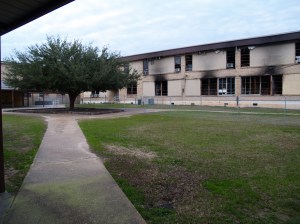
 At the end of November, the central academic wing of Jena High School was destroyed by fire (the smoke damage is evident in the picture above).  Over the weekend, a stream of white-initiated racial violence swept over the tiny community, adding to the trauma and tension. The following Monday, a white student was punched and kicked following a lunch-hour taunting match.  Six black athletes were arrested and charged with conspiracy to attempt second-degree murder.  If convicted, some defendants are facing sentences of between twenty-five and 100 years in prison without parole. (more…)

Supreme Court Delays Decision on Troy Davis Case

IMG_0686-1

Chances that the Supreme Court will address the Troy Davis case improved markedly when the court took its summer break without making a decision on the vexing case. 

The Davis case demonstrates the weakness of circumstantial murder prosecutions based largely on eyewitness testimony.  A series of crucial eye witnesses have recanted earlier testimony, often complaining that they were pressured by the authorities. 

What do we make of a juror who swears to one thing on the witness stand then, years later, reverses course?  Spencer Lawton, the prosecutor who convicted Troy Davis eighteen years ago, called the recanted testimony “suspicious”.  But will Larry Chisolm, the new Chatham County DA take the same view?

Common sense suggests that witnesses were more likely to get it right eighteen years ago because memory fades over time.  On the other hand, investigators desperate for a conviction in a high-profile case can shape testimony by abusing the power of suggestion.  Memory isn’t like photography; you don’t capture a pristine and timeless image that can be taken out and re-examined at a later date.  Initial impressions fade with remarkable rapidity.  At best, memory is a jigsaw puzzle with most of the pieces missing.  The mind creates a coherent memory by filling in the missing pieces, often drawing on fragments of unrelated memory and personal prejudice (wishful thinking) to connect the dots.  (more…)

The Jena 6 are Free!

P6264470-1

(An update of this story can be found here.)

The Jena 6 and Justin Barker are now free to move ahead with their lives.  The terms of the plea agreement were revealed in the course of a two-hour court hearing at the LaSalle Parish courthouse.  Each of the five remaining defendants in this case pleaded “no contest” to the misdemeanor charge of simple battery.  Each will be placed on non-supervised probation for one week and must pay a $500 fine and in most cases an additional $500 in court costs.  In addition, a civil suit filed by the family of Justin Barker was settled when the Jena 6 defendants (including Mychal Bell) agreed to pay the Barker family an undisclosed settlement.  Attorneys are not allowed to reveal the details of the settlement but a reliable source has disclosed that the payment was approximately $24,000.

The picture above was taken on the LaSalle courthouse steps moments after the settlement brought a two-and-a-half year legal fight to a satisfying conclusion.  Pictured (left to right) are Corwin Jones, 20, Jesse Ray Beard, 18, Bryant Purvis (20), Robert Bailey (19) and Theo Shaw (20) and, in the second row, yours truly (56).  Judge Thomas Yeager was clearly impressed that all five of the defendants who appeared before him today are enrolled in college.  Two of them tell me they are considering law school. (more…)

Praying for Death: Mercy, Malice and the Word of God


           Wiley Drake                                       Dwight McKissic

A Southern Baptist pastor raised eyebrows earlier this month when he told an interviewer that he is praying for the death of president Barack Obama

Wiley Drake, a California pastor who once served as second vice president of the Southern Baptist Convention, has biblical support for his death prayers.  The Book of Psalms contains a number of furious polemics against evil men who prey upon the weak and the innocent.  Here’s an example from Psalm 109:

May his days be few; may another seize his goods!  May his children be fatherless, and his wife a widow!  May his children wander about and beg, may they be driven out of the ruins they inhabit!  May the creditor seize all that he has; may strangers plunder the fruits of his toil!  Let there be none to extend kindness to him, not any to pity his fatherless children!

That’s just a brief excerpt; there’s lot’s more.  (more…)

Calling Eric Holder!

If anyone knows how to get the attention of Attorney General Eric Holder please give me a shout.

Federal judge Leon Holmes has rejected Alvin Clay’s motion for a new trial.  If you have no idea what I am talking about you can find a brief summary here.

In his motion for a new trial, Clay argued that the government’s case was based entirely on the testimony of Donny McCuien, a witness who lied repeatedly under oath.  Holmes didn’t deny that the egregious McCuien lacked credibility.  At trial, McCuien was eager to please his puppet masters and his lies were blatant, constant and frequently bizarre.  McCuien insisted that he had no experience buying or selling homes bought or sold homes or doing rehab work.  When Clay did his own investigation post-trial he turned up a long list of McCuien’s victims eager to testify that the seasoned con man had scammed them on real estate deals and had spent most of his professional life doing rehab work.

The government could easily have discerned that their main man was an ignorant psychopath—but that would have meant dropping their case against Clay.  So they crossed their fingers and hoped the truth wouldn’t come to light.

Judge Leon Holmes also rejected Clay’s argument that his attorneys were derelict for not discovering the truth about McCuien pre-trial.

You may be asking how a federal judge can refuse to grant a defendant a new trial when the credibility of the government’s only meaningful witness disintegrates utterly.  Holmes dodged the bullet by arguing that, even without McCuien, a reasonable jury might have convicted Clay simply because he was peripherally involved in transactions that were clearly illegal.  (more…)

Troy Davis has new friends

Rep. Hank JohnsonThis feature story from the Los Angeles Times will be of interest to all those concerned about the plight of Troy Davis.  With the Supreme Court unlikely to give Davis his day in court attention is shifting to Larry Chisolm, the fledgling District Attorney who may soon have a politically volatile decision to make.  Should he anger black Georgians by letting Davis die, or should he anger the (largely white) political and legal establishments by calling for a new hearing?  (See story pasted below).

In another development, the NAACP and the Black Congressional Caucus have thrown their support behind Mr. Davis, making it virtually impossible, in my opinion, for the state to carry out an execution.  Once a case achieves a critical mass of media attention and official concern the rules of the legal game change fundamentally.

You may be wondering why the NAACP has been so slow to come to Troy Davis’s defense.  When the state has lots and lots of witnesses (however dubious the quality) no one is willing to support the defendant. 

So, why is the legal establishment so opposed to re-opening this case now that most of the witnesses have recanted their original testimony?  The system sees recantations as inherently suspect.  The rule is simple: eye witnesses are to believed when they are singing in harmony with the state and become suspect when they stray off tune.  Got that? (more…)