To the surprise of no one, the Texas Court of Criminal Appeals has halted a controversial hearing in Houston designed to consider the constitutionality of the Texas death penalty. Prosecution and defense counsel have fifteen days to present arguments.
District Judge Kevin Fine is aware that the US Supreme Court has upheld the constitutionality of the Texas death penalty, but needs to be convinced that the statute can be fair in the case of John Edward Green Jr.
Bob Loper, one of the attorneys representing John Edward Green Jr, believes the hearing (originally scheduled to last two weeks) will continue. “We’re confident we’ll get a ruling in our favor,” Loper told the Associated Press. “We think our cause is just.”
This quote reminds me of the “expert” who told NPR recently that the TCCA would likely turn a deaf ear to Tom Delay’s appeal because “the court has a conservative reputation.” (Delay was recently convicted of conspiracy and money-laundering by an Austin, Texas jury.) The ulta-conservative tilt of the state’s highest court is precisely why Tom Delay has a good chance of getting a reversal and why and the hearing in Judge Fine’s court is unlikely to resume. (more…)
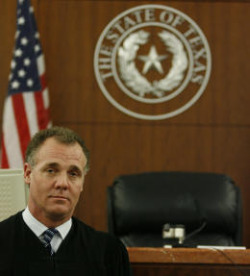
Harris County Judge Kevin Fine is presiding over a dramatic hearing that, in essence, has placed the Texas death penalty on trial. (As the picture to the left suggests, Judge Fine is not your average jurist. Do the tats suggest an affinity with the accused?)
According to the Houston Chronicle, “Defense lawyers for John Edward Green are arguing that Texas has executed two innocent defendants, and the procedures surrounding the death penalty in Texas are unconstitutional because there are not enough safeguards.” (more…)
A new study by the Institute for American values and the The National Marriage Project finds that support for marriage is rising among the most highly educated sectors of America and falling among the less well educated.
There is this:
Percentage of 25–44-year-olds Agreeing That Marriage Has Not Worked Out for Most People They Know, by Education
Update: The Leflore County Coroner has officially concluded that Mr. Carter’s death was a suicide.
The hanging death of Frederick Jermaine Carter is being interpreted as a suicide by local offials. The civil rights community has problems with that theory. According to Mississippi state senator, David Jordan, a resident of Greenwood, “There’s not a single black that’s talked to us who believes that he hanged himself.” The USA Today story below does a good job of presenting both sides of the argument. (more…)
I spent last weekend attending a conference on “the Emerging Church” held on the campus of Texas Christian University. Below, I have reproduced my noted from three talks, two by Brian McLaren, a clear-sighted Protestant, and one by Father Richard Rohr, a Roman Catholic priest dedicated to the contemplative life. These three talks complement one another and inform our struggle with mass incarceration, but I will leave it to you to make the connections. My summary is taken from my notes, so, gentlemen, if you read this and think I misrepresented your ideas, I am open to correction.
Brian McLaren 1: Clenched Fists and Open Hands
Brian McLaren
The world runs on stories, McLaren says. It is the role of religion to provide us with our stories; but what happens when these stories no longer help us address the big issues: poverty, peace and the planet?
The primary religious narrative in Western culture, McLaren suggests, has been the domination story: stories of the clenched fist which could also be called conflict narratives, warrior narratives or sword narratives. Typically, empires appear as the heroes of domination narratives. (more…)
Over at Religious Dispatches, Daniel Schultz takes the religious Left to task for being too nice. Here’s a teaser:
“I’ve been asked a lot over the course of this fall why we don’t have a politically effective religious left in America. The short answer is that there’s a significant trade-off between being nice (or engaging in “civil discourse,” as it’s called these days) and being potent. All the commitment to moral suasion, to building consensus, to reconciliation between political opponents, all the commitment in the world to “speaking out” about your values isn’t going to accomplish squat.”
Pastor Dan’s “support the poor, or go to hell” theme is one of several semi-serious suggestions for giving progressive religious messaging some much-needed bite. (more…)
This is the concluding segment in a five-part series. Earlier posts can be found here, here, here, and here.
Larry P. Stewart
Swisher County Sheriff Larry Stewart, Jena District Attorney Reed Walters and Mississippi prosecutor Doug Evans were raised in a culture that wore its racism like a badge of honor. As young children, Stewart, Walters and Evans were exposed to ideas, attitudes and experiences that left them deeply scarred. There is no sense condemning such men as if their adult behavior was exceptional or uncharacteristic of the larger society; it was not. Stewart, Walters and Evans were grown men with fully formed opinions when, suddenly and without warning, the racial rules changed. By 1991, the year all three men ascended to positions of power, public officials were officially colorblind. Now, two decades later, only those who use the n-word and publicly and embrace the principle of white supremacy are deemed worthy of the epithet “racist”.
Welcome to the colorblind world of the new Jim Crow, where nobody, black or white, Democrat or Republican can “see color”. The policy of mass incarceration is now too firmly entrenched to be questioned inside the American mainstream. Seven million Americans are “in the system” (prison, jail, probation and parole) another seven million Americans benefit, directly or indirectly, from the mass incarceration of American citizens.
J. Reed Walters
If other western democracies are anything to go by, America should be incarcerating just over 380,000 people; but we’re locking up six times that number. Either we have a lot more criminals than other countries, or something sinister is afoot.
Tragically, the criminal justice reform movement is splintered into hundreds of single-issue advocacy groups pressing for piecemeal and incremental “best practice” reforms. Some of us focus on juvenile justice, mandatory minimum sentences, the war on drugs, the death penalty or a dozen other worthy issues.
We have won a few isolated battles, but we are losing the war. Until we understand and expose the dynamics of the new Jim Crow, positive change is impossible. Our challenge is to change the way American thinks about race, crime and justice. With a goal that daunting, only a unified movement with a clear message can prevail.
Doug Evans
The mass incarceration of poor people of color is strictly hush-hush. You will rarely hear it mentioned on the evening news or by hip comedians like Jon Stewart on the Daily Show. But this isn’t somebody else’s nightmare; it belongs to you, and it belongs to me. Mass incarceration must end, brothers and sisters; the new Jim Crow has got to go.
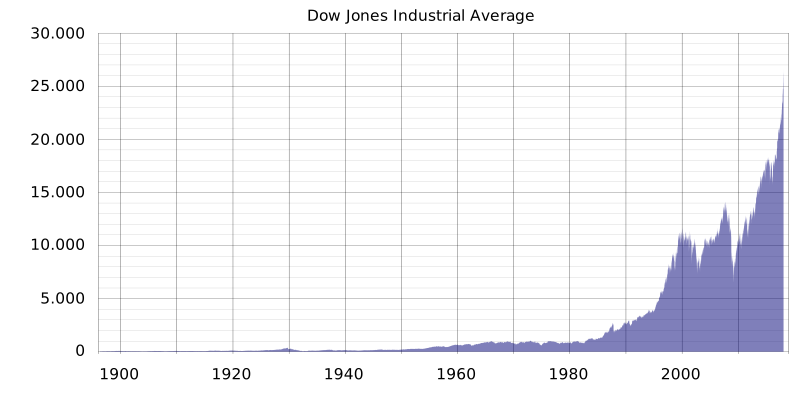
Check out the two graphs below. See any similarities?
Is it just a coincidence that the American incarceration rate and the Dow Jones Average have an identical trajectory between 1960 and 2000? In both cases we see decades of minor dips and blips followed by a rocket launch. (more…)



 Over at


 Friends of Justice