Latest outrage at Ole Miss points to a deeper distress

By Alan Bean

The University of Mississippi just can’t outrun its association with bigotry.

In 2012, a crowd of angry white students expressed their displeasure in the wake of Barack Obama’s re-election.

And just last week, a small group of freshmen wrapped an old Georgia flag bearing the Confederate stars and bars around the statue of James Meredith, the man who integrated “Ole Miss” in 1962.  In case somebody didn’t catch the symbolism, the students then wrapped a noose around the statue’s neck.

None of this bears a passing resemblance to the massive riots sparked by Mr. Meredith’s arrival on campus in 1962 that left two people dead.  But the mix of sophomoric immaturity, alcohol and Old South pride can still be toxic.  According to a CNN story, Kiesha Reeves, a black Ole Miss Senior, told police that, days after the statue incident, someone in a passing car carrying several white students threw alcohol on her and shouted a racial slur.

Mississippi, and its flagship university, have come a long way in the past 52 years; but Old South bigotry continues to smolder, largely because the folks in charge of institutions like Ole Miss routinely fail to denounce the hate with sufficient sincerity.  Everybody knows that racial resentment, in various degrees, continues to stalk the campus and that a small but significant minority of the white student body is working hard to keep the spirit of ’62 alive.  So, what can you do but make the best of a bad situation.  After all, things aren’t nearly as bad as they used to be.

Recent reports suggest that federal charges may be filed against the alleged perpetrators.  Is that really the answer?  If these students are a symptom of a larger social malady, (and they are), sending them to prison for six months or a year will simply create a scapegoat and sweep the nasty business under the rug yet again.

The problem here isn’t overt racial hatred.  The kids who defaced the Meredith statue may have black friends for all I know.

These kids just don’t want to let go of the Southern pride they imbibed with their mother’s milk.

They want to feel good about being white southerners.

They don’t want to reckon with the past or chart a fresh course.   (more…)

Explaining Ted Nugent

By Alan Bean

Texas Democrats are using Ted Nugent’s outrageous remarks about Barack Obama to embarrass Republican gubernatorial hopeful Greg Abbott and, of course, raise money for the Blue team.  That’s business as usual politics.  But I have two questions.  Why does Nugent talk this way, and why, given his rhetoric, is Nugent such a hit with the politicians?

If you aren’t familiar with Nugent’s history, this Wikipedia article should bring you up to speed.

To my knowledge, I have never heard a single Ted Nugent song, but for the past 40 years I’ve been aware of the man.  In the early 1970s his image was everywhere.  Nugent’s album covers (see the example above) combined images of electric guitars, wild animals, sleazy sex and shotguns. I found these images less than titillating and had zero interest in hearing the man’s music; but with 30 million albums sold, a lot of people must have been eating this stuff up.

Ted Nugent talks like a pro wrestling heel–the guy who loves to be hated.  Extreme lyrics, album covers and violent concert antics gained him an enthusiastic following in the 70s.  With the decent of his musical fortunes, Nugent maintained a measure of notoriety by making outrageous comments, such as calling Barack Obama a “subhuman mongrel”.

Nugent, like many Americans before him, mastered the art of foul invective because, when he speaks like a reasonable human being, nobody pays attention.  If you crave the limelight, and you have no genuine insights to offer, one must resort to slander and violent rhetoric.  Conservative and liberal lesser lights put a different spin on the ball, but the principle is the same. (more…)

William Barber lights a fire in Dallas

Displaying 20140219_135133.jpgBy Alan Bean

Yesterday, William Barber preached a mesmerizing sermon at the Samuel DeWitt Proctor Conference in Dallas.  Barber wants to recapture the moral high ground in American politics.  You can’t do that, he says, by shilling for the Democrats of the Republicans; you need a moral vision rooted in biblical justice.

Barber’s sermon yesterday centered on the theme of higher ground.  When you’re lost in the Wilderness, he says, the temptation to wander into the nearest valley is powerful.  Walking downhill seems natural because it is easy.  But the snakes live in the valleys.  The only safe course is to climb, even if it makes your legs burn and your chest heave.  Snakes can’t live at high altitudes, so the goal is to get above the snake line.

Barber doesn’t mess with left/right, black/white, or Democrat/Republican distinctions; he’s all about the cleavage between morality and immorality.

Sounds old school, I know, but when you start with the Bible, that’s where you end up.  Yesterday in Dallas, the preacher had his audience on their feet belting out the old gospel standard, Higher Ground.

Lord, lift me up, and let me stand
By faith on Canaan’s tableland;
A higher plane than I have found,
Lord, plant my feet on higher ground.

If you have never heard of Dr. Barber or the Moral Monday Movement in North Carolina, check out this brief video.  85,000 men and women rallied in Raleigh earlier this week to protest political extremism.  That’s the biggest civil rights crowd in the South since the 1960s.

Dr. Barber’s oratory in the video is restrained compared to the fireworks display he unleashed at the Fairmont hotel in Dallas yesterday.  Preaching for a room full of preachers brings out the best, but I suspect the relatively subdued tone in Raleigh was intentional.  Barber wants this movement to spread, and that can’t happen if everything depends on his personal charisma.

The Moral Monday movement has been successful because it’s goals are clear, limited and simple.  This is an agenda that people of good will can support regardless of party affiliation:

• Secure pro-labor, anti-poverty policies that insure economic sustainability;

• Provide well-funded, quality public education for all;

• Stand up for the health of every North Carolinian by promoting health care access and environmental justice across all the state’s communities;

• Address the continuing inequalities in the criminal justice system and ensure equality under the law for every person, regardless of race, class, creed, documentation or sexual preference;

• Protect and expand voting rights for people of color, women, immigrants, the elderly and students to safeguard fair democratic representation.

A couple of months ago, I attended an all-day briefing in Raleigh and shared my reaction.  If you want to know more about the philosophy and strategy underlying the Moral Monday phenomenon, my original post follows.

Moral Monday movement unleashes ‘linguistic trauma’

By Alan Bean

I write this from my motel room in Raleigh, North Carolina after spending the day with the most energized group of movement activists I have ever encountered.  You may have heard of the Moral Monday movement in North Carolina. These are the people that made it happen.

Dozens of gifted people have devoted their energies to the Moral Monday (or, more accurately, the Forward Together Moral Movement), but the undisputed leader is the Rev. Dr. William J. Barber II, a man of gentle power who may be the most gifted civil rights leader to emerge in the United States since Martin Luther King Jr. (more…)

Guns and the politics of race

By Alan Bean

The verdict in the Michael Dunn trial would be maddening and mystifying were it not for a Florida law composed with guys like Michael Dunn in mind.

The legislators (and their NRA buddies) behind the Floridian incarnation of the Stand Your Ground concept weren’t exactly advocating that white middle aged men who are offended by loud music should reach for the weapon in the glove compartment and start firing.  Nor did they anticipate that a self-appointed vigilante like George Zimmerman would fondle his firearm, leave his car, and confront an unarmed kid in a hoodie who looked “suspicious”.

But these laws are a proxy for white resentment.  They were written for white people who feel threatened by black people, particularly young black males.  The law doesn’t explicitly say that, of course, but this stuff isn’t subtle.

Here in the Lone Star State, Greg Abbott, the man who would be king of Texas, is running for the state’s highest office with Ted Nugent at his side.  This is the same Ted Nugent who famously called Barack Obama a “subhuman mongrel.”  Mr. Abbot thinks it’s okay to talk that way about the president because “I don’t think there is anybody in the state that is disliked more than Barack Obama.”

A couple of things.   (more…)

Dr. Bean is back! a reclamation jubilation by nancy bean

ImageDr. Bean is back full time as Executive Director of Friends of Justice.

Maybe you didn’t notice he was gone. For the last three weeks, Dr. Bean attempted the “tent-maker” approach. But although Alan discovered that he could make tents–or sell cars, in this case, Friends of Justice could not move forward without his full time attention.

So he’s back.

Your gift of $200 per month will make you a Patron of Friends of Justice and insure that Dr. Bean continues the transformative ministry of Friends of Justice full time. (Really, the world already has enough car salespeople!)

Your gift of $100 per month will make you a Sustainer of Friends of Justice and insure that Friends of Justice continues to recruit and empower leaders in this justice transformation.

Your gift of $50 per month will make you a Partner of Friends of Justice and insure that one faith-based study will be challenged to participate in God’s transformation of this world into a Common Peace Community.

And your gift of $25 per month will make you a Friend of Justice and participant in this vital ministry.

Click on the DONATE button to make your monthly donation. Or send your check to Friends of Justice 2706 Meadow Hill Lane Arlington, TX 76006

A meditation on the Common Peace Community by Nancy Bean

The banquet IS the good news.

A meditation on the Common Peace Community by Nancy BeanImage

Jesus turns the water to wine at the wedding banquet. Jesus tells the story of a banquet that the rich and important folks decline and that is full of the poor and the lame and the blind. Jesus overseas the spread for the fish and loaves banquet for the hungry peasants on the hill. Jesus is condemned for eating and drinking with sinners. Jesus shares the bread and wine banquet with his disciples on the night before he is betrayed.  He invites them to eat and drink the banquet of God’s body whenever they get together. Jesus is known not as he speaks with his discouraged friends on the road to Emmaus but in the breaking of the bread.

The banquet is the kingdom. Eating together is both sign and reality of God’s community.  Hunger is both sign and reality of our alienation from God.

Jesus prays over the scarce bread and fishes and then commands the disciples to feed the crowd.  And bounty abounds.  God’s economy and God’s reign is the banquet where everyone is fed.

Should we be so bold as to pray “Thy Kingdom come on earth?” Should we be so bold as to make our personal choices and our church mission and our political alignments about making sure everyone is welcome and fed at the table? Should we be so bold as to lay our basket of bread on the table as if God is the master of this abundant feast?

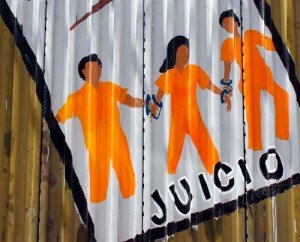
The moral dilemma at the heart of Operation Streamline

By Alan Bean

We talk a lot about Operation Streamline at Friends of Justice because it highlights the human cost of mass deportation.  This recent article from the Washington Post presents both sides of the debate.

Supporters of Operation Streamline appeal to the obvious: people who enter the United States illegally are criminals by definition and must live the consequences.  If we are to continue as a sovereign nation we must defend our borders.

But anyone who has sat through one of these humiliating “cattle call” hearings knows it isn’t that simple.  Most of the men and women who cross the border illegally are driven by a desperation few Americans can fathom.  Placed in their shoes, we would do the same without reservation or remorse.

The Post piece ends with a poignant vignette from a recent deportation hearing in Tucson that illustrates the moral dilemma perfectly: (more…)

Why immigration reform never comes

By Alan Bean

There are a holy host of great arguments for reforming our nations’ immigration laws.

Latino voters flexed their muscles in the last presidential election, convincing many Republicans that you can no longer win the White House without winning at least 40% of that demographic.

People of faith, including a well-organized cohort of evangelical leaders, recognize the deep disconnect between prevailing immigration policy and the biblical mandate to care for the stranger.

The Chamber of Commerce and most business leaders favor immigration reform because the economy requires a willing, hard working, motivated workforce.  Since a genuine clampdown on the undocumented would ruin states like Texas, a pathway to citizenship and legal status for America’s eleven million undocumented workers just makes sense.

These arguments made it possible for the Senate to pass a reform package which, though  deeply flawed, represents an improvement over the status quo.   (more…)

The New Racism? “The Triple Package” stirs controversy

Amy Chua Jed Rubenfeld 1

By Alan Bean

Why do some ethnic groups do so much better in America, on average, than others?  For instance, why do Cuban immigrants often outperform Mexicans or Puerto Ricans? And why do immigrant families from India experience greater success than, say, the Vietnamese?

Amy “Tiger Mom” Chua and her husband, Jed Rubenstein, think they know the answer.  American winners are tapping into what the authors call “the triple package”:

1) They believe themselves to be superior to other groups while 2) remaining deeply insecure about their place in American society. And 3) they all impose an extraordinary sense of self-discipline on their children.

The reaction to this thesis has been swift.  Some are calling this tendency to separate winner cultures from losers “the new racism”.

In TIME, Suketu Mehta points out that most immigrant families from places like India and Nigeria enter America laden with capital, cultural and otherwise.  These families are culled from the upper 1% of their native population and have a long list of advantages and opportunities to hand down to their children.

In an Atlantic article, Olga Kazan pokes holes in the author’s theory in exhaustive detail.

I have chosen to share Hector Tobar’s critique from the Los Angeles Times with you, largely because Tobar was the first journalist from a flagship newspaper to cover the Tulia (more…)