Category: Uncategorized

As one having authority

By Alan Bean

This week the Mustard Seed Conspiracy study is examining Jesus’ brief ministry in Capernaum as described in the Gospels of Mark and Luke.  In Luke, this material follows immediately on the heels of Jesus’ rejection in his hometown of Nazareth.  This is important for two reasons.  In Nazareth Jesus announced his agenda using the ancient words of Isaiah 61: “The Spirit of the Lord is upon me, because he has anointed me to preach good news to the poor; he has sent me to proclaim release to the captives.”  Now, in Capernaum, he makes good on his promise. 

Luke also uses the Nazareth-Capernaum contrast to make a second point: a prophet may be without honor in his own town, but the strangers down the road get it immediately.

The recurring theme of the Capernaum passages is authority.  Jesus takes authority over Shakespeare’s “slings and arrows of outrageous fortune”: the “unclean spirits of disease and disability (physical and mental). 

And Jesus takes authority over his audience–he has no interest in keeping the customers satisfied.

Let’s start with the unclean spirits.  On 23 occasions in the Synoptic Gospels, Jesus casts out unclean spirits (also referred to as demons).  There is something unseemly about these unclean spirits.  They twist their victims into grotesque shapes and exit the body with horrifying shrieks.  Why, we ask, couldn’t Jesus quietly heal people?  (more…)

Have we domesticated discipleship?

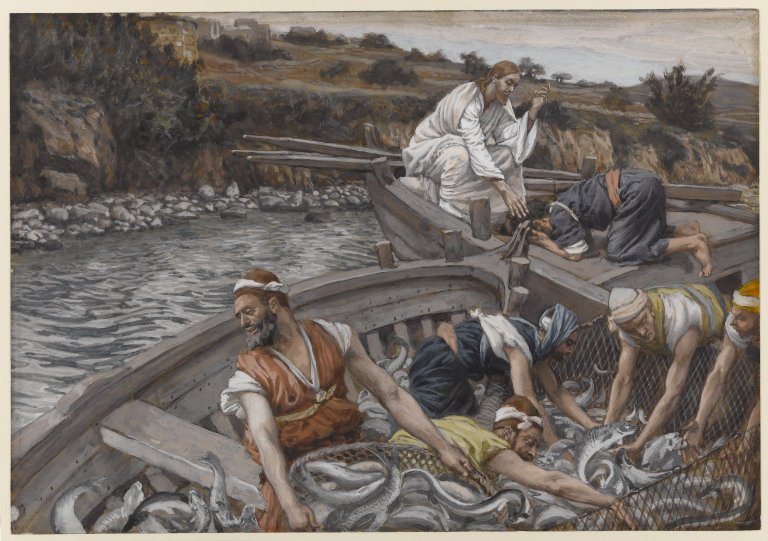
File:Brooklyn Museum - The Miraculous Draught of Fishes (La pêche miraculeuse) - James Tissot - overall.jpg

Then Jesus said to Simon, “Do not be afraid; from now on you will be catching people.” (Luke 5:10)

By Alan Bean

This week we consider Jesus’ calling of the first disciples. In Mark’s gospel, the subject is covered in five short verses; Luke’s account is twice as long and doubly detailed. The evangelists (a fancy word for the men who write the four gospels) inherited scores of traditional stories about the life and work of Jesus and used this material with great freedom.

In Mark’s gospel, Jesus appears to two groups of fisherman busy casting their nets into the sea. “Follow me,” he says, “and I will make you fish for people.” Without a word, the men drop their nets and follow.

In Luke, the action if far more complex. Right at the end of John’s gospel, we find a story about a miraculous catch of fish. Luke gives us the same story, but he places it in a very different setting. In John, the risen Christ appears to his disheartened disciples and asks them to let down their nets for a catch. In Luke, this request is extended right at the beginning of Jesus’ teaching ministry.

As a teenager growing up in McLaurin Baptist Church in Edmonton, Canada, I discussed Mark’s story with Sadie Beggs, an Irish Baptist. “Jesus just walks up and tells these guys to follow, and they do,” I said. “I wonder what was going through their heads.”

Sadie told me she had always been mystified by the disciples’ willingness to follow a perfect stranger. “It must have been a miracle,” she said.

In Luke, the decision to follow Jesus is more understandable. Jesus heals the mother-in-law of a soon-to-be disciple named Simon just shortly before the two men meet by the sea of Galilee. The call to discipleship doesn’t come from a complete stranger, in other words, Simon has already seen Jesus at work. (more…)

Jesus ain’t your home boy

By Alan Bean

If you can’t trust Jesus, who can you trust?

Unfortunately, you can’t trust Jesus.

Unless, that is, you are open to shocking new ideas about God, a counter-intuitive take on the created order, and a topsy-turvy understanding of the human condition.

When Jesus arrived in his hometown of Nazareth, everybody wanted to be impressed.  When a local boy makes good, small towns announce their association with the local-boy-made-good for the edification of passing motorists.  “We might look like just another hick town,”  the sign suggests, “but Bob Wills grew up here.”

Even if you’ve never heard of Bob Wills, you can’t help being a little bit impressed. 

Immediately after his wilderness encounter with the devil, Matthew tells us, Jesus took up residence in the little fishing village of Capernaum, on the northern shore of the Sea of Galilee, (or the Sea of Tiberias as Herod Antipas insisted on calling it).  From there, he moved into the surrounding communities, eventually arriving at his home town of Nazareth.

By this time, Jesus had acquired a reputation as a teacher with, it was widely rumored, the power to heal.  Nobody was thinking “Messiah” or “Son of God” at this point; but Rabbi was a distinct possibility.  Which explains why, when the hometown boy showed up for Sabbath worship, he was handed the scroll of the prophet Isaiah and asked to read a passage of his choosing.

Turning to what we call the 61st Chapter (there were no chapters or verses in his day), Jesus intoned a startling message that, like the Lord’s Prayer, had been domesticated by frequent repetition. 

The Spirit of the Lord is upon me,
because he has anointed me to bring good news to the poor.
He has sent me to proclaim release to the captives
and recovery of sight to the blind,
to let the oppressed go free,
to proclaim the year of the Lord’s favor.

 Then he handed the scroll back to the attendant and sat down.

Folks were impressed.  “He reads very well for a kid from Nazareth,” some thought.  “Good intonation, not too fast or too slow, and he fills the synagogue with his voice without appearing to shout.  Not bad for a rookie.” (more…)

Why declaring war on the undocumented is a really bad idea

By Alan Bean

A federal judge has upheld key portions of an Alabama immigration law that will likely drive thousands of Latino students out of the public school system.  Under the new law, public schools can now determine the immigration status of students.  Police can also question residents suspected of being undocumented and hold them without bond.

The Alabama law, as originally passed, was designed to make it impossible for undocumented residents to live in Alabama.  Judge Sharon Blackburn has temporarily blocked provisions that would:

_ Make it a crime for an undocumented immigrant to solicit work.

_ Make it a crime to transport or harbor an undocumented immigrant.

_ Allow discrimination lawsuits against companies that dismiss legal workers while hiring undocumented immigrants.

_ Forbid businesses from taking tax deductions for wages paid to workers who are in the country illegally.

_ Bar undocumented immigrants from attending public colleges.

_ Bar drivers from stopping along a road to hire temporary workers.

_ Make federal verification the only way in court to determine if someone is here legally.

Since the Hispanic population of Alabama is 3.9 percent, one wonders why state politicians are suddenly so exercised about immigration.  It’s simple.  Conservative politicians got elected by promising to clamp down on illegal immigration.  (more…)

Baptised in water, spirit and fire

By Alan Bean

This post was written in anticipation of a Mustard Seed Conspiracy study dealing with the baptism and temptation of Jesus.

Water baptism is a sacrament, “an outward and physical sign of an inward and spiritual grace.” In some Christian communions, children are baptized in anticipation of Spirit baptism.

But however we conceive it, baptism in the Holy Spirit is a glorious thing. As Jesus emerges from the Jordan, he sees the heavens ripped apart and the Holy Spirit, dove-like, descending to his shoulder.

Whether anyone else witnessed this event is hard to say. Matthew gives us the impression that the voice from heaven “This is my Son, the Beloved, with whom I am well pleased,” is addressed to the crowd; Mark and Matthew’s wording applies only to Jesus: “You are my Son, the Beloved, with you I am well pleased.”

But whether this Holy Ghost baptism was a personal or a communal experience, it was powerful and profound. The hand of God was on Jesus in a mighty way. Great things were coming, probably just around the next bend.

But in the Bible, as in life, glory merges into agony. For Christian disciples, the two are integrally connected. We are baptized in water, spirit and fire: a package deal.

It’s in the wilderness that we face the fire. (more…)

Capital Punishment and the Character of God

By Alan Bean

Troy Davis wasn’t the only man executed yesterday in America.  Lawrence Russell Brewer, the man convicted in the infamous dragging death of James Byrd Jr. in Jasper, Texas met his maker via lethal injection.  So far as I know, there were few protesters camped out in Huntsville Texas when Brewer died.  Georgia may have killed an innocent man (in which case, execution morphs into murder–the state has no mandate to kill the innocent); Texas executed a poster child for the death penalty.
 
If anyone deserved to die by lethal injection it was Larry Brewer.  A white supremacist with a sadistic streak, Brewer may be the least sympathetic victim of capital punishment on record.  Judged by purely pragmatic standards, the world is a better place without this guy.
 
But Larry Brewer was created in the image of God.  He didn’t invent racism, he took it in with his mother’s milk.  Brewer became a white supremacist in a Texas prison.  Some people find God in prison; others find Satan.  Larry was one of those.
 
Larry is our boy, a product of a world he didn’t create.  Is he responsible for his actions?  Certainly.  There were thousands of white ignorant white supremacists in southeast Texas the day James Byrd died, only one of them decided to litter the road with the body parts of a randomly selected black man.
 
I don’t know why Brewer did what he did.  We’re a clever bunch, but the mystery of human iniquity eludes us.  Crimes of passion we understand because we are passionate beings and many of our passions are irrational.  Monstrous cruelty eludes our understanding. 
 
We don’t understand Larry Brewer, but God does.
 
When the state takes a human life it defines that life as disposable.  On who’s authority?  The Roman Catholic Church respectfully disagrees.  I’m not a Roman Catholic, but I can’t argue with their stance on the death penalty.  I don’t just agree with it; I am convinced by the moral logic undergirding it.
 
Capital punishment isn’t just wrong when the facts are ambiguous; it is simply wrong.
 
True, the “eye for an eye” morality appears in the Bible, but Jesus explicitly rejects this ancient lex talionis.  To quote the Gideon’s  King James Bible I just removed from a drawer in my motel room, Jesus said, “Ye have heard that it hath been said, An eye for an eye and a tooth for a tooth.  But I say unto you that you resist not evil: but whosoever shall smite thee on thy right cheek, turn to him the other also . . . Ye have that it hath been said, Thou shalt love thy neighbour and hate thine enemy.  But I say unto you, Love your enemies, bless them that curse you, do good to them that hate you, and pray for them which despitefully you, and persecute you; That ye may be the children of your Father which is in heaven.”
 
Is Jesus the human face of God?  I believe he is.  Can Jesus unravel the mystery of iniquity?  I believe he can.  And on the basis of that belief I reject the death penalty.  Forced to choose between Jesus and Rick (236 and counting) Perry, I go with Jesus.
 
It has been argued, of course, that the Sermon on the Mount only relates to personal morality and cannot be applied to the actions of the state.  Thus we are to be merciful in our personal dealings while  we enthusaistically embrace the punitive brutality of the state.
 
Jesus calls us to be children of God but we have chosen another father.
 
The merciful God and father of Jesus will welcome Larry just as he has welcomed Troy.  God will have mercy on our souls (and ours) because that’s who God is.
 
Capital punishment is about the character of God. 

White supremacist gang member executed in Texas for dragging death of black man 13 years ago

By Associated Press, Published: September 21

HUNTSVILLE, Texas — White supremacist gang member Lawrence Russell Brewer was executed Wednesday evening for the infamous dragging death slaying of James Byrd Jr., a black man from East Texas.

Byrd, 49, was chained to the back of a pickup truck and pulled whip-like to his death along a bumpy asphalt road in one of the most grisly hate crime murders in recent Texas history.

Brewer, 44, was asked if he had any final words, to which he replied: “No. I have no final statement.”

He glanced at his parents watching through a nearby window, took several deep breaths and closed his eyes. A single tear hung on the edge of his right eye as he was pronounced dead at 6:21 p.m., 10 minutes after the lethal drugs began flowing into his arms, both covered with intricate black tattoos.

Byrd’s sisters also were among the witnesses in an adjacent room.

“Hopefully, today’s execution of Brewer can remind all of us that racial hatred and prejudice leads to terrible consequence for the victim, the victim’s family, for the perpetrator and for the perpetrator’s family,” Clara Taylor, one of Byrd’s sisters, said.

She called the punishment “a step in the right direction.”

“We’re making progress,” Taylor said. “I know he was guilty so I have no qualms about the death penalty.”

Appeals to the courts for Brewer were exhausted and no last-day attempts to save his life were filed.

Besides Brewer, John William King, now 36, also was convicted of capital murder and sent to death row for Byrd’s death, which shocked the nation for its brutality. King’s conviction and death sentence remain under appeal. A third man, Shawn Berry, 36, received a life prison term.

“One down and one to go,” Billy Rowles, the retired Jasper County sheriff who first investigated the horrific scene, said. “That’s kind of cruel but that’s reality.”

It was about 2:30 a.m. on a Sunday, June 7, 1998, when witnesses saw Byrd walking on a road not far from his home in Jasper, a town of more than 7,000 about 125 miles northeast of Houston. Many folks knew he lived off disability checks, couldn’t afford his own car and walked where he needed to go. Another witness then saw him riding in the bed of a dark pickup.

Six hours later and some 10 miles away on Huff Creek Road, the bloody mess found after daybreak was thought at first to be animal road kill. Rowles, a former Texas state trooper who had taken office as sheriff the previous year, believed it was a hit-and-run fatality but evidence didn’t match up with someone caught beneath a vehicle. Body parts were scattered and the blood trail began with footprints at what appeared to be the scene of a scuffle.

“I didn’t go down that road too far before I knew this was going to be a bad deal,” he said at Brewer’s trial.

Fingerprints taken from the headless torso identified the victim as Byrd.

Testimony showed the three men and Byrd drove out into the county about 10 miles and stopped along an isolated logging road. A fight broke out and the outnumbered Byrd was tied to the truck bumper with a 24½-foot logging chain. Three miles later, what was left of his shredded remains was dumped between a black church and cemetery where the pavement ended on the remote road.

Brewer, King and Berry were in custody by the end of the next day.

The crime put Jasper under a national spotlight and lured the likes of the Ku Klux Klan and the Black Panthers, among others, to try to exploit the notoriety of the case which continues — many say unfairly — to brand Jasper more than a decade later.

King was tried first, in Jasper. Brewer’s trial was moved 150 miles away to Bryan. Berry was tried back in Jasper. DNA showed Byrd’s blood on all three of them.

Brewer was from Sulphur Springs, about 180 miles to the northwest, and had been convicted of cocaine possession. He met King, a convicted burglar from Jasper, in a Texas prison where they got involved in a KKK splinter group known as the Confederate Knights of America and adorned themselves with racist tattoos. Evidence showed Brewer had violated parole and was involved in a number of burglaries and thefts in the Jasper area.

King had become friends with Berry and moved into Berry’s place. Evidence showed Brewer came to Jasper to stay with them.
Death comes for Troy Davis: Father forgive us, for we know exactly what we are doing

By Alan Bean

The State of Georgia has murdered Troy Davis.  I don’t use the m-word casually or for rhetorical effect.  But when it is no longer possible to distinguish guilt from innocence, when the state’s case lies in tatters and everybody knows it, there is no civil justification for taking a life.  State-sanctioned killing is never morally justified, but even those who support capital punishment in the abstract should have grave concerns about what happened tonight in Jackson, Georgia.

What happens when all legal remedies have been exhausted and the guilt-innocence question has not been resolved?  Do you carry out the sentence imposed in the good old days when the state appeared to have credible evidence, or do you commute the sentence to life without parole?

Georgia just answered that question.

I was sitting in the Airport Grocery in Cleveland MS listening to Jake and the Pearl Street Jumpers when the dreadful news from Laura Moye appeared on my cell phone.  I had been having a good time.  Suddenly I was sickened.  I generally eschew emotive language, but this is an honest to goodness outrage.

Please read Laura’s heart-felt message and follow the instructions at the bottom of her message.

Georgia Kills Troy Davis

Death Penalty, Prisoners and People at Risk, USA | Posted by: , September 21, 2011 at 11:16 PM
 
After a tense delay of more than 4 hours, the state of Georgia has just killed Troy Anthony Davis.

My heart is heavy. I am sad and angry. Georgia’s criminal justice system behaved with the viciousness of a defective machine, relentlessly pursuing his death while ignoring the doubts about his guilt that were obvious to the rest of the world.

Tonight we witnessed an abuse of power that exposed a justice system devoid of humanity, a dysfunctional destructive force in denial about its own deeply embedded flaws.

We could not ultimately stop Georgia’s machinery of death in this case, but the groundswell of activism Troy Davis has generated proves that people are hungry for a better system of justice. This will be his legacy. We will fight for a system of justice with more humanity, that accepts the possibility of mistakes, errors, and doubts. A system of justice that believes that innocence matters. A system of justice with more justice.

Let’s take a moment to honor the life of Troy Davis and Mark MacPhail. Then, let’s take all of our difficult feelings and re-double our commitment to the abolition of the death penalty.

not in my namePlease take this Pledge, and commit to working for abolition in your community, in your state, in your country, and in the world.

Tonight we mourn … tomorrow we organize!

Troy Davis and the tragedy of American Leadership

By Alan Bean

The decision to release poison into the veins of Troy Davis was ultimately political.  The Georgia Board of Pardons and Parole was bombarded with appeals from left and right.  They couldn’t act without enraging significant patches of the crazy quilt we call America.  Ultimately, they chose to satisfy the folks in their social and political world, the political and judicial establishment in Georgia.

So why are the power people in Georgia (and across America) so desperate to see Troy Davis die even though the evidence once used to ‘prove’ his guilt has long since evaporated?

This was a choice between a problem and a precedent.  Execute Troy Davis and you create a martyr whose name will feature prominently in anti-death penalty arguments for decades.  Commute his sentence to life without the possibility of parole and you question the system’s reliance on eye-witness testimony; further, you raise profound questions about the system itself.  Everyone knows that Troy Davis is merely the tip of the iceberg, an egregious case of business as usual.  Grant him relief, and you open the floodgates.

The Georgia Board would rather create a problem than establish a precedent.   They defended the integrity, indeed the sanctity of the American judicial system. 

American politics is like American entertainment; we give the people what they want even if what they want is a perverse blend of violence and pornography.  When western democracies like Canada and the UK dispensed with capital punishment popular support for the vile practice was stout.  But leading public officials decided they didn’t want their country associated with the myth of redemptive violence, so they pulled the plug.

In America, politicians decided to exploit the blood lust of the populace.  If support for the death penalty yields applause from the Tea Party, Rick Perry and his ilk are behind it.   

It isn’t that America is more democratic than other countries (although that may be true); we simply have a predatory political culture that makes the most of popular perversity.  That’s why we were slow to abolish slavery and why it took a cultural revolution to end Jim Crow.  When Jim Crow died, the Republican Party exploited white backlash.  Leading Republicans secretly despised the racist southerners crowding under their umbrella, but they were willing to take their votes and alter the party’s political platform accordingly.

Hence we have seen the Mississippification of American politics.

We need a nation where leaders lead.  What are the chances that Barack Obama lifts a finger to help Troy Davis?  To ask the question is to answer it.  It’s hard to exercise moral leadership and get re-elected.

In executing Mr. Davis, the American elite avoided a troubling precedent, but they have created a big long-term problem.  Barring a miracle (and I’m still praying) Troy Davis will die today; but he will not die in vain.

New York Times editorial: Davis decision a “tragic miscarriage of justice”

A Grievous Wrong

Troy Davis is scheduled to be executed on Wednesday for the 1989 killing of a police officer in Savannah, Ga. The Georgia pardon and parole board’s refusal to grant him clemency is appalling in light of developments after his conviction: reports about police misconduct, the recantation of testimony by a string of eyewitnesses and reports from other witnesses that another person had confessed to the crime.

This case has attracted worldwide attention, but it is, in essence, no different from other capital cases. Across the country, the legal process for the death penalty has shown itself to be discriminatory, unjust and incapable of being fixed. Just last week, the Supreme Court granted a stay of execution for Duane Buck, an African-American, hours before he was to die in Texas because a psychologist testified during his sentencing that Mr. Buck’s race increased the chances of future dangerousness. Case after case adds to the many reasons why the death penalty must be abolished.

The grievous errors in the Davis case were numerous, and many arose out of eyewitness identification. The Savannah police contaminated the memories of four witnesses by re-enacting the crime with them present so that their individual perceptions were turned into a group one. The police showed some of the witnesses Mr. Davis’s photograph even before the lineup. His lineup picture was set apart by a different background. The lineup was also administered by a police officer involved in the investigation, increasing the potential for influencing the witnesses.

In the decades since the Davis trial, science-based research has shown how unreliable and easily manipulated witness identification can be. Studies of the hundreds of felony cases overturned because of DNA evidence have found that misidentifications accounted for between 75 percent and 85 percent of the wrongful convictions. The Davis case offers egregious examples of this kind of error.

Under proper practices, no one should know who the suspect is, including the officer administering a lineup. Each witness should view the lineup separately, and the witnesses should not confer about the crime. A new study has found that even presenting photos sequentially (one by one) to witnesses reduced misidentifications — from 18 percent to 12 percent of the time — compared with lineups where photos were presented all at once, as in this case.

Seven of nine witnesses against Mr. Davis recanted after trial. Six said the police threatened them if they did not identify Mr. Davis. The man who first told the police that Mr. Davis was the shooter later confessed to the crime. There are other reasons to doubt Mr. Davis’s guilt: There was no physical evidence linking him to the crime introduced at trial, and new ballistics evidence broke the link between him and a previous shooting that provided the motive for his conviction.

More than 630,000 letters pleading for a stay of execution were delivered to the Georgia board last week. Those asking for clemency included President Jimmy Carter, 51 members of Congress and death penalty supporters, such as William Sessions, a former F.B.I. director. The board’s failure to commute Mr. Davis’s death sentence to life without parole was a tragic miscarriage of justice.

Georgia Board Refuses to Grant Clemency in Troy Davis Case

By Alan Bean

Melanie Wilmoth and I were eating breakfast in a Shoney’s restaurant just west of Jackson, Mississippi when I got the email.  The George Board of Pardons and Parole has refused to grant clemency to Troy Davis.  

I was shocked.  On the other hand, I would have been shocked if the call had gone in Troy’s favor.  This really is a case of the irresistible force meeting the immovable object.  How could the Board fail to grant clemency in a case riddled with so much ambiguity and uncertainty?  How could they refuse to do the right thing after so many public figures had publicly expressed their grave doubt about Troy’s guilt? 

Then again, how could the Board have ruled differently?   The tear-stained faces of Officer McPhail’s family were hard to ignore.   These people are convinced that their loved one was gunned down in cold blood by a man who has spent the past few decades eluding his just fate.  It would be a travesty, they told the board, if a convicted murderer was spared from his rendezvous with the needle.  Justice demands a killing, they seemed to say.

The conservative perspective in this case has always emphasized the repeated refusal of appeals courts to toss the jury’s original verdict.  Surely this means that the most objective and responsible people in the justice system are convinced that Davis is guilty as charged.

Actually, it means nothing of the sort.  There is no way of knowing who killed Mark McPhail.  Three jurors now say they could not have voted to convict if they knew then what they know now.  Seven of nine eye witneses have recanted their earlier testimony.  Many of these people claim that they were coerced and manipulated by investigators eager to nail the killing on somebody.  One of the two eye witnesses who has not backed away from their original testimony may be the actual perpetrator.  None of this proves that Troy Davis is innocent; but the foundation on which the conviction originally rested have long since crumbled to dust.

The Supreme Court ordered an innocence hearing to see if Troy Davis could produce compelling evidence of actual evidence.  US District Judge William Moore concluded that Davis hadn’t offered overwhelming evidence of innocence which meant he was still guilty in the eyes of the law.

Why didn’ the Supreme Court all for an ambiguity hearing to establish whether the State of Georgia still had enough evidence to convict Troy Davis?  There ain’t no such thing as an ambiguity hearing.  The state doesn’t need to prove they could convict Troy all over again; they simply had to show that he couldn’t prove he was innocent.  If he failed in this endeavor, the original verdict remained in place.

Another judge, say a Carter or Clinton appointee, could have ruled differently and probably would have, but Judge Moore was the man asked to make the call.

Should Troy Davis be forced to prove he didn’t pull the trigger?  Isn’t it reckless to kill a man who may be innocent? 

Or are these the operative questions?  Has the Troy Davis case devolved into a shoving match between people who look at the old duck-rabbit image and draw different conclusions? 

William Sessions and Bob Barr aren’t saying Davis is innocent; they are saying the evidence is too fuzzy for any objective conclusion to be drawn.

Which means that, should the State of Georgia take the life of Troy Davis they are either killing a man who, objectively considered, may be innocent; or they have been caught up on the partisan, ideological, subjective rhythms of a culture war tug-of-war and are determined to see their side win.  We are dealing with the equivalent of the subjective question, Did the receiver have control of the ball when he went out of bounds?  Fans of one team say he did; fans of the other say he didn’t.  But in this case, there appears to be no objective third-party to examine the film.  We simply see how many of our people we can put on the Board of Pardons and Parole and lobby for our chosen outcome.

Amnesty International, the human rights organization that has done the most to plead for Troy Davis, has never argued for actual innocence.  Some of the attorneys associated with the case may believe their man is actually innocent, but they know they can’t prove it.  What about the Georgia Board of Pardons and Parole?  Are they saying that, as things currently stand, the State of Georgia has enough evidence to convict  Troy Davis (or anyone else) of killing officer McPhail?   Or are they merely trying to shore up the integrity of a discredited judicial system?  What’s the rationale here; that’s what many of us are asking.

So, where do we go from here?  This thing is far from over.  The Governor of Georgia CAN NOT intervene in this case.  But the presiding District Attorney in the jurisdiction that convicted Davis could step in “in the interest of justice.”  Check out Melanie Wilmoth’s companion post to learn how you can help make this happen.