Author: Alan Bean

It’s time to free Ramsey Muniz!

Irma and Ramsey Muniz

By Alan Bean

In this op-ed, Texas attorney Steve Fisher argues that you don’t have to believe that Ramiro “Ramsey” Muniz is the victim of a racist frame-up to advocate for his freedom.

Friends of Justice has spent hundreds of hours examining every facet of this case, and we heartily agree.

Was Ramsey Muniz framed by racists?

No.  Muniz is the victim of the same kind of federal narcotics conspiracy prosecution that put Ann Colomb and three of her sons behind bars in 2006.

Mr. Fischer says he would be surprised if Muniz is innocent.  Well, Steve, prepare to be surprised.

We will have much more to say about that in a few weeks.

Who is Ramsey Muniz, you ask.  Mr. Fischer provides an excellent introduction.

It’s time to free Ramsey Muniz

CORPUS CHRISTI —In the 1972 election for Texas governor, Ramiro “Ramsey” Muniz, a Corpus Christi and Waco attorney, and his La Raza Unida Party won 214,000 votes (6 percent) versus Dolph Briscoe (Democrat) and Henry Grover (GOP). In Nueces County 13,813 people voted for Muniz and he garnered another 1,388 voters in San Patricio County.

On this 40th anniversary of that election Mr. Muniz  celebrates his own 70th anniversary at the Federal Penitentiary in Beaumon.Muniz, a college football star and a Baylor law graduate, is serving life without parole for his third strike against our drug laws. He was sentenced in 1994.

I am certainly not the first to write about this. The Internet is replete with editorials, most by leftist and/or ethnically motivated organizations such as The Prison Abolitionist and  Chicano Mexicano Prison Project that proclaim Muniz’s innocence and denounce those who “framed” him,  demanding his release. It’s hard to discern the actual facts when they are obscured by hate and covered with venom. (more…)

A review of Charles Murray’s ‘Coming Apart’: do the poor suffer because they are bad or because they are dumb?

By Alan Bean

Charles Murray took so much flak for controversial The Bell Curve that he decided to write a book about white people rooted in much the same argument. 

Coming Apart, a book about the diverging fortunes of upper and lower class white Americans, begins where The Bell Curve ended.  The big factor driving the growing gap between the educated and the uneducated, Murray suggests, is “cognitive homogamy”, the fact that individuals with similar cognitive ability are having children.

In the old world, Murray says, most people lived and died in rural communities and small towns.  The smartest males might have left home for a few years of college, but they generally returned to marry the prettiest (not necessarily the smartest) girl in town.  The result, kids of normal cognitive ability.  Wealth was distributed largely on the basis of inheritance, not ability and the kids at Harvard weren’t much smarter than the kids at a good state school.

Since the early 1960s, however, smart people have been marrying other smart people and having smart kids.  The sons and daughters of these blessed unions have increasingly clustered in segregated neighborhoods in which “everybody has a bachelor’s or graduate degree and works in high-prestige professions or management or is married to such a person.”  Among this new elite, wealth is distributed on the basis of merit, the elite colleges compete for the brightest and the best and lesser institutions make do with students who will never be ready for prime time. (more…)

“Phony theology” idea didn’t originate with Rick Santorum

By Alan Bean

Rick Santorum didn’t originate the notion that Barack Obama’s environmental views are the product of an unbiblical “phony theology”.  According to Rachel Tachnick, a leading authority on the Religious Right, this idea is a staple within the emerging world of Christian Right “Dominionist” theology.  In this alternative universe (well-funded by big oil firms, the Koch brothers et al), “Biblical Capitalism” is considered holy and opposing views are denounced as demonic.  Sound strange?  Check out Ms. Tabachnick’s post.

I was interested to note that the continuing shift from a Hal Lindsey-style end-times theology to a “preparing the world for the return of Jesus” Dominionist view has created an excellent platform for collaboration between Protestant evangelicals and American Roman Catholics. 

The big roadblock: conservative religious leaders who object to the political appropriation of biblical teaching.

Santorum meant exactly what he said

By Alan Bean

Rick Santorum has raised eyebrows with a comment about President Obama’s “phony theology”.  According to the surging presidential candidate, Obama’s worldview is driven by “some phony ideal, some phony theology. Oh, not a theology based on the Bible, a different theology, but no less a theology.”

Aked to explain this remark on Face the Nation, Santorum said he was referring to the president’s environmental views.  According to an AP article:

The former Pennsylvania senator said Obama’s environmental policies promote ideas of “radical environmentalists,” who, Santorum argues, oppose greater use of the country’s natural resources because they believe “man is here to serve the Earth.” He said that was the reference he was making Saturday in his Ohio campaign appearance when he denounced a “phony theology.”

But when reporters asked for an explanation of the “phony theology” remark immediately after it was uttered, the candidate made no reference to environmentalism, explaining instead that the president practiced one of the various “stripes” of Christianity.

So where does Mr. Santorum stand?  Does he think Barack Obama is a genuine Christian or doesn’t he? (more…)

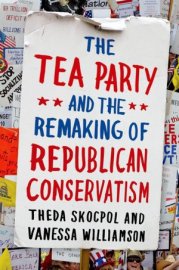
The Tea Party’s gravitational pull

By Alan Bean

Theda Skocpol (pronounced “Scotch-poll”) teaches sociology and government at Harvard University, hardly a hotbed of Tea Party conservatism.  But this nuanced account of the radicalization of the Republican Party carries her well beyond the breathless hysteria of the liberal blogosphere.

In her quest to understand Tea Party conservatism, Skocpol encounters three distinct movements with a common interest in driving Barack Obama into public life while pushing the Republican Party as far to the right as possible.

At the grassroots level, she finds, Tea Party people tend to be older, white conservatives who have no beef with big government programs like medicare, social security and generous veteran’s benefits; they just hate to see tax dollars squandered on the undeserving: welfare recipients, the undocumented, and losers who sign up for mortgages they can’t afford.

Secondly, there are the elite conservative lobbies and think tanks with a traditional small-government, pro-business agenda that want to slash government spending while eliminating many of the social programs grassroots conservatives endorse.

Finally, these uneasy bed-partners are being lionized and galvinized by an energized conservative punditocracy: FOX news, talk radio, and a growing right wing internet culture.  This adoring media attention exaggerates the cohesiveness of the contemporary conservative movement while extending its influence and elevating its stature.

These three expressions of Tea Party activism are at odds on many issues, Skocpol says, but their combined influence is radicalizing the GOP.  It is now impossible for a moderate Republican to succeed at the presidential level.

Will the 2012 election be a repeat of 2010, or are different forces at work?  Will America elect a movement conservative, or has the GOP veered too far from mainstream America? (more…)

Coverage of drug bust reveals healthy skepticism

By Alan Bean

A routine drug bust in Fort Worth, Texas has sparked a firestorm of media interest.

Seventeen people have been arrested, almost all of them charged with selling small amounts of marijuana to an undercover agent.

Fifteen of the defendants are students at Texas Christian University and four are football players.  Without the sports connection, no one would give much attention to a routine drug roundup, but in Fort Worth the Horned Frogs are the biggest thing going.

Reading through the half-dozen stories in this morning’s Star-Telegram, I couldn’t help thinking about the big Tulia drug bust in 1999.  But there is a difference.  Media response to the Tulia bust was universally positive.  Seldom was heard a discouraging word . . . until Friends of Justice got involved.

But the local paper’s coverage of the big TCU bust ranges from cautious praise for the school’s proactive stance against the drug scourge to deep skepticism.

Texas has changed a lot since 1999.  The wisdom of the war on drugs is no longer assumed. (more…)

The other L-word

By Alan Bean

Since Ronald Reagan rode to power on a wave of white racial resentment, programs designed to benefit America’s marginalized citizens have been treated as a political pinãta by conservatives and avoided as a liability by . . . well, non-conservatives.  No one dared identify as a liberal.  The L-word had become toxic.

There is another L-word: “legalization”.

Unless you are a big fan of Ron Paul, you have probably never been exposed to a compelling argument for legalizing drugs.  Libertarians support the legalization of drugs because (a) they don’t think the government should regulate hardly anything, (b)drug prohibition, like the prohibition of alcohol, is a futile attempt to repeal the law of supply and demand, and (c) our counter-productive war on drugs eats up billions of tax dollars.

Today, at the Samuel DeWitt Proctor Conference, three of America’s leading authorities on the drug war wrestled with the other l-word.

Michelle Alexander told us she was inching toward support for drug legalization but remained on the fence.  The author of the most successful criminal justice reform book in the history of publishing is committed to ending the war on drugs and the policy of mass incarceration.  Should legalizing drugs be part of the program?  She’s still thinking about it. (more…)

The Elephant in the Room

By Lisa D’Souza

Yesterday, I attended a celebration of Timothy Cole’s life at which the State of Texas officially acknowledged the wrong done Mr. Cole by placing a historical marker at his grave.  Among the attendees were six men, all of whom had been arrested, tried and convicted of crimes they had not committed. Each of them served years, some decades, in prison before winning their release.

At the close of the luncheon event, Frederic White, the dean of Texas Wesleyan School of Law, who hosted the event, recollected a police encounter he had as a youngster zooming through town on his new bicycle. The police stopped him and accused him of having stolen it. He was carrying his bicycle registration in his pocket, and could prove the bike was in fact his, so the police allowed him to go on his way. (more…)

“The Power to Make us One”: Heather McGhee’s One-People America

By Alan Bean

heather.mcghee – Netroots NationI recently heard Heather McGhee speak at the Samuel Dewitt Proctor conference in Chicago. She began with the obvious fact that America was not created to be one people, or one public.  Some folks were clearly part of the culture; others were not.  The primary dividing line was skin color.  Up until 1965, she reminded us, American immigration policy was built around strict racial quotas.  People of African descent were practically excluded altogether.  People from Eastern Europe were also subject to severe restrictions because they were considered ‘ethnic’.

That all changed in 1965.  In the wake of the civil rights movement, mainstream America was embarrassed by the undisguised racism implicit in the nation’s immigration policy.  The rules changed in fundamental ways.  Now, when you walk through an airport, you see every conceivable shade of skin color and you hear a wide variety of accents.  We have become, in a few brief decades, the world’s most audacious experiment in cultural diversity.

(more…)

New and Improved Curtis Flowers Page

By Alan Bean

Friends of Justice is pleased to announce that we have updated our Curtis Flowers page.  All the important stuff from the old page is still available, but thanks to the efforts of Lisa D’Souza, the new Friends of Justice Legal Director, the information is now much much accessible and user-friendly. 

The old page evolved over time, willy-nilly, and had come to resemble an overgrown garden in which it’s hard to find the veggies. 

The appeal filed following the 2010 trial in which Curtis was convicted and sentenced to death  is currently awaiting a response from the Mississippi Supreme Court.  The Court can’t proceed, we are told, because the prosecution has been slow to turn over important documentation.  In the meantime, Friends of Justice has been monitoring the case, visiting Mr. Flowers and his family, and insisting that a crude frame-job of an innocent man be replaced by  a real investigation into the tragic quadruple homicide in a Winona, MS furniture store in 1996.  

If you aren’t familiar with this case, our revised Curtis Flowers page will quickly bring you up to speed.  If you want to delve into the intricacies of the case, or if you’re curious about the social and historical context, you will find a wealth of valuable information.  So, if you’re looking for a quick intro or the whole nine yards, we’ve got what you need.